
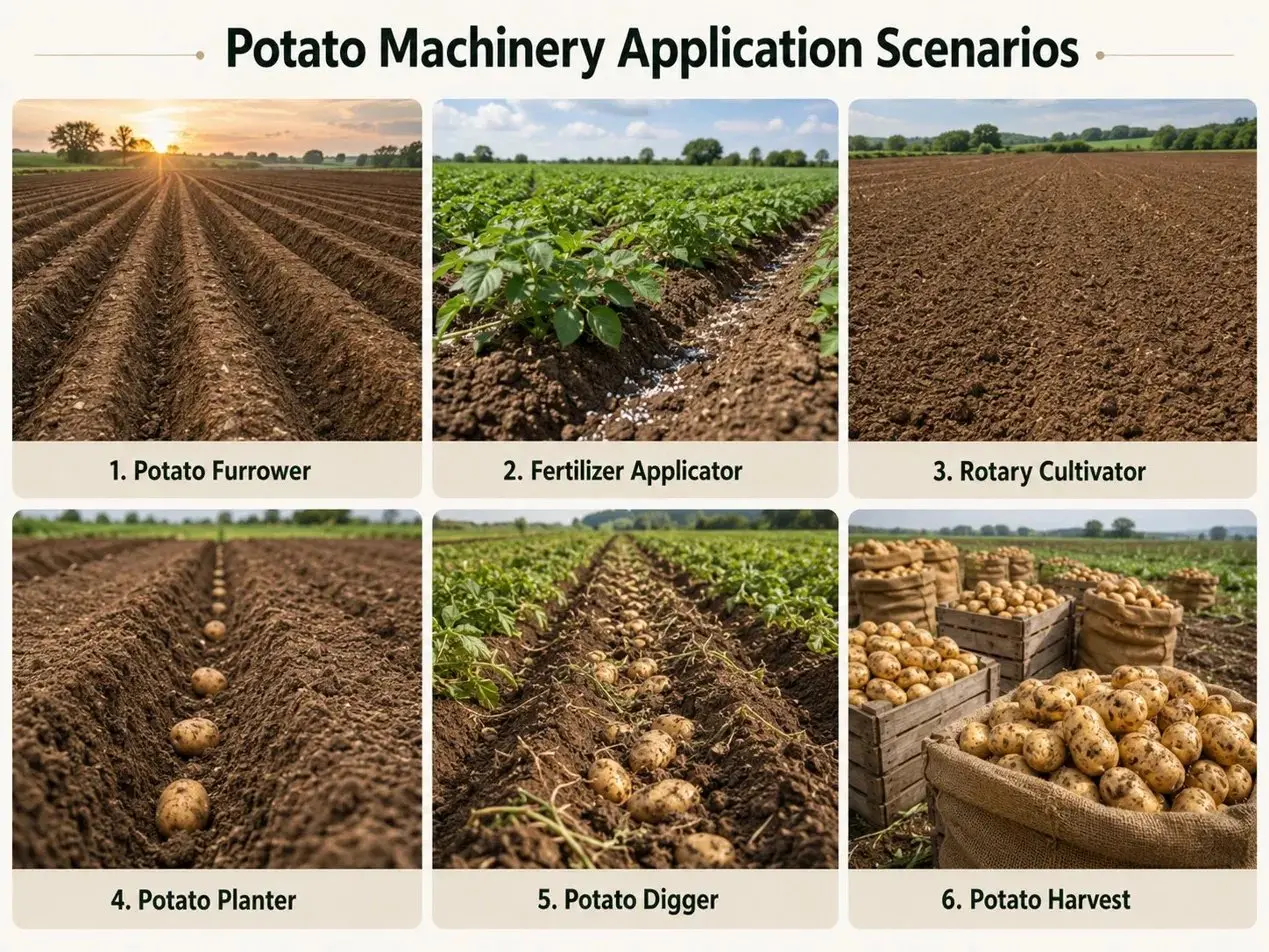
Korean highland potato production — concentrated in Gangwon-do’s Pyeongchang-gun, Hoengseong-gun, Jeongseon-gun, and Inje-gun — faces a specific combination of challenges that lowland vegetable farms do not. Rocky granite soil that requires stone clearance every spring. A narrow planting window dictated by highland frost calendars. Steep terraced field geometries that limit the size of machines that can work effectively. And the agronomic demands of potato varieties (Atlantic, Superior, Dejima, Haryoung) grown for fresh market and processing supply chains — each with specific requirements for seedbed quality, planting depth, row spacing, and harvest timing.
Watanabe’s potato machinery range addresses all seven steps of the production cycle, from initial stone clearance through to in-field harvest and grading. This guide walks through the complete system — what each machine does, how the machines connect to each other mechanically and agronomically, and how to select the right configuration for your farm scale and row structure.
The Most Important Decision You Make Before Selecting Any Machine
Decide your row count before selecting any machine in this system. The number of rows per pass — 2, 3, 4, or 5 — must be consistent from the furrower (Step 3) through to the potato digger (Step 7). A furrower set for 3 rows at 75 cm spacing requires a planter configured for exactly those 3 rows at exactly those centres, and a digger with shares spaced to lift exactly those rows. A mismatch at any point means the digger cuts through tuber zones rather than beneath them — causing direct mechanical damage at harvest. Decide your row count first; then select all machines to match.
Step 1 — Surface Stone Clearance
Machine: EP-EW-4000 Rock Rake · 75 HP · 3.6 m · Cat. 2 hitch · 540 RPM PTO · Early spring
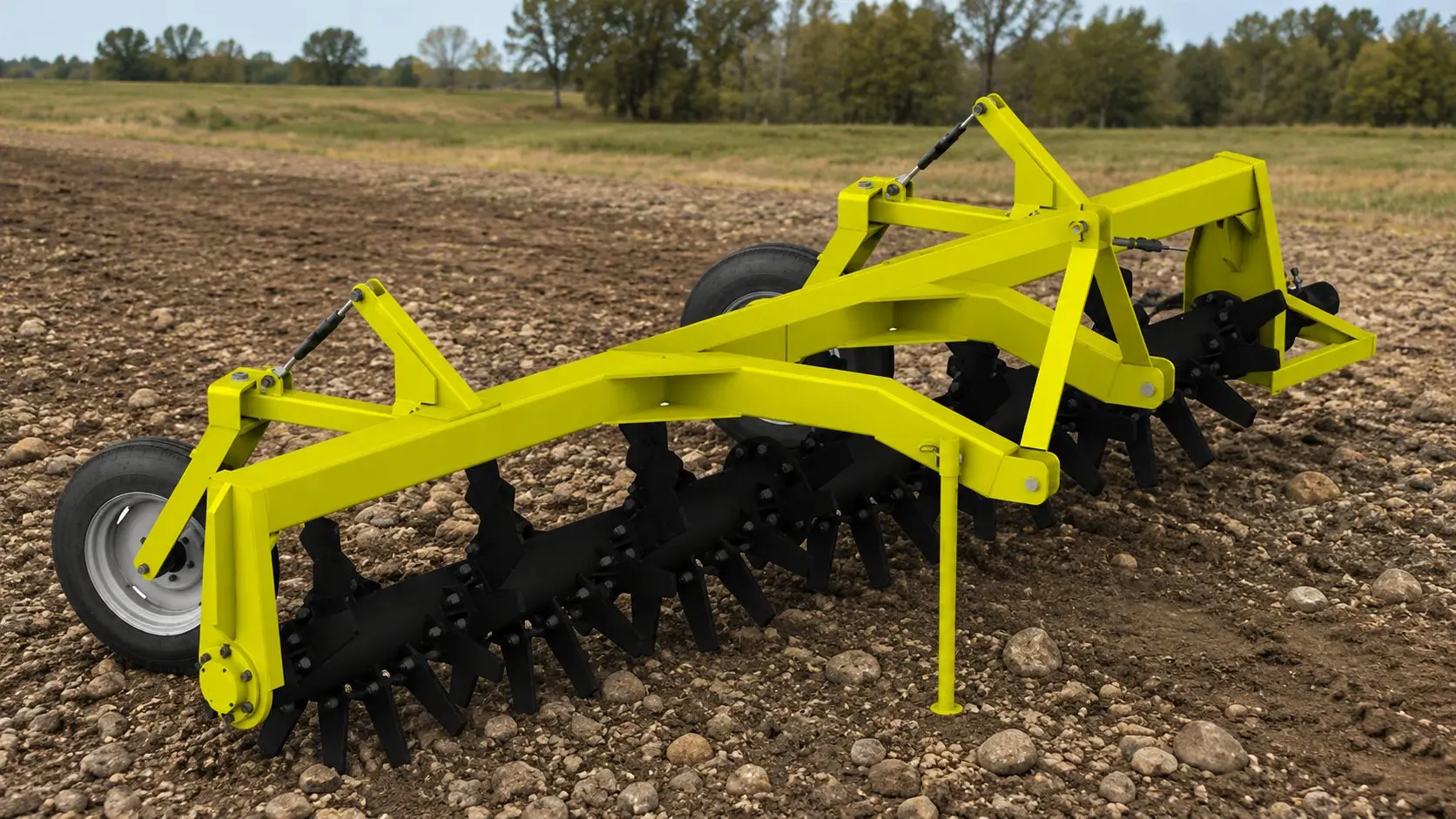
Korean highland potato soils are granite-derived and subject to annual frost-heave that pushes surface stones up through the soil profile every winter. By early spring — before any tillage or bed preparation can begin — a layer of stones of varying sizes has reappeared on the field surface. These stones must be managed before Step 2 rotavator tillage because running heavy tillage equipment through uncleared surface stones causes rotor blade damage, increases fuel consumption, and produces uneven tillage depth in stone zones.
The EP-EW-4000 rock rake (75 HP minimum, 3.6 m working width) sweeps surface stones into windrows at 3–6 km/h without crushing or collecting them — concentrating them for subsequent removal by stone picker or crusher. The 75 HP tractor requirement is the same machine that will later operate the potato furrower (Step 3), fertilizer applicator (Step 4), planter (Step 5), and mid-season cultivator (Step 6) — which means the smaller tractor already on the farm handles stone clearance without requiring a dedicated high-HP machine at this stage.
For heavier stone conditions where individual stones exceed 30 cm or where thorough sub-surface rock processing is required before tillage, a stone crusher pass (THOR 2.4, 180 HP) replaces the rock rake as Step 1 — or precedes it. On commercial highland operations clearing 50+ hectares, the BlackBird Rock Rake (9.5 m, 300 HP) covers the same area in approximately one-quarter the time of the EW-4000.
Step 2 — Primary Tillage
Machine: PSW-3200 Rotavator · 140 HP · 3.0–3.6 m adjustable · 540/1000 RPM PTO

After stone clearance, the field requires primary tillage to create the loose, aerated seedbed that potato ridge formation in Step 3 depends on. The PSW-3200 rotavator operates at 3.0–3.6 m adjustable working width at 140 HP minimum, combining primary tillage and crop residue incorporation in a single pass at 3–5 km/h.
For potato seedbed preparation specifically, the 1000 RPM PTO setting is preferred — the higher blade tip speed produces finer particle size and more complete incorporation of the previous crop’s residue, which matters for the consistent ridge geometry that mechanical planters require. The 540 RPM setting is adequate for initial residue incorporation passes where fine tilth is not the priority. Three variants are available: Standard (1,650 Kg), A model with extended frame for better balance at wider width settings (1,665 Kg), and B model with integrated 2,000 Kg fertilizer bunker that combines Step 2 and Step 4 into a single pass.
Row count lock-in point: The PSW-3200 working width should be set to match the total planted width of your intended row count — 3.0 m for 3 rows at 75 cm spacing, 3.6 m for 4 rows at 75–80 cm spacing. Set this before the season starts and maintain it through all subsequent operations.
Step 3 — Furrow Opening
Machine: EP-R-380 (3-row) or EP-R-580 (5-row) Potato Furrower · 75 HP · Cat. 2 · 540 RPM
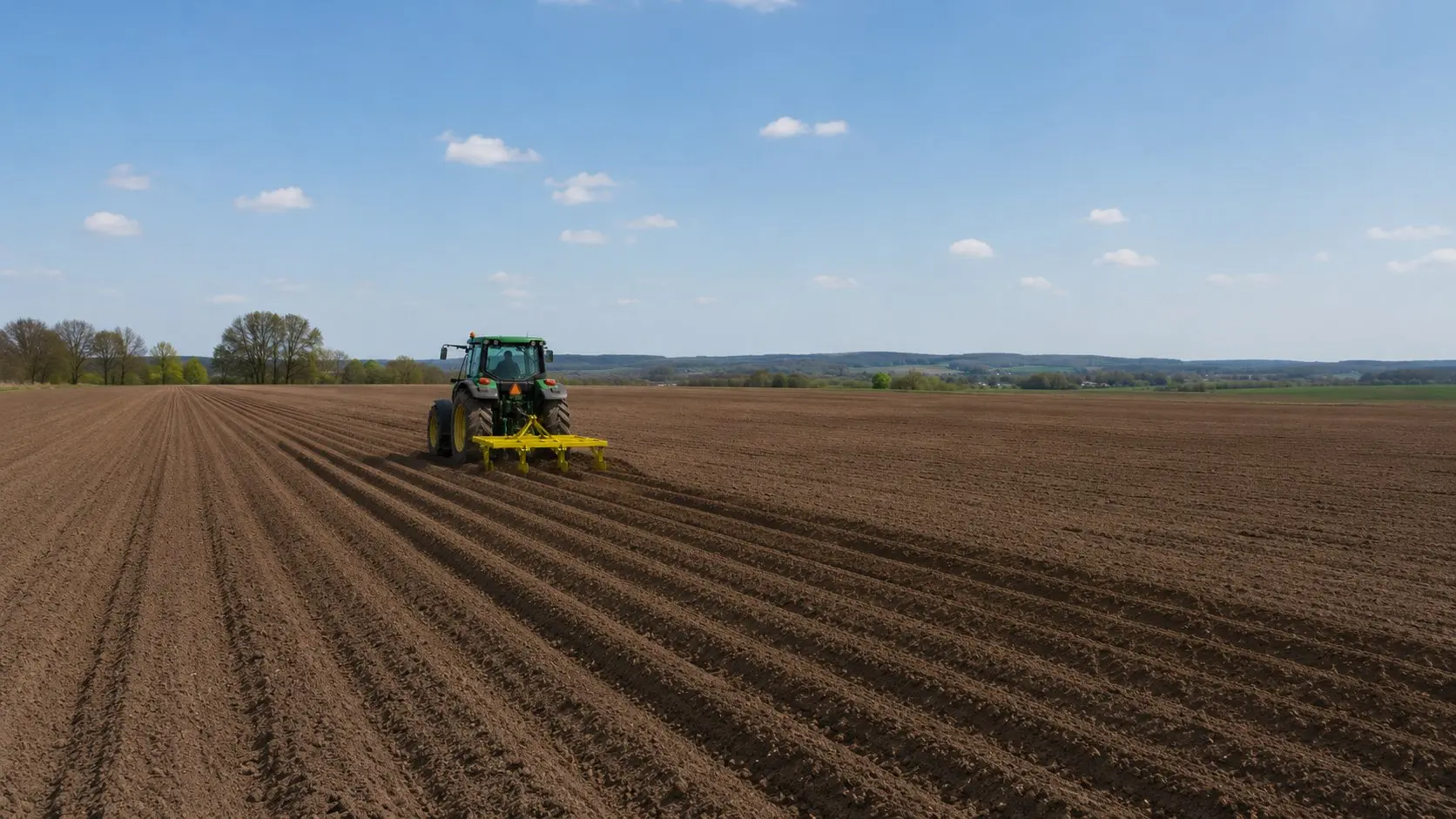
After the rotavator has prepared the seedbed, the furrower opens V-shaped planting trenches at the correct row spacing and depth. The EP-R-380 covers 3 rows and the EP-R-580 covers 5 rows, both operating at 75 HP from the Cat. 2 three-point hitch at 540 RPM PTO.
Furrow geometry at this stage directly determines potato development quality. A properly formed furrow at 15–20 cm depth with consistent sidewall geometry allows the seed potato to sit at a uniform depth with adequate soil coverage — the condition that produces uniform emergence timing, consistent ridge formation, and predictable tuber development depth at harvest. The spring-tine design of the EP-R-380/R-580 adapts to the slight surface undulations typical of Korean highland terraced fields, where a fixed-shank furrower would skip or chatter on uneven sub-surfaces.
The row count set at Step 3 is the reference point for all subsequent machines. The furrower sets the physical rows in the soil that the planter must place seed into, the cultivator must hill around, and the digger must lift from.
Step 4 — Base Fertilizer Application
Machine: EP-ADB-380 (3-row) or EP-ADB-480 (4-row) · 75 HP · Cat. 2 · In-furrow banded application
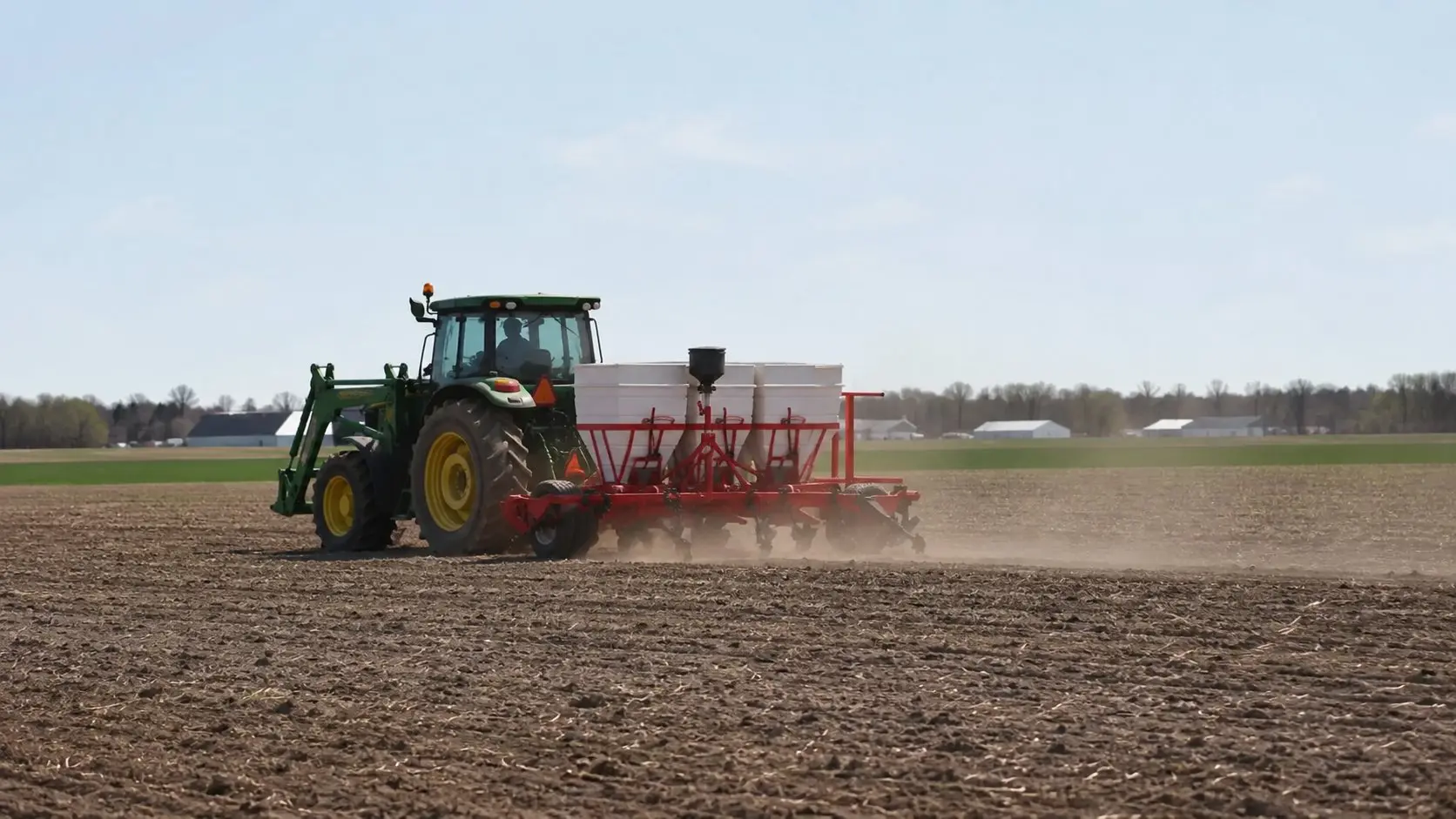
Korean commercial potato production requires base fertilizer placement in-furrow at planting depth, not broadcast and incorporated. In-furrow banded application positions the compound NPK fertilizer within the developing root system’s primary uptake zone from emergence, achieving higher nitrogen and phosphorus utilization efficiency than broadcast application at the same total nutrient rate.
The EP-ADB-380 (3-row) and EP-ADB-480 (4-row) applicators deliver granular compound fertilizer from individual row bunkers at a controlled metered rate. Each row unit operates independently, allowing the operator to confirm application rate per row before and during the pass. These machines run at 75 HP from the same tractor as the furrower — often the furrower and fertilizer applicator passes are done in a combined sequence on the same day to minimize soil disturbance and tractor tracks before planting.
PSW-3200 B option: If the PSW-3200 B rotavator (with integrated 2,000 Kg fertilizer bunker) was chosen at Step 2, base fertilizer was already incorporated during primary tillage. In that case, Step 4 is eliminated and the total field operations before planting is reduced from four passes to three.
Step 5 — Planting
Machine: EP-PAI-2100 (2-row) / EP-PANTHER (2 or 4-row) / EP-PAI-480-AR (4-row drawbar) · 75–100 HP
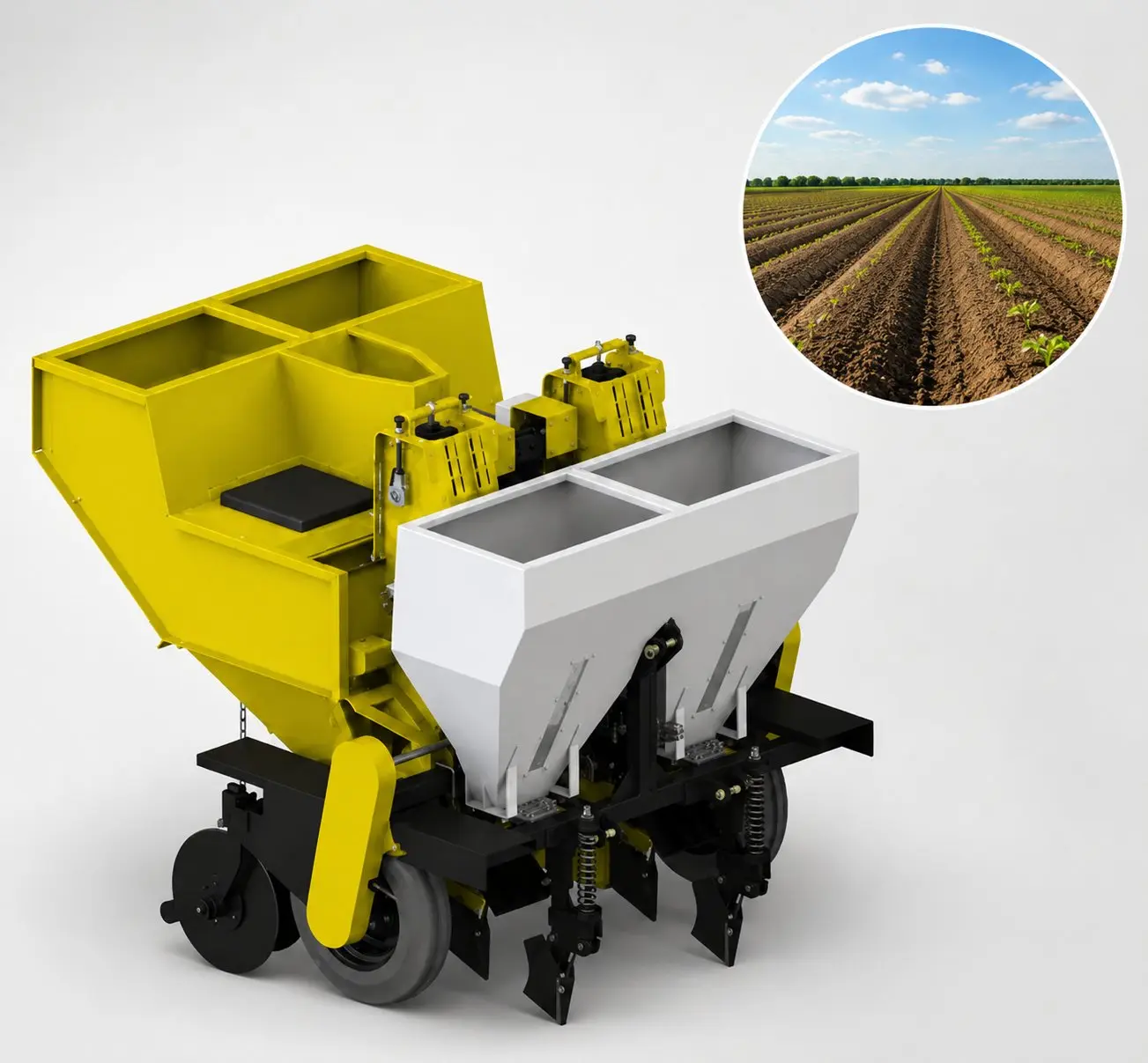
Potato planting in Gangwon-do takes place within a narrow spring window — typically mid-April to early May depending on altitude and microclimate. At 700 m elevation in Pyeongchang-gun, the frost-free planting window may be 10–14 days shorter than at 400 m in Hoengseong-gun. Getting seed potatoes into the ground at the correct seed spacing, correct depth, and correct ridge geometry within that window directly determines yield potential for the entire season. A planting delay of even 7 days in Korean highland conditions can reduce final yield by 8–12%.
The EP-PAI-2100 is the 2-row planting baseline for smaller operations: Cat. 2 hitch, 75 HP, with a 16-gear seed spacing adjustment system covering 25–40 cm spacings to accommodate variety-specific optimal spacings. Atlantic (the dominant processing potato variety in Gangwon-do) plants optimally at 28–30 cm; fresh market varieties like Superior and Dejima at 25–28 cm. The 16-gear adjustment allows precise tuning for each variety without modification parts.
The EP-PANTHER series extends to 4-row configurations for larger operations. The EP-PAI-480-AR is a drawbar-mounted 4-row planter with 4,000 Kg seed bunker capacity per bunker — suited to operations planting 50+ hectares per season where bunker fill stops are the principal workflow constraint.
Step 6 — Mid-Season Hilling and Cultivation
Machine: EP-ERA-2100/3100/5100 Rotary Cultivator · 75 HP · 4–6 weeks after planting · Potato-specific design
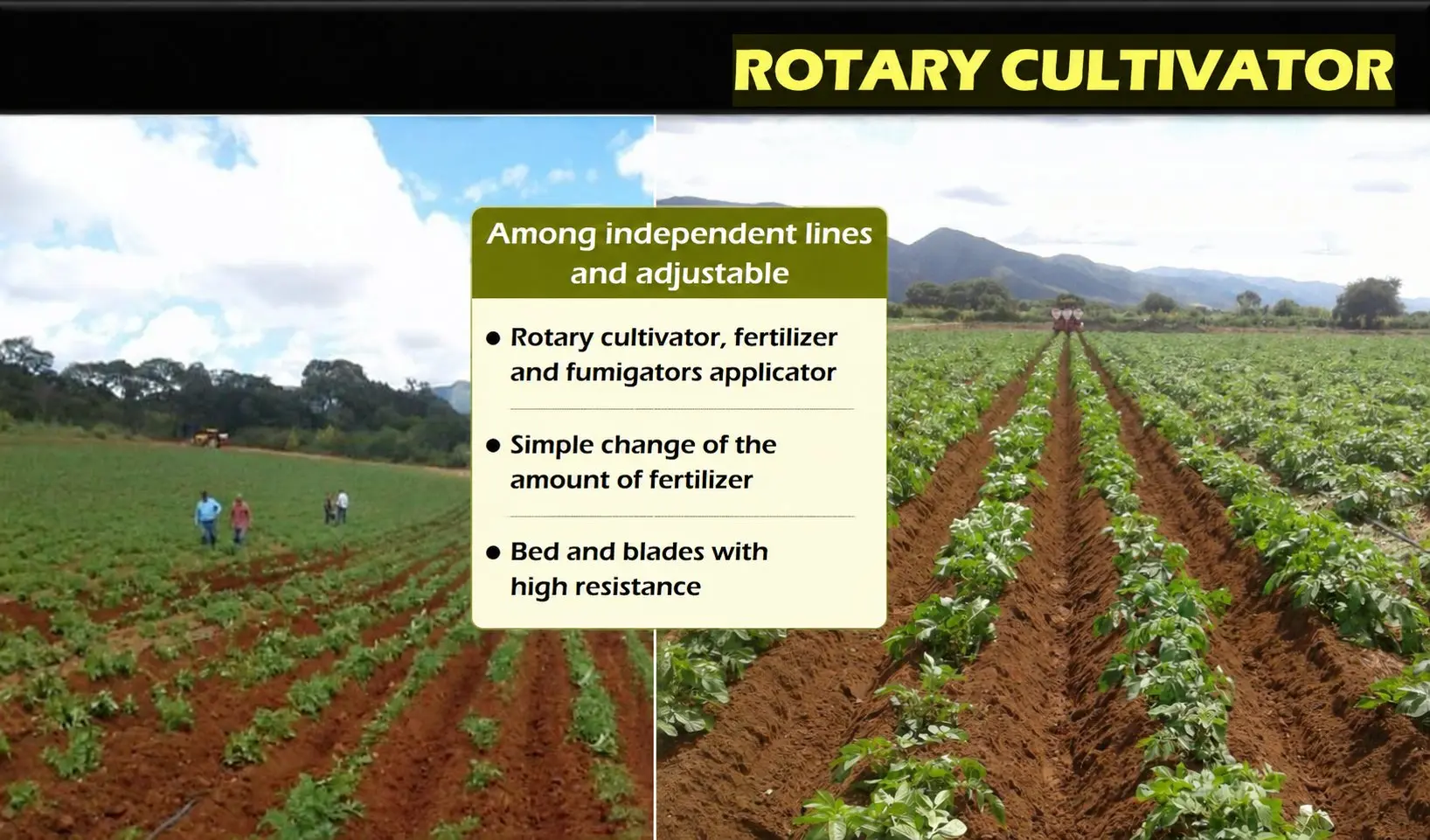
Approximately 4–6 weeks after planting — when potato shoots have emerged and reached 15–25 cm height — the EP-ERA Rotary Cultivator performs the hilling operation (배토, 培土): drawing soil up around the base of the plant to cover developing stolons, prevent tuber greening near the surface, and encourage additional stolon formation. At the same pass, inter-row cultivation for weed control and soil aeration is completed.
Despite the “Rotary Cultivator” name, the EP-ERA is a potato-specific implement. Three design features distinguish it from general-purpose inter-row cultivators:
Spring-loaded furrower arms: The soil-moving arms are mounted on spring-loaded linkages. If an arm contacts a developing tuber or a subsurface stone, it deflects rather than applying fixed force — the critical tuber-protection feature during the period when tubers are growing rapidly and most vulnerable to mechanical bruising. Fixed-arm cultivators cannot provide this protection.
Independent row units: Each row is cultivated independently, allowing the machine to follow actual ridge contour variations — important on Korean highland fields where frost-heave and variable soil moisture produce uneven ridge profiles between spring emergence and first hilling. A fixed-geometry cultivator tracking rows opened weeks earlier would miss the actual ridge centres on uneven terrain.
Top-dressing fertilizer bunker: The EP-ERA’s 125 Kg per row fertilizer bunker delivers nitrogen top-dressing simultaneously with the hilling operation — combining two mid-season tasks in one field pass. The timing is agronomically important: nitrogen application at hilling coincides with the period of maximum potato plant nutrient demand during the rapid tuber bulking phase.
The three model designations — EP-ERA-2100, EP-ERA-3100, EP-ERA-5100 — correspond to 2-row, 3-row, and 5-row configurations. The number must match the row count established at Steps 3–5.
Step 7 — Harvest
Machine: EP-AWB-1600 / EP-AWB Trailed Series / EP-CWB-2L · 75–110 HP · Late summer/autumn
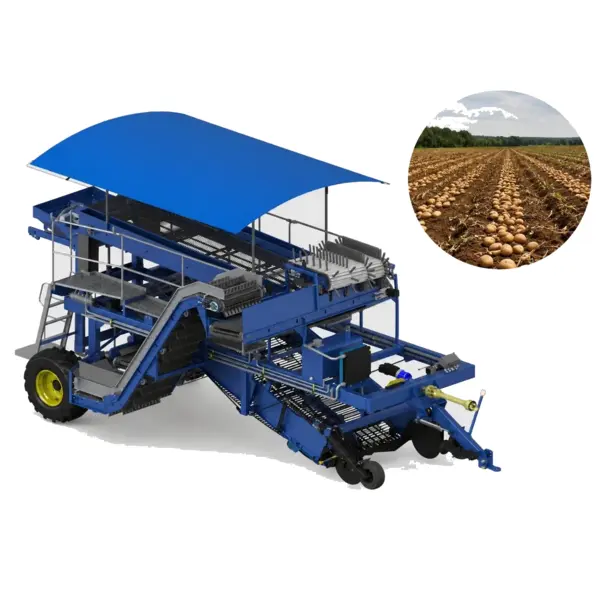
Harvest is where the quality of every upstream decision becomes visible. A correctly prepared, stone-free, precisely ridged field with consistent plant spacing produces a clean mechanical harvest with low damage and loss rates. A field with residual stone, inconsistent ridges, or misaligned row spacing produces damaged tubers, harvester stoppages, and high labour requirements at the picking table.
The EP-AWB-1600 is the standard 2-row mounted potato digger (Cat. 2, 75 HP) used by the majority of Korean commercial highland potato operations. The machine lifts two rows simultaneously on its lifting shares, passes the lifted material across a vibrating web separator that removes loose soil and small stones, and presents clean tubers to the collection system. Three output configurations are available: Kit A (side windrow for manual picking), Kit B (rear elevator to following cart), and Kit C (transfer elevator to trailer). Gangwon-do operators most commonly use Kit B or Kit C to reduce manual picking labour — the primary driver of system adoption.
For larger operations, the EP-AWB Trailed series (2-row and 4-row) and the EP-AWB-3200 (4-row) provide higher daily throughput. The EP-CWB-2L Big Bag Harvester targets operations supplying directly to processing plants — it grades and packs into 500 Kg FIBC (big bag) containers in the field, eliminating the intermediate bulk handling step at the packhouse.
Building Your System — Configurations by Farm Scale
Not every farm needs all seven machines from day one. Korean highland potato operations typically build out the system in stages based on scale, budget, and the labour-saving priority at each step:
Small Operation — up to 5 ha
Priority purchases: EP-EW-4000 Rock Rake (Step 1) + EP-PAI-2100 Planter (Step 5) + EP-AWB-1600 Digger Kit A (Step 7). Contract Steps 2–4 and 6 in the first seasons. Focus budget on the steps with the highest labour-saving impact first.
2-row alignment throughout · 75 HP tractor
Medium Operation — 5–20 ha
Full 7-step in 3-row configuration: EW-4000 + PSW-3200 (140 HP) + EP-R-380 + EP-ADB-380 + EP-PAI-2100 + EP-ERA-3100 + EP-AWB-1600 Kit B. The 75 HP tractor runs Steps 1, 3, 4, 5, 6; the 140 HP tractor covers Step 2.
3-row · two tractors · all steps owned
Large Operation — 20+ ha
4-row system: BlackBird Rock Rake + PSW-3200 B (combines Steps 2+4) + EP-R-580 + EP-PANTHER 4-row + EP-ERA-5100 + EP-AWB-3200 (4-row trailed) or EP-CWB-2L for processing supply chains.
4-row · parallel tractor operation · max throughput
Frequently Asked Questions
What happens if my planter row spacing doesn’t match my digger?
The digger operates by running its lifting shares under the centre of each planted row. If the share centres don’t match the planted row centres, the shares cut through the tuber zone rather than beneath it — causing direct mechanical damage to tubers during lifting. Losses of 5–15% of yield from digger-planter mismatch are reported by growers switching to mechanical harvest without confirming alignment. Measure your planted row spacing before selecting the digger. The safest approach is to select furrower, planter, and digger from the Watanabe system together so row matching is confirmed at purchase.
Which machine should I buy first if I’m starting to mechanize?
For most Korean highland potato farms, the harvest digger (Step 7 — EP-AWB-1600) delivers the highest immediate labour-saving impact because potato digging is the most labour-intensive manual operation. The second priority is typically planting (Step 5 — EP-PAI-2100), which is the most time-sensitive operation relative to the narrow highland planting window. Stone rake (Step 1) and rotavator (Step 2) often already exist in some form on established farms. Build the system from the harvest and planting steps first; add the intermediate steps as each additional machine’s ROI becomes clear.
Can the EP-ERA Rotary Cultivator (Step 6) be used for other crops, not just potatoes?
The EP-ERA is specifically designed for potato mid-season cultivation. Its spring-loaded arm design, independent row tracking, and tuber-protection geometry are all potato-specific features. The machine performs its defined function (inter-row cultivation + hilling + top-dressing) on potato crops with precision that general-purpose inter-row cultivators cannot match, because it was engineered around potato ridge geometry and tuber vulnerability to mechanical contact. Using it on other row crops is technically possible but the design advantages are specific to the potato application.
How much time does the complete 7-step sequence take per hectare?
As a practical estimate for a 3-row Gangwon-do operation: Step 1 (rock rake, 0.8–1.2 ha/h) = 0.8–1.2 hrs; Step 2 (rotavator, 2–3 ha/h) = 0.3–0.5 hrs; Steps 3–4 (furrower + fertilizer, 2–3 ha/h) = 0.3–0.5 hrs each; Step 5 (planter, 0.8–1.2 ha/h) = 0.8–1.2 hrs; Step 6 (cultivation, 1–2 ha/h) = 0.5–1.0 hrs; Step 7 (digger, 0.5–0.8 ha/h) = 1.2–2.0 hrs. Total active machine time across the season: approximately 5–7 tractor-hours per hectare. Compare this to 30–60 person-hours for predominantly manual production — the labour efficiency case for mechanization is compelling, particularly given the chronic seasonal labour shortage in Korean highland agricultural zones.
Are Korean agricultural machinery subsidies available for these implements?
Agricultural machinery purchase subsidies (농업기계화 촉진 지원사업) are administered annually by the Ministry of Agriculture, Food and Rural Affairs (농림축산식품부) through provincial agricultural technology centers (농업기술센터). Eligible equipment categories change annually. Subsidy rates vary by implement type and provincial supplementary programs. Confirm current eligibility with your regional agricultural technology center before purchase. We can provide the technical specification documentation required for subsidy applications for any machine in the Watanabe potato system.
Ready to Build Your Potato Machinery System?
Tell us your farm area in hectares, your current row configuration (if any), your target row count, main potato variety (Atlantic / Superior / Dejima), and whether you supply fresh market or processing — we confirm the specific Watanabe machine configuration for your scale, with row matching verified before any order is placed. All potato machinery models in Korea local stock in Ansan-si, Gyeonggi-do.
Editor: Cxm