Korea Watanabe Rock Crusher Tractor Co., Ltd. supplies Italian-manufactured Watanabe machinery to Korean agricultural operations from its base in Ansan-si, Gyeonggi-do. The range covers stone crushing, stone collection, soil tillage, soil stabilisation, road building, and the complete potato production machinery chain — more than 20 machine models matched to Korean agricultural conditions and supported by Korean-language service documentation, Korean agricultural machinery certification, and Korean government subsidy programme compliance.
A first-time buyer looking at this range faces a common challenge: which machine to prioritise when the budget cannot cover the full system at once, and in what order to build the system over successive seasons. This guide provides the definitive answer to both questions — drawing on the machine-specific guides throughout this article series and synthesising them into a single buyer decision framework. All specifications in this guide are from the official Watanabe brochure.
The Complete Korea Watanabe Machine Range — All Confirmed Models
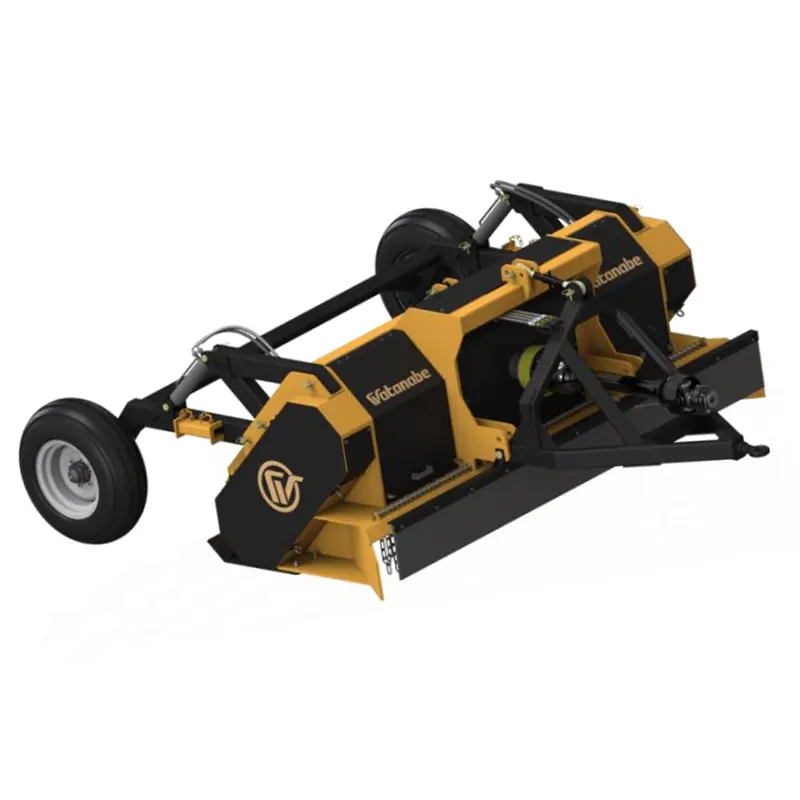
All specifications from the official Watanabe product brochure. Korea Watanabe holds Korean agricultural machinery certification for all listed models.
Stone Crushers (THOR Range)
180HP / 2.4m / 2,300Kg / 90+6 teeth / 550mm rotor / stones to 30cm / Cat.2 / 1000RPM / Kit Drawbar included. The anchor machine of the range. Highland potato and vegetable farms 5–20 ha. Zero-tolerance field clearance and annual frost-heave maintenance.
230HP / 3.0m / 2,800Kg / 108+8 teeth / 600mm rotor / stones to 40cm / Cat.2 / 1000RPM / 2 hydraulic valves / Drawbar Kit. Contractor operations, new land with 40cm+ stones, BlackBird companion for road clearing.
CVT tractor required / forestry and silviculture / stump and rock clearing / 1000RPM. For land conversion from forest to agriculture — handles stump material the THOR 2.4 is not designed for.
250HP CVT / 0–200mm milling depth / 92 Kennametal RK4 bits / 5,300Kg / 0.5–1.5 km/h / 1000RPM. Not a stone crusher — a full-depth soil stabiliser for Korean rural road FDR and pavement rehabilitation.
Stone Collection and Surface Management
110HP / 1.95m / 3,400Kg / 2.5m³ bunker / max 80Kg stone / 3–5km/h / 60L/min hydraulic / Cat.2 / 2 valves. Collects THOR 2.4 output. Pairs with THOR 2.4 as the core two-machine clearance system. Bunker deposits stone aggregate at headland.
75HP / 3.6m / Cat.2 / 540RPM. Surface rock rake for annual frost-heave re-emergent collection on established cleared fields. Supplements THOR 2.4 annual maintenance on established fields.
9.5m width / 300HP minimum / 1000RPM PTO / rear hitch for THOR 3.0 coupling. Contractor-scale road and wide-area surface clearing. Highest-coverage stone management tool in the range.
Tillage and Road Infrastructure
140HP / 3.0–3.6m adjustable / Standard, A (PSW-3200A), and B (with 2000Kg bunker) variants / 540/1000RPM / Cat.2. Primary tillage machine for all Korean highland crops. Produces fine tilth after THOR 2.4 clearance. Available with optional bunker for integrated field operations.
Front-mount / 2,140mm / 1,300Kg mandatory front ballast / 2 internal rollers / electronic cab control. Binder/lime spreader for road construction and field lime application. Front-mount design enables simultaneous spreading and following machine operation.
Compost and Barn Aerators
75HP / 2m width / 80cm aeration depth / Cat.2 / 540RPM. Compost barn deep-litter aerator for cattle and livestock operations. Produces organic material for field application.
80HP / 3m width / 80cm aeration depth / Cat.2 / 540RPM. Wider barn coverage for larger livestock operations.
Complete Potato Machinery Range
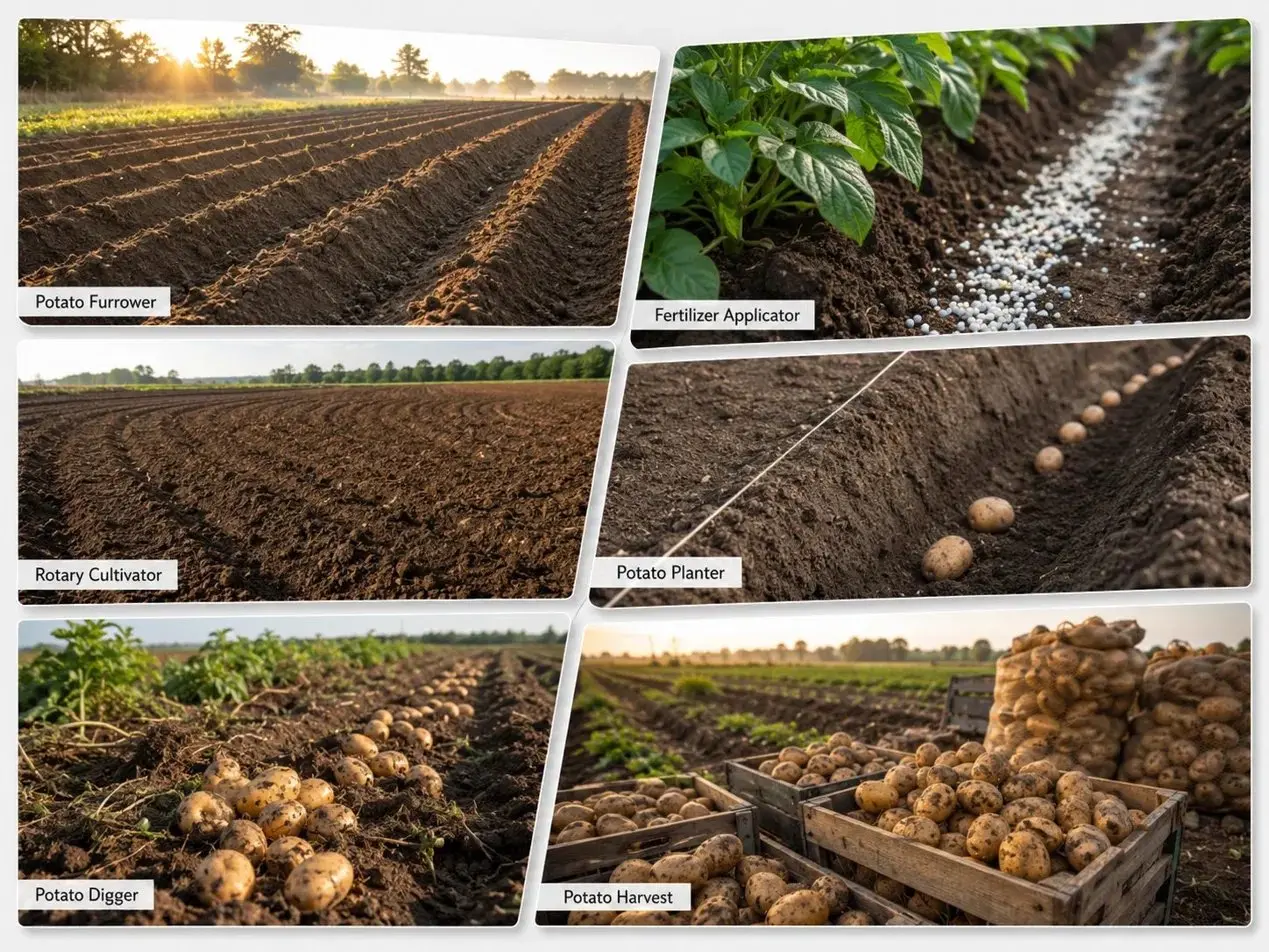
3-row/5-row furrowers, 75/100HP, Cat.2 — ridge formation at Step 3.
3-row/4-row combined furrower+fertiliser, 75HP, Cat.2 — Step 3 with integrated band fertiliser application.
2-row planter, Cat.2, 75HP, 16-gear spacing 25–40cm — Step 4 planting for standard-width terrace farms.
2–4 row adjustable planter, Cat.2, 75–100HP — Step 4 planting for mixed-width terrace farms needing row-count flexibility.
2/3/5-row rotary hiller, 75HP, Cat.2, 540RPM — Step 6 hilling and cultivating.
2-row mounted digger, Cat.2, 75HP — Step 7 harvest, 3 kit options (side discharge, elevator, bunker).
4-row trailed digger, continuous belt elevator — Step 7 for large-scale 4-row systems requiring dedicated collection vehicle.
4-row trailed harvester, 4,000Kg bunker drawbar — large-scale bunker harvest without following collection vehicle requirement.
2-row Big Bag Harvester, FIBC 500Kg bags, grading system — direct big-bag market harvest for export-grade packaging.
Which Machine to Buy First — The Answer Is Always the THOR 2.4
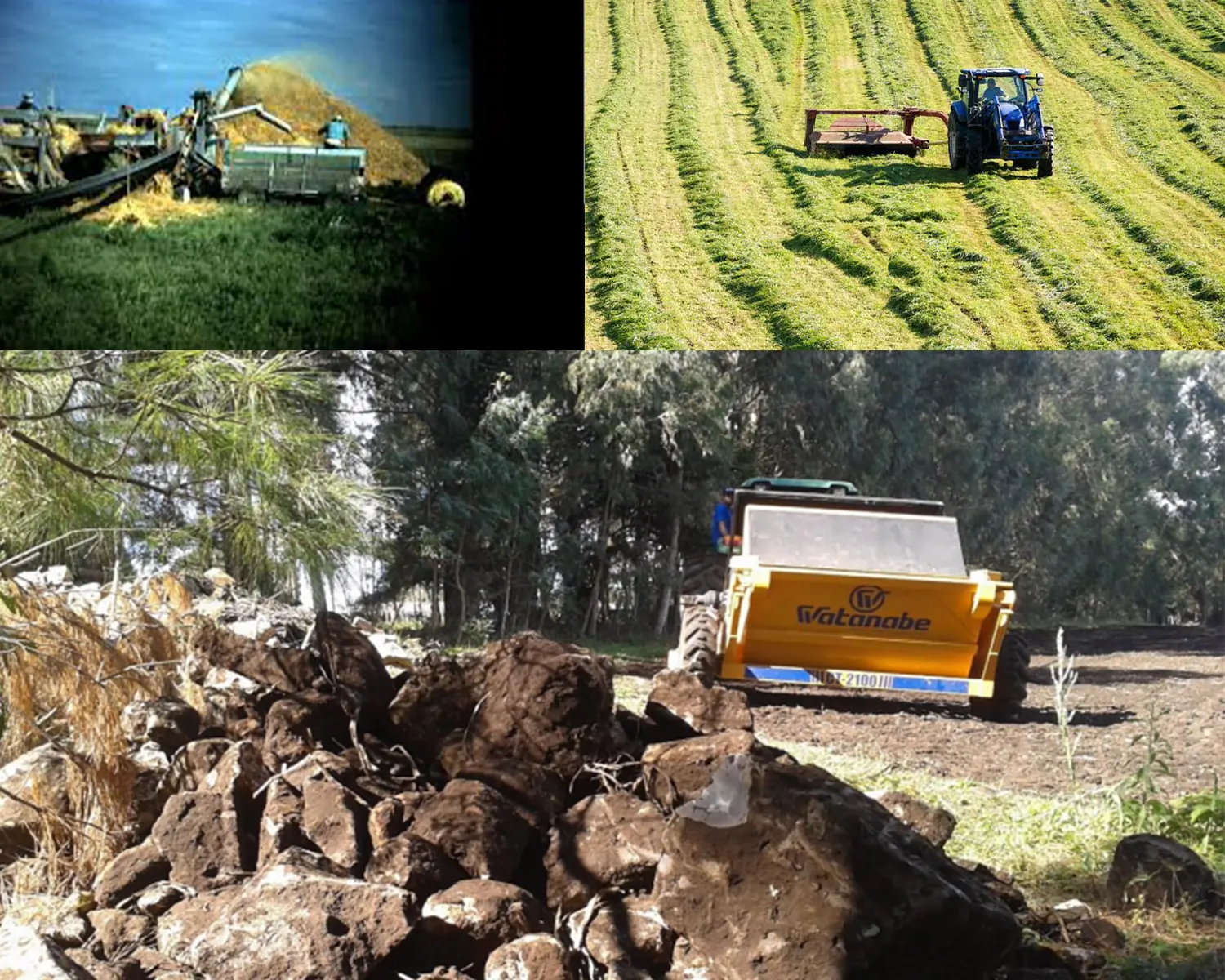
No matter which crop you grow, which market channel you are targeting, or which scale you are farming at, the first Watanabe machine for any Korean highland farm with stone problems should always be the THOR 2.4. The reason is structural: all other Watanabe machine investments — the PSW-3200, the EP-PAI-2100, the EP-AWB-1600 — deliver their designed productivity only on stone-cleared fine-tilth fields. Buying the potato system before clearing the stones produces a planter that seeds into coarse, stone-disrupted ridges and a harvester that operates in stone-contaminated soil. The productivity of every downstream machine depends on the THOR 2.4 having done its work first.
The “THOR first” principle — why it is non-negotiable
The 3-Stage System Build — From Stone Clearing to Full Potato Mechanisation
Most Korean highland farms build the Watanabe system over 3–5 years rather than purchasing everything at once. The 3-stage build sequence maximises ROI at each stage and ensures that each machine added to the system has cleared fields to operate on:
THOR 2.4 + CT-2100. The two-machine clearance system. The THOR 2.4 fragments stones to the full crop development depth. The CT-2100 collects the output and deposits it at the headland. Together these two machines transform un-cleared highland fields into the zero-tolerance stone-free environment that every subsequent investment requires. In Stage 1 the farm continues current tillage and planting equipment — the THOR 2.4 and CT-2100 begin immediately delivering Grade 1 proportion improvement and market channel access that generates the revenue to fund Stage 2. Total subsidy-eligible investment under farmland improvement category.
PSW-3200 + EP-EW-4000 + EP-R-380 (or EP-ADB-380) + EP-PAI-2100. With stone-cleared fields established from Stage 1, Stage 2 adds the tillage and planting system. The PSW-3200 produces the fine tilth from which all crop quality benefits flow. The EP-EW-4000 supplements the THOR 2.4 for annual maintenance passes on established cleared fields. The EP-R-380 or EP-ADB-380 furrower and EP-PAI-2100 planter complete the spring preparation sequence. Stage 2 machines qualify for potato cultivation machinery subsidies — apply in January of the purchase year.
EP-ERA-2100 (or 3100) + EP-AWB-1600 Kit B. The hilling and harvest machines that complete the 7-step potato system. With the foundation (Stage 1) and preparation system (Stage 2) in place, the EP-ERA and EP-AWB-1600 replace the remaining labour-intensive operations — hilling by hand and harvest by hand or small lifter — with the machinery system that produces the consistent Grade 1 proportion that direct market and certified seed channels require. These machines also qualify for potato cultivation machinery subsidies. The complete Stage 1–3 system enables single-operator management of a 10 ha highland potato farm with 2–3 seasonal harvest workers.
Why Korea Watanabe — Five Reasons Customers Choose the System
All Korea Watanabe machines hold Korean agricultural machinery certification — a prerequisite for subsidy eligibility. Not all imported machines have this certification; without it, no subsidy is available regardless of machine quality. Korea Watanabe’s certification status is maintained and updated with each new model, and documentation is prepared for customers as a standard purchase service.
THOR 2.4, CT-2100, PSW-3200, and the core potato machinery range are maintained in Korean stock — 5–15 working day delivery versus 6–12 weeks for import-to-order. For Korean highland farms purchasing before the March preparation season, this delivery speed difference determines whether the machine arrives in time for the first season’s use.
The THOR 2.4’s 550 mm rotor at 1,000 RPM with the 90+6 tungsten carbide tooth pattern was developed and refined on hard European siliceous rock — the same rock type as Korean highland granite. The fragmentation output from the THOR on Korean granite is the 2–8 cm fragment distribution that the CT-2100 collects most efficiently. Alternative machines designed for softer limestone or mixed-aggregate soils do not produce this distribution on Korean hard granite.
Every machine in the Watanabe range is designed to work with every other machine in the range — row spacings, hitch standards, and operating depths are coordinated across the THOR, PSW-3200, EP-R, EP-PAI, EP-ERA, and EP-AWB system. Buying a mixed system from multiple suppliers introduces compatibility uncertainties that Korea Watanabe’s integrated range eliminates.
Korea Watanabe has supported THOR 2.4 customers in Korean highland farms for over a decade. The operational knowledge of how THOR 2.4 performs on Gangwon-do and Gyeonggi-do highland granite soils is built into Korea Watanabe’s service capability — the Ansan-si team understands the specific challenges of the Korean highland operating environment, not just the machine specification. Customers who want a supplier relationship, not just a product transaction, consistently cite this Korea-specific knowledge as the deciding factor.
Subsidy Access — The Korean Government Purchase Support Programme
The Korean agricultural machinery purchase support programme covers 30–50% of eligible Watanabe machine costs under two primary categories. Understanding which category applies to each machine is important for maximising the total subsidy contribution across the full system purchase sequence:
| Machine | Subsidy category | Application window |
|---|---|---|
| THOR 2.4, THOR 3.0, CT-2100, EP-EW-4000, BlackBird | Farmland improvement machinery (nongji gaeryang gigyehwa) | January (priority window) |
| PSW-3200 | Agricultural tillage machinery | January |
| EP-R, EP-ADB, EP-PAI, EP-PANTHER, EP-ERA, EP-AWB, EP-CWB, EP-PAI-480-AR | Potato cultivation machinery (gamja jaebae gigyehwa) | January |
| THOR ST, DCW 2.2 | Road infrastructure / binder spreading | January (confirm county allocation) |
| EP-DESTROYER 2.0 / 3.0 | Livestock management machinery | January |
Korea Watanabe’s subsidy documentation service
Korea Watanabe holds Korean agricultural machinery certification for all models in the range and prepares the full subsidy application documentation package for every customer purchase. This includes: certification registration numbers, machine specification sheets matching the Korean agricultural office’s format, field area confirmation support, and application timing guidance for each county’s allocation window. The documentation service is provided at no additional charge for all Korea Watanabe machine purchases. Contact Korea Watanabe in November–December to begin the January application preparation.
Frequently Asked Questions for First-Time Buyers
My farm has both stone problems and old potato machinery. Which problem should I address first?
Address the stone problem first — always. Old potato machinery operating on stone-cleared fine-tilth fields produces better results than new potato machinery operating on un-cleared coarse fields. The reason is that stone clearing is the soil environment that all machinery performance depends on, while machinery quality is a multiplier within that environment. A first season with the THOR 2.4 clearing the fields and your existing machinery operating on cleared ground will produce meaningfully better results than the same season with your existing machinery on un-cleared ground, regardless of how advanced your existing machinery is. After the THOR 2.4 delivers cleared-field results for one full season, the case for upgrading the potato machinery in Stage 2 and Stage 3 is then based on actual cleared-field performance data from your farm — making the machine selection decision for the potato system far better-informed.
How long does delivery take after placing an order with Korea Watanabe?
Delivery timing varies by machine availability and the Korean agricultural preparation season. Korea Watanabe maintains stock of the most commonly purchased machines (THOR 2.4, CT-2100, EP-EW-4000, PSW-3200, and the core potato machinery range) in Korean local stock — these machines can typically be delivered within 5–15 working days of order confirmation. Machines not in local stock require import from Italy with a delivery lead time of 6–12 weeks. The practical implication: to receive a THOR 2.4 before the March–April preparation season, order by January at the latest (for stock machines) or by October–November of the previous year (for imported-to-order machines). Korea Watanabe confirms stock availability at time of enquiry and provides realistic delivery estimates at the consultation stage before any purchase commitment is made.
What tractor does my farm need to run the THOR 2.4?
The THOR 2.4 requires a minimum 180 HP tractor with: rear three-point hitch Cat.2 rated to minimum 4,000 Kg lift capacity; rear PTO rated to 1,000 RPM and capable of delivering the THOR 2.4’s operating power demand; and at least one rear remote hydraulic valve for the rear hood position control. The Kit Drawbar slope mode requires a second hydraulic valve — if your tractor has only one rear remote valve, confirm with Korea Watanabe whether the slope terrain you will be operating on requires Kit Drawbar hydraulic operation. Many Korean domestic tractors in the 100–200 HP range (LS, TYM, Kukje models in the 180+ HP class) meet these specifications. Provide your tractor model and serial number to Korea Watanabe for a specific compatibility confirmation before purchase — this takes 1–2 working days and prevents any post-purchase configuration surprises.
What ongoing service and parts support does Korea Watanabe provide after purchase?
Korea Watanabe provides full after-sales service for all Watanabe machines sold in Korea. The service package includes: Korean-language operator and maintenance documentation; annual pre-season consultation (by phone, video call, or in-person at Ansan-si) covering the coming season’s operation plan and parts requirements; priority parts supply from Korean local stock for wear items (THOR 2.4 tooth sets, CT-2100 tine sets, PTO shaft joints) with standard order-to-delivery of 5–15 working days; and on-request technical support for field troubleshooting of any machine issue. Customers who purchased their first THOR 2.4 from Korea Watanabe 10 or more years ago continue to receive the same service level for their machine — the after-sales relationship is not time-limited.
Why Watanabe versus domestic Korean stone crusher alternatives?
Korean domestic stone management machines and European alternatives to the Watanabe range exist, and Korea Watanabe does not discourage comparison. The basis on which Korea Watanabe’s customers consistently choose Watanabe is the combination of three factors that are not always available together in alternative offerings: (1) the THOR series’ specific combination of rotor diameter, tooth geometry, and hood design that produces the fragment size distribution best matched to Korean highland granite — the 550 mm rotor at 1,000 RPM with the 90+6 tooth pattern fragments Korean granite to the residual size that the CT-2100 can collect; (2) Korean agricultural machinery certification that makes all machines eligible for Korean government subsidies — not all imported machines hold this certification; and (3) Korea Watanabe’s local stock, Korean-language service, and 10+ year after-sales track record in the Korean highland market. Comparing machines on paper specifications alone does not capture these field-performance and service dimensions — Korea Watanabe encourages potential buyers to visit current THOR 2.4 users in their region before making a purchase decision.
Start Your System — First Consultation With Korea Watanabe
Farm area (ha) + crop system + existing tractor model + target first season → Stage 1 machine recommendation with tractor compatibility confirmation and January subsidy application timeline. Korea Watanabe, Ansan-si, Gyeonggi-do.
Editor: Cxm