The potato harvest decision is the final and most time-compressed operational window in the production year. Unlike planting — where a three-morning soil temperature reading and a weather forecast give reasonable predictability — the harvest window is defined by three simultaneous constraints that move independently and can close at different rates: the biological skin set process (which determines when tubers can be harvested without surface damage), the digger’s throughput capacity relative to the farm’s total area (which determines whether the window is physically achievable), and the stone condition of the field (which determines what the digger will encounter and how long it will run without a mechanical stoppage). Managing all three in parallel — not sequentially — is the discipline that separates harvest operations that complete within the skin set window from those that extend past it into the zone where skin damage, storage rot, and grade loss accumulate.
This guide covers the skin set biology that governs the harvest window, the throughput calculation that determines which Korea Watanabe potato machinery digger configuration is required for a given farm area, the three specific harvest damage mechanisms that stone condition directly controls, and the pre-harvest machinery readiness protocol that determines whether the digger is fit to enter the field when the window opens.
Skin Set — The Biological Gate That Governs Harvest Timing
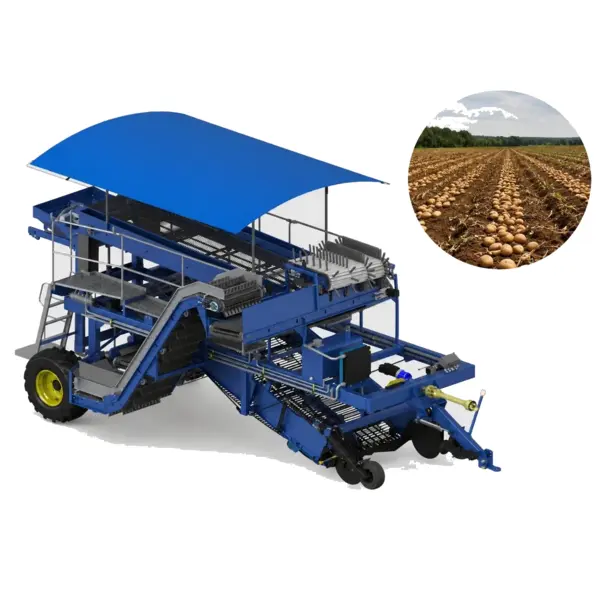
Skin set is the hardening of the potato tuber’s outer periderm layer — the thin cork-like tissue that forms the tuber’s protective barrier against water loss, pathogen entry, and mechanical abrasion. During the active growth phase, the periderm is metabolically immature and relatively soft; a tuber harvested at this stage loses its outer epidermal layer on contact with any rough surface — share edges, elevator rods, sorting table components — exposing the sub-epidermal cells to desiccation and disease. This “skinning” damage is often invisible at harvest (the tuber looks intact) but becomes apparent within 2–4 weeks of storage as the exposed cells dehydrate, discolour, and provide an entry point for soft rot pathogens.
Haulm destruction — by mechanical flailing, chemical desiccant (diquat), or natural frost — initiates the skin set process by cutting the supply of photosynthate and growth hormones from the above-ground plant to the developing tubers. In the absence of this supply, the tuber’s outer cells shift from growth mode to suberisation — the deposition of suberin (a waxy polymer) into the cell walls of the periderm. This suberisation process takes 14–21 days at the optimum soil temperature range of 15–20°C at tuber depth. At temperatures below 7°C, suberisation essentially halts — the physiological process continues, but so slowly that a 21-day post-haulm window may only achieve the skin set equivalent of 5–7 days at 15°C. This temperature dependency is the reason why calendar-based harvest timing (“harvest 14 days after burning off”) fails in cold autumns: the biological process may require 28–35 days to complete at 8–10°C soil temperature.
| Soil Temp at Tuber Depth |
Skin Set Rate |
Minimum Days Post-Haulm |
Harvest Decision |
| Below 7°C |
Near zero |
28–35+ days |
Wait — skin abrasion damage certain if harvested; do not rely on calendar day count |
| 7–10°C |
Slow |
21–28 days |
Verify by skin rub test — harvest only if skin resists thumb pressure without sliding |
| 10–15°C |
Moderate |
16–21 days |
Skin rub test — most varieties will be ready at 18–21 days; verify before committing full throughput |
| 15–20°C |
Optimum |
14–18 days |
Proceed at 14 days minimum — skin rub test to confirm, then begin full harvest campaign |
The Skin Rub Test — Field Verification Before Digger Entry
Excavate three tubers from mid-ridge depth in three field positions (headland, mid-field, opposite headland). Apply firm thumb pressure to the widest skin surface area and slide the thumb approximately 30 mm. Result assessment: (a) skin slides freely or peels away from the flesh — skin set incomplete, do not harvest; (b) skin resists sliding and remains firmly attached with no visible delamination — skin set sufficient to proceed. The test should pass at all three positions before harvest begins. A fail at even one position indicates that field area is not ready, and spot-harvesting the ready zones while leaving the unready zones is rarely practical — plan the harvest sequence to begin with fields that pass the full three-position test.
Throughput Capacity — Calculating Whether the Window Is Achievable
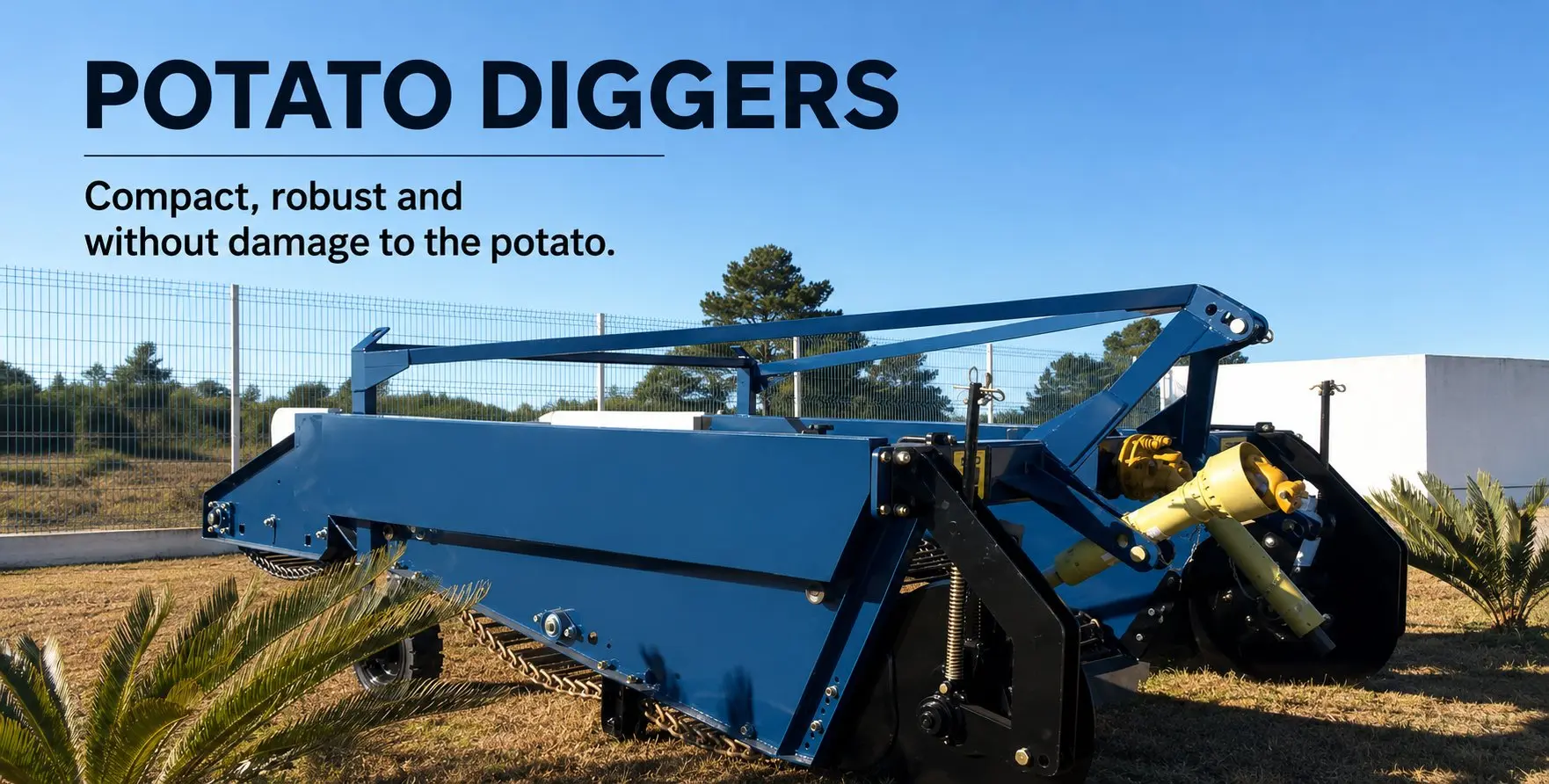
The skin set window defines how many calendar days are available for harvest. The throughput calculation converts this into a minimum daily harvest rate that the digger must achieve, and compares it to the machine’s achievable throughput under realistic field conditions. The gap between required throughput and achievable throughput determines whether the chosen digger configuration can complete the harvest within the skin set window — or whether the crop extends past the window into the damage zone.
The Throughput Calculation — Step by Step
1
Total area ÷ viable harvest days = required daily rate
Viable harvest days = calendar window days (14–21) minus weather stoppages (estimated 3–5 days of rainfall or wet soil in a typical temperate autumn) minus mechanical stoppage allowance (1–2 days per campaign for share changes, chain repair). Example: 20 ha potato area ÷ 12 viable days = 1.67 ha/day minimum required rate.
2
Compare to achievable digger rate
Mounted single-row digger: 0.5–0.8 ha/day in typical conditions (6–8 working hours, allowing for headland turns and hopper discharge). Trailed digger: 1.5–2.5 ha/day (higher sustained throughput, offset tractor path reduces headland time, continuous operation in wet conditions that would stop the mounted digger). Example continued: 1.67 ha/day required exceeds the mounted digger’s achievable rate on most days — trailed digger required for this operation.
3
Add stone condition adjustment
On uncleared stone-risk fields: add 0.5–1.5 additional mechanical stoppage days per 10 ha (share changes, chain incidents, gearbox checks) to the stoppage allowance. This reduces viable harvest days and increases required daily rate. Example: 20 ha with moderate uncleared stone risk — add 1.5 mechanical days; viable days drop to 10.5; required rate rises to 1.9 ha/day. Stone clearing before harvest — the pre-harvest BlackBird pass — directly improves this calculation by reducing the mechanical stoppage allowance.
| Potato Area |
Required Rate (14-day window) |
Digger Configuration |
Window Margin |
| Up to 8 ha |
0.5–0.7 ha/day |
Mounted single-row |
Good margin — 2–4 contingency days remain in typical year |
| 8–15 ha |
0.7–1.3 ha/day |
Mounted (dry soil); Trailed (wet/clay) |
Marginal — mounted has no weather margin in wet years; trailed recommended above 12 ha |
| 15–30 ha |
1.3–2.5 ha/day |
Trailed (essential) |
Mounted rate cannot meet required daily rate; trailed provides adequate margin |
| Above 30 ha |
2.5+ ha/day |
Two trailed diggers |
Single trailed digger at risk above 25 ha in average weather years; second machine required above 30 ha |
Three Harvest Damage Mechanisms — and How Stone Condition Controls Two of Them
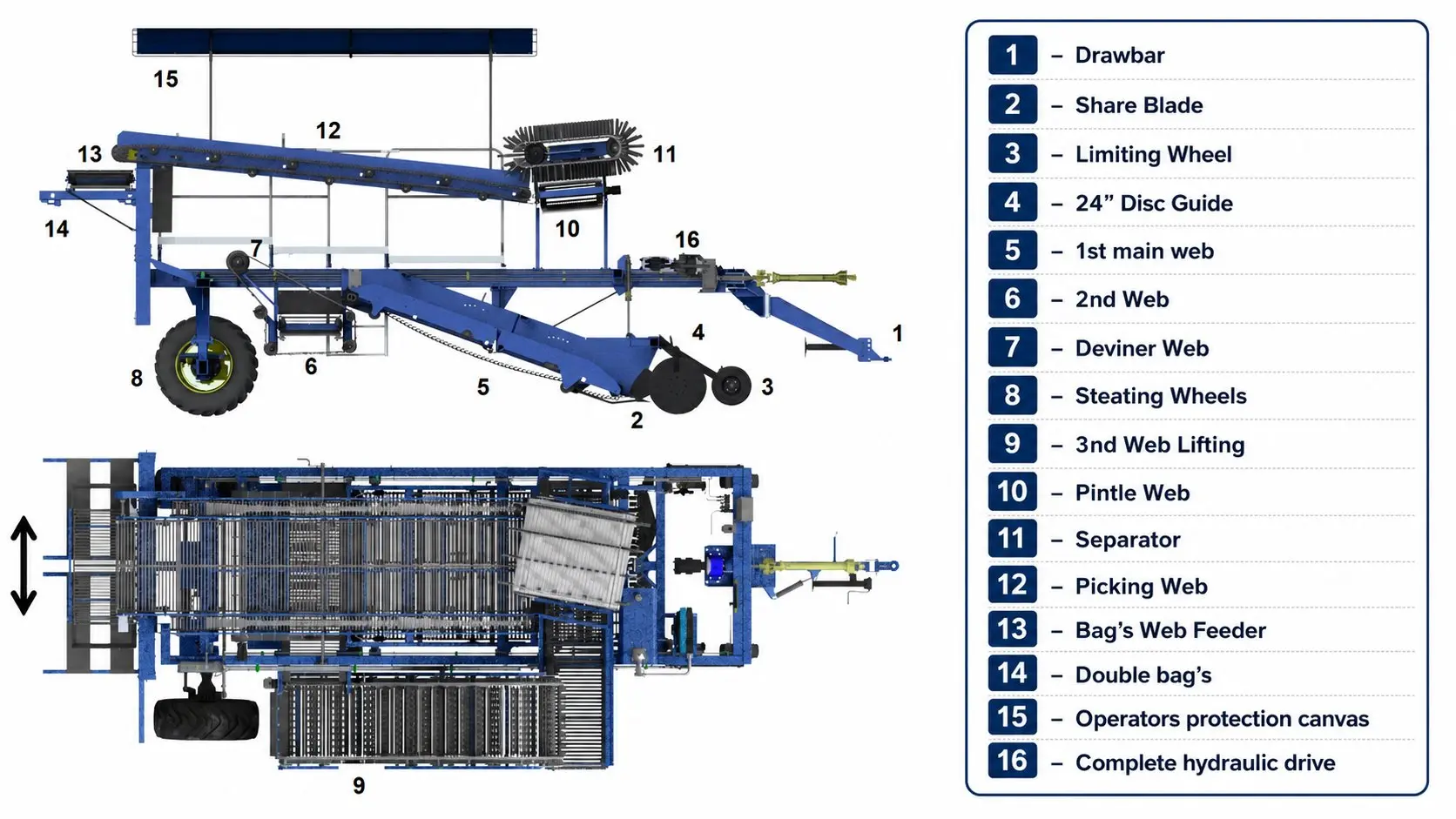
Tuber damage at harvest occurs through three distinct mechanical contact events, each with different causes, different damage patterns, and different mitigation strategies. Two of the three are directly modulated by the stone condition of the field — they are worse on stony uncleared ground and better on cleared ground, independent of the digger’s mechanical condition or the operator’s skill. The third is unrelated to stone and is managed through machine speed adjustment.
①
Share-to-Tuber Contact — Stone-Condition Dependent
The digging share lifts the ridge and separates the soil-tuber mass as it passes under the ridge. On stone-free cleared ground, the share travels a consistent depth and the tuber cluster is contacted by the upper face of the share in a controlled lifting action — the contact geometry is designed to pass beneath the cluster without direct tuber impact. On stony uncleared ground, stone encounters cause the share to deflect laterally (15–40 mm) or vertically (diving deeper or riding higher) at the moment of impact — changing the contact geometry so that the share edge strikes the tuber cluster’s lower or lateral surface. This direct edge-to-tuber contact causes the “black heart” bruising (blackening of the internal tissue at the impact point, visible only when cut) that develops 24–48 hours after harvest and causes pack house downgrade.
Damage pattern
Bruising on tuber crown and basal surfaces; black internal discolouration at impact site; asymmetric distribution (more on one side of the tuber matching the direction of share deflection)
Mitigation
THOR clearing +
CT-2100 collection + pre-harvest BlackBird. Stone-free field eliminates share deflection events.
②
Elevator Rod Pinching — Stone-Condition Dependent
As the soil-tuber mass travels up the elevator chain, tubers pass between the steel elevator rods. Under normal clean-field operation, the gap between rods is wide enough to pass all tubers without contact as they travel with the moving soil mass. When stones are present in the elevator load, they can bridge across the rod gaps or jam at the chain link connection points — creating a momentary constriction that the following tuber is squeezed through rather than passed through freely. This pinching contact causes elliptical bruises on the tuber’s widest diameter, typically appearing as parallel lines matching the rod spacing — the characteristic “rod mark” bruise visible when tubers are examined at a pack house sorting line.
Damage pattern
Parallel rod-mark bruises on tuber equator; internal discolouration develops 24–36 hours post-harvest; most visible on pale-skinned varieties (Maris Piper, Rooster)
Mitigation
Stone clearing removes the bridging/jamming agents from the elevator load. Chain speed reduction (slower elevator) also reduces impact energy of pinch contact — adjust elevator speed to minimum that maintains soil separation efficiency.
③
Drop Impact — Not Stone-Dependent, Managed by Elevator Speed
At the top of the elevator, tubers are released from the rod chain and fall to the windrowing point or directly into the collection trailer. The free-fall distance (typically 300–600 mm depending on machine configuration) and the elevator chain tip speed at the release point determine the tuber’s impact velocity and therefore the bruise energy at landing. This damage mode is stone-independent: it occurs identically on cleared and uncleared fields because the stone condition does not affect the drop height or the tuber’s velocity. However, it is affected by the elevator chain speed — faster chain means higher tip speed at release, higher impact velocity at landing, and greater bruising per tuber. Reducing elevator chain speed by 15–20% below maximum on bruise-susceptible varieties or in warm conditions (warmer tubers are more susceptible to bruising) is the standard mitigation.
Damage pattern
Impact bruising on the tuber surface that contacts the receiving surface; black internal bruising develops 24–72 hours post-harvest; most severe on large tubers with thin skin (baking/processing grades)
Mitigation
Reduce elevator chain speed by 15–20% on large-tuber varieties; use padded windrowing bar or low-drop outlet extensions; harvest when tuber temperature is below 15°C (cooler tubers are less bruise-susceptible)
Pre-Harvest Machinery Readiness Checklist
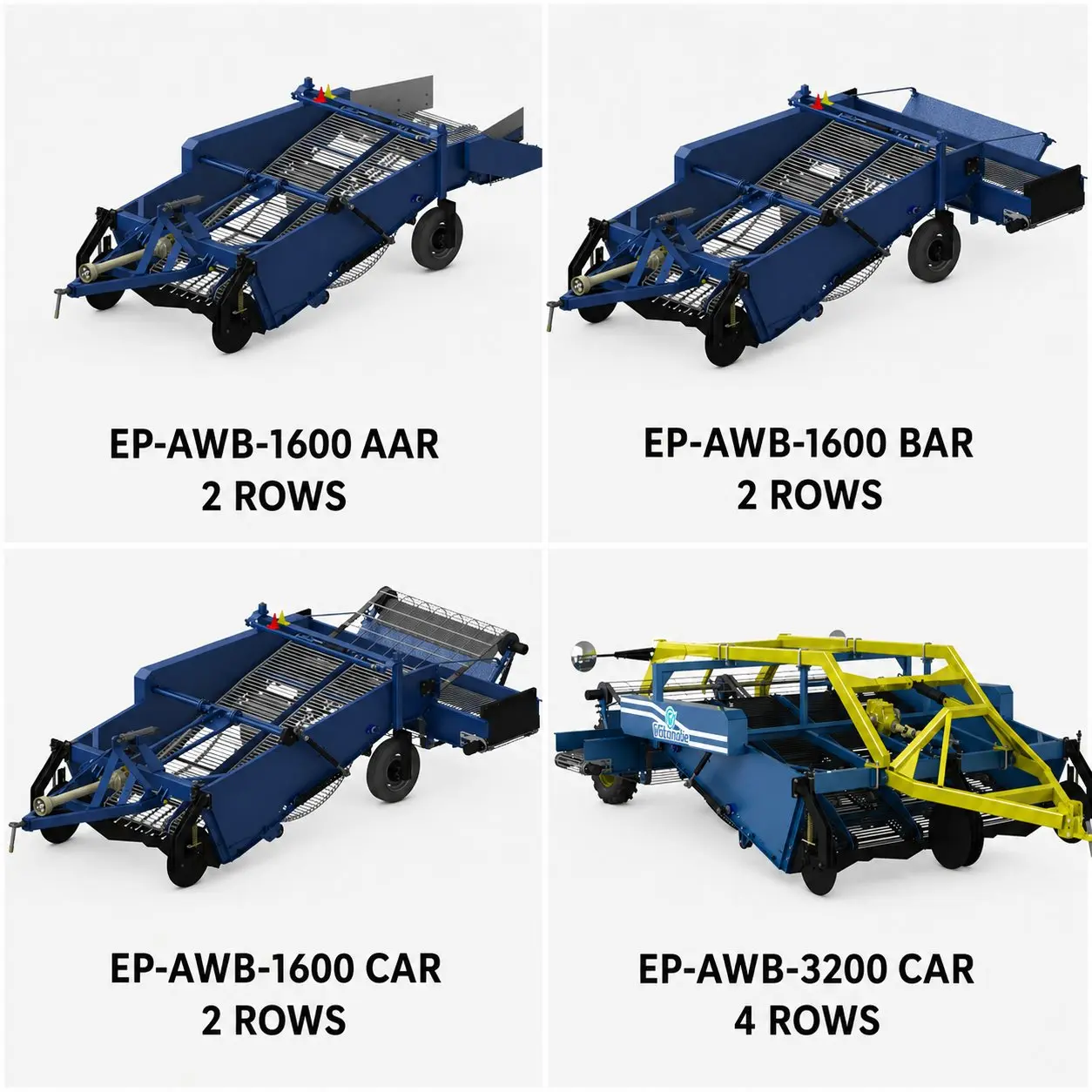
A
Field Readiness — Before Digger Entry
□Skin rub test passed at all three field positions (headland, mid-field, opposite headland)
□Pre-harvest BlackBird surface pass completed within 14 days of harvest start date
□Surface stone count below 3/m² at 50+ mm size after BlackBird pass
□Soil trafficability confirmed — walk field with 80 kg representative person; footprint depth below 50 mm indicates safe digger entry
□Planting record retrieved: ridge crown height, planting depth, row spacing for this field
□Share depth setting calculated from planting record: (crown height) + (planting depth) + 30 mm
B
Digging Share and Depth Control
□Digging shares inspected — tips above minimum thickness threshold; replace full set if any share is at threshold
□Share bolts torqued to specification — loose shares cause excessive vibration and accelerated wear
□Depth gauge wheels at calculated harvest depth setting — verified by 3-position excavation in first 30 m of field
□Spare share set loaded on the tractor/trailer for mid-field replacement (carry minimum one full replacement set)
□Skid shoes and side plates free of cracking — replace cracked skid shoes before campaign begins
C
Elevator Chain, Star Wheels and Drive
□Elevator chain tension set — chain sag midpoint below 30 mm under own weight; overtight chain causes rod damage, slack chain causes tuber pinching
□All elevator rods inspected — bent or broken rods replaced; a cracked rod weld will fail under stone load within the first half-day of harvest
□Chain link pins and split pins inspected — replace any pin showing deformation or cracks
□Star wheel elements (rubber or polyurethane) inspected — cracked elements replaced; worn elements allow stone pass-through that damages tubers
□Gearbox oil checked — level and condition; milky oil indicates water ingress (seal replacement required before harvest)
□PTO shaft guards intact and snap-ring collars engaging correctly on tractor PTO output
Frequently Asked Questions
Q
How is soil trafficability assessed before the digger enters — is there a reliable field test beyond the footprint depth method?
The footprint depth method (below 50 mm = safe entry) is the most practical field-side test available to most operators. Additional tests that provide more information: (1) Cone penetrometer — a soil penetrometer pushed to 15 cm depth with a 30° cone provides a shear resistance reading in kPa; values above 200 kPa at 15 cm indicate soil is firm enough for digger entry without excessive rutting. Penetrometers are available from agricultural suppliers at low cost and are reusable across seasons. (2) Tyre sinkage — drive the tractor and digger combination along the field headland (on the headland that will not be dug) for 10 m and observe tyre sinkage. If tractor rear tyre sinkage exceeds 80 mm, the field is too wet for safe digger entry without compaction damage to the remaining unlifted crop. (3) Soil ball test — take a handful of soil from 15–20 cm depth, squeeze and release. If the ball retains a smooth surface without crumbling and shows finger-print detail: plastic range — too wet. If the ball crumbles at the edges but holds general shape: friable range — proceed. If the ball breaks completely into crumbs: dry range — ideal. The wet-end of these tests coincides with the conditions where the mounted digger struggles and the trailed digger’s independent running gear provides the access advantage described in the trailed digger product guide.
Q
Rainfall in the 48 hours before harvest — how does recent rain affect tuber skin condition and damage susceptibility?
Recent rainfall in the 48 hours before harvest has two distinct effects on tuber damage susceptibility. First, soil moisture elevation: a fully set potato skin is less susceptible to abrasion damage in moist soil than in dry soil — the thin film of moisture between the tuber surface and any contact surface provides a lubrication layer that reduces the friction component of abrasion. This means that harvesting 12–24 hours after moderate rain (20–30 mm) on a field with full skin set can actually produce less skinning damage than harvesting the same field in drought conditions. The exception is if the rain has softened the skin set process or if the variety is prone to skin cracking on wet-dry cycling (Kerr’s Pink, some varieties in continental climates). Second, tuber turgidity: recent rain increases tuber water content and turgor pressure — which increases bruise susceptibility for the impact damage mechanisms (share contact, elevator pinching, drop impact). A fully turgid tuber at high turgor pressure is more likely to develop black internal bruising from mechanical impact than the same tuber under mild moisture stress. The practical balance: harvesting 24–36 hours after moderate rain is generally the optimum — soil moist enough to reduce abrasion, tubers not yet at maximum turgor from soil moisture recharge. Avoid harvesting within 6 hours of heavy rainfall (>30 mm) or in standing water conditions.
Q
After a mid-campaign share replacement stop, what checks are required before restarting the digger?
A share replacement mid-campaign requires a five-point restart check before the PTO is re-engaged: (1) New share bolts torqued to the full specification — never re-use the bolts removed with the worn share; the repeated thermal cycling and impact loading of a harvesting share causes the bolt threads to deform, and re-used bolts can back out under vibration within 2 ha of the restart. (2) Depth gauge wheel re-set — confirm the share depth setting has not changed during the replacement; the depth wheel carrier can shift during the replacement procedure if the machine has been raised and lowered. Dig 3 positions in the first 20 m after restart and excavate to confirm depth is at target. (3) Skid shoes inspected — the stone that caused the share replacement may have also contacted the adjacent skid shoe; check for cracking at the heel of the skid shoe, which is the most common secondary damage point from a stone impact event. (4) PTO shaft collar re-engaged and guard replaced — a share replacement in the field often requires the PTO shaft to be disconnected; confirm the collar is fully snapped before re-engaging the tractor PTO. (5) First 50 m at reduced forward speed — operate the first 50 m after a share replacement at two-thirds of normal forward speed while listening for abnormal vibration or scraping sounds that indicate an incomplete assembly or a secondary contact issue from the same stone event that caused the original share failure.
Q
How should the harvest sequence be planned across multiple fields with different skin set dates and stone histories?
Multi-field harvest sequencing is governed by three overlapping priority rules, applied in this order when they conflict: (1) Skin set priority: fields that completed haulm destruction earliest should be harvested earliest — their skin set window opens and closes first. Do not harvest a late-set field before an early-set field simply because it has a better stone history; the skin damage from harvesting an early-set field too late outweighs the stone risk reduction from the better stone history. (2) Stone risk priority within same skin set date: where two fields have completed haulm destruction on the same date, harvest the higher-stone-risk field first and the lower-stone-risk field last. The higher-stone-risk field consumes more share replacements and mechanical stoppage time — scheduling it earlier leaves more calendar days to absorb those stoppages within the window, whereas scheduling it last compresses the stoppages into the tail of the window where running past skin set is most damaging. (3) Soil condition priority: if a field that has reached skin set readiness is too wet for safe digger entry while another field is ready and dry — harvest the dry field regardless of its skin set sequence position. A day lost to wet soil at the start of the window is recoverable; soil damage from digger entry into wet conditions can cause compaction below the root zone that affects yields for 2–3 seasons.
Q
Can the digger be set deeper than the calculated depth to recover tubers that were planted deeper than intended?
Increasing the digger share depth beyond the calculated setting to compensate for deeper-than-intended planting is possible but has four specific costs that should be weighed against the tuber recovery benefit. First, power demand: each additional centimetre of digging depth increases draft force requirement by approximately 8–12% — on a 60 HP tractor that is already at 85–90% power utilisation at the target depth, adding 3 cm may require forward speed reduction to stay within the tractor’s power envelope, which reduces throughput. Second, soil volume per pass: a deeper share lifts more soil volume per metre of travel, increasing the load on the elevator chain and increasing the probability of rod pinching for any stones present. Third, accuracy uncertainty: if the planting logbook shows a 3 cm depth discrepancy, the actual variation across the field may be non-uniform — it may be 2 cm deeper at one headland and 4 cm at mid-field. Setting the digger at a uniform 3 cm deeper compensates for the average but does not address the variation. Fourth, headland tuber losses: the first and last 10 m of each pass, where tractor pitch changes as it enters and exits the ridge, are the zones where depth errors are amplified most — a deeper-set share on a pitching tractor is more likely to miss the shallowest-planted tubers at the headland. The recommended approach: set the digger at the calculated depth from the planting record, then walk behind the first two passes and observe the reject windrow for missed tubers. Adjust depth incrementally — 1 cm at a time — until visual windrow inspection shows no whole tubers remaining behind the share. This empirical adjustment, done in the first 100 m of the first field, accounts for all sources of actual depth variation rather than relying on a single arithmetic correction.
Korea Watanabe Potato Machinery
Harvest Readiness — Digger Specification and Stone Clearance for Your Window
Farm area + skin set window + stone condition → Korea Watanabe specifies the correct potato machinery digger configuration and pre-harvest stone clearance programme to ensure your harvest completes within the skin set window, every season.
Korea Watanabe Rock Crusher Tractor Co., Ltd. · Ansan-si, Gyeonggi-do
Editor: Cxm