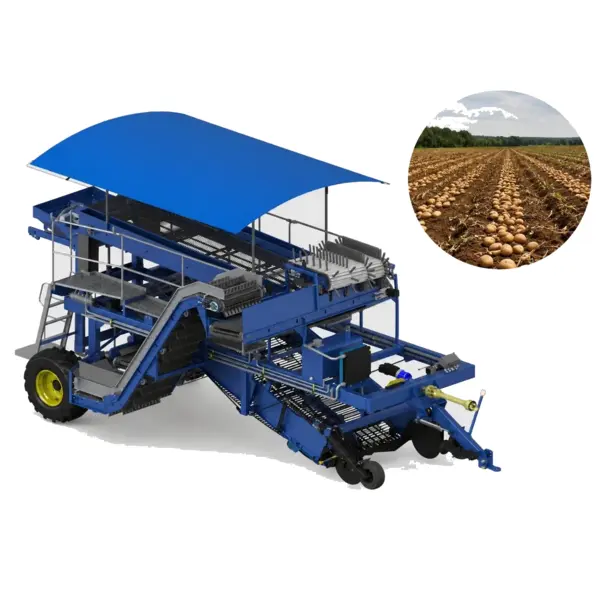
The EP-AWB potato harvester series completes the Korean highland potato production system: stone cleared by the THOR 2.4 rock crusher, seed bed prepared by the PSW-3200, planted by the EP-PAI-2100 or EP-PANTHER, hilled by the EP-ERA, and finally harvested by the EP-AWB. The harvester is the machine that converts months of field work into saleable product — and the harvester’s gentleness with the tuber at collection is the final quality gate before the Grade 1 proportion is confirmed.
Two models serve different farm scales: the EP-AWB-1600 (2-row mounted, 75 HP) for highland terrace farms in the 5–15 ha range, and the EP-AWB-3200 (4-row trailed, continuous belt elevator) for commercial-scale operations above 20 ha. The comparison is not simply about row count — the mounted vs trailed configuration, the harvest window capacity implications, and the stone-cleared field performance differences between the two models each affect which is the right choice for a specific Korean highland farm. This guide covers all of them.
Confirmed Specifications — EP-AWB-1600 and EP-AWB-3200
All specifications are confirmed from the official Watanabe product brochure. Both models carry Korean agricultural machinery certification and are eligible for the MAFRA subsidy programme.
Belt Elevator Mechanism — Why Gentleness at Collection Determines Grade 1
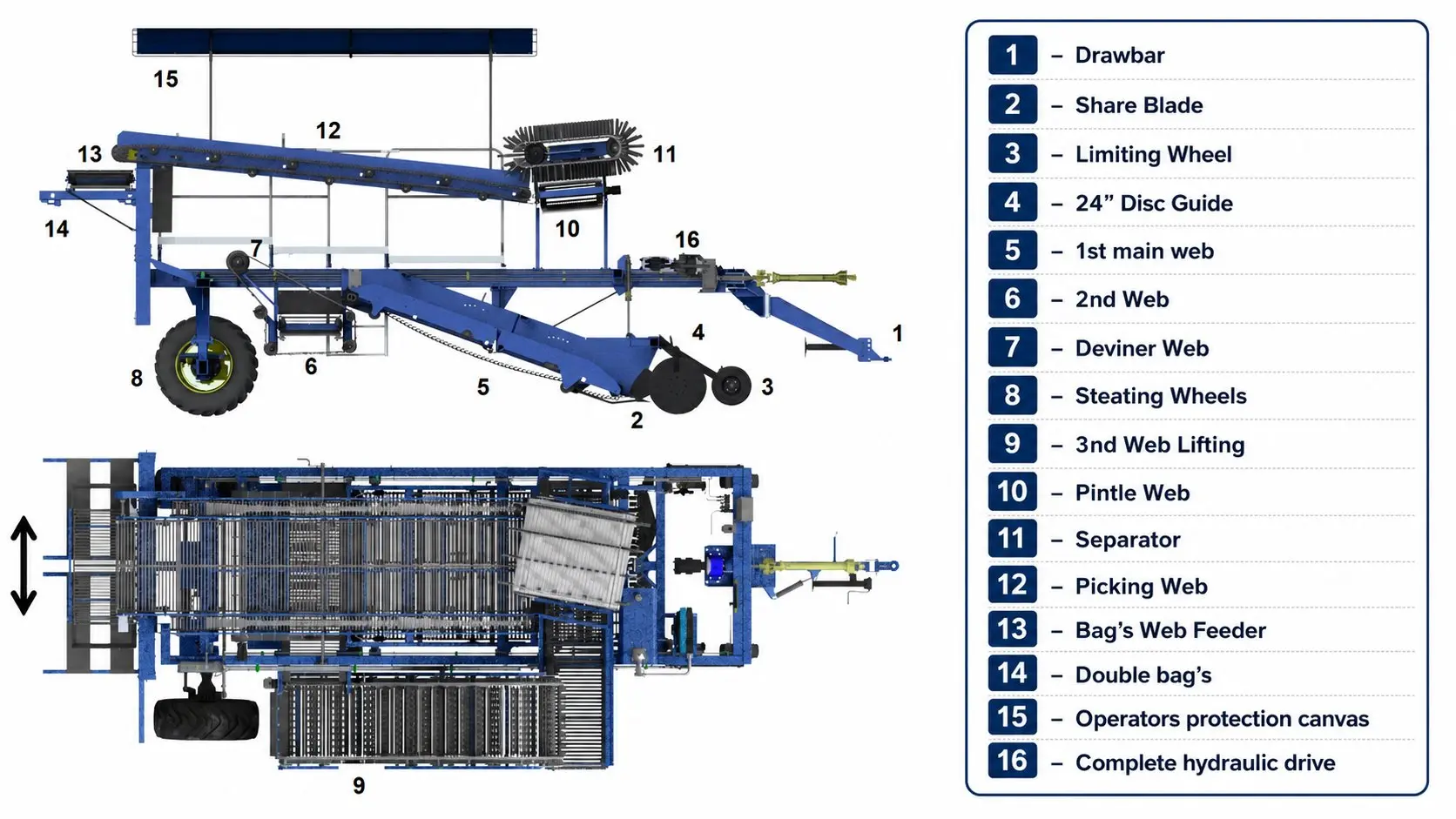
The EP-AWB’s continuous belt elevator is the feature that distinguishes it from web-type potato harvesters common in older Korean highland operations. The engineering difference is not subtle — it directly determines the skin condition of every tuber at the collection point, and skin condition at collection is the quality attribute that determines cold storage success or failure for Dubaek, and Grade 1 eligibility for all highland varieties.
EP-AWB Belt Elevator — Tuber Transfer Path Cross-Section
The practical consequence of the belt elevator design: EP-AWB-harvested Dubaek potato on a stone-cleared Korean highland field consistently achieves the skin condition score required for the 8–10 month cold storage programme. The same Dubaek variety harvested with a web-type harvester on the same cleared field produces measurably lower skin scores — not because the tubers are less well-grown, but because the mechanical handling at collection creates the micro-abrasions that become skin defects under cold storage conditions.
The Harvest Window — Why Throughput Capacity Is a Quality Decision, Not Just Efficiency
The Korean highland potato harvest window — the period between skin set completion and the onset of late-season quality decline — is approximately 18–22 days at typical Gangwon-do highland altitudes (600–800 m, July–August harvest). Every day outside this window costs Grade 1 proportion:
Skin fully set. Grade 1 proportion at peak (88–94% on cleared fields). Optimum harvest period. Any harvester completes small areas without quality risk.
Skin begins thinning in high-temperature conditions (daytime 28°C+ at low altitude). Late-planted areas or areas not yet harvested start accumulating sun scald and heat-stress skin defects. Grade 1 proportion drifts downward at approximately 1–2% per day of delay past Day 8 at 650m altitude in August heat.
Late monsoon rain risk. August rainfall events (50–100 mm per event) push tubers toward secondary growth — the tuber re-sprouts after rain exposure, cracking the skin. Cracked skin is a Grade 2 or Grade 3 defect that immediately disqualifies cold storage and reduces harvest revenue to cooperative bulk pricing.
Daily Throughput Comparison — How Many Days to Complete Harvest?
Days Required to Complete Harvest — at 3.5 ha/day vs 7 ha/day effective rate
EP-AWB-3200: 0.7 days
EP-AWB-3200: 1.4 days
EP-AWB-3200: 2.1 days
EP-AWB-3200: 2.9 days
EP-AWB-3200: 4.3 days
Based on 3.5 ha/day (EP-AWB-1600) and 7.0 ha/day (EP-AWB-3200) effective daily coverage. Actual rates vary with field size, terrain, and weather breaks.
The throughput table shows why the EP-AWB-1600 / EP-AWB-3200 decision is not purely about row count — it is a harvest window risk decision. For farms above 15 ha, the EP-AWB-1600’s coverage rate produces an unacceptable probability of missing the optimal harvest window in a Korean highland August heat event or extended monsoon period. The EP-AWB-3200’s higher coverage rate provides the buffer needed to complete harvest within the quality window even if 2–3 days are lost to weather or mechanical delay.
Stone Contact Bruising — The Chain From Un-Cleared Field to Storage Failure
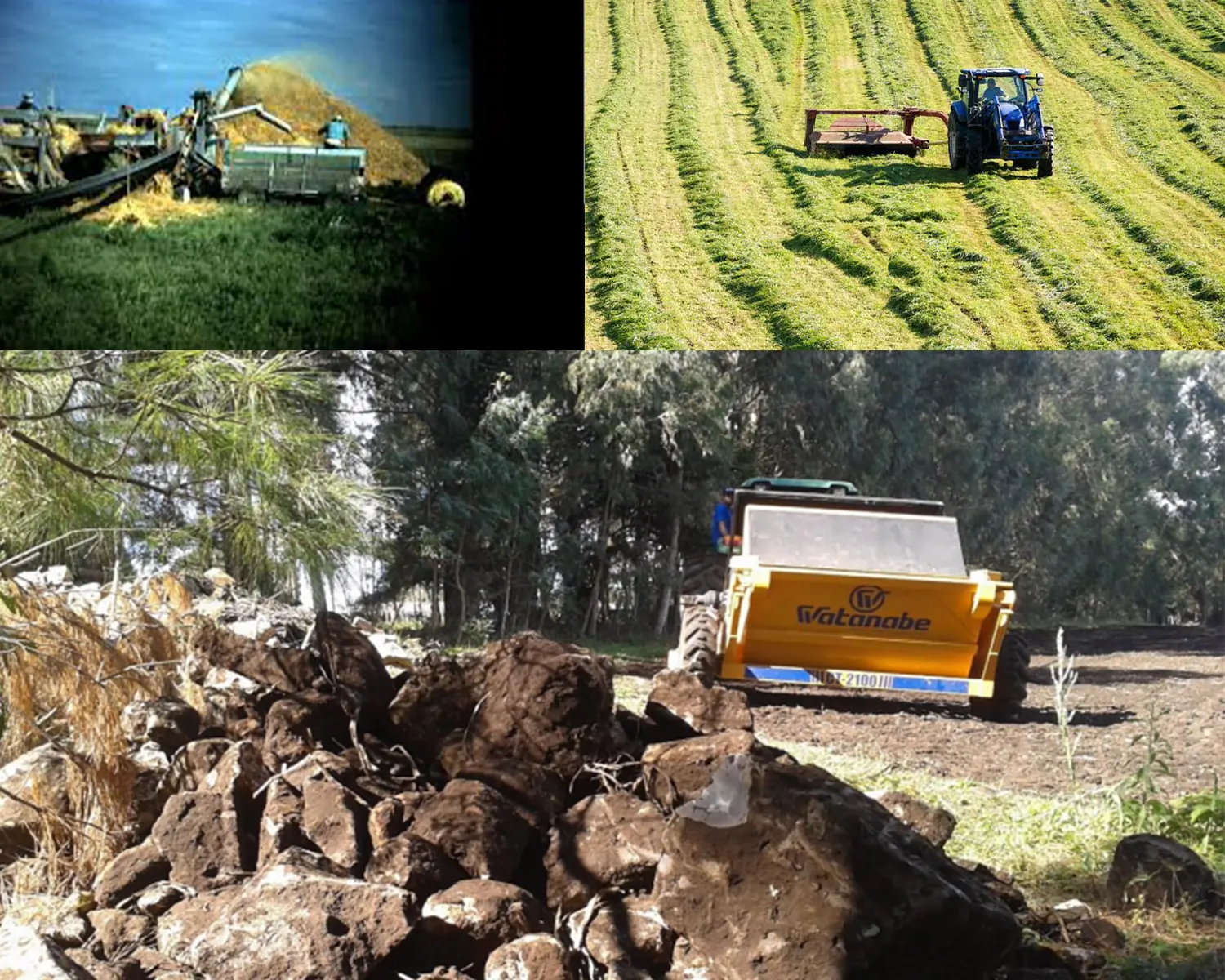
One of the most important but least discussed benefits of Korean highland stone clearing is what it prevents at harvest — not during cultivation. The stone contact bruising chain is the sequence of events that converts a Grade 1 tuber on an un-cleared field into a Grade 2 or storage failure before the tuber reaches the buyer.
Harvest Timing Decision Matrix — When to Start, When to Wait, When to Prioritise
| Soil temp (10 cm) | Skin set stage | Dubaek — cold storage | Sumi — direct market | Atlantic — processing |
|---|---|---|---|---|
| Below 15°C | Incomplete | ⚠ WAIT — skin tears on harvest if not fully set. Wait minimum 3 more days. | ⚠ Wait — skin damage risk high | ⚠ Wait — DM still accumulating |
| 15–20°C | Approaching set | ⚠ Test vine kill first. Delay 7 days post-vine kill before harvest. | ✅ Begin harvest — acceptable skin condition | ✅ Begin — DM sufficient |
| 18–22°C | Fully set | ✅✅ OPTIMAL — harvest all Dubaek immediately. Belt elevator EP-AWB essential. | ✅✅ Optimal Grade 1 window | ✅✅ Peak DM content |
| Above 25°C | Peak + heat stress | ❌ Harvest NOW if not already started — heat damage accumulates rapidly. Accept some unripe blocks rather than risk whole-field loss. | ⚠ Begin immediately — heat defects building daily | ⚠ Harvest or DM starts declining |
| Rain event >30mm | Secondary growth risk | ❌ DELAY 48 hrs after rain stops. Wet soil destroys belt elevator function + secondary growth starts if exposed tubers remain in wet ridge. | ❌ Delay 48 hrs — machine damage risk in wet soil | ❌ Delay — wet conditions degrade DM |
Planter–Harvester Row-Spacing Matching — The Most Common System Error
The most common system configuration error in Korean highland potato machinery is a mismatch between the planting row spacing set on the EP-PAI-2100 and the harvesting row spacing set on the EP-AWB. Both machines must be configured to the same row spacing, measured in centimetres at the ridge centreline.
Row-Spacing Confirmation Checklist — Before First Season Use
Frequently Asked Questions
What is the best potato harvester for Korean highland tractor use — EP-AWB-1600 or EP-AWB-3200?
For Korean highland farms up to 15 ha planting area, the EP-AWB-1600 is the appropriate choice — its Cat.2 mounted configuration suits the terrace dimensions and 75 HP tractor requirements common on Korean highland family farms, and its 3–4 ha/day coverage rate completes 15 ha within the 4–5 day effective harvest window. For farms above 15 ha, the EP-AWB-3200 is recommended because its 6–8 ha/day coverage ensures harvest completion within the 18–22 day quality window even with weather interruptions. The belt elevator mechanism is the same in both models — the quality protection of the continuous belt surface applies equally to both choices. The selection is a throughput-capacity decision, not a quality decision.
How does stone clearing change the EP-AWB harvester’s operating efficiency on Korean highland fields?
Stone clearing improves EP-AWB harvester operating efficiency in three specific ways. First, it eliminates the digging blade deflection events that occur when the blade contacts embedded stones — on un-cleared fields at medium stone density (5–10 kg/m²), blade deflection events occur every 2–5 metres of travel and produce the tuber impact damage described in the bruising chain section. Second, it eliminates the stone material that rides the separation web alongside the tubers — on un-cleared fields, the web must be run at slower agitation speed to reduce stone-on-tuber abrasion, reducing effective throughput by 15–25%. Third, it reduces the maintenance requirement on the digging blade and picking web — stone contact accelerates blade edge wear and chain link wear at 3–4× the rate on stone-cleared fields. The combination of throughput improvement and reduced wear parts cost makes stone clearing an EP-AWB harvester operating cost reduction, not just a crop quality improvement.
Can the EP-AWB-1600 harvest Dubaek potato for cold storage on Korean highland slopes above 12%?
Yes — the EP-AWB-1600’s Cat.2 mounted configuration maintains the correct operating angle relative to the ridge profile on Korean highland slopes up to approximately 15% gradient, which covers the majority of Korean highland terrace farming terrain. Above 15% gradient, the mounted machine’s attitude angle changes relative to the horizontal, which can cause the digging blade to either dig too shallow on ascending passes or too deep on descending passes. Korea Watanabe recommends: on slopes above 12%, always harvest in the uphill direction to maintain consistent blade depth; configure the blade depth stop to compensate for the angle change at your specific field gradient; and on the steepest sections, reduce forward speed to 2 km/h to allow the blade depth to stabilise before each new row engagement. For Dubaek cold storage harvest specifically — where skin condition is the primary quality attribute — the reduced speed approach on steep sections is worth the throughput reduction to maintain the skin quality that cold storage requires.
Does the EP-AWB harvester qualify for the Korean agricultural machinery subsidy in 2026?
Yes — both the EP-AWB-1600 and EP-AWB-3200 carry Korean agricultural machinery certification and qualify for the MAFRA 2026 potato and root crop machinery subsidy category. The subsidy rate for harvesting machinery in the 2025–2026 programme cycle is typically 30–40% of the certified purchase price, subject to county quota availability. As discussed in Korea Watanabe’s subsidy guide, the EP-AWB harvester is most effectively purchased as the Stage 3 machinery acquisition in a 3-year combined purchase strategy — after the stone clearing system (Stage 1) and soil preparation system (Stage 2) are already in place and generating the cleared-field revenue improvement that funds the Stage 3 potato machinery investment. Contact Korea Watanabe — see the CT-2100 rock picker guide too — for the 2026 EP-AWB subsidy confirmation for your specific county and the combined planter + harvester subsidy strategy if purchasing both the EP-PAI-2100 and EP-AWB-1600 in the same application cycle.
How is the EP-AWB-3200 row spacing configured to match the EP-PAI-480-AR planter for commercial 4-row production?
The EP-PAI-480-AR planter and EP-AWB-3200 harvester must be configured to the same row spacing — measured at the ridge centreline — before the first planting season of the matched system. The EP-PAI-480-AR planter uses fixed-spacing mechanisms for its 4-row configuration; confirm the exact spacing dimension from Korea Watanabe at the time of purchase. The EP-AWB-3200’s four digging blades are set to match this planting spacing using the adjustable blade mount positions. Korea Watanabe performs the matched-system configuration verification for any combined EP-PAI-480-AR + EP-AWB-3200 purchase, confirming both machines are configured to the same row spacing standard before delivery. The matched-system approach eliminates the configuration mismatch error that is one of the most common causes of mechanical tuber damage during the first commercial-scale harvest season.
Complete Harvest System — EP-AWB Matched to Your Planter and Field Scale
Farm area + current planter model + row spacing + altitude + storage plan → Korea Watanabe confirms the correct EP-AWB model, row-spacing configuration, harvest timing window and 2026 subsidy strategy for your complete Korean highland potato system.
Editor: Cxm