
The EP-AWB-1600 potato digger is the Step 7 machine in the Watanabe 7-step Korean highland potato system — the mounted 2-row potato digger that lifts tubers from the harvest ridge, separates them from soil through the vibrating web separator, and deposits them for collection. Harvest is the point at which the season’s stone clearing, tillage, planting, hilling, and growing investment is converted into a marketable product — or damaged, if harvest setup and timing is incorrect.
This guide covers the complete operational setup for the EP-AWB-1600 in Korean highland conditions — from pre-harvest readiness checks through share depth setting, collection system selection (Kit A, B, or C), working speed, and the management of the compressed Korean highland harvest window before first frost.
EP-AWB-1600 Confirmed Specifications
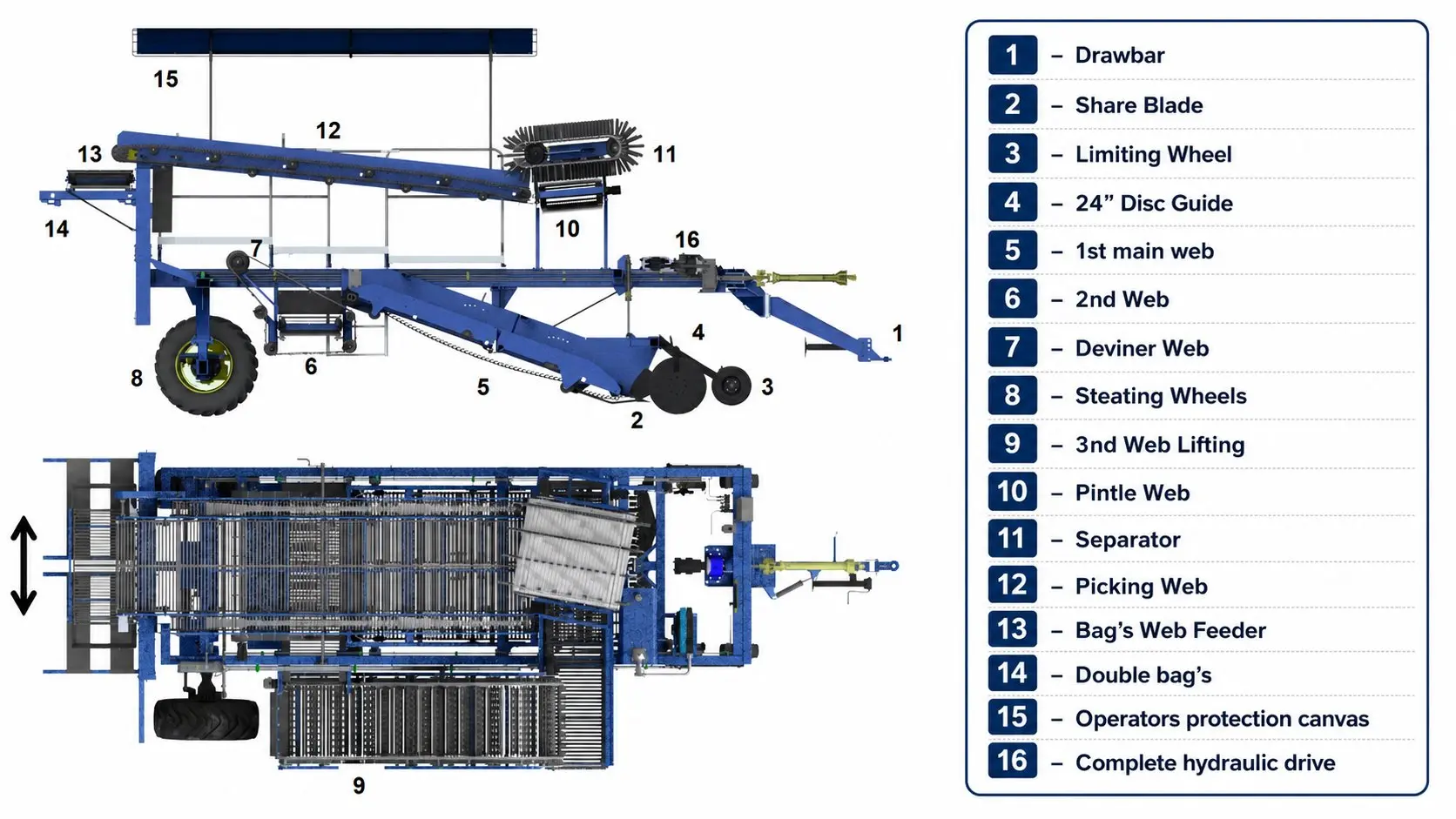
All specifications from the Watanabe official product brochure.
Kit A, B, and C — Selecting the Right Collection System
The EP-AWB-1600’s Kit options determine how harvested tubers are collected after the vibrating web separator — this is the selection that matches the machine to the market supply chain:
Kit A
Side Deposit — Field Windrow
Tubers are deposited at the side of the machine in a field windrow for subsequent manual picking, tractor-loader pick-up, or follow-on collection equipment. Simplest configuration, lowest capital requirement. Appropriate for small operations where hand-picking from the windrow is the collection method, or for farms that use a separate collection vehicle to follow the digger in a second pass. On stone-cleared fields, the windrow is clean — on un-cleared fields, stone contamination of the tuber windrow from share-deflected stones is a significant additional sorting labour cost.
Kit B
Rear Elevator — Into Trailer or Collection Cart
Tubers are elevated by a cross-conveyor from the vibrating web to a rear discharge elevator that deposits them into a collection cart or trailer towed behind the EP-AWB-1600. This continuous-flow system allows uninterrupted harvesting across the full field without stopping for windrow collection. The collection cart is exchanged when full (typically every 300–500 m of field length). Kit B is the standard configuration for Korean highland fresh market and cooperative supply operations where tractor-trailer collection is the logistics model.
Kit C
Extended Elevator — For Higher-Volume Collection
Kit C provides an extended rear elevator with greater discharge height — suitable for loading into truck beds or larger bulk containers directly. Reduces handling steps between field and storage by allowing direct loading from the digger to the transport vehicle. On Korean highland farms where trucks access the field headland, Kit C enables the most efficient harvest-to-storage logistics chain — combined with the CT-2100 for autumn post-harvest field management with minimal intermediate handling that could cause tuber bruising.
Pre-Harvest Readiness — The Three Confirmations Before Starting
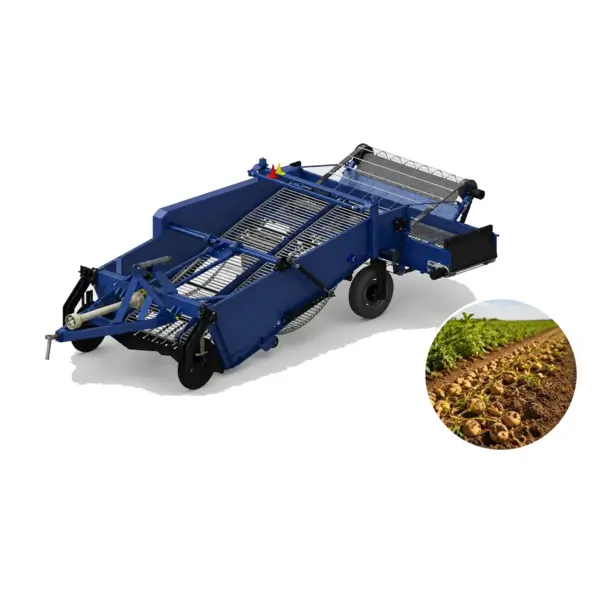
Three readiness checks must be completed before the EP-AWB-1600 begins its first harvest pass — skipping any of these produces correctable or irreversible problems that reduce harvest quality or require mid-harvest intervention:
Working Speed and Tuber Damage — The Trade-Off
Working speed is the variable that most directly determines tuber bruising rates. Every velocity increase in the EP-AWB-1600’s forward speed increases the velocity at which harvested tubers contact the vibrating web, the chain links, and each other during the separation process. Higher contact velocity = higher bruising rate. The optimal working speed balances daily coverage area against acceptable bruising for the target market:
| Working speed | Daily coverage | Bruising risk |
|---|---|---|
| 1.5–2.0 km/h (slow) | 2–3 ha/day | Lowest — recommended for fresh market Grade 1, seed potato |
| 2.0–3.0 km/h (standard) | 3–5 ha/day | Moderate — acceptable for cooperative fresh market supply |
| Above 3.5 km/h (fast) | 5–7 ha/day | Higher — suitable only for processing supply where bruising is less critical than fresh market |
The frost deadline creates pressure to harvest faster than the tuber bruising optimum allows. The management strategy: harvest the lower-altitude fields first (they mature earlier and first-frost risk is lower) at the brusing-optimal slower speed, then accelerate on higher-altitude fields as frost risk approaches while accepting higher bruising on those lots. Routing the faster-harvested, higher-bruising lots to processing supply and the slower-harvested, lower-bruising lots to fresh market segregates quality outcomes by harvest speed.
Vibrating Web Separator — Setup and Soil Condition Adjustments
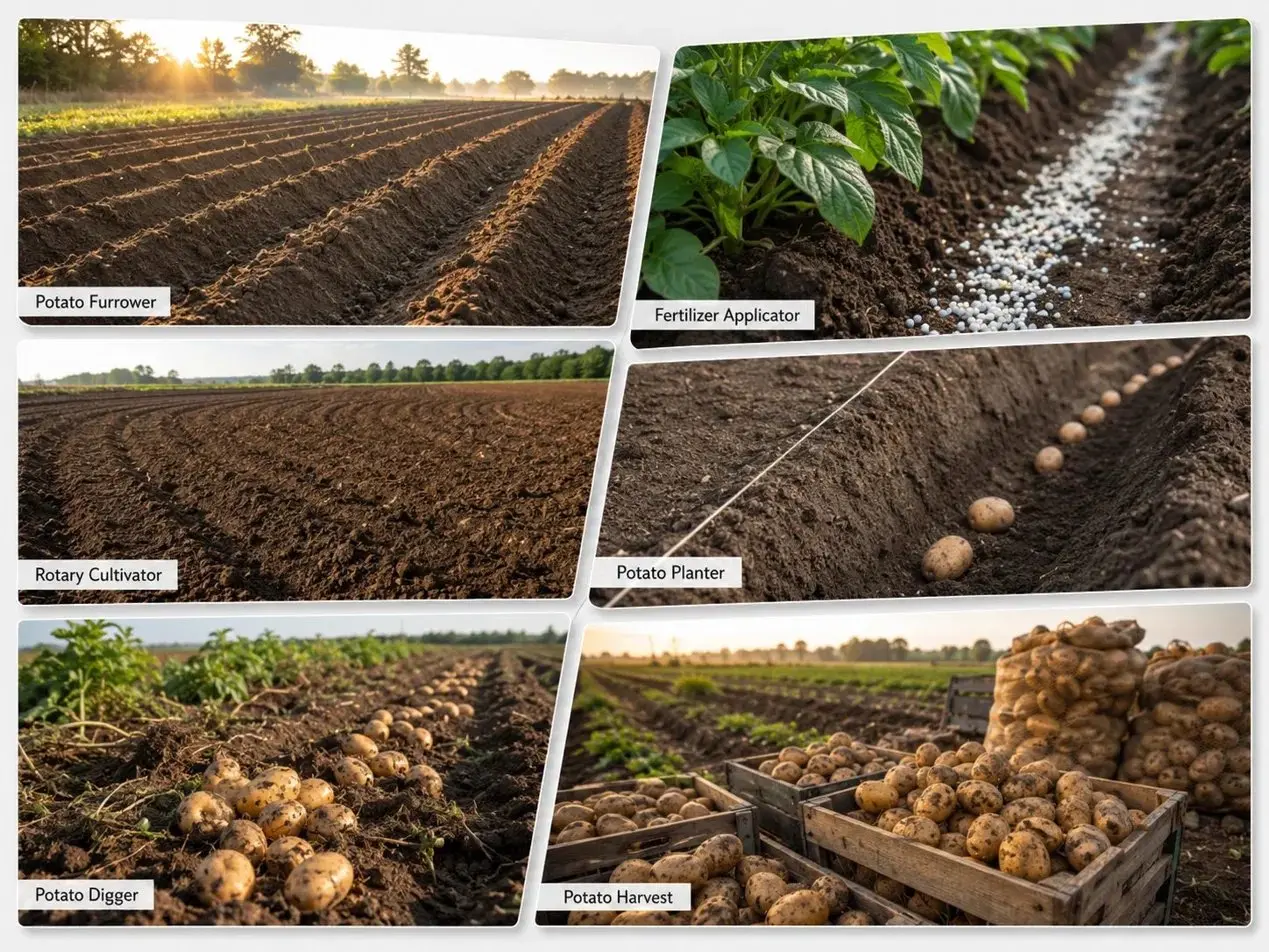
The vibrating web separator is the component that separates soil from tubers as the lifted ridge material passes over it. Web vibration frequency and amplitude, combined with forward speed, determine how efficiently soil falls through the web while tubers are retained. The web setup must be adjusted for the specific soil conditions at harvest:
Dry, friable soil (ideal)
Standard web vibration. Soil separates quickly from tubers with minimal web loading. Working speed can be at the upper end of the target range. Web clogging is not a risk. Stone-cleared field soil at the correct moisture for harvest passes through the web cleanly, leaving tubers well-separated for collection.
Moist or clay-rich soil
Reduce forward speed — wet soil clods are heavier and load the web more slowly. Increase web vibration amplitude where adjustable. On stone-cleared fields, moist soil separation is manageable. On un-cleared fields, moist soil clods mixed with stone fragments create combined heavy loads that progressively overload the web and reduce separation efficiency.
Wet or post-rain harvest
Reduce speed to minimum (1.5 km/h). Wet soil is the most challenging condition for the vibrating web — heavy, sticky clods clog the web chains. If web clogging begins (visible accumulation of soil on the web between passes), stop and clean the web manually before the clogging causes web chain damage. Post-rain harvest should be delayed at least 24–48 hours after significant rainfall to allow surface drying.
When to Choose the EP-CWB-2L Instead — Big Bag vs Conventional Harvest
The EP-CWB-2L big bag harvester (2-row, in-field FIBC 500 Kg packing, grading system) is the alternative to the EP-AWB-1600 for specific market supply chains. Understanding when to choose the EP-CWB-2L over the EP-AWB-1600 requires understanding the market supply chain:
| Supply chain | EP-AWB-1600 | EP-CWB-2L |
|---|---|---|
| Fresh market (cooperative consignment) | ✅ Standard choice | Can be used |
| Processing supply (Atlantic to crisp manufacturer) | Can be used | ✅ Preferred — lot traceability per bag |
| Certified seed potato (NAAS traceability) | Can be used with manual lot segregation | ✅ Preferred — per-bag field and lot ID |
| Direct graded sale (premium market) | Requires post-harvest grading facility | ✅ Built-in grading system in field |
| Small farm (<5 ha) | ✅ Lower capital cost | Higher capital cost vs EP-AWB-1600 |
Post-Harvest Field Management — What Happens After the EP-AWB-1600 Finishes
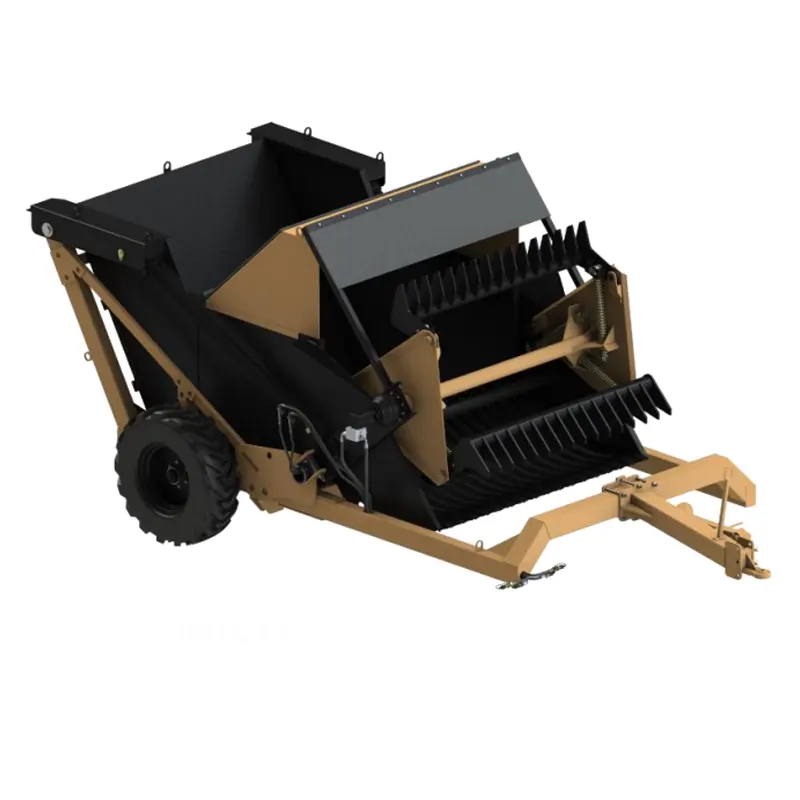
The EP-AWB-1600’s final pass completes the harvest season — but field management does not stop at harvest. The post-harvest field condition affects next season’s stone clearing and spring preparation calendar significantly:
①
Surface stone check after harvest: The EP-AWB-1600 share occasionally deflects small stones to the surface that were previously embedded. Walk the field after harvest and assess whether any newly surfaced stones are above the rake collection threshold. If so, a quick EP-EW-4000 rake pass before autumn PSW-3200 tillage removes them before they can become a problem for the following spring.
②
Haulm incorporation timing: The potato haulm (vine) remaining after mechanical harvest contains organic matter and nutrients. Incorporate it into the autumn PSW-3200 tillage pass within 2–4 weeks of harvest completion — before it dries out completely and becomes difficult to cut with the rotavator blades. Early incorporation starts decomposition before winter, releasing nutrients for the following spring’s crop.
③
Autumn stone clearance window: The period between harvest completion (September–October) and ground freeze (November–December) is the optimal window for autumn THOR stone clearance — removing the full clearance requirement from the compressed spring calendar. Fields where the EP-AWB-1600 has indicated heavier stone conditions at harvest (through share deflection events or irregular harvest depth) are priority candidates for autumn THOR clearance before the next rotation cycle begins.
The EP-AWB-1600 is therefore not just a harvest machine but an annual soil condition monitor — the operator’s experience each harvest season (where stone contacts occurred, where depth was inconsistent, which field sections had the highest web loading) provides the most accurate guide to the following year’s stone clearing schedule. Experienced Korean highland potato farmers treat the harvest pass as an annual field assessment that directly informs the autumn THOR management plan.
Complete potato harvest system — Korea Watanabe Korean local stock: The EP-AWB-1600 potato digger (Kit A, B, or C configuration), EP-CWB-2L big bag harvester, and all accessory parts are available from Korea Watanabe at Ansan-si, Gyeonggi-do with standard 5–10 business day delivery. Both machines hold current Korean agricultural machinery certification qualifying for 30–50% government subsidy. Korea Watanabe prepares all documentation for the application process. Contact us in January for the upcoming season to confirm configuration and initiate the subsidy documentation process before the spring planting and summer growing season that precedes the August harvest window.
Harvest Logistics Planning — The Three-Vehicle System for Efficient Daily Coverage
The EP-AWB-1600’s 3–5 ha/day harvest rate generates significant daily collection volume — typically 90–150 tonnes of potatoes on a 30 t/ha yield field. Planning the collection logistics to match this rate prevents the most common Korean highland harvest inefficiency: the digger stopped, waiting for collection. A structured three-vehicle approach maximises the EP-AWB-1600’s productive field time:
This three-vehicle system keeps the EP-AWB-1600 moving continuously — its limiting factor is forward speed and tuber bruising tolerance, not collection capacity. Korean highland farmers who have implemented this logistics system report 25–40% improvement in daily harvested area compared to operating the digger with a single trailing collection vehicle and waiting for it to return after each load.
Tuber Quality Protection — How Stone Clearing Reduces Bruising at Harvest
The connection between stone clearing quality and post-harvest tuber bruising rate is direct and quantifiable. Tuber bruising occurs when individual tubers receive mechanical impact exceeding the potato cell wall’s elastic limit — the point at which cellular damage occurs, producing the brown discolouration beneath the skin that reduces Grade 1 classification and accelerates storage deterioration. Stone-cleared fields reduce bruising through three mechanisms:
Mechanism 1: No stone-to-tuber contact
On stone-cleared fields, the EP-AWB-1600 share lifts soil and tubers without stone fragments entering the soil stream. No hard stone surfaces in the lifted material means no high-energy tuber-to-stone impacts in the web separator zone. This eliminates the most severe bruising category — the direct impact bruise from stone contact that produces large, deep brown areas affecting significant proportions of the tuber surface.
Mechanism 2: Consistent share travel
Stone deflection of the share on un-cleared fields produces sudden depth changes and brief deceleration events that throw tubers against the web at higher-than-intended velocity. Consistent share travel on stone-cleared soil maintains tubers in a steady, predictable flow through the web separator — reducing the velocity variability that produces bruising even without stone contact.
Mechanism 3: Web separator free-flow
A clean, stone-free soil stream allows the vibrating web to run at optimal separation efficiency — tubers flow smoothly across the web without congestion. Stone accumulation on the web (from un-cleared fields) creates local congestion zones where tubers pile up and contact each other at elevated velocity — producing tuber-to-tuber bruising in addition to stone-contact bruising.
Korean highland studies consistently show that stone-cleared field potato harvest produces 15–30% lower bruising rates than un-cleared field harvest at the same working speed and soil moisture conditions. For fresh market potato where bruising is a Grade 1 disqualifier, this difference directly translates to 15–30% more Grade 1 tubers reaching the market from every harvested hectare — a revenue improvement that compounds the yield and grade benefits of stone clearing described in the stone clearing ROI article.
EP-AWB-1600 Maintenance Between Seasons — Keeping Harvest Readiness
Unlike the THOR 2.4 and PSW-3200 which are used intensively in spring, the EP-AWB-1600 operates in a concentrated August–September harvest window after 5–6 months of storage since the previous season. Pre-season maintenance before harvest — not just before spring — is essential because a machine with a failed bearing or worn share discovered at the start of harvest creates a repair delay during the compressed harvest window rather than during the less critical winter storage period.
July pre-harvest service:
One month before harvest — complete service on all bearings (grease all nipples); inspect and replace share if at or below 60% of new tip profile; test web vibration mechanism; check chain tension and chain wear; confirm hydraulic hose condition on Kit B/C elevator.
During harvest (every 8 hours):
Grease bearing nipples; check share for stone impact damage after any confirmed stone contact event; inspect elevator chain tension on Kit B/C.
Post-harvest (October) storage preparation:
Pressure wash all soil from web, chain, and share zones; grease all bearing points; apply anti-corrosion spray to share; store in dry shed. Replace any borderline share or chain section identified during harvest — do not begin the following year’s harvest season without replacing items that showed excessive wear in the current season.
Frequently Asked Questions
How does the EP-AWB-1600’s performance differ between stone-cleared and un-cleared fields?
The performance difference is significant and measurable. On stone-cleared fields: shares travel through stone-free soil with consistent resistance, maintaining constant depth and share tip integrity. Tubers arrive at the vibrating web with minimal stone contamination in the soil stream — the web separates cleanly and tubers accumulate undamaged on the collection elevator. On un-cleared fields: embedded stones deflect the share intermittently, producing variable harvest depth and stone-to-tuber contact in the share path. The vibrating web handles mixed stone-and-soil loads — stone fragments cannot fall through the web like soil particles, accumulating on the web and progressively reducing effective soil separation. Periodic manual stoppages to clear stone accumulation from the web are required on un-cleared fields, reducing daily harvest coverage by 20–35% compared to stone-cleared field operation.
What is the recommended haulm destruction timing before EP-AWB-1600 harvest?
Haulm destruction (vine killing, ) should be performed 2–3 weeks before the target harvest date to allow skin set development. Haulm destruction methods: chemical (desiccant herbicide application) or mechanical (flail mowing). Chemical desiccation is faster and more complete — the entire vine is killed simultaneously, triggering uniform skin set development across all plants in the field. Mechanical mowing leaves some stub tissue that can slow skin set on some root connections. For Korean highland certified seed potato (where complete skin set is most critical), chemical desiccation 2–3 weeks before harvest is strongly preferred. Confirm the haulm destruction timing against the 10-day frost forecast — if frost is predicted within 10 days of the planned vine destruction date, accelerate the vine destruction timeline so skin set is complete before potential frost damage.
What causes the vibrating web to clog on Korean highland granite soils?
Web clogging on Korean highland fields is caused by three factors: (1) residual stone fragments from un-cleared fields — granite fragments above 2–3 cm lodge between web chain links and do not fall through like soil particles, progressively blocking the web. (2) Wet clay-silt soil during wet harvest conditions — Korean highland silt-rich soils become sticky when wet, adhering to web chains rather than falling through. (3) Large organic matter chunks from incorporated green manure or crop residue in the soil — incompletely decomposed plant material forms mats on the web surface. Prevention: stone clearing to eliminate (1); delay harvest 24–48 hours after rainfall to reduce (2); complete green manure incorporation 6+ weeks before harvest to allow decomposition and reduce (3).
Can the EP-AWB-1600 harvest on slopes above 10% — what are the operational limitations?
The EP-AWB-1600 can harvest on Korean highland terrace slopes up to approximately 15%. Above this gradient, the share cutting angle relative to horizontal changes enough to affect tuber lifting completeness — on steep uphill harvesting passes, the share angle may leave deeper tubers in the ground. Additionally, the collection elevator discharge angle and Kit B/C elevator geometry are designed for level field operation — excessive slope may affect the smoothness of tuber flow through the collection system. For harvesting on slopes above 12–15%, harvest along the slope contour (across rather than up and down) where the lateral gradient presents lower harvesting angle challenges, while confirming that the tractor’s side-slope stability allows safe cross-slope operation with the combined EP-AWB-1600 weight.
What is the maintenance schedule for the EP-AWB-1600 shares between seasons?
EP-AWB-1600 shares are high-wear items that should be inspected before every harvest session and replaced at the end of each season if wear is significant. Share wear indicators: reduced cutting tip sharpness (increased draft force on the same soil), visible tip rounding or chipping, or any crack in the share body from stone impact. On stone-cleared fields, share wear is primarily from soil abrasion — typically requiring replacement every 1–2 seasons at 5–15 ha/season scale. On un-cleared fields, stone impacts accelerate share wear significantly — replacement may be required mid-season on heavy-stone un-cleared fields. Korea Watanabe holds replacement share sets for the EP-AWB-1600 in Korean local stock. Order replacement shares in January before the season to ensure delivery before the August–September harvest window.
Potato Harvest System — EP-AWB-1600 or EP-CWB-2L for Your Supply Chain
Target market (fresh market / processing / seed) + farm area (ha) + existing tractor HP → Kit selection recommendation with collection logistics planning guidance. Korea Watanabe, Ansan-si, Gyeonggi-do.
Editor: Cxm