Korean fruit orchards — apple (사과, dominant in North Gyeongsang’s Yeongcheon-si, Cheongsong-gun, and Andong-si; Gangwon-do’s Yangyang-gun), pear (배, South Gyeonggi and South Chungcheong), and persimmon (감, South Gyeongsang’s Gimcheon, Sangju, and Miryang regions) — are established on mountain and foothill terrain that shares the same granite and basalt geology as Korean highland crop farms. Surface stone management in these orchards presents a specific set of constraints that require a different approach from open crop field stone clearing.
Three constraints define orchard stone clearing and separate it from crop field applications: the permanent tree row structure that limits machine working width and turning radius; the established root system that cannot be disturbed by deep tine penetration or rotor working depth; and the sloped terrain that requires slope-capable machine configuration throughout the orchard alley network. Understanding these constraints is essential before selecting equipment and designing the stone clearing approach for a Korean commercial orchard.
Three Constraints That Define Orchard Stone Clearing
Constraint 1: Permanent Tree Rows
Tree row-to-row spacing in Korean commercial orchards is typically 4.0–6.0 m for apple (spindle/central leader training) and 5.0–7.0 m for pear (Y-trellis and open centre). The working machine must operate within the alley between tree rows without contact with the tree trunk or low-hanging branches. A 3.6 m wide stone crusher operating in a 4.0 m alley leaves only 20 cm clearance each side — requiring precise tractor tracking. Orchards with alleys below 3.0 m width are inaccessible to standard stone crusher working widths without equipment modification.
Constraint 2: Established Root Zone
Korean apple, pear, and persimmon tree root systems spread laterally from the trunk throughout the orchard alley — particularly in mature orchards above 10 years of age. Root density in the surface 15–20 cm of the alley soil increases with orchard age. Stone crushing at 20–30 cm rotor penetration depth in a mature orchard alley causes root severance that can stress the tree, particularly in dry seasons when root damage reduces water uptake. Orchard stone clearing must be shallower than crop field clearance — rotor or tine penetration depth should stay within 10–15 cm in established orchards.
Constraint 3: Sloped Terrain
Korean orchard alleys on mountain and foothill terrain regularly have gradients of 10–25%. Standard rear three-point hitch implement mounting at machine weights of 2,000–2,300 Kg on these gradients creates the front-axle lift and steering stability issues described in the Kit Drawbar guide. Orchard stone clearing on gradients above 15% requires the THOR 2.4 in Kit Drawbar pull-mode — the same configuration required for highland crop field use — to maintain front-axle steering control throughout the orchard alley working pass.
The Orchard Stone Clearing Approach — Stage by Stage
Stage 1 — New Orchard Establishment Clearance
The most comprehensive stone clearing opportunity in an orchard’s life occurs before tree planting — while the site is still open crop land or scrubland with no tree root restriction and no width constraint from permanent tree rows. This pre-planting clearance window should be used to achieve the most thorough stone removal possible, because subsequent clearance around established trees will always be limited by root zone and alley width constraints.
Pre-planting clearance — use full crop field sequence
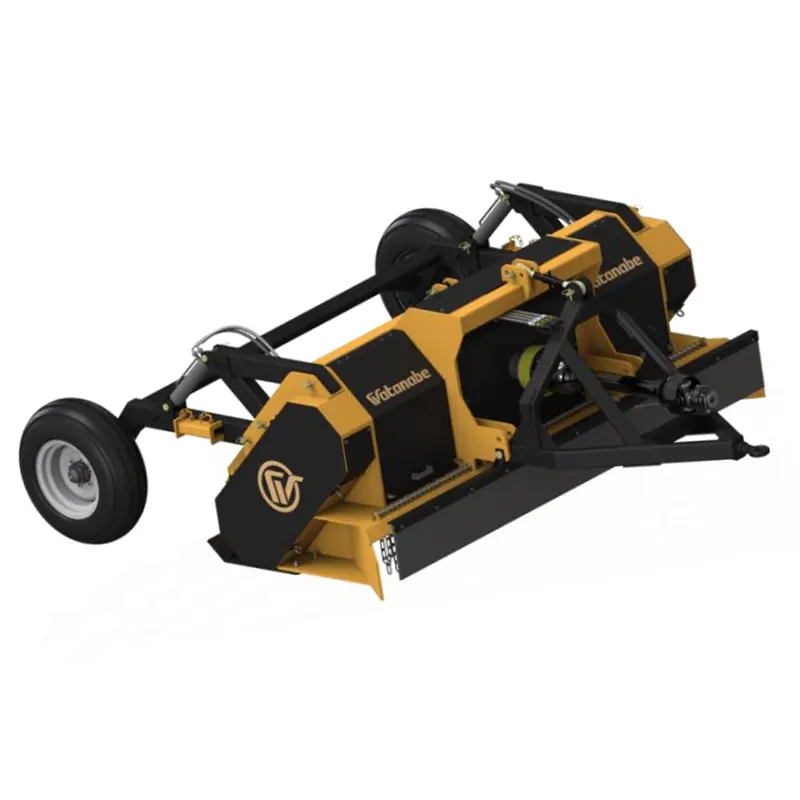
Before trees are planted: THOR 2.4 stone crusher (180 HP, Kit Drawbar for slope) → CT-2100 rock picker (110 HP, 2.5 m³ bunker). This sequence clears embedded boulders that will become permanently inaccessible once trees are planted and root systems develop. An investment in thorough pre-planting clearance reduces the scale of stone management needed throughout the orchard’s productive life — which in Korean commercial orchards is 20–30+ years for apple, 25–40 years for pear.
Stage 2 — Young Orchard Clearance (First 3–5 Years After Planting)
In the first 3–5 years after planting, tree root systems are still concentrated near the planting hole and have not yet spread extensively through the alley soil. This window allows somewhat deeper stone management (down to 15–20 cm rotor penetration) than is possible in mature orchards, while the tree row structure already limits working width to the alley dimension. For frost-heave stones that have emerged in the alley during the first winters after planting:
- →
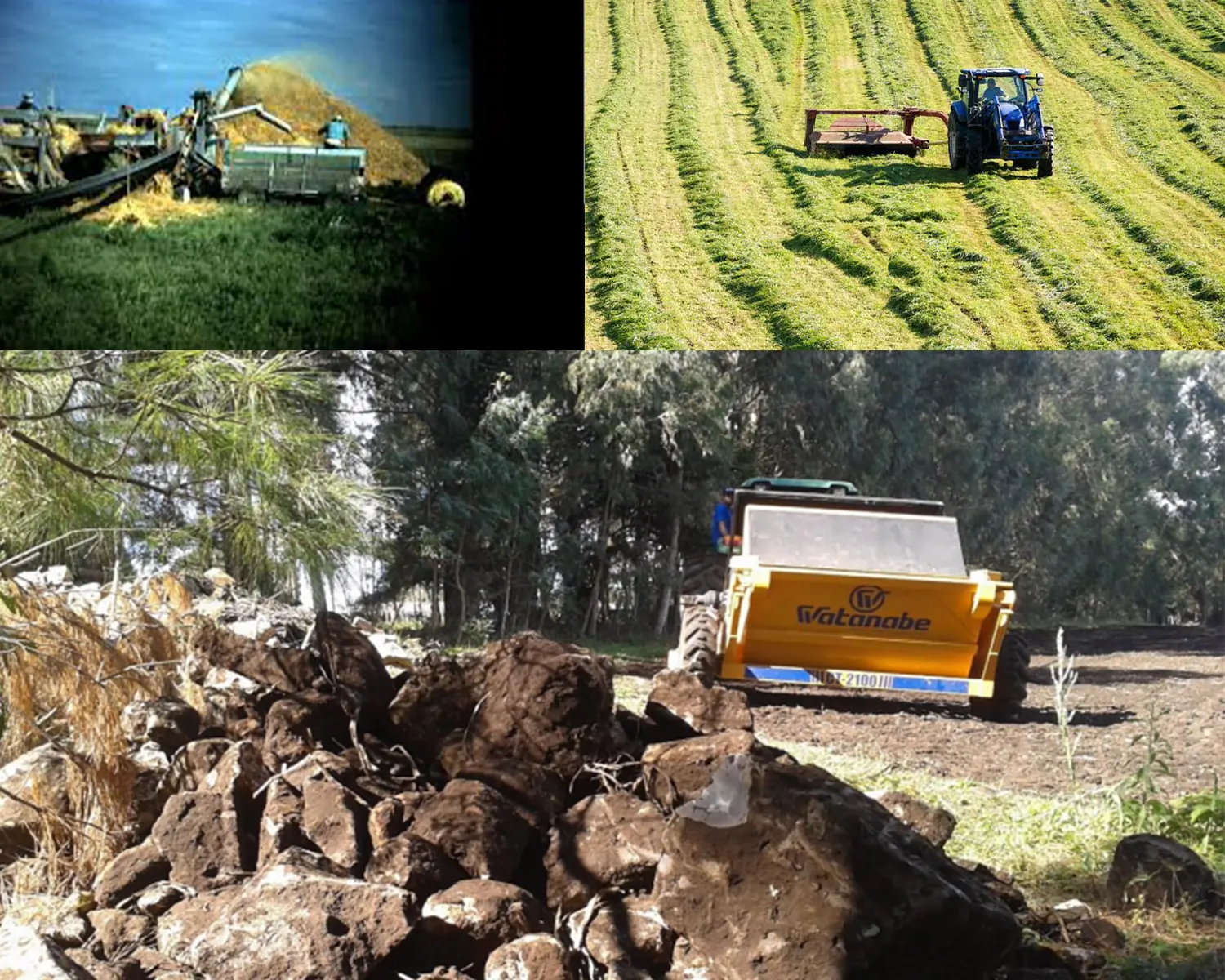
Light stone (below 40 Kg): EP-EW-4000 rock rake at 3.6 m width (if alley width permits) → CT-2100 collection. The rake is the preferred machine at this stage — lower tine depth, less root disturbance, adequate for light stone conditions. - →
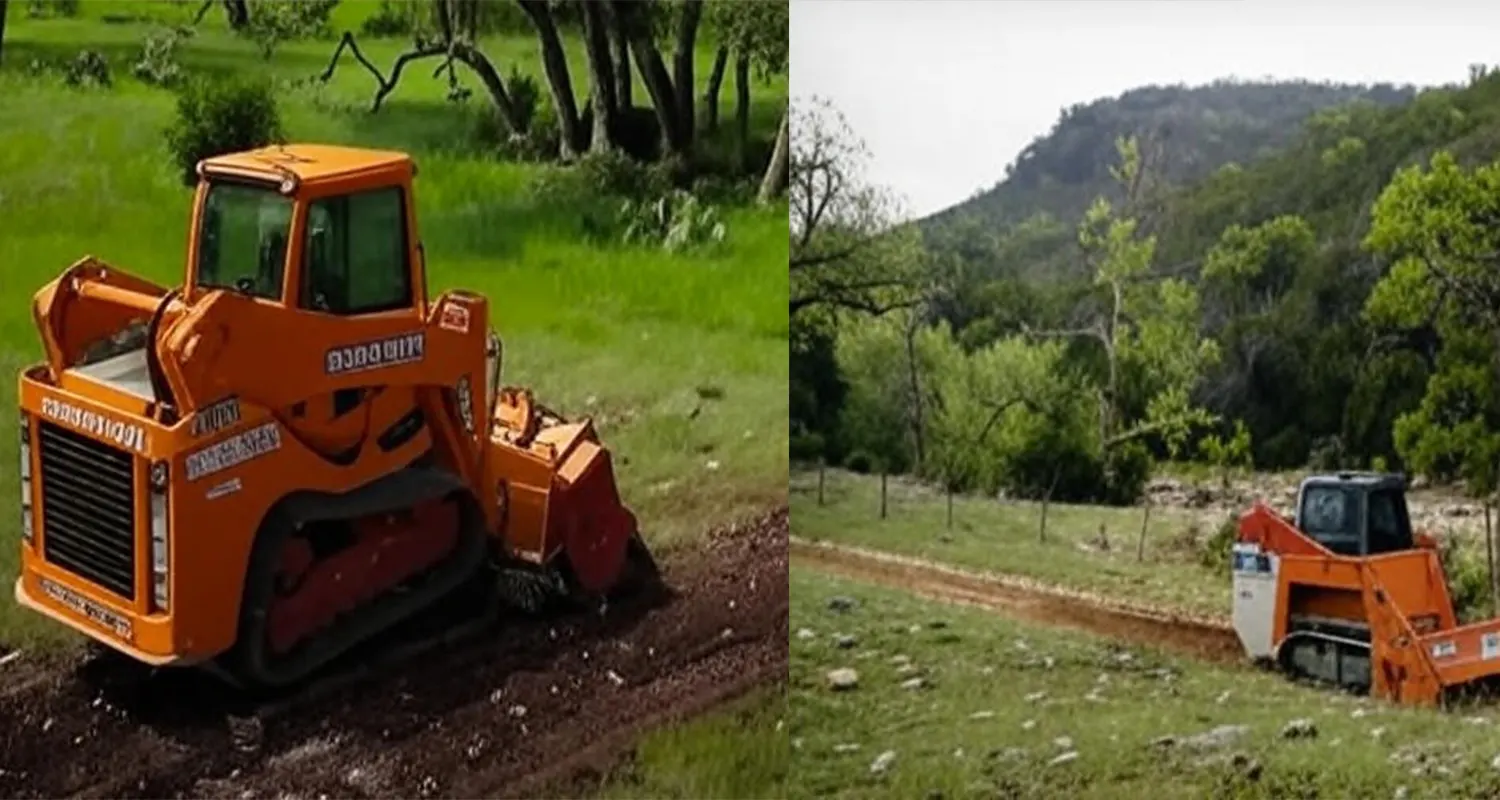
Medium-heavy stone (above 40 Kg) in alleys wider than 3.5 m: THOR 2.4 in Kit Drawbar mode at shallow setting (rear hood partially raised to limit rotor penetration to 10–15 cm) → CT-2100 collection. The shallower working depth reduces root disturbance relative to standard crop field operation.
Stage 3 — Mature Orchard Annual Maintenance (5+ Years)
In mature orchards, annual frost-heave stone management is the primary need. The stone density and size of annual frost-heave are generally lower than in open crop fields — the orchard’s maintained surface vegetation (grass or mulch) moderates freeze-thaw soil movement compared to bare fallow field surfaces. The standard annual management approach for Korean mature orchards:
Alley Width and Equipment Compatibility — Can the Machine Fit?
Before deploying any clearing equipment in a Korean orchard, measure the actual alley width — from tree trunk to tree trunk across the working alley. Compare this to the machine working widths:
| Machine | Working width | Min. alley width needed | Notes |
|---|---|---|---|
| EP-EW-4000 rake | 3.6 m | ~4.2 m | 0.3 m clearance each side to tree trunk |
| THOR 2.4 crusher | 2.4 m | ~3.2 m | 0.4 m clearance each side (wider stone throw buffer) |
| CT-2100 picker | 1.95 m | ~2.6 m | 0.3 m clearance each side; compatible with most Korean orchard alleys |
| Tractor width (tyres) | ~2.0–2.4 m | Alley must accommodate tractor | Confirm with your tractor model; narrow 75 HP tractors for orchard use preferred |
Practical orchard alley width guidelines for Korean commercial orchards:
Korean apple orchards (spindle, central leader, Y-trellis training systems) with row spacing of 4.0–5.0 m can accommodate both the EP-EW-4000 rake and the THOR 2.4 crusher in the working alley. Korean pear orchards with row spacing of 5.0–7.0 m provide comfortable working width for all three machines (rake, crusher, CT-2100 picker). Korean persimmon orchards on open-vase training systems with typical row spacing of 5.0–6.0 m are similarly accessible. Confirm alley width by direct measurement before ordering equipment for a new orchard operation.
Seasonal Timing — When to Clear in Korean Orchards
Stone clearing timing in Korean commercial orchards is constrained by the tree’s seasonal management calendar. Two windows are typically available for stone clearing machinery deployment:
✅ Early Spring (February–March)
After soil thaw and before bud break. The alley surface is accessible (grass is dormant, not yet spring growth), the tree is dormant (bark is not in sap-rise mode — less sensitive to incidental contact), and frost-heave stones have fully emerged through the winter. This is the primary annual clearance window for Korean orchards. Soil moisture from snowmelt typically provides good stone release conditions. Complete clearance before bud break (typically mid-March in North Gyeongsang apple zones, late March in Gangwon-do) to avoid machinery contact with emerging shoot growth.
✅ Post-Harvest (October–November)
After fruit harvest and before soil freeze. The alley is accessible, machinery contact with the tree is lower risk after leaf drop, and undertaking clearance in autumn leaves the orchard ready for spring without the time pressure of early spring operations. Autumn clearance is particularly appropriate for operations also undertaking orchard floor renovation (reseeding grass alleys, installing drip irrigation) that requires cleared surfaces. Less common than early spring clearance but agronomically sound.
Avoid: Active growing season (April–September)
Stone clearing machinery operating in Korean orchard alleys during the active growing season (bud break through harvest) risks contact with flowering spurs, fruit-carrying branches at low positions, and the active root zone at its most vulnerable period (active water and nutrient uptake). Accidental tractor or implement contact with fruiting branches during this period directly reduces the current season’s harvest yield. Reserve machinery deployment to pre-bud-break and post-harvest windows.
Orchard Renovation — Clearing for New Plantings and System Changes
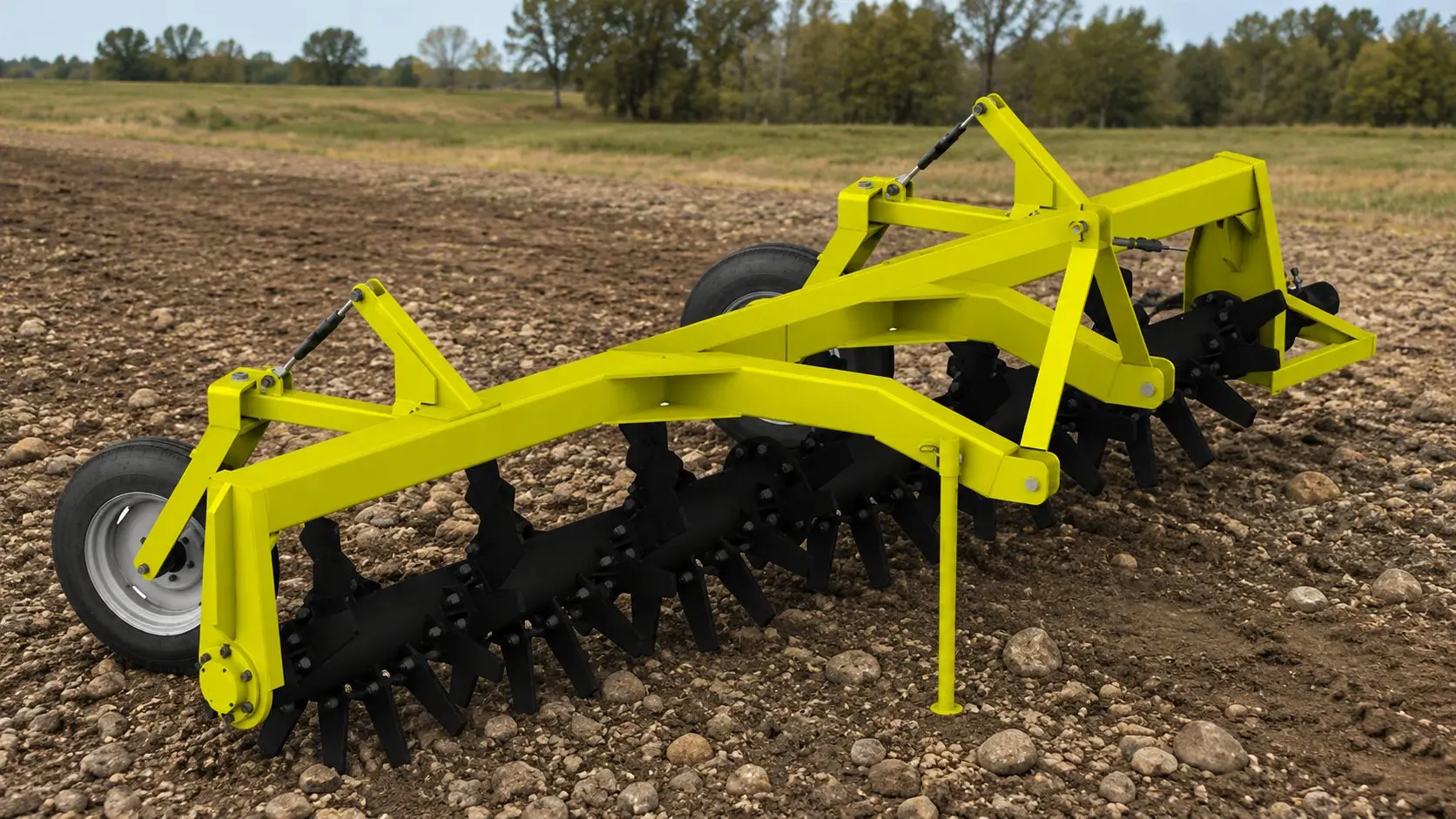
Korean commercial orchards undergo periodic renovation — removing old trees and replanting to new varieties, changing training systems, or converting to higher-density planting configurations. This renovation cycle creates another full stone clearing opportunity equivalent to new orchard establishment, with no root zone or alley width constraint during the period between old tree removal and new tree planting. Korean orchard operators who use this renovation window for thorough THOR+CT-2100 clearance before replanting benefit from reduced stone management requirements throughout the new planting’s productive life.
Korean Apple Variety Change Programs — Stone Clearing Opportunity
Korean apple production has been undergoing significant variety change — transitioning from the dominant Fuji variety to early-season varieties (Tsugaru, 추석 사과), club variety programs, and premium coloured varieties that can command premium prices in the domestic market and export. This variety transition involves old tree removal and new tree establishment — typically on a block-by-block schedule rather than whole-farm simultaneous renovation. Each block renovation creates a full stone clearing window that should be used before replanting, regardless of whether the previous block management required stone clearing or not.
Why Orchard Stone Management Affects Long-Term Fruit Quality and Yield
Korean orchard operators sometimes view stone clearing as a tractor safety issue — avoiding tyre and implement damage from large surface stones — rather than as an agronomic management decision with long-term quality implications. Both perspectives are valid, but the agronomic dimension is the one that compounds across decades of orchard production.
Machinery Access and Operation Safety
Korean commercial orchard management relies on tractor-mounted equipment for fertilizer application, sprayer operation, mowing, and harvest assistance throughout the growing season. Large surface stones in orchard alleys — particularly those that protrude 10–15 cm above the alley surface after frost-heave — create puncture risk for tractor tyres, impact damage to low-hanging sprayer equipment, and increased operator fatigue from navigating rough alley surfaces at speed during spray operations (where timing matters for efficacy). Annual rake-and-collect operations maintain smooth, navigable alley surfaces that allow faster, more comfortable tractor operation throughout the season — directly improving orchard management quality and reducing machine wear costs.
Water Management and Drainage
Korean highland orchards receive intense spring and autumn rainfall. Large stones accumulating in orchard alleys create micro-topographic barriers that interrupt even surface water flow, potentially diverting water toward tree trunk zones where standing water promotes crown rot (Phytophthora collar rot) — a significant threat to Korean apple and pear trees on susceptible rootstocks. Clear, smooth alley surfaces maintain consistent water flow away from tree trunk zones toward designated drainage outlets, reducing the crown rot risk that Korean orchard operators in highland Gangwon-do and North Gyeongsang manage as a constant background threat in high-rainfall years.
Root Zone Soil Health
Large stones accumulating in orchard alleys over multiple uncleaned seasons create persistent soil compaction zones around stone clusters — the stone concentrates tractor traffic stress to the area immediately adjacent to it, while the stone itself prevents root penetration through the zone it occupies. In mature orchards where the entire alley surface is root-active territory, this stone-concentrated compaction reduces the effective root-accessible soil volume below the orchard’s maximum potential. Maintaining clear alley surfaces through annual EP-EW-4000 rake management preserves the full alley soil volume for root exploration and water uptake — particularly important in Korean highland orchards on relatively shallow granite-derived soils where rooting depth is limited by bedrock or fragmented rock layer proximity.
Harvest Efficiency
Korean apple and pear harvest is increasingly mechanised — platform harvesters, picking aids, and produce handling systems that require smooth, level alley surfaces to operate efficiently. Large surface stones in alleys create instability for platform harvesters and obstacle hazards for harvest bins and handling equipment moving through the alley. Operations that maintain smooth alley surfaces through regular stone management operate harvest equipment at higher speeds with lower mechanical risk than operations with irregular, stone-cluttered alley surfaces. Given that Korean apple harvest season — September to November for the main varieties — is already a compressed, weather-dependent window, alley surface quality directly affects how much harvest area can be covered per productive day.
Annual stone management cost vs delayed management cost
Annual EP-EW-4000 rake maintenance (75 HP, 1–2 days for a 5 ha orchard, fuel and operator time) is the smallest per-unit-area stone management cost in the Watanabe range. Deferring annual maintenance for 3–5 years allows stone accumulation to build to the point where the THOR 2.4 crusher is required to process the larger embedded stones that have worked deeper into the alley soil over uncleaned seasons. The deferred-maintenance scenario — skip 3 years of annual rake, then spend 2 days of THOR crusher — typically costs more in total operating expense and machine wear than 3 consecutive annual rake passes. Annual maintenance is the economically optimal approach for established orchards with annual frost-heave stone volumes in the light-to-medium range.
Frequently Asked Questions
Can the THOR 2.4 crusher clear the vegetation between tree rows (grass alleys) at the same time as clearing stones?
Yes — the THOR’s rotor simultaneously mulches surface vegetation (grass, weeds, small shrubs) as it crushes surface stone. In early spring orchard use (February–March), the dormant grass is low and does not impede the THOR’s stone crushing action; the mulched grass returns to the alley as organic matter. This combined stone-and-vegetation clearing function means a single THOR pass handles both the stone management and the first of the season’s orchard floor management passes simultaneously. After the THOR pass and CT-2100 pick, the alley surface is both stone-cleared and grass-mulched — ready for the first fertilizer application or irrigation setup work of the season.
My apple orchard has drip irrigation lines running through the alleys — can I still use the THOR crusher?
Drip irrigation lines running along the alley surface are vulnerable to damage from tractor wheel contact and from stone fragments thrown by the crusher rotor. Before deploying the THOR in orchards with surface-run drip lines: (a) raise or temporarily remove the drip lines from the crusher’s working path and store them against the tree row fence or trunk; (b) after the THOR pass and CT-2100 collection, replace the drip lines in their working position. This temporary line removal and replacement takes 15–20 minutes per 100-metre alley and is the practical management approach for orchards with surface drip irrigation. Buried drip lines (below 15–20 cm) are below the THOR’s operating depth and are not at risk from a shallow-set THOR pass (rear hood raised to limit rotor penetration to 8–12 cm).
Korean government programs support orchard modernisation — can stone clearing equipment be included?
Korean orchard modernisation support programs — administered through the Ministry of Agriculture, Food and Rural Affairs (MAFRA) and provincial orchard development offices (원예과, 과수 담당부서) — typically target variety change, trellising system upgrades, and mechanization improvement. Stone clearing machinery (stone crusher, rock picker, rock rake) may qualify under the 농지 정비 기계류 (farmland improvement machinery) category of the general agricultural machinery subsidy program, particularly when the stone clearing is directly associated with a new planting or orchard renovation project. Confirm current program eligibility for stone clearing equipment in orchard renovation contexts with your regional agricultural technology center (농업기술센터) and the provincial orchard development office. Korea Watanabe provides technical specification documentation for all relevant machines to support orchard renovation machinery applications.
Is the stone cleared from Korean orchards useful or does it need to be disposed of?
Stone collected from Korean orchard clearance via the CT-2100 bunker has several disposal and use options depending on the stone size and local conditions. THOR-crushed angular granite aggregate from orchard clearance can be used for: on-farm access track surfacing (the crushed aggregate is road-quality material); drainage-trench backfill over perforated drainage pipes; and in some cases, sale to local construction or landscaping operations. For orchards on Jeju Island, collected basalt can sometimes be incorporated into traditional stone wall (돌담) repair or extension — a use valued by the local agricultural heritage preservation context. For small volumes (below 10–20 tonnes per year), on-farm field margin storage or periodic licensed disposal is the practical solution. Korea Watanabe can advise on stone disposal logistics common to the specific orchard region where you are operating.
Orchard Stone Clearing? Tell Us Your Alley Width, Stone Condition, and Gradient.
Fruit type + alley width (m) + typical stone weight + gradient (%) + orchard age → specific rake, crusher, or two-machine sequence recommendation with Kit Drawbar configuration guidance for your Korean orchard. Korea local stock, Ansan-si, Gyeonggi-do.
Editor: Cxm