Korea’s potato processing industry — crisps (과자), frozen products, starch, and food service potato supply — has grown steadily over the past decade as Korean consumers’ consumption of processed potato products has increased alongside the expansion of Korean convenience food, fast food, and industrial food manufacturing sectors. This processing industry growth has created a distinct supply chain segment separate from the fresh market: farms contracted directly to processing companies, delivering potato in large format packaging (FIBC big bags of 500 Kg) rather than in bulk bins, nets, or fresh-market retail packaging.
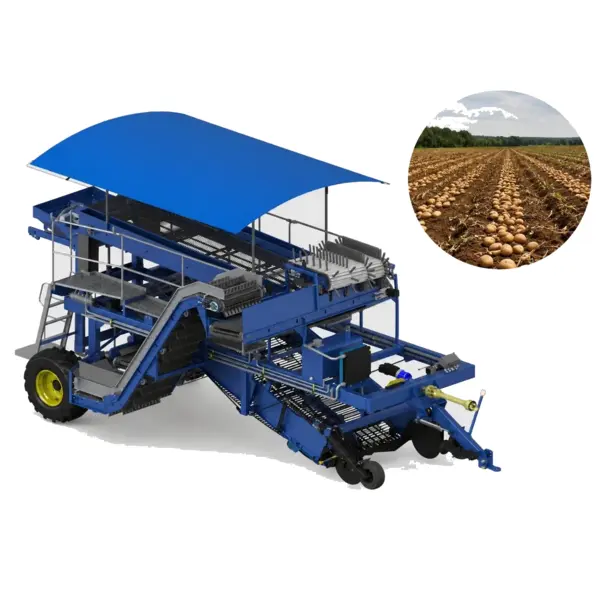
The EP-CWB-2L big bag harvester is Watanabe’s solution for this specific supply chain configuration — a machine that harvests, grades, and packages potato directly into 500 Kg FIBC bags in-field, eliminating the packhouse handling step between field and processing plant. This guide explains what the machine does, exactly which Korean operations benefit from it, and — equally important — when the standard EP-AWB-1600 potato digger remains the better choice.
What the EP-CWB-2L Does — Step by Step
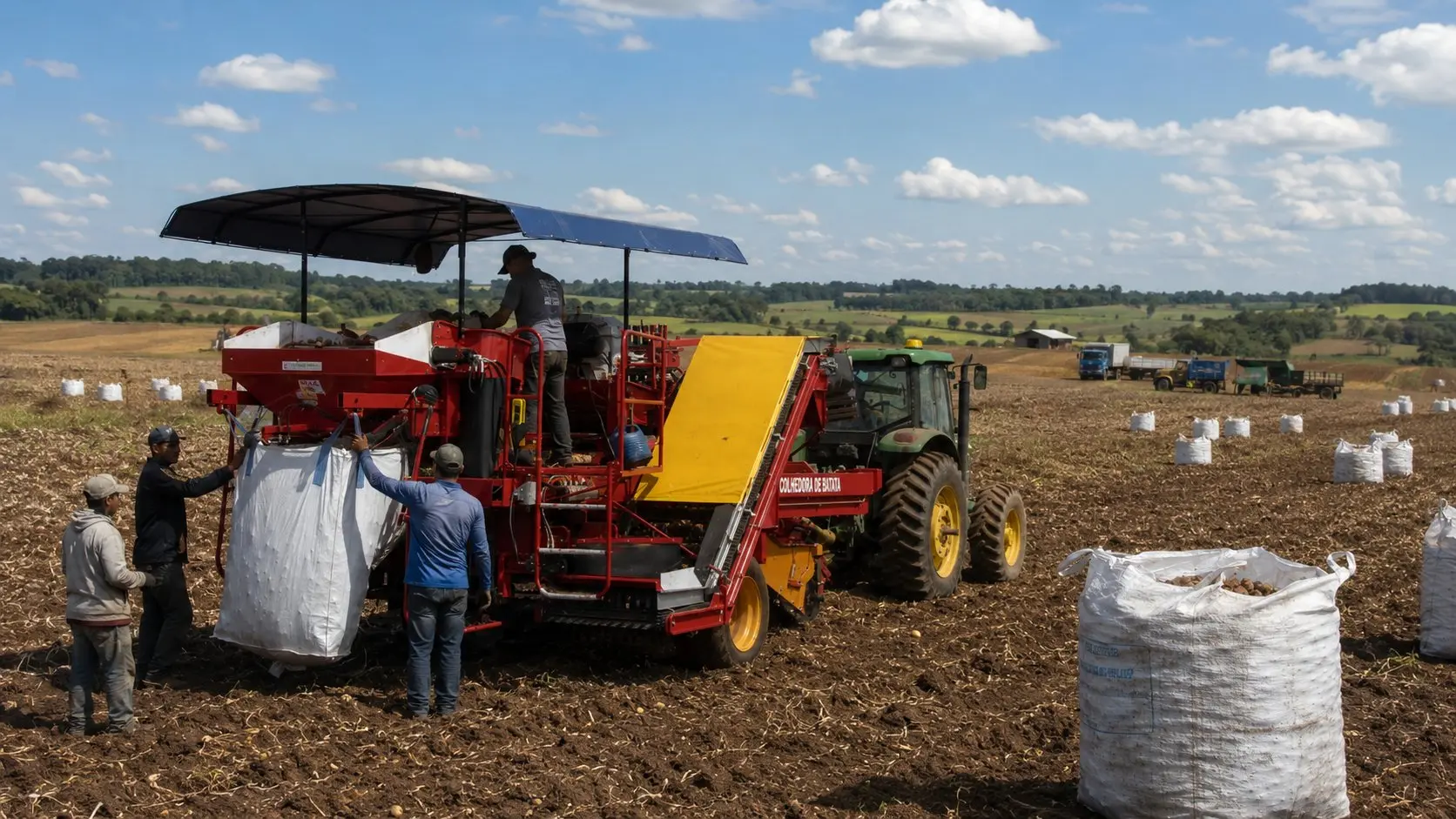
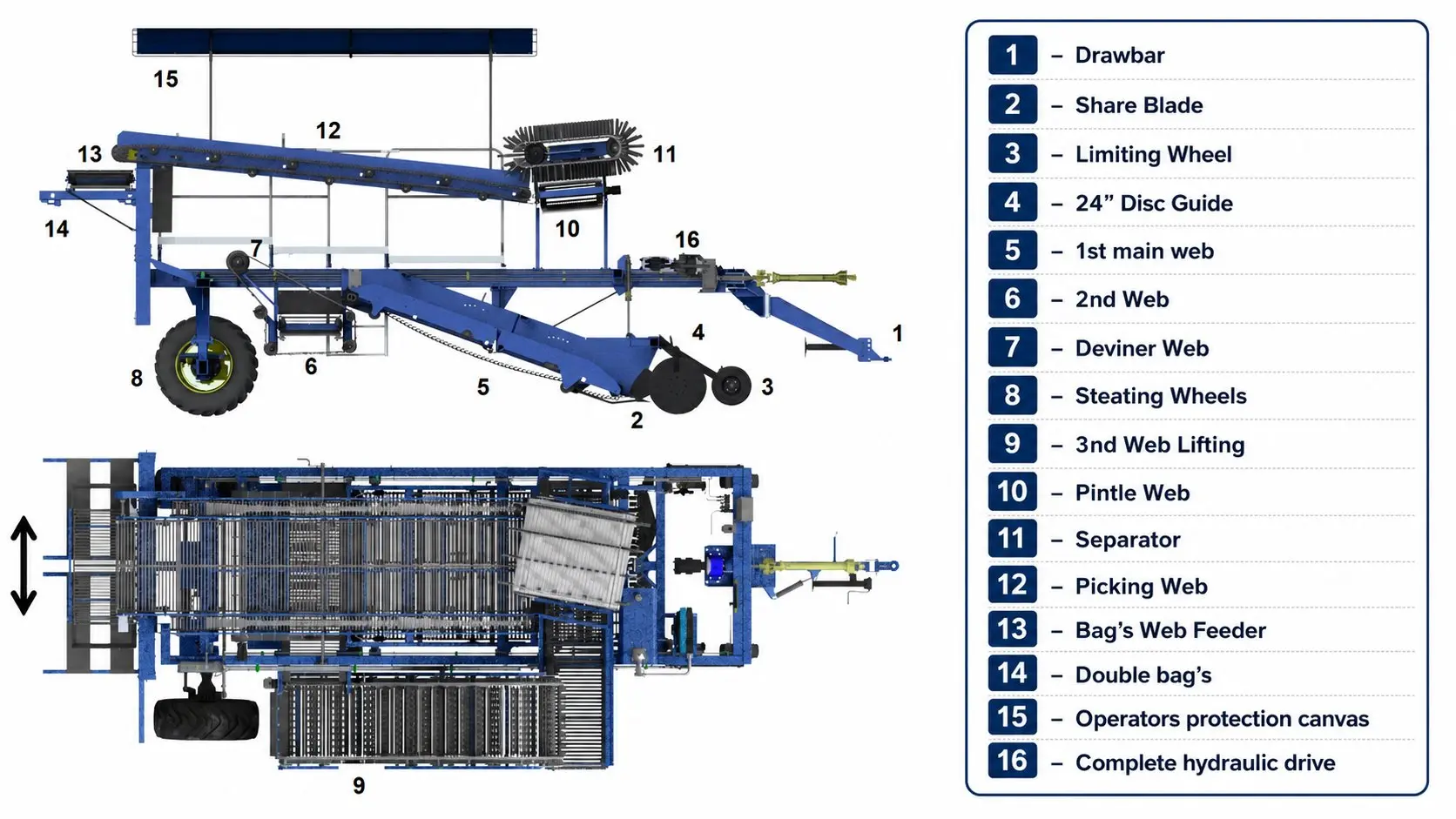
The EP-CWB-2L performs the complete harvest-through-packaging sequence in a single field pass. Understanding each stage of the sequence explains why it enables the direct processing supply chain:
The Supply Chain the EP-CWB-2L Enables — and the Economics
The EP-CWB-2L is designed for a specific supply chain model that differs structurally from the fresh market supply chain used by most Korean potato farmers:
EP-CWB-2L Supply Chain
Packhouse step eliminated. Farm receives processing grade premium price for direct delivery.
Standard Fresh Market Chain
Packhouse investment and operating cost required. Higher price per Kg but higher handling cost.
The Economics of Packhouse Elimination
Korean farms selling processed potato to crisps manufacturers, starch processors, and frozen food companies via direct big-bag supply typically receive lower per-kg prices than farms selling premium fresh market potato. However, the elimination of packhouse handling costs can improve net farm margin even at lower gross prices. The cost items eliminated or reduced by switching from fresh market (packhouse) to direct processing supply (EP-CWB-2L) include:
- −
Packhouse facility capital cost: Purpose-built packhouse buildings, grading machinery, washing lines, and cold storage represent significant capital investment. Operations that can eliminate this investment through direct field-to-plant delivery reduce their capital cost base. - −
Packhouse labour: Grading, sorting, and packaging in a packhouse requires seasonal labour — a resource that has become significantly more expensive and harder to secure in Korean rural areas over the past decade. The EP-CWB-2L’s in-machine grading eliminates the packhouse sorting labour requirement for the processing grade output. - −
Cold storage cost: Fresh market potato requires temperature-controlled storage between harvest and market delivery — a week or more for most supply chains. Processing supply potato delivered immediately from field harvest does not require intermediate cold storage. - −
Product loss in handling: Each handling step from field to packhouse to market creates mechanical damage that produces culls and grade-reduction. In-field packaging minimises the number of handling steps and reduces mechanical damage between harvest and delivery.
Who the EP-CWB-2L Is Actually For — and Who It Is Not For
✅ Operations that genuinely benefit:
- ✓Farms with formal processing plant supply contracts specifying big-bag delivery of 500 Kg FIBC units
- ✓Operations above 20–25 ha where packhouse cost elimination produces material financial impact
- ✓Farms that grow primarily processing varieties (Atlantic, Russet Norkotah) with uniform size distribution suited to in-machine grading
- ✓Operations seeking to reduce dependence on seasonal packhouse labour in rural areas where labour availability is declining
- ✓Cooperative farming groups that share the EP-CWB-2L across multiple member farms all contracted to the same processing company
❌ Operations that don’t need the CWB-2L — EP-AWB-1600 is the better choice:
- ✗Farms selling to fresh market — fresh market potato requires fresh-to-retail packaging and presentation, not bulk FIBC for industrial processing
- ✗Operations below 15–20 ha where the packhouse cost base is manageable and the EP-CWB-2L investment payback period is too long
- ✗Seed potato producers — certified seed potato requires lot traceability, individual sampling, and certification documentation that in-field bulk packaging does not facilitate in the same way as packhouse processing
- ✗Farms without a processing plant contract — the EP-CWB-2L’s FIBC output is specifically designed for industrial processing intake; without a contracted processing buyer, the product cannot be diverted to fresh market without repackaging
- ✗Highland farms with steeply sloped, short-row fields — the EP-CWB-2L’s combined harvesting and filling operation requires longer row lengths and adequate field width for the machine’s larger turning envelope
EP-CWB-2L vs EP-AWB-1600 — Side by Side
| Factor | EP-CWB-2L | EP-AWB-1600 |
|---|---|---|
| Primary output | 500 Kg FIBC big bags (field-ready for truck) | Loose tubers to following collection cart |
| In-field grading | Yes — integrated grade separation | No — all tubers to cart |
| Packhouse needed? | No — eliminated by design | Yes (for processing/fresh market) |
| Best supply chain | Direct-to-processing-plant FIBC delivery | Fresh market, cooperative, seed potato |
| Field requirements | Longer rows, flatter terrain, headland for FIBC staging | Short rows OK, slopes OK, compact |
| Min. scale benefit | 20+ ha with processing contract | 2 ha and above |
| Harvest throughput | Comparable per row (bag fill stops offset speed) | Continuous — no bag fill stops |
The EP-CWB-2L in the Complete Watanabe Potato System
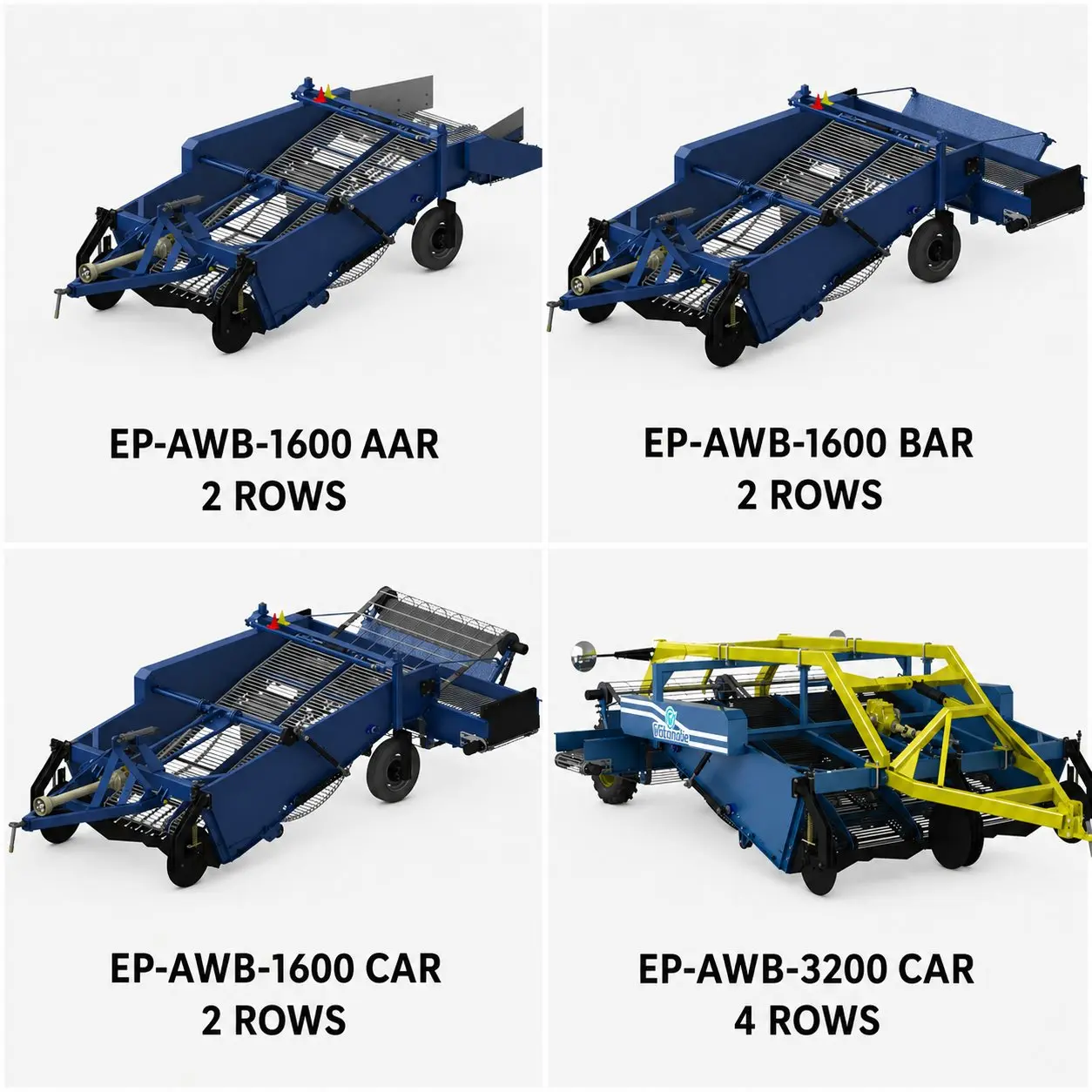
The EP-CWB-2L replaces Step 7 (harvest) in the Watanabe 7-step potato system for operations using the direct processing supply chain. Steps 1–6 remain identical regardless of whether harvest is via the EP-AWB-1600 or the EP-CWB-2L:
The upstream preparation quality (Steps 1–6) affects both harvest systems equally and critically. The EP-CWB-2L’s in-field grading is only as effective as the size uniformity of the planted crop — which is determined by the seed spacing precision of the EP-PAI-2100 planter (Step 5), which in turn depends on the row consistency of the furrower (Step 3), which depends on the tillage uniformity of the PSW-3200 rotavator (Step 2). A well-graded, processing-quality harvest from the EP-CWB-2L begins with the preparation quality at Step 2 — not with the harvester itself.
Korean Processing Potato Market — Who Buys in Big Bags
The Korean processing potato market that creates demand for big-bag FIBC supply chains includes several distinct buyer segments, each with different specifications for the potato they receive:
🍟 Crisp Manufacturers
Orion, Lotte, Crown and OEM manufacturers buying Atlantic, Russet, and similar high-solids varieties. Strict specific gravity specifications. FIBC delivery to factory receiving dock. Volume contracts typically 500–5,000 tonnes per season per supplier farm.
🏭 Starch Processors
Industrial starch extraction from whole potato — less size-sensitive than crisp supply. Any variety with adequate starch content. FIBC or bulk delivery. Lower per-kg price than crisp supply but broader specification tolerance.
🍲 Frozen Food Manufacturers
French fry and wedge manufacturers requiring specific size and shape — larger, elongated tubers preferred. Russet and similar varieties. FIBC delivery standard for industrial intake volumes.
🗎 Food Service Distribution
Restaurant and catering supply chains buying pre-washed or unwashed potato in large format. FIBC or 25 Kg sacks. Some specification overlap with retail — often the secondary market for EP-CWB-2L farms with mixed output.
Operating the EP-CWB-2L Efficiently — Day-to-Day Management
The EP-CWB-2L’s operational efficiency depends on three logistics elements working in coordination: the harvesting tractor and machine, the FIBC bag supply, and the collection truck. A breakdown in any one of these elements stops the entire harvest operation. Experienced Korean big-bag harvest operations manage these three elements with the following approaches:
📋 FIBC Staging Protocol
Pre-position 20–30 empty FIBCs at the field headland before the harvest session begins. The machine operator or a dedicated ground crew replenishes the bag staging area from the bulk FIBC store every 2–3 hours. Never allow the empty bag supply at the headland to fall below 5 bags — a bag shortage creates an immediate harvester idle stop that disrupts the tractor’s working rhythm.
🚙 Truck Timing Coordination
Filled FIBCs cannot be left indefinitely at the field headland — in warm weather, stacked FIBC bags left in direct sun accumulate heat. For processing supply, confirm with the processing plant the maximum elapsed time between harvest and plant delivery that meets their intake specification. Coordinate truck departure and return timing so filled bags are collected every 2–3 hours rather than accumulating for a single end-of-day truck run.
📈 Grading System Daily Check
The in-field grading system’s size separation performance should be verified at the start of each harvest day by sampling the on-grade product stream and the off-grade stream and comparing actual size distribution to the contract specification. If the separation is not meeting specification — either passing off-grade product into the FIBC or rejecting good-quality on-grade product — adjust the grading setting before continuing. Processing plant rejection of a delivered FIBC load for specification non-compliance creates logistics and financial problems that are avoided by daily grading verification.
Korean Operations Using Big-Bag Harvest Supply — Profile Examples
Gangwon-do Processing Potato Cooperative — 35 ha Combined Area
A five-farm cooperative in Pyeongchang-gun, total combined planting area of 35 ha of Atlantic variety under contract to a Korean crisp manufacturer. Each member farm plants 5–10 ha; the cooperative jointly purchased the EP-CWB-2L and shares it among member farms on a rotating harvest schedule during the August–September harvest window. The cooperative’s combined Atlantic volume meets the processing plant’s minimum contract supply volume, which individual farms of 5–10 ha could not supply independently. The EP-CWB-2L’s big-bag output delivers directly to the plant; the cooperative collectively eliminated their previously shared packhouse operation, reducing overhead costs across all five members.
South Gyeonggi Processing Supplier — 28 ha, Frozen Product Contract
A single large family farm in Anseong-si, Gyeonggi-do, supplying frozen product manufacturer with Russet variety. Flat lowland field geometry — ideal for the EP-CWB-2L’s operational profile. The 28 ha annual supply volume and a 3-year frozen product supply contract justified the EP-CWB-2L investment. Harvest in late September after winter crop planting; the FIBC-format delivery meets the frozen food manufacturer’s intake specification for large-diameter Russet at specific gravity above 1.080. The farm has no packhouse — the EP-CWB-2L eliminated the need for one at the time of the processing plant contract initiation.
When the EP-AWB-1600 Was the Right Choice Instead
A Hoengseong-gun highland operation producing 12 ha of Superior and Dejima variety for the Seoul wholesale vegetable market (가락시장) — classic fresh market supply. This operation evaluated the EP-CWB-2L in 2024 and concluded the EP-AWB-1600 Kit B (rear elevator to following cart) was the appropriate harvester: the fresh market supply chain requires variety-specific size grading, washing, and net bag packaging that the EP-CWB-2L’s FIBC output cannot support without repackaging — eliminating the packhouse saving. The operation’s sloped highland field geometry (15–25% gradient on several sections) further limited the EP-CWB-2L’s operational suitability. The EP-AWB-1600 remains the right machine for this operation’s supply chain and field conditions.
Frequently Asked Questions
What happens to the off-grade potato (undersized, oversized) separated in-field by the grading system?
The EP-CWB-2L’s in-machine grading system separates off-grade tubers to a separate discharge stream — not to the FIBC being filled with on-grade product. The off-grade material falls to the field surface or is directed to a separate small collection bin depending on the machine configuration. Off-grade potato on Korean processing farms is typically: (a) sold at lower price to local fresh market, school meal service, or animal feed buyers; (b) returned to the field as organic matter if volume is small and no buyer is available; (c) composted on-farm. Farms using the EP-CWB-2L should plan a disposal route for off-grade material before harvest begins — the volume of off-grade depends on crop uniformity, which is determined by seed spacing precision at planting.
How many FIBCs need to be on hand for a harvest day?
At 500 Kg per FIBC and typical potato yields of 25–40 tonnes per hectare, a 1-hectare harvest day produces 50–80 FIBC bags. For a 10-hectare harvest day (EP-CWB-2L running at approximately 1.0–1.5 ha/hour for 8 productive hours), that is 500–800 FIBC bags on-site. FIBC logistics — ensuring sufficient empty bags are on the field headland at all times, and that filled bags are collected by the delivery truck promptly — are the critical operational variable that determines whether the harvester operates continuously or stops for logistics. Plan truck arrival frequency and empty bag delivery to maintain the harvester’s productive rhythm without idle stops at the bag exchange station.
Can the EP-CWB-2L operate on the same Korean highland slopes as the EP-AWB-1600?
The EP-CWB-2L’s combined harvesting and bag-filling operation creates a wider and heavier machine than the mounted EP-AWB-1600. On Korean highland slopes above approximately 10–15%, the stability of the combined harvester-plus-filled-bag configuration requires more careful assessment than the EP-AWB-1600 mounted machine. The EP-CWB-2L is primarily suited to the flatter field sections of Gangwon-do’s highland zones — the valley floor and lower terrace positions where slopes are below 10%. For higher-slope field sections, the EP-AWB-1600 remains the more appropriate harvester. Operations with mixed slope terrain should consider deploying the EP-CWB-2L on flat sections and the EP-AWB-1600 (with Kit B following cart) on sloped sections — separate machines for separate terrain profiles.
Is the EP-CWB-2L eligible for Korean agricultural machinery subsidies?
Potato harvesting machinery (감자 수확기) has been included in the Korean agricultural machinery purchase support program (농업기계 구입 지원사업) eligible equipment list in recent program years. The EP-CWB-2L, as a potato harvest and packaging machine, may qualify under the potato harvesting machinery category or the post-harvest handling equipment category, depending on the current year’s program specification. Confirm current year eligibility for the EP-CWB-2L specifically with your regional agricultural technology center (농업기술센터) before purchase, and confirm that your operation’s scale and supply chain (direct processing supply) meets the program’s use criteria. Korea Watanabe provides the technical specification documentation required for the subsidy application process.
Processing Plant Contract and Considering Big Bag Harvest? Let’s Confirm the Right Configuration.
Annual harvest area + supply chain (fresh / processing / FIBC specification) + field slope + tractor HP → EP-CWB-2L vs EP-AWB-1600 recommendation with honest ROI analysis for your specific Korean operation. Korea local stock, Ansan-si, Gyeonggi-do.
Editor: Cxm