EP-AWB-3200 Trailed Potato Digger — When Large-Scale Korean Potato Harvest Needs More Than the Mounted Machine

The EP-AWB-1600 mounted digger handles up to 15–20 ha. When the scale grows beyond that — or when tractor hitch lift capacity becomes the constraint — the trailed EP-AWB-3200 changes the harvest economics.

Get a Digger Recommendation for Your Scale

The Watanabe potato digger range addresses two distinct operational scales. The EP-AWB-1600 — 2-row, rear three-point hitch mounted, 75 HP minimum — is the standard machine for Korean highland potato operations up to approximately 15–20 ha. At this scale, the EP-AWB-1600’s productive harvest rate of 0.8–1.2 ha/hour covers the harvest area within the Korean highland harvest window without time pressure, and its compact mounted configuration navigates the narrower headlands and variable row geometry of Korean mountain terrace fields.

The EP-AWB-3200 trailed digger addresses larger operations — those where the EP-AWB-1600’s harvest rate creates genuine time pressure against the autumn frost window, or where the field geometry (long rows, flatter terrain, large area) makes the trailed configuration’s higher throughput economically justified. Understanding exactly when the scale threshold is crossed — and what the trailed configuration requires of the tractor, the field, and the harvest logistics — is the information Korean large-scale potato operators need before making the digger investment decision.

EP-AWB-1600 vs EP-AWB-3200 — Side by Side

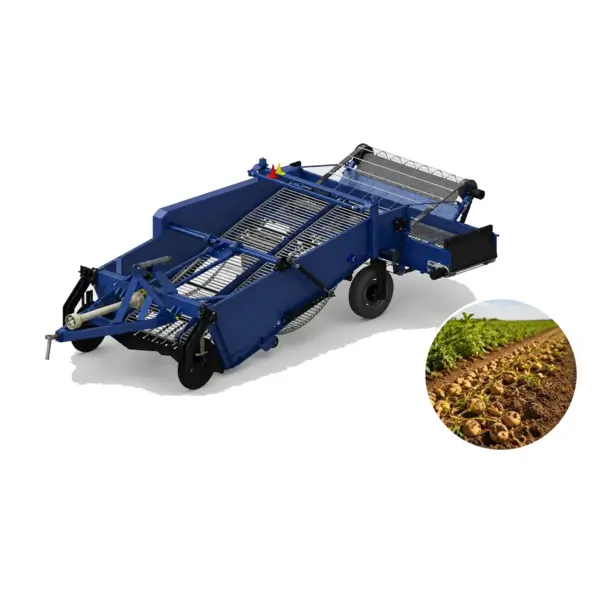
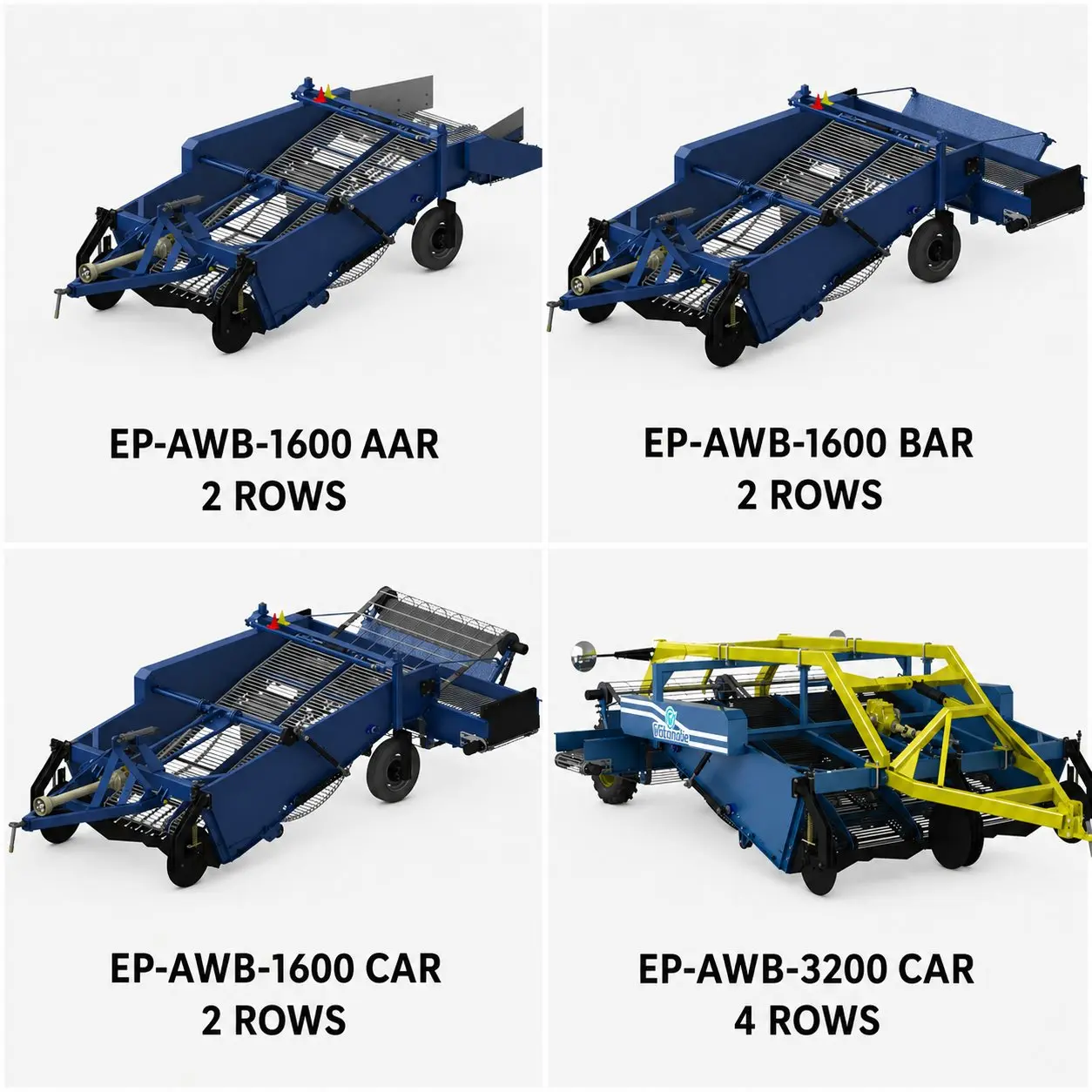
EP-AWB-3200 trailed potato digger — 4-row large-scale configuration for Korean highland potato harvest

STANDARD / MOUNTED

EP-AWB-1600

2-row · 75 HP · Cat.2 rear hitch

  • 75 HP minimum — standard farm tractor
  • Mounted — compact, tightest turning
  • 0.8–1.2 ha/hr productive rate
  • Short rows, slopes, terraces OK
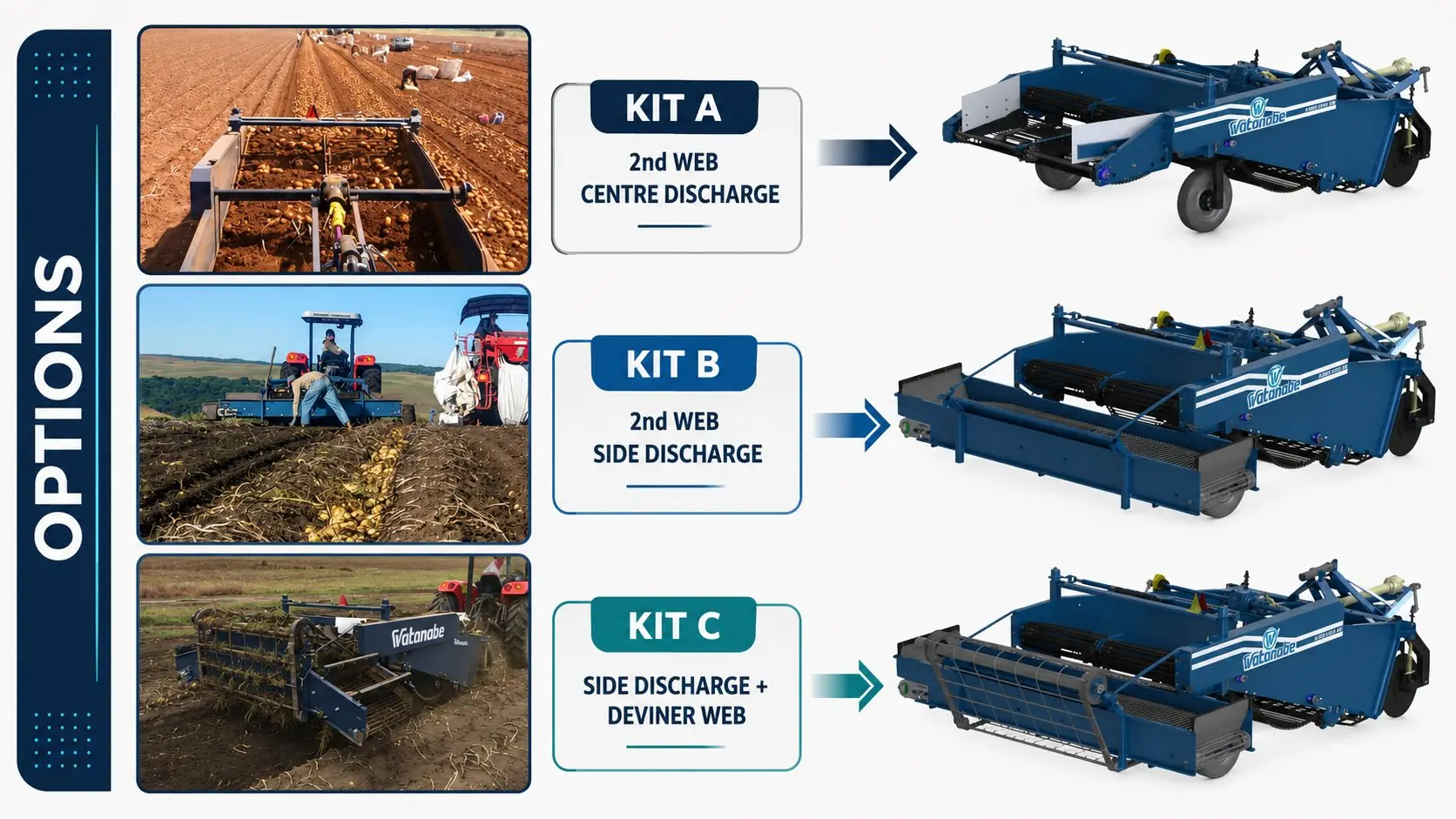
  • Kit A (windrow) / Kit B (elevator) / Kit C (transfer)
  • Best scale: up to 15–20 ha
LARGE-SCALE / TRAILED

EP-AWB-3200

4-row · Higher HP · Drawbar trailed

  • Drawbar tow — tractor not lifting machine weight
  • 4-row simultaneous harvest — 2× row throughput
  • Higher daily harvest area
  • Longer rows and flat-moderate terrain best
  • Wider turning radius at headland
  • Best scale: 20+ ha operations

Why Trailed Configuration — The Engineering Rationale

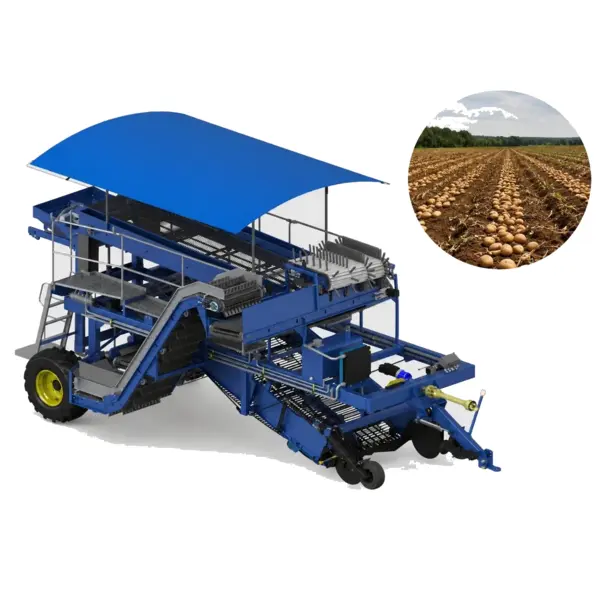
EP-AWB-3200 trailed potato digger combined view — showing drawbar attachment and 4-row working configuration

The shift from mounted to trailed configuration is not simply a matter of adding rows — it reflects a fundamental change in how the machine’s weight is borne by the tractor system. A 4-row digger is significantly heavier than a 2-row mounted machine. Mounting a 4-row digger on the rear three-point hitch of a standard farm tractor would require:

Rear hitch lift capacity exceeding standard tractor spec. Most Korean farm tractors in the 100–150 HP class have rear three-point hitch lift capacities of 3,000–6,000 Kg at the hitch point. A 4-row digger machine exceeds these limits, requiring either a specialist high-lift tractor or an entirely different mounting approach.

Front axle stability loss. An extremely heavy rear-mounted implement lifts the tractor’s front axle — creating steering and stability problems on sloped or uneven Korean highland terrain. This is the same physics that makes the Kit Drawbar necessary for the THOR 2.4 on orchard slopes, applied at greater scale.

The trailed configuration solves both problems at once. The EP-AWB-3200 connects to the tractor via drawbar — a simple tow hitch. The machine’s weight is borne by its own ground wheels, not by the tractor’s rear hitch. The tractor provides forward pulling force and PTO drive; the machine supports its own weight on dedicated running wheels that also maintain working depth. The tractor’s front axle remains properly loaded, maintaining steering control throughout the harvest operation.

The Scale Threshold — When Does the EP-AWB-3200 Make Sense?

The scale threshold where the EP-AWB-3200 becomes economically justified over the EP-AWB-1600 depends on three converging factors:

Factor 1: Harvest area vs window

At Gangwon-do 600 m altitude, the harvest window before first autumn frost is approximately 30–45 productive harvest days from late August to early October. The EP-AWB-1600 at 0.8–1.2 ha/hour and 8 productive hours/day covers 190–280 ha in that window. Operations substantially below 200 ha do not face a harvest window constraint from the digger. Operations pushing above 200–250 ha seasonal area — either single large farms or cooperatives using one machine across multiple members — begin to feel the constraint.

Factor 2: Field row length

The EP-AWB-3200’s wider turning radius at headland is a genuine disadvantage on short-row fields. A farm where average row length is below 60–80 m spends disproportionate time turning at headlands with the trailed machine versus the tighter-turning mounted EP-AWB-1600. The break-even point where the 4-row throughput advantage exceeds the headland time penalty is typically at row lengths above 80–100 m.

Factor 3: Terrain gradient

The trailed EP-AWB-3200 is most effective on flat-to-moderate terrain (below 12–15% gradient). On steep highland terraces (15–25% gradient), the trailed configuration’s stability and turning geometry at headlands becomes more challenging. The EP-AWB-1600 mounted machine navigates steep and narrow highland terrain better than the trailed EP-AWB-3200 — which favours lower-altitude valley floor and wider terrace fields.

How the EP-AWB-3200 Works — Technical Operation

EP-AWB-3200 trailed potato digger detail — lifting shares, vibrating web conveyor, and discharge system for 4-row operation

The EP-AWB-3200’s harvesting principle is identical to the EP-AWB-1600 — lifting shares travel below the planted tuber zone, elevating the ridge soil and tubers onto a vibrating web separator conveyor that removes soil while carrying tubers rearward for discharge. The differences lie in scale and in the trailed configuration’s specific operational characteristics:

1
4-row simultaneous lifting. Four sets of lifting shares work simultaneously — each set straddles one planted row, with the shares set to the row spacing established at furrowing. All four rows are lifted, separated, and processed in parallel in a single tractor pass, covering 4× the row count per pass versus the EP-AWB-1600’s 2 rows.
2
Ground wheel depth control. Unlike the mounted EP-AWB-1600 whose working depth is set by the tractor three-point hitch depth control, the EP-AWB-3200’s lifting depth is controlled by dedicated ground wheels on the machine itself. The ground wheels ride the compacted inter-row surface, maintaining consistent lifting depth independent of tractor hydraulic settings — an advantage on fields where inter-row surface height varies, as the machine self-adjusts to local surface conditions.
3
PTO-driven conveyor system. The vibrating web separator and transfer conveyor are PTO-driven from the tractor — the same 540 or 1000 RPM PTO source as the EP-AWB-1600. Confirm your tractor’s PTO output rating and shaft specification match the EP-AWB-3200’s requirement when ordering. The higher throughput of the 4-row system places higher PTO torque demands on the tractor’s PTO shaft than the 2-row EP-AWB-1600.
4
Discharge and collection logistics. The EP-AWB-3200’s higher throughput rate places greater demand on the following collection cart — it fills faster than a cart following the EP-AWB-1600. A larger collection cart, or a second cart that exchanges with the first while the first is being emptied, maintains continuous EP-AWB-3200 operation. Plan the cart logistics before the first harvest day — the most common cause of EP-AWB-3200 idle time is waiting for an empty cart, not a machine problem.

The Cooperative Sharing Model — How Korean Farmers Access EP-AWB-3200 Economics

Many Korean highland potato operations that individually plant 10–15 ha — not enough to justify an EP-AWB-3200 purchase on their own — access the trailed digger’s productivity advantage through agricultural cooperative machinery sharing programs (농협 공동 농기계 사업). Under these programs, the cooperative purchases and owns the EP-AWB-3200 and schedules its use across member farms during the harvest window. Each member pays a per-hour or per-hectare use charge rather than the full machine purchase cost.

Cooperative sharing logistics — planning considerations

  • All participating farms must have matching row spacing — the EP-AWB-3200 share spacing is set for a specific row-to-row distance and cannot be rapidly re-set between farms during the harvest season without significant downtime.
  • Harvest scheduling must be coordinated around crop maturity — each farm’s harvest date depends on its planting date and variety maturation period, not on administrative convenience. Plan the cooperative harvest schedule around variety-specific maturity dates for each member farm confirmed 3–4 weeks before expected harvest start.
  • Transport between farms adds time — the trailed EP-AWB-3200 requires truck transport between cooperating farms. Plan transport logistics so the machine moves between farms on non-harvest weather days to maximise productive harvest days on each farm.
  • Contact Korea Watanabe for EP-AWB-3200 technical documentation required for cooperative machinery purchase subsidy applications — the 공동 농기계 지원사업 program may provide higher subsidy rates for cooperative purchases than individual farm purchases.

Step 7 Options — Matching the Digger to Your Operation

Korean highland potato harvest — digger model choice determines harvest rate and operational logistics at Step 7

Your situation EP-AWB-1600 EP-AWB-3200
Farm area 2–20 ha ✅ Well suited Oversized
Farm area 20–50 ha Marginal on schedule ✅ Justified
Farm area 50+ ha Window pressure ✅ 必須
Field rows < 80 m (short highland terraces) ✅ Better turning Headland penalty
Field rows > 100 m (valley floor, flat) OK ✅ Full advantage
Gradient > 15% ✅ More stable Stability consideration
Processing supply (FIBC direct) Use CWB-2L instead Use CWB-2L instead
Cooperative shared machine Individual scale ✅ Cooperative economics
PSW-3200ロータリー耕うん機 at 3.6 m (5-row system) 2-row only (3+ passes) ✅ Matches 4-row system

Harvest Climate Management — How the Highland Autumn Window Affects Digger Choice

The EP-AWB-3200’s productivity advantage only translates to better harvest outcomes if the harvest window itself provides adequate working days. Korean highland autumn harvest windows — the period between crop maturity and first hard frost — are defined by altitude and year-to-year weather variability in ways that affect digger choice directly.

At 600 m altitude in Gangwon-do, Atlantic potato matures approximately 80–100 days after emergence. For April 25 planting, emergence occurs around May 15, placing maturity in early-to-mid August. The first highland frost risk begins in late September at this altitude. This gives a theoretical 6-week harvest window. However, Korean highland autumn weather introduces three constraints on productive harvest days within this window:

Soil moisture after rain: Post-rain soil conditions in Korean highland fields take 2–4 days to drain to trafficable condition depending on soil drainage class. A 100 mm rainfall event (not unusual in Korean late-summer typhoon season) can eliminate 3–4 harvest days from the window. Both digger configurations are equally affected by wet soil — the tractor cannot safely operate in highly saturated conditions regardless of which machine it pulls.

Morning ground frost: Early autumn ground frosts at highland altitude arrive before the first killing frost — typically in late August at 700–800 m elevation. Ground frost softens ridge soil overnight, potentially increasing tuber skin damage from share impact in early morning harvesting. Most Korean highland operators delay the start of each harvest day until soil temperature rises above 8–10°C — reducing effective daily harvest hours.

Crop maturity staggering: Korean highland farms planted in stages (April 20 and April 30, for example) have crop that matures in two waves — reducing the overlap in harvest timing but also meaning the digger cannot begin the second block until after the first is complete. This staggering inherently limits how much daily area the digger handles, partially reducing the throughput advantage of the EP-AWB-3200 over the EP-AWB-1600 on staggered-maturity operations.

The practical implication for digger selection: operations at or below 15 ha with single-maturity-date planting rarely face harvest window pressure from the digger alone — logistical constraints (cart availability, truck scheduling, storage capacity) typically limit daily harvest area before the digger’s rate does. Operations above 20 ha with single-planting-date may face genuine window pressure in difficult weather years, where the EP-AWB-3200’s higher throughput provides real insurance against late-season frost catching un-harvested crop.

Post-Harvest Tasks — What Follows the Digger Pass

After the EP-AWB-3200 digger pass, three downstream tasks complete the harvest operation:

Hand-gleaning behind the digger

Any tubers missed by the lifting shares remain in the field. A hand-gleaning pass after the digger — 1–2 workers per row following 30–40 minutes behind the tractor — recovers missed tubers and inspects field coverage quality. The EP-AWB-3200’s wider 4-row pass makes gleaning logistics slightly more complex than the 2-row EP-AWB-1600 — plan gleaning crew allocation accordingly.

Vine/haulm management

The desiccated vine material (haulm) from the lifted ridges is spread across the field surface after the digger pass. For the following season’s rotavator tillage, the vines need to be incorporated — either by desiccation (leaving through winter) or by a flail mower pass before spring tillage. Plan vine management as part of the post-harvest autumn field preparation sequence.

Soil compaction assessment

Harvest machinery on slightly-wet highland soils creates wheel tracks and inter-row compaction. Assess the field for compaction damage after harvest — if tracks are visible and penetration resistance is high, a subsoiling or deep-tillage pass before spring preparation may be warranted to restore the aeration and drainage profile that potato production requires.

よくある質問

Can one tractor operate both the EP-AWB-3200 and the furrower, planter, and cultivator during the same season?

Yes — the EP-AWB-3200 uses a drawbar hitch and PTO drive, which the same tractor that operates the furrower (Cat.2 three-point hitch) and planter (Cat.2 three-point hitch) can also provide. Hitching between mounted implements (furrower, planter) and the trailed EP-AWB-3200 requires only hitch system changes — unhooking the Cat.2 implement and connecting the drawbar, which takes 10–15 minutes. In seasonal operation, the furrower and planter are used in April–May (spring preparation), and the EP-AWB-3200 in August–September (harvest) — there is no seasonal conflict for the same tractor between these operations. However, the tractor HP requirement for the EP-AWB-3200 may be higher than for the mounted furrower and planter — confirm that the same tractor meets the EP-AWB-3200’s HP and PTO torque requirement when ordering.

How is the EP-AWB-3200 share spacing adjusted between seasons if row spacing changes?

The EP-AWB-3200’s share spacing — the distance between lifting shares — is set to match the row spacing established at furrowing. Unlike in-row seed spacing (which is changed by a gear selector on the planter), share spacing is a physical machine adjustment that typically requires mechanical re-setting of the share frame positions. This is a beginning-of-season or between-farm adjustment, not an in-field daily operation. Confirm share spacing before ordering the EP-AWB-3200 — specify the measured row-to-row spacing of your planted rows (measured in the field before harvest begins, not relying on the furrower’s nominal specification, as actual spacing may vary slightly). Korea Watanabe configures the share spacing to your specified measurement at the time of machine supply.

What is the EP-AWB-3200 minimum row length for efficient operation?

As a general guideline, field row lengths below 60–70 m result in the EP-AWB-3200 spending more than 30% of total operating time in headland turns — significantly reducing effective hourly output. At row lengths of 100 m and above, headland time drops below 15–20% of total time, and the 4-row throughput advantage over the EP-AWB-1600 is largely realised. Korean highland valley floor potato fields in Pyeongchang-gun and Hoengseong-gun’s flatter sections typically have row lengths of 80–200 m — within the range where the EP-AWB-3200 achieves good efficiency. Mountain terrace fields with rows below 50 m are better served by the EP-AWB-1600 regardless of overall farm area.

Is the EP-AWB-3200 eligible for Korean agricultural machinery subsidies, including cooperative purchase programs?

The EP-AWB-3200 trailed potato digger (감자 수확기 — 굴취형 트레일러) qualifies under the potato harvesting machinery category in the Korean agricultural machinery purchase support program. For cooperative (농협 공동 농기계) purchases, the 공동이용 농기계 지원사업 program administered through MAFRA and regional agricultural cooperatives may provide higher effective subsidy rates per machine than individual farm purchases, reflecting the economies of shared machine utilisation across multiple farms. Cooperative machinery purchase applications typically require a formal cooperative machinery sharing agreement (공동이용약정) among participating farms. Korea Watanabe provides complete technical specification documentation for both individual and cooperative EP-AWB-3200 subsidy applications on request.

Farm Scale + Row Length + Gradient = Which Digger. Let’s Confirm.

Annual harvest area (ha) + average field row length (m) + terrain gradient (%) + tractor HP + supply chain (fresh/processing/seed) → EP-AWB-1600, EP-AWB-3200, or EP-CWB-2L recommendation. Korea local stock, Ansan-si, Gyeonggi-do.

今すぐお問い合わせください

編集者: Cxm

タグ: