Rangkaian mesin penggali kentang Watanabe menangani dua skala operasional yang berbeda. EP-AWB-1600 — 2 baris, dipasang pada pengait tiga titik belakang, minimal 75 HP — adalah mesin standar untuk operasi penanaman kentang di dataran tinggi Korea hingga sekitar 15–20 ha. Pada skala ini, tingkat panen produktif EP-AWB-1600 sebesar 0,8–1,2 ha/jam mencakup area panen dalam jendela panen dataran tinggi Korea tanpa tekanan waktu, dan konfigurasi pemasangannya yang ringkas memungkinkannya melewati lahan pinggir yang lebih sempit dan geometri baris yang bervariasi di lahan teras pegunungan Korea.
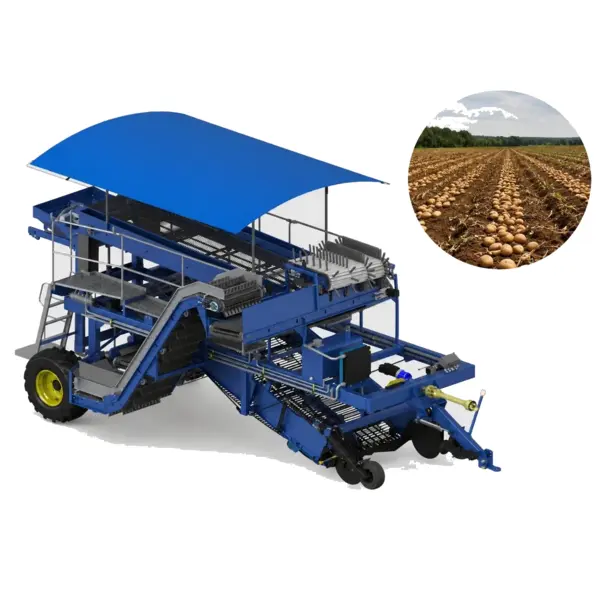
Mesin penggali gandeng EP-AWB-3200 ditujukan untuk operasi yang lebih besar — yaitu operasi di mana laju panen EP-AWB-1600 menciptakan tekanan waktu yang nyata terhadap jendela embun beku musim gugur, atau di mana geometri lahan (baris panjang, medan yang lebih datar, area luas) membuat kapasitas produksi yang lebih tinggi dari konfigurasi gandeng secara ekonomis dapat dibenarkan. Memahami secara tepat kapan ambang batas skala dilampaui — dan apa yang dibutuhkan konfigurasi gandeng dari traktor, lahan, dan logistik panen — adalah informasi yang dibutuhkan oleh operator kentang skala besar Korea sebelum mengambil keputusan investasi mesin penggali.
EP-AWB-1600 vs EP-AWB-3200 — Perbandingan Langsung
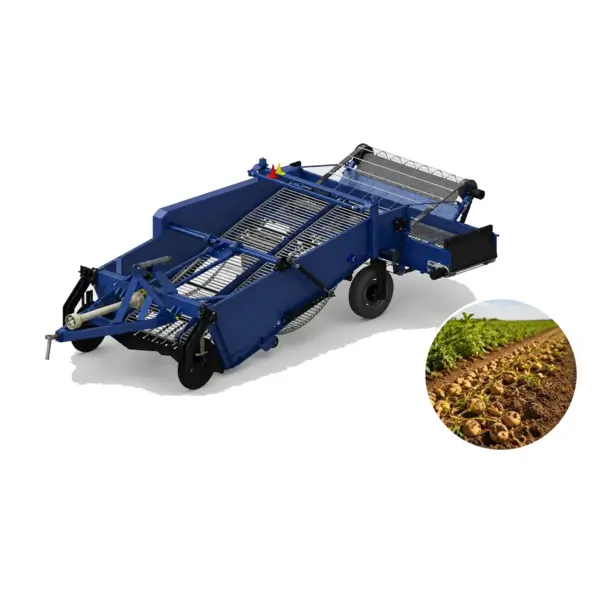
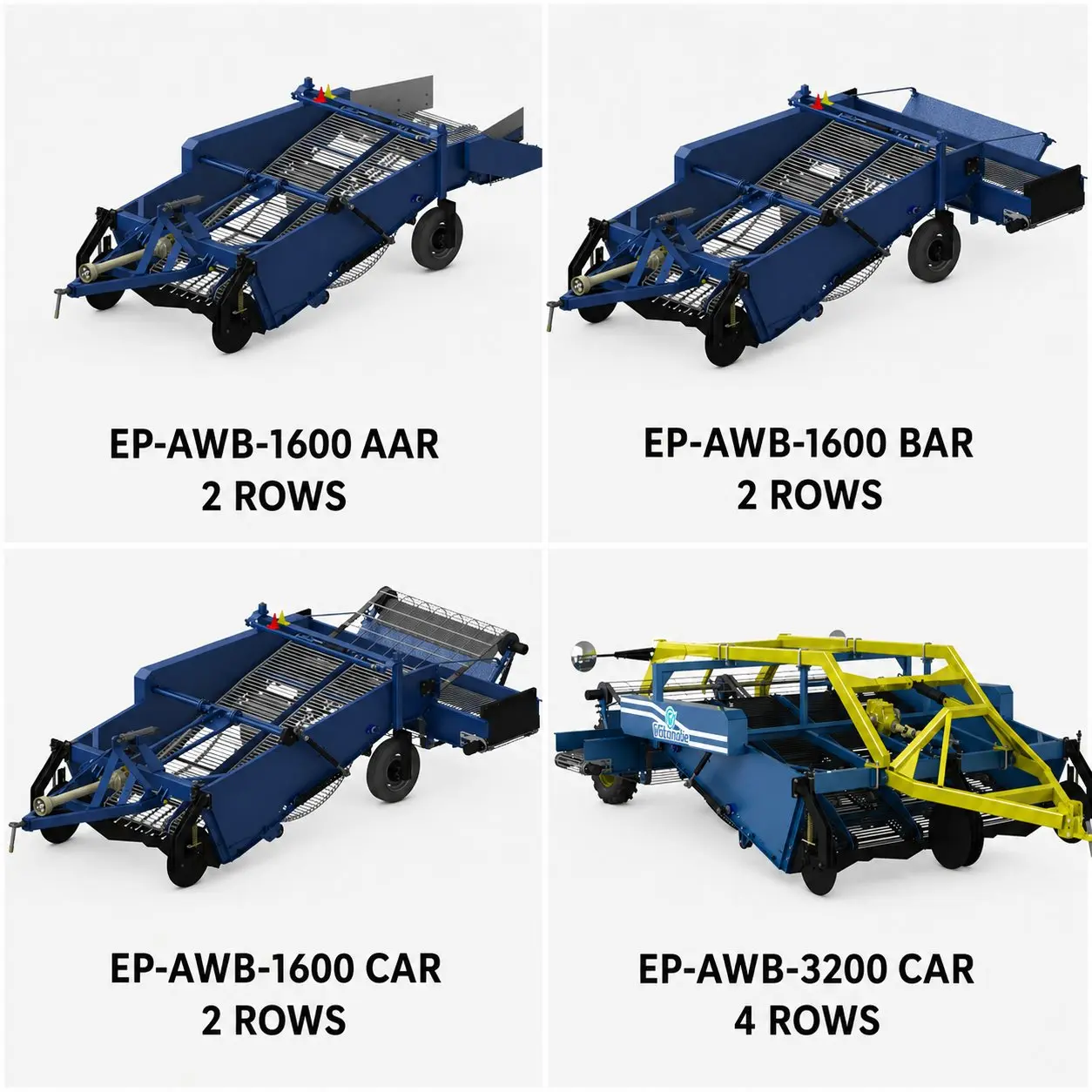
EP-AWB-1600
2 baris · 75 HP · Pengait belakang Kategori 2
- ✓Minimal 75 HP — traktor pertanian standar
- ✓Terpasang — ringkas, putaran paling tajam
- ✓Tingkat produktivitas 0,8–1,2 ha/jam
- ✓Barisan pendek, lereng, teras cocok.
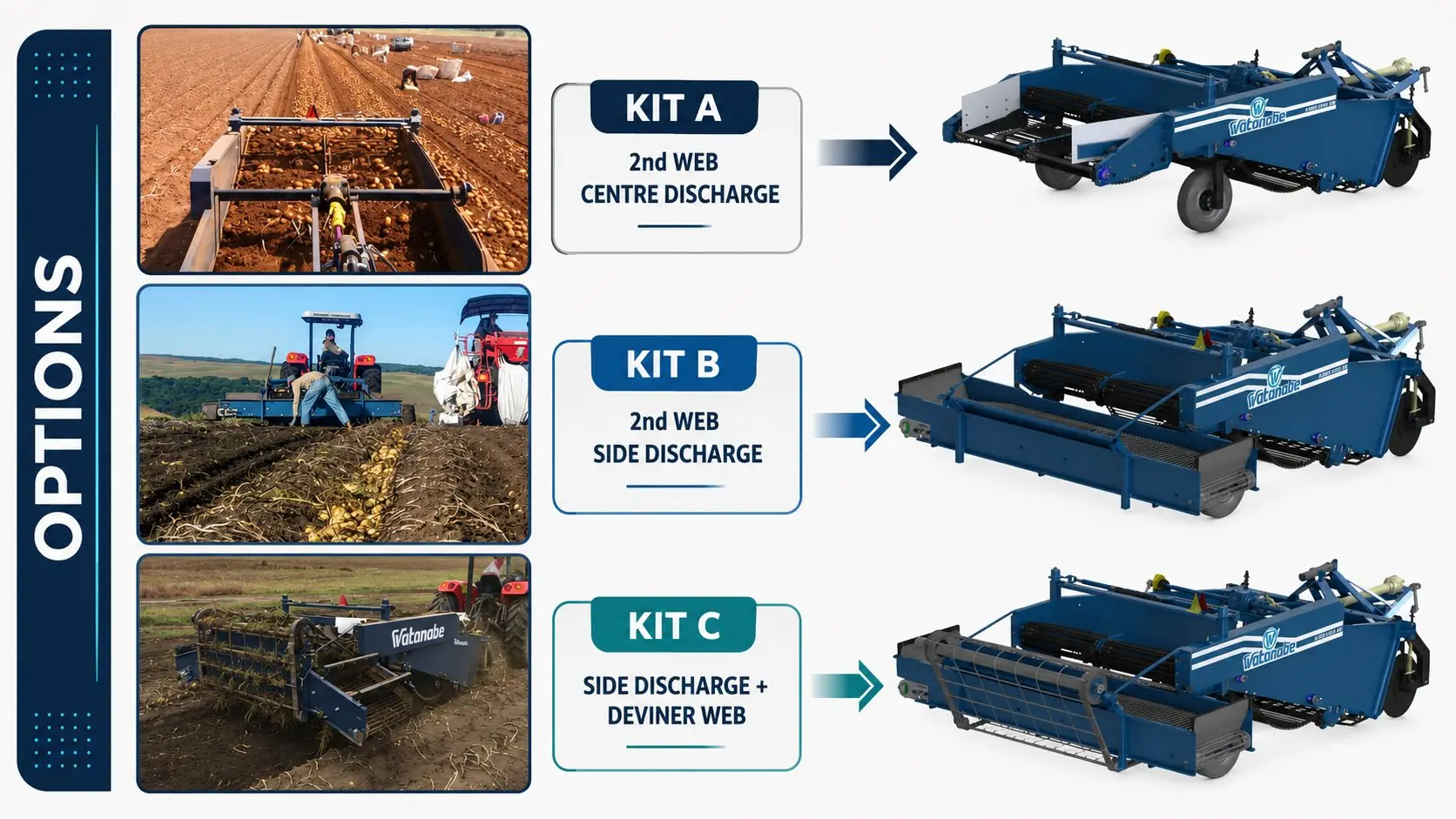
- ✓Kit A (pengumpulan jerami) / Kit B (elevator) / Kit C (pemindahan)
- ✓Skala terbaik: hingga 15–20 hektar
EP-AWB-3200
4 baris · Tenaga kuda lebih tinggi · Drawbar ditarik
- ✓Penarik batang penarik — traktor tidak mengangkat berat mesin
- ✓Panen simultan 4 baris — throughput 2× baris
- ✓Luas lahan panen harian yang lebih besar
- ✓Barisan yang lebih panjang dan medan datar hingga sedang adalah yang terbaik.
- ✓Radius putar yang lebih lebar di tanjung
- ✓Skala terbaik: Operasi seluas 20+ hektar
Mengapa Konfigurasi Trailer — Alasan Rekayasa
Pergeseran dari konfigurasi terpasang ke konfigurasi ditarik bukan hanya soal menambahkan baris — ini mencerminkan perubahan mendasar dalam cara beban mesin ditanggung oleh sistem traktor. Penggali 4 baris jauh lebih berat daripada mesin 2 baris yang terpasang. Memasang penggali 4 baris pada pengait tiga titik belakang traktor pertanian standar akan membutuhkan:
Kapasitas angkat pengait belakang melebihi spesifikasi traktor standar. Sebagian besar traktor pertanian Korea di kelas 100–150 HP memiliki kapasitas angkat tiga titik belakang sebesar 3.000–6.000 Kg pada titik pengait. Mesin penggali 4 baris melebihi batas ini, sehingga membutuhkan traktor pengangkat tinggi khusus atau pendekatan pemasangan yang sama sekali berbeda.
Kehilangan stabilitas gandar depan. Alat berat yang dipasang di bagian belakang mengangkat gandar depan traktor — menciptakan masalah kemudi dan stabilitas di medan dataran tinggi Korea yang miring atau tidak rata. Ini adalah fisika yang sama yang membuat Kit Drawbar diperlukan untuk THOR 2.4 di lereng kebun, yang diterapkan dalam skala yang lebih besar.
Konfigurasi yang ditarik ini memecahkan kedua masalah sekaligus. EP-AWB-3200 terhubung ke traktor melalui batang penarik — sebuah pengait penarik sederhana. Berat mesin ditopang oleh roda tanahnya sendiri, bukan oleh pengait belakang traktor. Traktor memberikan gaya tarik ke depan dan penggerak PTO; mesin menopang beratnya sendiri pada roda penggerak khusus yang juga mempertahankan kedalaman kerja. Gandar depan traktor tetap terbebani dengan tepat, mempertahankan kendali kemudi selama operasi panen.
Ambang Batas Skala — Kapan EP-AWB-3200 Masuk Akal?
Ambang batas skala di mana EP-AWB-3200 menjadi lebih ekonomis dibandingkan EP-AWB-1600 bergantung pada tiga faktor yang saling berkaitan:
Faktor 1: Area panen vs jendela panen
Di Gangwon-do pada ketinggian 600 m, jendela panen sebelum embun beku pertama di musim gugur adalah sekitar 30–45 hari panen produktif dari akhir Agustus hingga awal Oktober. EP-AWB-1600 dengan kecepatan 0,8–1,2 ha/jam dan 8 jam produktif/hari mencakup 190–280 ha dalam jendela tersebut. Operasi dengan luas lahan kurang dari 200 ha tidak menghadapi kendala jendela panen dari mesin penggali. Operasi dengan luas lahan musiman lebih dari 200–250 ha — baik pertanian besar tunggal atau koperasi yang menggunakan satu mesin untuk beberapa anggota — mulai merasakan kendala tersebut.
Faktor 2: Panjang baris lahan
Radius putar EP-AWB-3200 yang lebih lebar di ujung lahan merupakan kerugian nyata pada lahan dengan baris pendek. Lahan pertanian dengan panjang baris rata-rata di bawah 60–80 m menghabiskan waktu yang tidak proporsional untuk berputar di ujung lahan dengan mesin yang ditarik dibandingkan dengan EP-AWB-1600 yang dipasang di mesin dengan radius putar yang lebih sempit. Titik impas di mana keuntungan throughput 4 baris melebihi penalti waktu di ujung lahan biasanya berada pada panjang baris di atas 80–100 m.
Faktor 3: Gradien medan
Mesin EP-AWB-3200 yang ditarik paling efektif di medan datar hingga sedang (di bawah kemiringan 12–15%). Di teras dataran tinggi yang curam (kemiringan 15–25%), stabilitas dan geometri belok konfigurasi yang ditarik di ujung lahan menjadi lebih menantang. Mesin EP-AWB-1600 yang dipasang di traktor lebih baik dalam menavigasi medan dataran tinggi yang curam dan sempit daripada EP-AWB-3200 yang ditarik — yang lebih cocok untuk dasar lembah di ketinggian rendah dan lahan teras yang lebih luas.
Cara Kerja EP-AWB-3200 — Operasi Teknis
Prinsip pemanenan EP-AWB-3200 identik dengan EP-AWB-1600 — mata pisau pengangkat bergerak di bawah zona penanaman umbi, mengangkat tanah dan umbi ke konveyor pemisah jaring bergetar yang membuang tanah sambil membawa umbi ke belakang untuk dibuang. Perbedaannya terletak pada skala dan karakteristik operasional spesifik konfigurasi yang ditarik:
Model Berbagi Koperasi — Bagaimana Petani Korea Mengakses Ekonomi EP-AWB-3200
Banyak usaha pertanian kentang dataran tinggi Korea yang masing-masing menanam 10–15 ha — tidak cukup untuk membenarkan pembelian EP-AWB-3200 sendiri — mengakses keunggulan produktivitas penggali gandeng tersebut melalui program berbagi mesin pertanian koperasi (농협 공동 농기계 사업). Dalam program ini, koperasi membeli dan memiliki EP-AWB-3200 dan menjadwalkan penggunaannya di seluruh lahan pertanian anggota selama musim panen. Setiap anggota membayar biaya penggunaan per jam atau per hektar, bukan biaya pembelian mesin penuh.
Logistik berbagi secara kooperatif — pertimbangan perencanaan
- →Semua lahan pertanian yang berpartisipasi harus memiliki jarak antar baris yang sama — jarak antar baris pada alat tanam EP-AWB-3200 telah ditetapkan untuk jarak tertentu antar baris dan tidak dapat diubah dengan cepat antar lahan pertanian selama musim panen tanpa waktu henti yang signifikan.
- →Penjadwalan panen harus dikoordinasikan berdasarkan kematangan tanaman — tanggal panen setiap lahan pertanian bergantung pada tanggal penanaman dan periode kematangan varietasnya, bukan pada kemudahan administratif. Rencanakan jadwal panen koperasi berdasarkan tanggal kematangan spesifik varietas untuk setiap lahan pertanian anggota yang dikonfirmasi 3–4 minggu sebelum perkiraan dimulainya panen.
- →Transportasi antar lahan pertanian menambah waktu — EP-AWB-3200 yang ditarik truk memerlukan transportasi truk antar lahan pertanian yang bekerja sama. Rencanakan logistik transportasi agar mesin dapat berpindah antar lahan pertanian pada hari-hari di luar musim panen untuk memaksimalkan hari panen yang produktif di setiap lahan pertanian.
- →Hubungi Korea Watanabe untuk mendapatkan dokumen teknis EP-AWB-3200 yang diperlukan untuk permohonan subsidi pembelian mesin pertanian koperasi — program 공동 농기계 지원사업 mungkin memberikan tingkat subsidi yang lebih tinggi untuk pembelian koperasi dibandingkan pembelian oleh petani perorangan.
Langkah 7 Opsi — Mencocokkan Ekskavator dengan Operasi Anda
| Situasi Anda | EP-AWB-1600 | EP-AWB-3200 |
|---|---|---|
| Luas lahan pertanian 2–20 hektar | ✅ Sangat cocok | Terlalu besar |
| Luas lahan pertanian 20–50 hektar | Sesuai jadwal | ✅ Dibenarkan |
| Luas lahan pertanian 50+ hektar | Tekanan jendela | ✅ Wajib |
| Barisan ladang < 80 m (teras dataran tinggi pendek) | ✅ Belokan lebih baik | Hukuman tanjung |
| Barisan ladang > 100 m (dasar lembah, datar) | OKE | ✅ Keuntungan penuh |
| Gradien > 15% | ✅ Lebih stabil | Pertimbangan stabilitas |
| Pasokan pemrosesan (FIBC langsung) | Gunakan CWB-2L sebagai gantinya. | Gunakan CWB-2L sebagai gantinya. |
| Mesin berbagi koperasi | Skala individual | ✅ Ekonomi Koperasi |
| Rotavator PSW-3200 pada 3,6 m (sistem 5 baris) | Hanya 2 baris (3+ lintasan) | ✅ Cocok dengan sistem 4 baris |
Pengelolaan Iklim Panen — Bagaimana Jendela Musim Gugur Dataran Tinggi Mempengaruhi Pilihan Mesin Penggali
Keunggulan produktivitas EP-AWB-3200 hanya akan menghasilkan hasil panen yang lebih baik jika jendela panen itu sendiri menyediakan hari kerja yang memadai. Jendela panen musim gugur di dataran tinggi Korea — periode antara kematangan tanaman dan embun beku pertama — ditentukan oleh ketinggian dan variabilitas cuaca dari tahun ke tahun dengan cara yang secara langsung memengaruhi pilihan mesin penggali.
Di ketinggian 600 m di Gangwon-do, kentang Atlantik matang sekitar 80–100 hari setelah muncul. Untuk penanaman tanggal 25 April, kemunculan terjadi sekitar tanggal 15 Mei, sehingga kematangan terjadi pada awal hingga pertengahan Agustus. Risiko embun beku pertama di dataran tinggi dimulai pada akhir September di ketinggian ini. Ini memberikan jendela panen teoritis selama 6 minggu. Namun, cuaca musim gugur di dataran tinggi Korea menghadirkan tiga kendala pada hari-hari panen produktif dalam jendela ini:
Kelembapan tanah setelah hujan: Kondisi tanah pasca hujan di ladang dataran tinggi Korea membutuhkan waktu 2–4 hari untuk mengering hingga kondisi yang dapat dilalui kendaraan, tergantung pada kelas drainase tanah. Curah hujan 100 mm (bukan hal yang tidak biasa di musim topan akhir musim panas Korea) dapat menghilangkan 3–4 hari dari jendela panen. Kedua konfigurasi penggali sama-sama terpengaruh oleh tanah basah — traktor tidak dapat beroperasi dengan aman dalam kondisi yang sangat jenuh terlepas dari mesin mana yang ditariknya.
Embun beku di permukaan tanah pada pagi hari: Embun beku di permukaan tanah pada awal musim gugur di dataran tinggi tiba sebelum embun beku pertama yang mematikan—biasanya pada akhir Agustus di ketinggian 700–800 m. Embun beku melunakkan tanah di lereng bukit dalam semalam, berpotensi meningkatkan kerusakan kulit umbi akibat benturan mata bajak saat panen pagi hari. Sebagian besar petani dataran tinggi Korea menunda dimulainya setiap hari panen hingga suhu tanah naik di atas 8–10°C—mengurangi jam panen harian yang efektif.
Kematangan tanaman yang berbeda-beda: Ladang dataran tinggi Korea yang ditanami secara bertahap (misalnya, 20 April dan 30 April) memiliki tanaman yang matang dalam dua gelombang — mengurangi tumpang tindih waktu panen tetapi juga berarti mesin penggali tidak dapat memulai blok kedua sampai blok pertama selesai. Penanaman bertahap ini secara inheren membatasi seberapa banyak area harian yang dapat ditangani oleh mesin penggali, sehingga sebagian mengurangi keunggulan kapasitas EP-AWB-3200 dibandingkan EP-AWB-1600 pada operasi dengan kematangan bertahap.
Implikasi praktis untuk pemilihan mesin penggali: operasi pada atau di bawah 15 ha dengan penanaman satu tanggal kematangan jarang menghadapi tekanan jendela panen hanya dari mesin penggali saja — kendala logistik (ketersediaan gerobak, penjadwalan truk, kapasitas penyimpanan) biasanya membatasi area panen harian sebelum laju mesin penggali. Operasi di atas 20 ha dengan penanaman satu tanggal mungkin menghadapi tekanan jendela yang nyata pada tahun-tahun dengan cuaca buruk, di mana kapasitas produksi EP-AWB-3200 yang lebih tinggi memberikan jaminan nyata terhadap embun beku akhir musim yang merusak tanaman yang belum dipanen.
Tugas Pasca Panen — Apa yang Terjadi Setelah Penggalian
Setelah mesin penggali EP-AWB-3200 lewat, tiga tugas selanjutnya menyelesaikan operasi panen:
Memungut sisa panen dengan tangan di belakang ekskavator.
Umbi yang terlewat oleh mata bajak pengangkat tetap berada di ladang. Setelah penggalian, dilakukan pemungutan manual—1–2 pekerja per baris setelah 30–40 menit di belakang traktor—untuk mengambil umbi yang terlewat dan memeriksa kualitas cakupan ladang. Lebar jalur 4 baris pada EP-AWB-3200 membuat logistik pemungutan sedikit lebih kompleks daripada EP-AWB-1600 yang hanya memiliki 2 baris—rencanakan alokasi kru pemungutan sesuai dengan hal tersebut.
Pengelolaan tanaman merambat/batang
Sisa batang tanaman anggur yang telah dikeringkan (haulm) dari gundukan yang diangkat disebar di permukaan lahan setelah alat penggali lewat. Untuk pengolahan tanah rotavator musim berikutnya, batang tanaman anggur perlu dimasukkan ke dalam tanah — baik dengan pengeringan (dibiarkan selama musim dingin) atau dengan melewati mesin pemotong rumput sebelum pengolahan tanah musim semi. Rencanakan pengelolaan tanaman anggur sebagai bagian dari rangkaian persiapan lahan musim gugur pasca panen.
Penilaian pemadatan tanah
Mesin panen di tanah dataran tinggi yang sedikit basah menciptakan jejak roda dan pemadatan antar baris. Periksa lahan untuk kerusakan akibat pemadatan setelah panen — jika jejak terlihat dan daya tembusnya tinggi, pengolahan tanah dalam atau pembajakan dalam sebelum persiapan musim semi mungkin diperlukan untuk mengembalikan profil aerasi dan drainase yang dibutuhkan untuk produksi kentang.
Pertanyaan yang Sering Diajukan
Bisakah satu traktor mengoperasikan EP-AWB-3200 dan alat pembajak alur, penanam, serta pengolah tanah pada musim yang sama?
Ya — EP-AWB-3200 menggunakan pengait batang penarik dan penggerak PTO, yang juga dapat disediakan oleh traktor yang sama yang mengoperasikan pembajak alur (pengait tiga titik Kategori 2) dan penanam (pengait tiga titik Kategori 2). Pengaitan antara alat yang terpasang (pembajak alur, penanam) dan EP-AWB-3200 yang ditarik hanya memerlukan perubahan sistem pengait — melepaskan alat Kategori 2 dan menghubungkan batang penarik, yang memakan waktu 10–15 menit. Dalam operasi musiman, pembajak alur dan penanam digunakan pada bulan April–Mei (persiapan musim semi), dan EP-AWB-3200 pada bulan Agustus–September (panen) — tidak ada konflik musiman untuk traktor yang sama antara operasi ini. Namun, kebutuhan daya kuda (HP) traktor untuk EP-AWB-3200 mungkin lebih tinggi daripada untuk pembajak alur dan penanam yang terpasang — pastikan bahwa traktor yang sama memenuhi persyaratan daya kuda (HP) dan torsi PTO EP-AWB-3200 saat memesan.
Bagaimana penyesuaian jarak tanam pada EP-AWB-3200 dilakukan antar musim jika jarak antar baris berubah?
Jarak antar mata bajak pada EP-AWB-3200 — jarak antara mata bajak pengangkat — diatur agar sesuai dengan jarak antar baris yang ditetapkan saat pembuatan alur. Tidak seperti jarak antar benih dalam baris (yang diubah dengan pemilih gigi pada mesin tanam), jarak antar mata bajak adalah penyesuaian fisik mesin yang biasanya memerlukan pengaturan ulang mekanis pada posisi rangka mata bajak. Ini adalah penyesuaian awal musim atau antar lahan pertanian, bukan operasi harian di lapangan. Konfirmasikan jarak antar mata bajak sebelum memesan EP-AWB-3200 — tentukan jarak antar baris yang telah Anda ukur (diukur di lapangan sebelum panen dimulai, bukan berdasarkan spesifikasi nominal mesin pembuat alur, karena jarak sebenarnya mungkin sedikit berbeda). Korea Watanabe akan mengkonfigurasi jarak antar mata bajak sesuai dengan pengukuran yang Anda tentukan pada saat pengiriman mesin.
Berapakah panjang baris minimum EP-AWB-3200 agar beroperasi secara efisien?
Sebagai pedoman umum, panjang baris tanaman di bawah 60–70 m mengakibatkan EP-AWB-3200 menghabiskan lebih dari 30% total waktu operasi untuk berputar di ujung lahan—secara signifikan mengurangi hasil per jam yang efektif. Pada panjang baris 100 m dan lebih, waktu di ujung lahan turun di bawah 15–20% total waktu, dan keunggulan kapasitas 4 baris dibandingkan EP-AWB-1600 sebagian besar terwujud. Ladang kentang di lembah dataran tinggi Korea di bagian yang lebih datar di Pyeongchang-gun dan Hoengseong-gun biasanya memiliki panjang baris 80–200 m—dalam kisaran di mana EP-AWB-3200 mencapai efisiensi yang baik. Ladang teras pegunungan dengan baris di bawah 50 m lebih baik dilayani oleh EP-AWB-1600 terlepas dari luas lahan pertanian secara keseluruhan.
Apakah EP-AWB-3200 memenuhi syarat untuk subsidi mesin pertanian Korea, termasuk program pembelian koperasi?
Mesin penggali kentang gandeng EP-AWB-3200 (감자 수확기 — 굴취형 트레일러) memenuhi syarat dalam kategori mesin pemanen kentang dalam program dukungan pembelian mesin pertanian Korea. Untuk pembelian koperasi (농협 공동 농기계), program 공동이용 농기계 지원사업 yang dikelola melalui MAFRA dan koperasi pertanian regional dapat memberikan tingkat subsidi efektif per mesin yang lebih tinggi daripada pembelian pertanian individu, yang mencerminkan penghematan biaya dari penggunaan mesin bersama di beberapa pertanian. Permohonan pembelian mesin koperasi biasanya memerlukan perjanjian berbagi mesin koperasi formal (공동이용약정) di antara pertanian yang berpartisipasi. Korea Watanabe menyediakan dokumentasi spesifikasi teknis lengkap untuk permohonan subsidi EP-AWB-3200 baik perorangan maupun koperasi berdasarkan permintaan.
Skala Lahan Pertanian + Panjang Baris + Kemiringan = Jenis Penggali yang Tepat. Mari Kita Konfirmasi.
Luas panen tahunan (ha) + panjang rata-rata baris lahan (m) + gradien medan (%) + daya kuda traktor + rantai pasokan (segar/pengolahan/benih) → Rekomendasi EP-AWB-1600, EP-AWB-3200, atau EP-CWB-2L. Stok lokal Korea, Ansan-si, Gyeonggi-do.
Editor: Cxm