
Korean highland terrace farming creates a dual infrastructure need that flatland agriculture does not face: access roads must traverse significant elevation changes across narrow terrace structures, carry loaded tractor-trailer combinations at harvest time, and remain trafficable through the highland monsoon season (late June to late August) when lowland road materials would turn to mud. The standard solution — importing crushed aggregate from a quarry — is expensive, slow to arrange, and relies on truck access that many highland terrace systems cannot accommodate.
The THOR 3.0 + BlackBird combination offers an alternative that converts what would otherwise be a waste product — the granite fragments removed from cleared fields — into a high-quality road base material that can be positioned at the farm road network’s exact construction points. Understanding the road design standards applicable to Korean highland farm tracks, the material quality that THOR 3.0-crushed granite provides, and the logistics of BlackBird windrow placement creates an integrated farm road construction system that costs a fraction of imported aggregate while building simultaneously with the stone clearing operation.
Why Korean Highland Farm Roads Fail — The Four Root Causes
Korean highland farm tracks that were built without specification — or that accumulated over decades of tractor traffic on unprepared ground — share four characteristic failure modes. Understanding them explains why correct construction pays back across decades of operational life:
Insufficient base depth
Korean highland summer rainfall (June–August) saturates the sub-grade soil. A road base less than 25 cm deep over saturated soil cannot distribute the 8–12 tonne axle loads of a loaded potato trailer without rutting. Standard highland farm tracks built directly on topsoil fail at the first July harvest run after heavy rain.
No drainage provision
Water that cannot drain off a highland road surface flows along the road surface toward the lowest point — progressively eroding the road edge and undercutting the road base. Highland terrace roads without cross-drainage culverts at every 30–50 m interval progressively migrate downslope regardless of initial construction quality.
Excess gradient
Highland terrace road sections exceeding 18% gradient with a loaded trailer cannot be safely descended with standard tractor brake systems in wet conditions. Gradients above 20% on descents produce trailer push — the trailer pushing the tractor ahead — which is a primary cause of tractor-trailer rollovers on Korean highland roads.
Incorrect aggregate size
Quarry-supplied aggregate that is too large (above 40–50 mm) produces a loose, unstable surface that tractors cannot grip on slopes. Sub-5 cm THOR 3.0-fragmented granite — the standard agricultural output — is actually slightly too fine for the base layer but ideal for the wearing surface. The correct design uses a compacted 15–20 cm base layer of angular fragments combined with the THOR-output fine material as a binding surface layer.
Korean Highland Farm Road Specifications — Width, Depth, Gradient and Drainage
The following specifications are derived from Korea Rural Development Administration (RDA) guidance on highland farm access infrastructure and practical Korea Watanabe field experience. They represent the minimum standard for a road capable of carrying loaded potato trailers safely across a full highland operating season:
| Parameter | Minimum standard | Notes |
|---|---|---|
| Running width (single lane) | 3.5 m minimum | 4.0 m preferred. Allows 180 HP tractor + wide attachment (PSW-3200 at 3.6 m) to travel without shoulder damage. |
| Base layer depth (compacted) | 20–25 cm | Angular fragments 10–40 mm from CT-2100 stockpile or quarry. Compacted by tractor wheel passes before wearing surface applied. |
| Wearing surface (THOR output) | 5–8 cm | Sub-5 cm THOR 3.0 fragmented granite spread over compacted base. Self-binding surface that consolidates under traffic. Annual maintenance top-up extends surface life indefinitely. |
| Maximum gradient (loaded descent) | 16–18% maximum | Above 18% on descent with 4 t potato trailer: trailer-push risk increases sharply. Switchback routing reduces gradient where terrain exceeds this limit. |
| Cross-fall (drainage) | 2–3% | Road surface crowned or one-side cambered toward the drainage ditch. Prevents surface water from pooling on the running surface. |
| Culvert spacing | Every 30–50 m on gradients above 8% | 300 mm concrete pipe culvert minimum. Position at natural water flow points identified during survey. Korean highland 1-hour rainfall intensity (50-year return) design standard: 80–100 mm/hr. |
| Turning bay / passing place | Every 150–200 m on single-lane sections | Minimum 8 m × 8 m cleared area. Essential for reversing tractors during harvest when road is one-way by convention. |
Farm Road Cross-Section — Layer Construction Standard
Total road build depth from sub-grade: 28–38 cm. Road width: 3.5–4.0 m minimum.
THOR 3.0 + BlackBird — How the Combination Produces Road Material
The THOR 3.0 rock crusher + BlackBird combination operates as follows in the road aggregate production workflow: the THOR 3.0 fragments stones to the sub-40 mm range ahead of the tractor, while the BlackBird — attached to the THOR 3.0’s rear hitch — sweeps a 9.5 m swath of fragmented material into a concentrated windrow behind the machine. This windrow can be directly positioned along the intended road alignment by planning the THOR 3.0 clearing passes to follow the road route.
Road Aggregate Production Rate — THOR 3.0 + BlackBird Reference Calculation
Representative medium-density Korean highland field: 5 Kg/m² of surface stone to 30 cm depth, bulk density ~1,700 Kg/m³ → ~35–40 kg of stone per metre of THOR 3.0 pass width at the fragmentation depth
THOR 3.0 crushes 3.0 m width; BlackBird sweeps 9.5 m width. At 1.5 km/h forward speed on cleared field: ~1.4 ha/hr aggregate production area swept into windrow
On 1 ha (10,000 m²) at 5 Kg/m² surface stone: approximately 50,000 Kg = 50 tonnes of fragmented granite per hectare of collection area
~50 tonnes → sufficient for approximately 80–120 linear metres of completed road (3.5 m wide, 25–30 cm total build depth) using the collected material for both base and wearing surface layers
The practical implication: every hectare of Korean highland field cleared with the THOR 3.0 + BlackBird system produces the equivalent aggregate for 80–120 m of completed farm road. A 10 ha field clearance operation produces aggregate for 800–1,200 m of road network — enough to connect most highland terrace systems to a permanent access route without importing any external aggregate. The only external material cost is the drainage culverts. Farms using a rock picker can supplement BlackBird collection and any compaction layer supplementation where field aggregate volume alone does not provide sufficient base depth.
The operation requires one additional logistics step: once the BlackBird has collected material into windrows, a front loader or telescopic handler repositions the windrow material to the road construction alignment. This repositioning pass — combined with tractor-wheel compaction during the first loaded harvest season — produces a self-compacting wearing surface that strengthens over the first 3–6 months of traffic.
Small-Scale Alternative — CT-2100 Bunker Dump Stockpiling for Road Aggregate
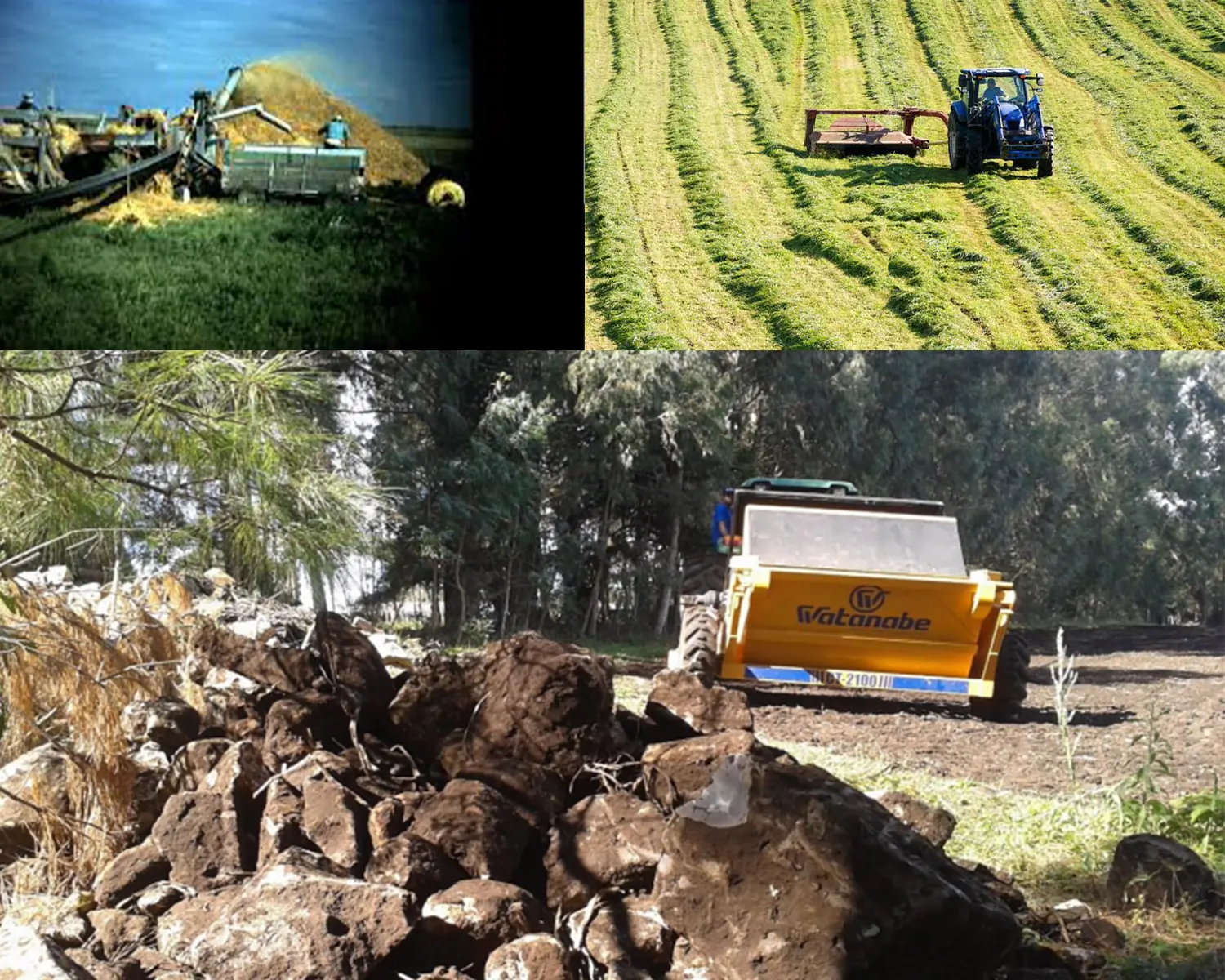
Farms operating the THOR 2.4 rock crusher without the BlackBird can still build farm roads from their own cleared stone — the process is slower but requires no additional equipment beyond the THOR 2.4 and CT-2100 that most Korean highland farms already own.
The CT-2100 stockpile method: instead of dumping the CT-2100 bunker at the field boundary (standard practice for cleared-field waste), plan a series of dump points along the intended road alignment at 15–20 m intervals. Over a full field clearing season, these dump points accumulate progressively larger aggregate stockpiles that can be spread and graded as the road construction proceeds. The CT-2100’s 2.5 m³ bunker holds approximately 3–4 tonnes per load at typical Korean highland fragment bulk density — 20–25 dumps along a 400 m road route produces the aggregate for the complete wearing surface layer.
BlackBird method (THOR 3.0 required)
Crushes and collects simultaneously. 9.5 m sweep width collects maximum material per pass. Produces windrows directly positionable along road alignment. Best for farms building 500+ m of road from field aggregate. Requires 300 HP CVT tractor + THOR 3.0 + BlackBird system.
CT-2100 stockpile method (THOR 2.4 sufficient)
Collects from field and dumps at planned road points. Aggregate volume limited by CT-2100 bunker capacity and dump frequency planning. Best for farms building 100–400 m of access track from normal field clearing operations. Requires no additional equipment investment.
Drainage — The Most Critical Korean Highland Road Design Decision
Korean highland monsoon season rainfall intensity — typically 50–100 mm per hour during peak events in late July and early August — makes drainage the critical farm road design parameter. A road that is structurally adequate under dry conditions can be completely undermined in a single monsoon event if drainage is not correctly designed.
The Korean RDA guidance document on highland farm infrastructure specifies culvert sizing based on contributing catchment area and design rainfall intensity. For practical farm road construction planning, the following simplified decision criteria apply:
Annual Road Maintenance — Keeping the Road Network Viable for Under 500,000 KRW/km/Year
A well-constructed Korean highland farm road requires annual maintenance to remain at full specification. The good news is that the same THOR 3.0 field clearing operations that generated the original construction material also generate the maintenance material — each year’s clearing season produces fresh wearing surface material that can be applied to the road network as part of the same operational pass.
Annual Maintenance Schedule and Estimated Cost — 1 km Farm Road
Walk inspection of all culverts — clear debris from inlets. Check road surface for frost-heaved material. Cost: 2–3 hours operator time.
Apply fresh wearing surface material (10–15 cm loose depth) collected from spring THOR 3.0 operations to any sections showing rut depth above 5 cm. Grade with tractor bucket or blade attachment. Cost: fresh material from field operations (zero import cost) + 4–6 hours equipment time.
Inspect for erosion damage after monsoon season. Check culvert outlets for sediment blockage on downstream side. Repair any edge slump on high-gradient sections before harvest. Cost: 3–5 hours inspection + repair as needed.
Bulk of annual maintenance pass. Apply wearing surface material from autumn THOR 3.0 operations. Compact with loaded tractor passes. Clear drainage ditches of accumulated vegetation. Cost: material from field operations + 6–8 hours equipment time.
Culvert replacement (allowance 5% per year): ~100,000–200,000 KRW. Equipment operating time: ~300,000 KRW/km. Material: zero (from field operations). Total: ~400,000–500,000 KRW/km/year. Compare: quarry aggregate import for equivalent maintenance: 800,000–1,500,000 KRW/km/year.
Frequently Asked Questions
How do I build a farm road on Korean highland terrain — what is the minimum specification for a loaded tractor?
The minimum specification for a Korean highland farm road designed for a 180 HP tractor pulling a 4-tonne loaded potato trailer is: 3.5 m running width, 20–25 cm compacted aggregate base, 5–8 cm wearing surface, maximum 16–18% gradient on descents, cross-drainage culverts at every 30 m on gradients above 8%. Any section below this specification will fail under repeated harvest-season loading, particularly on sections where the sub-grade soil is saturated from monsoon season rainfall. The specification is achievable using THOR 3.0-fragmented field granite as the primary aggregate source — no external import is required for farms clearing 5+ ha of adjacent field area.
What is the road aggregate production rate of the THOR 3.0 and BlackBird combination per day?
At 1.5 km/h forward speed with the THOR 3.0 + BlackBird combination on moderate-density Korean highland granite (5 Kg/m² surface stone), the combination covers approximately 1.4 ha per hour of net collection area at an 8-hour effective operating day — producing aggregate from approximately 8–10 ha of field collection area per operating day. At 50 tonnes of aggregate per hectare of collection, this produces 400–500 tonnes of road-grade material per day — sufficient for 500–700 linear metres of farm road wearing surface application. This production rate exceeds what any truck-delivered aggregate service could provide to highland terrace sites with limited access. The practical bottleneck is not aggregate production but redistribution logistics: the BlackBird places material in windrows, but a front loader or dedicated grading operation is required to place and level the material onto the road formation.
Does building a farm road from crushed granite require planning permission in Korea?
Farm access roads built within registered agricultural land and used exclusively for agricultural operations are generally classified as agricultural infrastructure rather than road construction projects under Korean land law, and do not require construction permits equivalent to those required for public roads. However, several situations do require consultation with the county agricultural committee: (1) roads that cross property boundaries (even between parcels owned by the same person require registration of the right of passage); (2) roads that connect to or cross a public road at a new junction point (requires consultation with the county road authority); (3) roads that alter natural watercourses or drainage channels (requires consultation with the county irrigation authority). For farm roads entirely within one’s own agricultural land and not intersecting public roads, the construction process is generally self-regulatory — document the road construction in the farm record and include it in the next soil conservation report. Korea Watanabe recommends confirming with the local county agricultural office before beginning construction on any road that approaches or crosses a property or administrative boundary.
Can the THOR 2.4 produce usable road aggregate or does this require the THOR 3.0?
The THOR 2.4 produces the same sub-5 cm fragment size as the THOR 3.0 — the fragment size output is determined by the rotor speed and tooth geometry, not the machine width or power rating. THOR 2.4-fragmented granite is perfectly usable as road wearing surface material. The argument for the THOR 3.0 + BlackBird combination in a road construction context is not fragment quality but collection efficiency: the BlackBird sweeps a 9.5 m collection width simultaneously with the THOR 3.0’s crushing pass, producing 3× more collected aggregate per operating hour than a sequential THOR 2.4 + CT-2100 approach. For farms that already own the THOR 2.4 and CT-2100 and are building road in stages alongside their annual field clearing programme, the CT-2100 stockpile method (described in Section 4 above) produces adequate aggregate from the existing machine combination — it simply takes longer and requires more deliberate dump-point planning to accumulate the volume needed.
Is there a Korean government subsidy for farm road construction using own aggregate?
Korean highland farm access road construction using own-produced aggregate does not have a dedicated machine subsidy (the aggregate comes from the farm’s own field clearing operations). However, the THOR 3.0 and BlackBird machines used to produce the aggregate are eligible for the standard Korean agricultural machinery subsidy at 40–50% of purchase price — meaning the aggregate production system itself benefits from subsidy. The road construction labour and equipment operating costs (culvert materials, fuel, operator time) are generally not separately subsidised but can be documented as farm infrastructure investment in the farm record for tax accounting purposes. Contact the county Nong-hyup or agricultural office and see the rock crusher product range for the current classification of farm road infrastructure investment under Korean agricultural capital improvement incentive programmes, which are periodically revised and may offer additional support depending on the farm’s county location and registered crop.
Farm Road Planning From Your Stone Clearing Operation
Field area + planned road network + terrain gradient → Korea Watanabe provides road specification, aggregate volume calculation from THOR 3.0 + BlackBird operations, drainage culvert spacing plan and annual maintenance schedule.
Editor: Cxm