
Korean highland terrace farms were originally designed around human and animal labour — paths wide enough for a person carrying a load, gradients accessible by a bull or small hand tractor, and field entries positioned for ease of walking. Modern Watanabe machinery has fundamentally different access requirements: the THOR 2.4 + tractor system requires a minimum road width of 2.5 m, a maximum sustained gradient of 25% on the approach track (with 20% as the operating standard on the field itself), and a turning circle that allows the tractor + machine combination to reach each terrace field without backing manoeuvres that are dangerous on slope terrain.
The investment in the THOR 2.4 rock crusher, CT-2100 rock picker, and potato machinery system often precedes the road network assessment — Korean highland farmers purchase machines and then discover that several field blocks cannot be accessed without road improvements. This article addresses road network planning as a first-step exercise that precedes machine selection: mapping the existing access routes, identifying the blocks that are not machine-accessible, specifying the road improvements needed, and calculating the investment required to make the full farm mechanically accessible.
Why Road Network Assessment Comes Before Machine Purchase
The farm access road network determines the machine deployment map — the set of field blocks on which each machine can actually be operated. The productivity and ROI projections for the Watanabe system assume that the machines can reach every field block that needs stone clearance, tillage, or harvest operations. Where the access road network has gaps, the machines cannot deploy, the production from inaccessible blocks cannot be improved, and the ROI projection is over-estimated for the actual operational territory available.
The inaccessible block problem
A typical Korean highland mixed-terrace farm of 10 ha has 15–25 individual field blocks at various altitudes and terrace levels. On average, 20–35% of these blocks have access routes that do not meet modern machine access standards — they are accessible by a 25 HP hand tractor but not by a 75–100 HP standard tractor with a rear-mounted THOR 2.4 or CT-2100. These blocks cannot receive stone clearing or mechanised potato preparation until the access route is improved. They continue to be farmed by hand — the least productive and least economic approach — while the adjacent blocks receive the full mechanisation benefit.
Road improvement as machine access enabler
A road improvement investment that converts one inaccessible 1.5 ha block from hand-tractor-only to full-machine-access adds the equivalent of 1.5 ha of new productive mechanised farmland to the farm system — without purchasing additional land. The cost of the road improvement is typically 2,000,000–8,000,000 KRW per 100 linear metres of improved track (depending on terrain, current condition, and surface material) — often less than the annual production value of the 1.5 ha block once it receives full THOR 2.4 + potato system mechanisation.
Machine Access Requirements — Gradient, Width, and Turning Circle Specifications
Each machine in the Watanabe system has specific access route requirements that determine whether it can safely traverse a given track to reach a field block. The access requirements increase from the smallest to the largest machine:
| Machine | Max sustained approach gradient | Minimum track width | Minimum turning radius |
|---|---|---|---|
| 75 HP tractor (unladen) | 35% | 2.0 m | 4.0 m |
| THOR 2.4 + tractor (operational) | 25% (Kit Drawbar required above 12%) | 2.8 m | 6.5 m |
| CT-2100 (loaded, 6–8 tonne) | 15% loaded descent, 20% ascent | 2.5 m | 7.0 m |
| EP-AWB-1600 + tractor (operational) | 20% | 2.5 m | 6.0 m |
| Harvest collection trailer (5–8 tonne, full) | 12% loaded descent | 3.0 m | 8.0 m |
| Agricultural truck (5 tonne, for market) | 10% loaded descent | 3.5 m | 10.0 m |
The governing constraint is the most restrictive machine
The road standard required for a field block is determined by the largest, heaviest machine that must access that block. A block served only by the THOR 2.4 for stone clearing needs 2.8 m width and 25% maximum gradient. A block that also requires harvest truck access needs 3.5 m width and 10% maximum loaded descent gradient — the harvest truck is the governing constraint. Design every farm road section to the standard of its most restrictive intended user, not its average user.
Road Surface Specifications — What Korean Highland Machines Need Underfoot
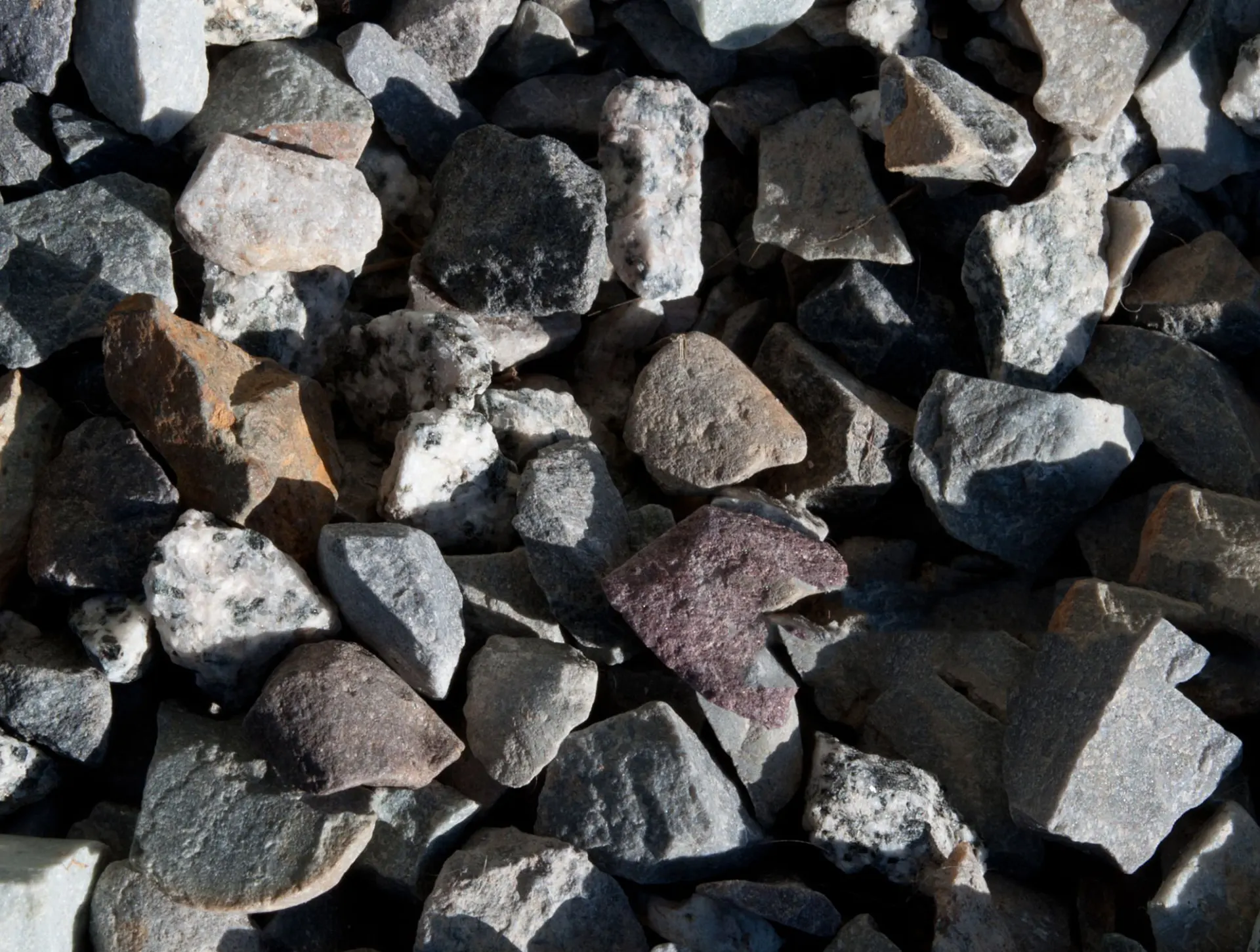
Korean highland granite terrain offers natural road building material in abundance — the crushed stone aggregate produced by THOR 2.4 and THOR 3.0 operations is exactly the angular crushed granite that makes superior road surfacing material. The key is matching the aggregate specification to the road section’s traffic requirements:
150–200 mm compacted aggregate base layer of 40–80 mm THOR 3.0 crushed granite (coarse base for load distribution and drainage), topped with 50–80 mm of 10–20 mm THOR 2.4 aggregate (finer surface layer for traction and smoothness). Total 200–280 mm compacted depth. On gradient sections above 15%, add a 20–30 mm fine aggregate blind coat on top to improve grip in wet conditions. Annual inspection: check for rut formation after the first heavy rain each autumn; re-grade and top-dress as needed before the next spring preparation season.
100–150 mm compacted aggregate from THOR 2.4 output, blended from 10–40 mm fragment range. These tracks carry tractor + THOR 2.4 or tractor + EP-AWB-1600 only — not loaded harvest trailers or harvest trucks. A lighter surface specification is appropriate and reduces construction cost significantly. Target surface: firm, level, no loose material more than 30 mm diameter that could cause tyre damage.
The CT-2100’s collected output from THOR field clearing operations is the most cost-effective road surface material available to Korean highland farms — it is produced as a byproduct of the essential field clearing operation that would be conducted regardless of the road building programme. CT-2100 deposit zones located strategically near planned road sections allow the aggregate to be redistributed directly to the road surface without double-handling. On farms planning road improvements, coordinate the THOR clearing schedule to deposit aggregate adjacent to the road sections being built.
BlackBird 9.5 m for Wide-Area Road Clearing — The High-Coverage Road Infrastructure Tool
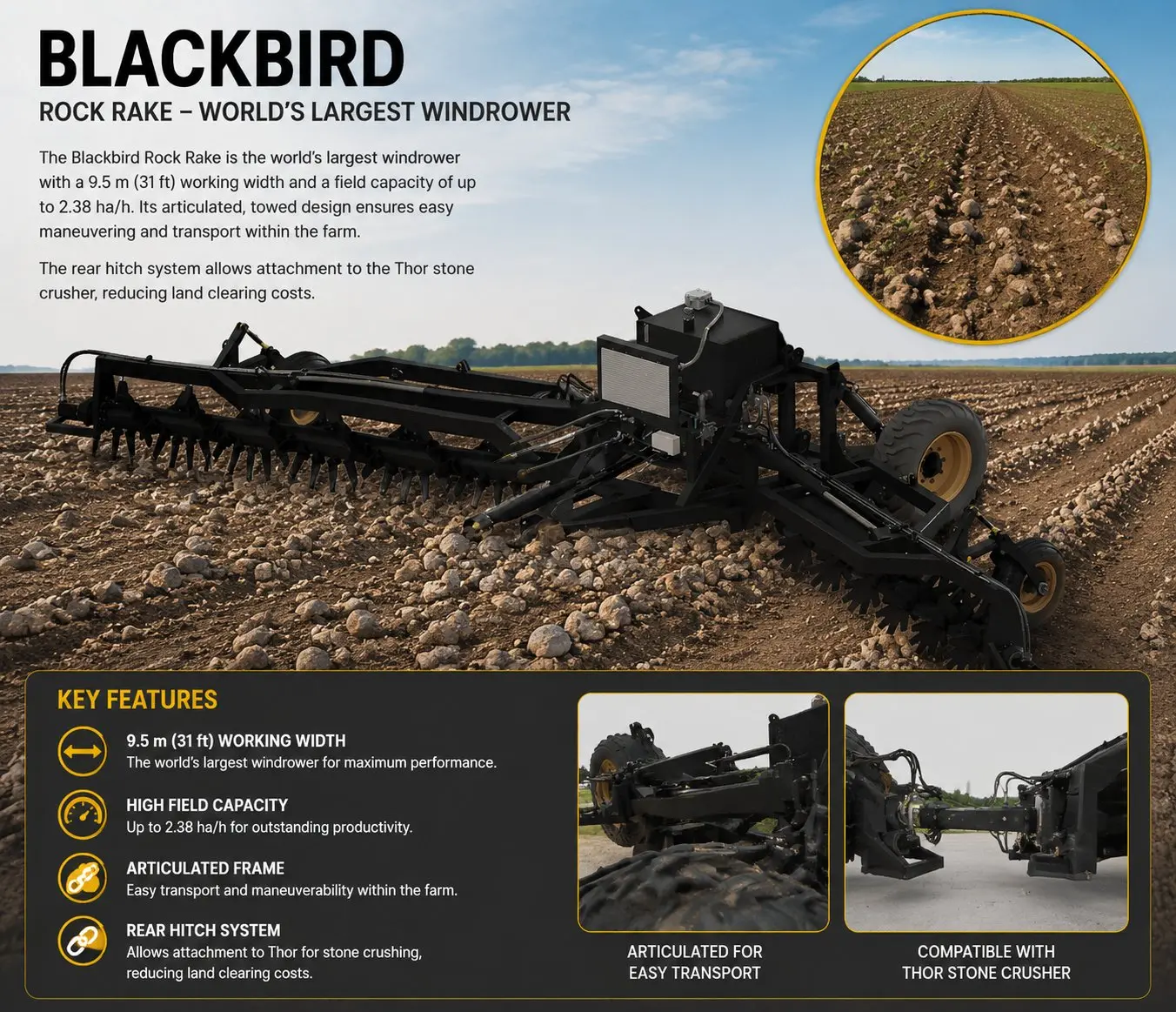
For Korean highland farms with extensive road networks to clear and maintain — particularly contractors or large farm operations where road clearing is a recurring annual requirement — the BlackBird 9.5 m rock rake provides a coverage rate for road and adjacent margin stone management that no other Watanabe machine approaches. Where the THOR 2.4 + CT-2100 combination is the definitive field stone clearing system, the BlackBird’s 9.5 m working width makes it the definitive road and wide-margin stone clearance system:
Road surface and shoulder clearing
The BlackBird’s 9.5 m width simultaneously clears the road surface (3.0–3.5 m) and both road shoulders (1.0–1.5 m each side), collecting stones from the full road cross-section in a single pass. This comprehensive clearance prevents the shoulder stone accumulation that reduces effective road width over multiple seasons. Annual BlackBird passes on the full farm road network can be completed in 1–2 days per km of road — a fraction of the time required for equivalent clearance by THOR + CT-2100 operating on roads.
THOR 3.0 companion for hard aggregate production
The BlackBird’s product specification confirms that it can be paired with the THOR 3.0 through a rear hitch connection — the THOR 3.0 fragments stones in the path ahead of the BlackBird while the BlackBird collects both the freshly fragmented material and existing surface stone simultaneously. This THOR 3.0 + BlackBird combination is the highest-productivity Korean road and margin stone clearing system for contractor operations or large farm networks where new road construction requires both large stone fragmentation and surface collection in a single deployment.
Seasonal Road Maintenance Programme — Protecting the Access Infrastructure Investment
Korean highland farm roads face two primary degradation mechanisms that require systematic seasonal maintenance: frost heave stone emergence (winter) and monsoon runoff erosion and surface displacement (July–August). A simple maintenance calendar prevents the progressive road quality deterioration that makes access increasingly unreliable over successive seasons:
Drainage Design — The Single Factor That Determines Korean Highland Road Longevity
Korean highland farm roads without adequate drainage fail regardless of surface material quality. The monsoon rainfall that delivers 200–400 mm in a 48-hour typhoon event will destroy any road surface that does not have designed water management. The drainage elements that distinguish a durable Korean highland farm road from one that requires major annual reconstruction:
Every road section must be built or maintained with a transverse crown — a slight convex cross-section that drains water off both sides of the road surface. Target crown: 2–3% cross-slope from centreline to edge on straight sections. Without crown, water ponds on the road surface and softens the sub-base, producing ruts under machine axle loads. The grader or blade pass in the April pre-season maintenance restores the crown profile lost to traffic wear and frost deformation.
Water that is drained off the road surface by the crown profile must have somewhere to go. On slope roads where the uphill side is a cut face and the downhill side is a fill embankment, side drains must be cut at 20–30 m intervals to carry surface water off the road and down the slope through defined channels rather than allowing it to accumulate on the road surface or undermean the fill embankment. Korean highland roads without side drain outfalls progressively accumulate water behind any obstruction, causing embankment failure.
Any point where a natural water flow path crosses the road alignment requires a culvert — a drainage pipe (minimum 300 mm diameter for Korean highland monsoon flows) installed under the road surface to carry water through rather than over the road. Culverts are the most costly individual drainage element but their absence is the most common cause of catastrophic road failure: a blocked natural drainage path builds pressure behind the road until the road surface itself is breached, typically in a typhoon event.
The Road Network Investment Case — Unlocking Blocked Field Productivity
The investment case for Korean highland farm road improvement is built on a straightforward calculation: what is the annual production value of the currently inaccessible field blocks that would become machine-accessible after road improvement?
Representative investment case — 10 ha Korean highland farm with 2 ha currently inaccessible:
Frequently Asked Questions
Does the Korean government provide any subsidy or support for farm road construction?
Yes — the Korean Ministry of Agriculture, Food and Rural Affairs (MAFRA) operates the farmland infrastructure improvement programme which includes support for agricultural road construction and improvement. The programme covers qualified access road improvements that enable mechanised farming on previously inaccessible agricultural land. Application is through the county agricultural office or directly through the Rural Development Corporation (Han-guk nongeo gongsa). The subsidy covers up to 50–70% of eligible road construction costs for access roads that serve registered agricultural land and enable improved machinery access. Korea Watanabe can provide introduction to the relevant county agricultural office contacts for customers planning road improvement as part of their mechanisation programme. Confirm current rates and eligibility criteria in January of the planned construction year, as programme allocations and subsidy rates change annually.
Can the THOR 2.4 itself be used to improve an existing rough track surface?
Yes — the THOR 2.4 can fragment large stones in an existing rough track surface, producing the angular crushed material that becomes the road’s improved aggregate base. This is one of the most cost-effective uses of the THOR 2.4 when field clearing operations are complete for the season and the machine has remaining capacity: running the THOR 2.4 along existing rough tracks fragments the large embedded stones that create the height variations and axle impacts that damage vehicles and machines. The subsequent CT-2100 pass collects the oversized fragments, leaving the compacted angular crushed surface that provides the traction and stability needed for the improvement. The THOR 2.4’s road improvement role is surface fragmentation of existing stones — it does not add new aggregate material. Sections that have lost aggregate depth require additional CT-2100 deposit material to restore surface depth.
How wide does a turning area at each terrace headland need to be?
The turning area (headland turning circle) required at each terrace level depends on which machines are turning there. For THOR 2.4 + 75 HP tractor: minimum 6.5 m diameter clear area — the THOR 2.4’s width and length require this minimum to complete a 180-degree turn without reversing on the terrace headland. For harvest trailer + collection tractor: minimum 8.0 m diameter. For harvest truck (5 tonne): minimum 10.0 m diameter or a dedicated reversing bay where through-turning is not possible. On Korean highland terraces where the headland turning area is constrained by the terrace geometry, designing a wider turning apron at the headland during the initial terrace construction or road improvement provides the access that makes all subsequent machine operations more efficient. Many Korean highland access problems are solved not by widening the road itself but by widening the headland turning area at each terrace level.
How does road network quality affect the economics of using a contractor rather than owning machines?
A contractor pricing stone clearing services charges a per-hectare rate that assumes the THOR 2.4 and CT-2100 can reach the field blocks within a reasonable transport time from the road entrance. Field blocks that require the contractor to traverse degraded tracks, cross steep undeveloped gradients, or perform slow manual vehicle recoveries add time that the contractor cannot absorb in the standard per-hectare rate — either the rate increases for difficult-access fields or the contractor declines to service them. Korean highland farms that invest in road improvement before calling a contractor find that: (1) more contractors are willing to service the farm; (2) the per-hectare rate is lower because the access time overhead is reduced; and (3) the contractor can complete more hectares per day (better productivity → lower per-hectare cost for the farm). The road improvement investment benefits contractor service economics as much as own-machine operation economics.
What is the minimum road specification for getting the THOR 2.4 to a field that has never been machine-accessed?
For the first-ever THOR 2.4 access to a previously unmachined field block, the minimum viable approach route requires: width — a continuous clear path of 3.0 m (allow 0.2 m margin each side of the 2.8 m THOR + tractor combination width for overhang and tracking variation); gradient — no section exceeding 25% sustained, with 20% as the safe operating standard for repeated daily use; surface — firm enough to support the 75–100 HP tractor’s drive wheels without rutting more than 80 mm depth (rutted tracks that allow the tractor’s differential to engage are manageable; tracks that allow the tractor to sink to the axle are not). If any one of these three criteria cannot be met on the intended approach route, plan the road improvement before attempting the first THOR 2.4 access. A THOR 2.4 that gets stuck or tips on an unmaintained track during the first access attempt creates a recovery cost that typically exceeds the road improvement cost that would have prevented the problem.
Farm Road Network Assessment — Before Machine Purchase
Farm map (ha) + number of field blocks + estimated inaccessible blocks + planned machine system → road improvement priority list with specification and investment estimate. Korea Watanabe, Ansan-si, Gyeonggi-do.
Editor: Cxm