The furrower is Step 3 in the Watanabe 7-step Korean highland potato system — positioned after stone clearing (Step 1) and primary tillage (Step 2), and immediately before planting (Step 4). The furrower’s role is to form the initial ridge and furrow geometry that structures the entire potato plant’s growing environment: the ridge is the tuber development zone, the furrow is the drainage channel, and the row spacing is the geometry that the planter, cultivator-hiller, and harvester must all follow precisely.
The EP-R-380 (3-row, 75 HP, Cat.2, 540 RPM) and EP-R-580 (5-row, 100 HP, Cat.2, 540 RPM) are the furrower models in the Watanabe potato machinery range, confirmed from the official Watanabe product brochure. This guide covers the mechanical operation of both models, the critical ridge geometry parameters that determine downstream system performance, the interaction between furrower depth and stone clearing quality, the fertiliser band placement option available at the furrowing step, and the row spacing coordination requirements with the EP-PAI-2100 planter, EP-ERA cultivator-hiller, and EP-AWB-1600 digger.
EP-R-380 and EP-R-580 Confirmed Specifications
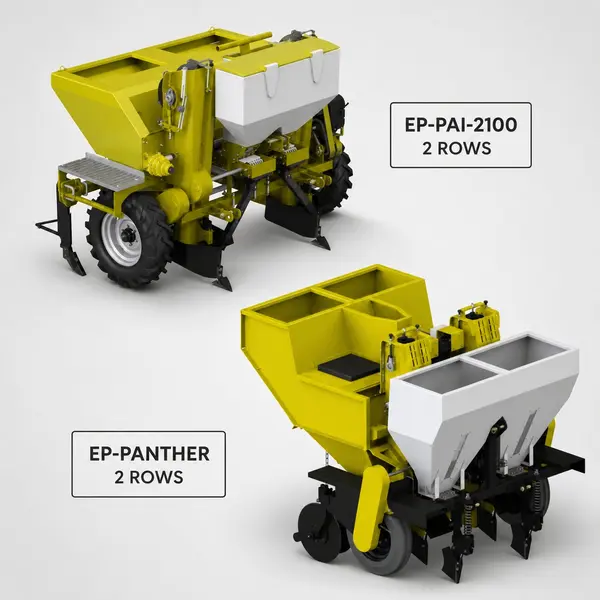
All specifications from the Watanabe official product brochure.
EP-R-380
3-row — standard highland farm
- ▸Rows: 3 simultaneous
- ▸Power: 75 HP minimum
- ▸Hitch: Cat.2
- ▸Best for: farms using EP-ERA-3100 hiller, 3-row planting pattern
EP-R-580
5-row — large-scale or contractor
- ▸Rows: 5 simultaneous
- ▸Power: 100 HP minimum
- ▸Hitch: Cat.2
- ▸Best for: farms using EP-ERA-5100 hiller, 5-row or EP-PAI-480-AR 4-row scale
What the Furrower Does — Ridge Formation Mechanics
The furrower’s operation is mechanically straightforward but produces a result with far-reaching agronomic consequences. Each row unit consists of a hiller body (a V-shaped blade or disc assembly) that pushes through the tilled soil surface, displacing soil laterally and upward to form a raised ridge with a furrow (channel) in between adjacent rows. The furrow centreline becomes the wheel track for the tractor on subsequent field operations; the ridge top becomes the planting zone for the seed potato.
Ridge height (target):
12–18 cm above the furrow base level — sufficient for EP-ERA hilling to add a further 10–15 cm at Step 6, achieving the final pre-canopy closure ridge height of 22–30 cm. An initial furrower ridge that is too low (below 10 cm) cannot be adequately supplemented by hilling without throwing excessive soil onto the plant, risking stem burial.
Ridge width at base (target):
40–50 cm — wide enough to contain the developing tuber zone without excessive soil compaction at the ridge edges. Too narrow a ridge (below 35 cm at base) constrains tuber development laterally and increases surface exposure risk. Too wide (above 55 cm) reduces the furrow width that provides drainage — potentially increasing waterlogging risk on Korean highland soils with limited subsoil drainage.
Furrow depth (target):
8–12 cm below the tilled field surface — sufficient to provide rapid drainage after heavy rainfall without being so deep that the furrow base is below the stone-cleared and tilled zone, creating a drainage channel in un-prepared subsoil.
Row spacing (critical system parameter):
The row spacing set at furrowing determines the geometry of all subsequent operations in Steps 4–7. The furrower’s row spacing must be confirmed in the field before the first operating pass — and must precisely match the configured spacing of the EP-PAI-2100 planter, EP-ERA cultivator-hiller, and EP-AWB-1600 digger. The most common Korean highland furrower spacing settings are 70 cm, 75 cm, and 80 cm — confirm your farm’s standard with Korea Watanabe when purchasing any of the Step 3–7 machines.
How Stone Clearing Quality Determines Furrower Performance

The furrower operates on the tilled soil surface produced by the PSW-3200 rotavator at Step 2. The quality of this tilled surface — its uniformity, tilth fineness, and freedom from embedded stones — directly determines the furrower’s ridge geometry output. This is where the Step 1 stone clearing quality propagates forward to affect Step 3:
On stone-cleared fine tilth
The EP-R-380/580 hiller bodies move through the uniform fine tilth without obstruction — each row unit traces the same depth path consistently across the field. The resulting ridges are symmetrical, uniform in height and width, and consistent in row spacing from the first pass to the last. The planter at Step 4 can be set to seed depth based on the ridge geometry from this consistent furrowing — and the EP-ERA hiller at Step 6 finds the same geometry in every row across the field, producing consistent hilling results.
On un-cleared coarse tilth
Residual stones in the PSW-3200 tilth deflect the EP-R hiller body laterally or vertically when contacted — producing ridges that deviate from the intended centreline position. A 3–5 cm lateral deviation in ridge centreline across a 100 m field row means the EP-AWB-1600 digger share (set to the intended row spacing) is no longer aligned with the ridge centreline at the end of the row — missing tubers on one side of the ridge. Stone-obstructed tilth also produces variable ridge height — some sections higher where soil was deflected upward by a stone, some lower where soil was not adequately moved. Variable ridge height means variable planting depth from the EP-PAI-2100 — producing uneven emergence timing across the field.
Fertiliser Band Placement at Furrowing — Incorporating the Base Fertiliser at Step 3
The EP-R-380 and EP-R-580 furrowers are compatible with fertiliser banding attachments that deposit base fertiliser in a concentrated band at the base of the furrow as it is formed — positioning the nutrient supply precisely where the developing root system will access it during early plant establishment. Fertiliser banding at furrowing is the most placement-efficient method for Korean highland potato base fertiliser application:
Band placement advantage vs broadcast:
Broadcast fertiliser application (applied before PSW-3200 tillage and incorporated into the full tilth volume) distributes nutrient throughout the entire tilled zone — including the furrow area where no crop roots will develop in the early season. Fertiliser banded at the ridge base positions the nutrient in the zone where the seed piece and developing roots are located — increasing early-season nutrient uptake efficiency by 20–35% compared to broadcast application on equivalent nutrient rates, because plant roots access the concentrated band before the nutrient disperses through the broader soil volume.
Position relative to seed:
The fertiliser band should be placed 5–8 cm below and 5 cm to the side of the seed piece position — close enough for early root access but not in direct seed contact. Direct seed-fertiliser contact (particularly with high rates of potassium or ammonium-based nitrogen) causes fertiliser burn at the seed piece surface that inhibits germination and emergence. The correct positioning is achieved by setting the furrower fertiliser band outlet to deposit in the furrow base before the ridge soil is moved over it — producing a band covered by the ridge soil above the seed planting depth.
Materials suitable for band application:
Granular compound NPK fertiliser (the standard Korean highland potato base fertiliser in 15-15-15 or 10-20-20 formulations) flows reliably through banding mechanisms on the EP-R furrower. Soluble materials (single superphosphate, muriate of potash) are also suitable. Organic amendments (compost, poultry manure) are not suitable for band application — their variable particle size and moisture content clogs band applicator mechanisms and requires broadcast+incorporation instead.
Row Spacing Coordination — Aligning the Full 7-Step System
Row spacing is the geometry that connects all machines from Step 3 (furrower) through Step 7 (harvester). If any machine in the chain uses a different row spacing than the others, the misalignment compounds with each operation — producing planting that misses the ridge centre, hilling that throws soil onto plant stems rather than around them, and harvesting that misses tuber rows on one side of the share. The row spacing alignment checklist for the full Korean highland potato 7-step system:
| Step | Machine | Must match EP-R spacing? | Consequence of mismatch |
|---|---|---|---|
| 3 | EP-R-380 / EP-R-580 (furrower) | Sets reference | This machine establishes the row spacing standard for all subsequent steps |
| 4 | EP-PAI-2100 (planter) | Yes — critical | Seed placed off-centre from ridge — germination in sub-optimal soil position, uneven emergence |
| 5 | Irrigation tape placement | Yes — critical | Drip emitter off-centre from plant stem — uneven root zone irrigation |
| 6 | EP-ERA-2100/3100/5100 (hiller) | Yes — critical | Hilling arms contact stem rather than passing beside it — direct stem damage |
| 7 | EP-AWB-1600 / EP-PAI-480-AR (harvester) | Yes — critical | Share off-centre from ridge — incomplete tuber extraction on one side of the ridge |
The row spacing alignment confirmation should be performed at the beginning of each season before any Step 3–7 machine makes its first operating pass. The confirmation procedure: after the EP-R furrower makes the first 10 m test pass, stop and measure the furrow-to-furrow spacing at 5 positions along the 10 m section. Confirm the average matches the intended spacing. If any deviation exceeds 2 cm from the target, adjust the furrower row body positions before continuing. This 10-minute confirmation at the start of Step 3 prevents the cascade of misalignment errors that would otherwise propagate through all subsequent steps.
EP-R-380 vs EP-R-580 — Which Model for Your Farm
The choice between the EP-R-380 (3-row, 75 HP) and EP-R-580 (5-row, 100 HP) is determined by three factors: available tractor power, the row configuration of the rest of the system, and farm scale. The two models serve different farm profiles:
Choose EP-R-380 if:
Your tractor is 75–99 HP; you are using EP-ERA-3100 (3-row hiller) and EP-AWB-1600 (2-row digger) in a standard 3-row / 2-row mixed system; your farm is 5–15 ha; Korean highland narrow terraces limit wider implements; you are building the system incrementally with one tractor.
Choose EP-R-580 if:
Your tractor is 100 HP or above; you are using EP-ERA-5100 (5-row hiller) and EP-PAI-480-AR (4-row trailed digger); your farm is 15 ha or above; you operate as a contractor serving multiple farms and need maximum daily coverage; your field geometry accommodates the wider 5-row working width without access restrictions.
Key rule:
Never use a 5-row furrower with a 3-row planter, 3-row hiller, or 2-row harvester in the same system — the row count mismatch produces the alignment failures described in the table above. The furrower model selection locks in the row count for the entire system. Confirm the row count of each Step 3–7 machine with Korea Watanabe before placing any order to ensure full-system compatibility.
Furrowing Timing and Soil Moisture — Getting Step 3 Right
Soil moisture at furrowing determines ridge stability — whether the formed ridges hold their geometry through to planting (3–7 days after furrowing) or collapse and require re-forming before the EP-PAI-2100 planting pass. Two soil moisture failure modes affect Korean highland furrowing:
Too wet — slump and smear
Furrowing on wet, plastic soil produces ridges that slump back toward the furrow within 24–48 hours as the formed soil structure collapses under its own weight. The soil also smears on the hiller body surface — producing a polished compacted layer on the ridge shoulder that restricts water infiltration. On Korean highland granite soils, the wet condition that causes slumping is typically 3–5 days after significant rainfall at 600 m altitude. Wait for the soil to be workable (does not smear when squeezed in the hand) before furrowing.
Too dry — dust and friability
Furrowing on very dry soil produces ridges that are loose and friable — the soil does not cohere into a stable ridge structure and disperses in the wind before planting can follow. Korean highland spring conditions in late April at 600 m are typically moist enough after snow melt, but delayed planting into May dry spells can produce overly dry furrowing conditions. If the soil crumbles to dust when squeezed, irrigation before furrowing (to field capacity) followed by 2–3 days of drainage before furrowing is better than furrowing dry and producing unstable ridges.
Frequently Asked Questions
How much time should pass between furrowing (Step 3) and planting (Step 4)?
The optimal interval between furrowing and planting on Korean highland granite soils is 2–5 days. This interval allows: (1) the freshly formed ridge soil to settle to a stable structure from its initial loose, freshly-displaced state (a ridge planted immediately after furrowing can shift under the planting machine weight, altering the seed depth); (2) any surface moisture that was brought up from the subsoil during furrowing to evaporate, preventing seed piece contact with excessively wet soil; and (3) any overnight frost risk at 600 m altitude in late April to pass on the exposed ridge tops before seed is placed. Beyond 7 days, the ridge surface begins to dry excessively in spring conditions and may need light irrigation before planting. Do not forrow more than 7 days ahead of planting unless the field can be moisture-managed between the two operations.
Can I use the EP-R-380 with a 2-row EP-AWB-1600 digger if I plant 3 rows at a time?
Yes — many Korean highland farms use a 3-row EP-R-380 furrower with a 2-row EP-AWB-1600 digger. The mismatch works operationally because: the EP-AWB-1600 harvest pass simply harvests 2 rows per pass across the 3-row-per-furrowing-pass pattern. On a 3-row furrowed, 3-row planted field section, the EP-AWB-1600 makes 1.5 passes per furrower pass (two EP-AWB-1600 passes cover 4 rows, which corresponds to 1.33 furrower passes). The harvester alignment is maintained by tracking the planted row positions — the harvester share aligns with the planted rows regardless of the furrower’s row count per pass. The important requirement: confirm that the EP-AWB-1600 share spacing (centre-to-centre between the two harvest shares) matches the planted row spacing (from the furrower setting). If the EP-R-380 forms ridges at 75 cm spacing, the EP-AWB-1600 must harvest at 75 cm × 2 rows = 150 cm between share centrelines.
Is there a furrower option that combines ridge formation and seed planting in a single pass?
Yes — in some European potato farming systems, combined furrower-planters form the ridge and place seed in a single pass. In the Watanabe Korean system, Step 3 (furrower) and Step 4 (planter) are separate operations — the EP-R-380/580 furrower forms the ridge, and the EP-PAI-2100 planter places seed in the pre-formed ridge in a separate pass. The two-step approach is standard in Korean highland conditions for practical reasons: the pre-formed ridge allows visual inspection and confirmation of ridge geometry before the irreversible seed placement pass; any furrower stone deflection issues can be identified and corrected before the seed is placed; and the separate passes allow a 2–5 day stability and moisture equilibration period between ridge formation and planting that improves planting consistency in the variable Korean highland spring conditions.
Does the EP-R-380 work with the EP-ADB fertiliser applicator?
Yes — the EP-ADB (3-row and 4-row furrower + fertiliser applicator combination, confirmed in the official Watanabe brochure) integrates fertiliser application and ridge formation in a single machine. The EP-ADB combines the EP-R furrowing function with an integral fertiliser hopper and metering system — simplifying the field operation sequence by completing both fertiliser placement and ridge formation in a single pass rather than requiring a separate broadcast fertiliser application before the furrowing pass. For farms that prefer the band placement efficiency described in this guide, the EP-ADB is the all-in-one solution for Step 3. For farms that use broadcast fertiliser application as part of the PSW-3200 tillage pass (incorporating fertiliser into the full tilth at Step 2), the EP-R-380 or EP-R-580 without the fertiliser option is sufficient. Korea Watanabe advises on which configuration matches your preferred fertiliser management approach.
Is the EP-R-380 or EP-R-580 eligible for Korean agricultural machinery subsidies?
Yes — both EP-R models qualify under the Korean agricultural machinery purchase support program in the potato cultivation machinery category. Korea Watanabe holds Korean agricultural machinery certification for both the EP-R-380 and EP-R-580 and provides full subsidy documentation at no charge. For farms building the complete 7-step Watanabe system across multiple seasons, the EP-R furrower is typically purchased in the same season as the EP-PAI-2100 planter (Steps 3 and 4 together) — both qualify in the same annual subsidy application. Confirm current certification status and subsidy rate with Korea Watanabe in January as part of the annual pre-season documentation preparation.
EP-R Furrower Selection — Row Count, Spacing, and Full System Compatibility
Existing tractor HP + planned planter and harvester configuration + row spacing target → EP-R-380 or EP-R-580 recommendation with full 7-step system alignment confirmation. Korea Watanabe, Ansan-si, Gyeonggi-do.
Editor: Cxm