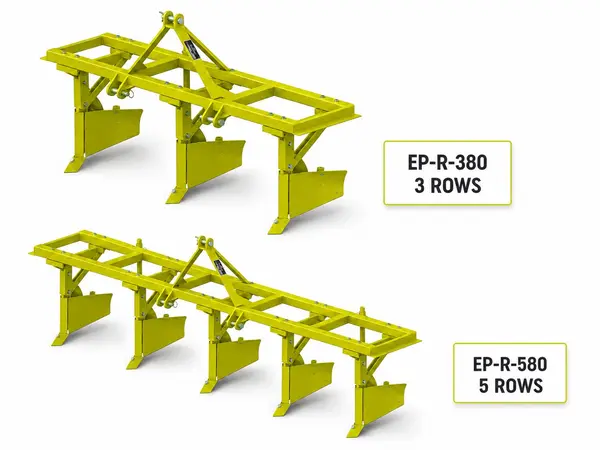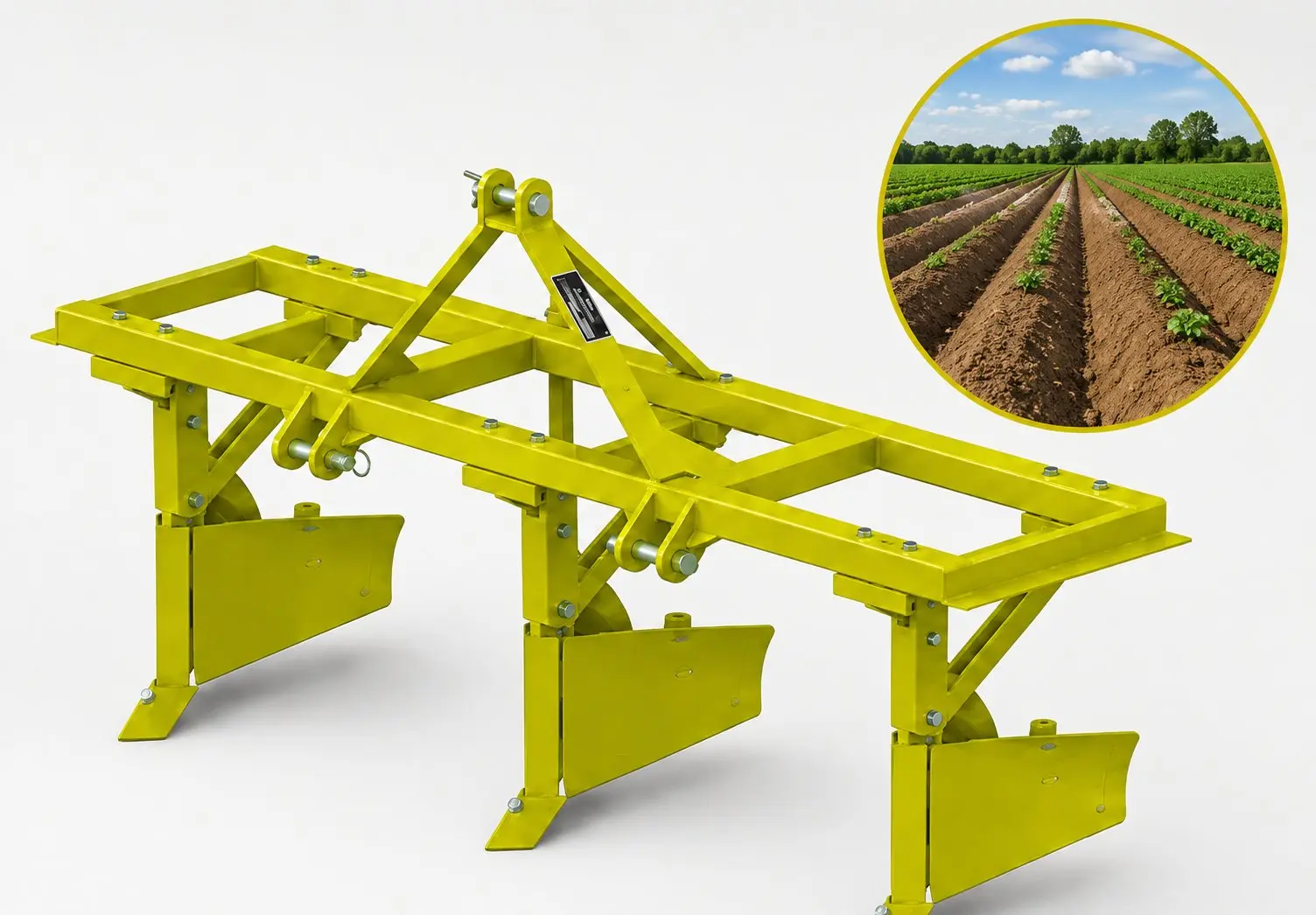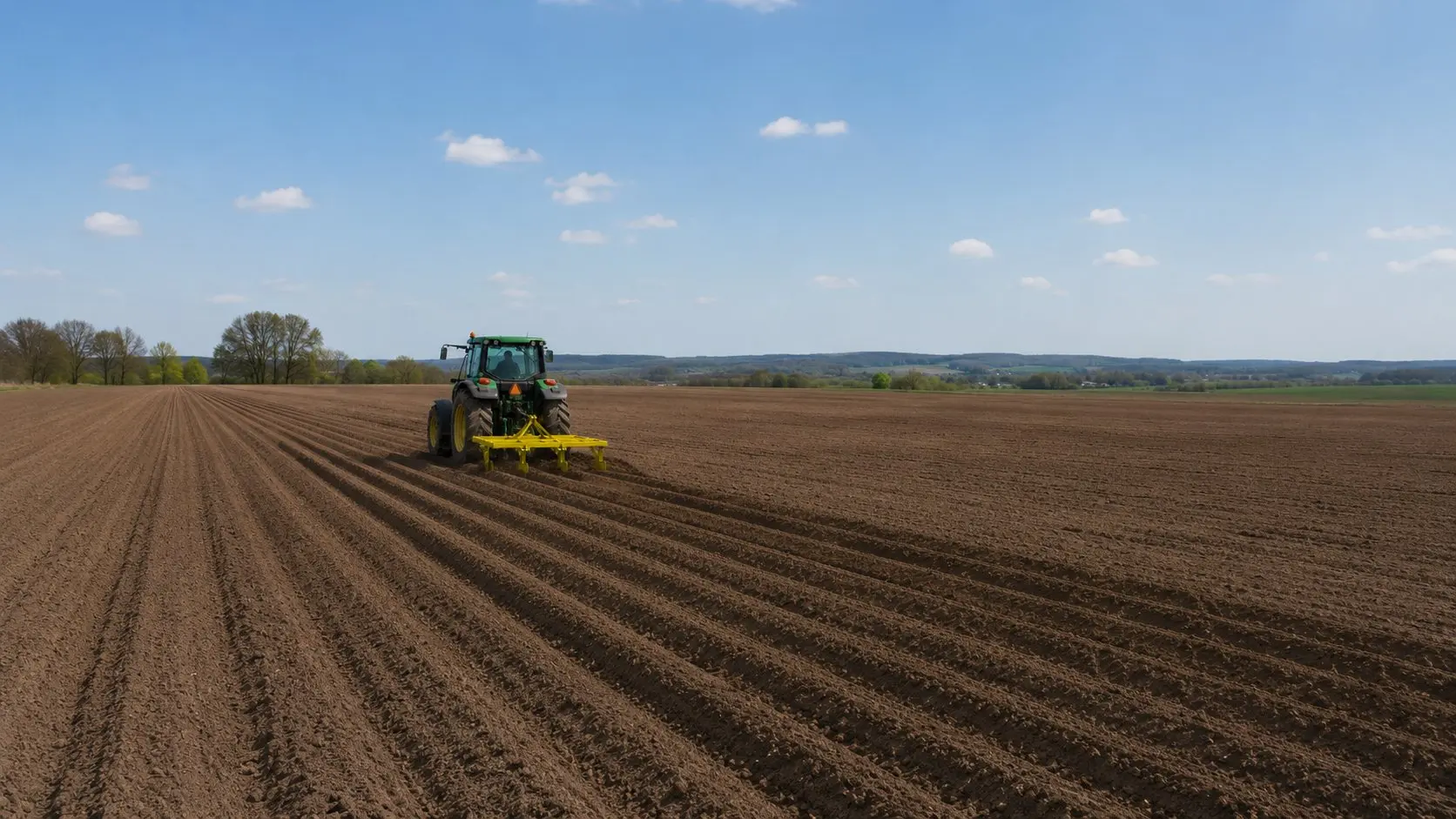
In the Watanabe 7-step Korean highland potato production system, Step 3 — the potato furrower (감자 두둑 성형기, EP-R-380 for 3-row systems, EP-R-580 for 5-row) — is the pivot point between soil preparation and crop establishment. The PSW-3200 rotavator (Step 2) created the uniform, fine-tilth seedbed. Now the furrower uses that seedbed to form the planting ridges — raised rows of mounded soil — that every subsequent machine and the crop itself will depend on for the entire growing season.
The furrower’s job sounds simple: open furrows and form ridges. In practice, furrower setup and operation determines ridge height (which governs drainage and tuber development space), row-to-row spacing (which must match every downstream machine simultaneously), and ridge soil structure (which determines planting depth consistency and mid-season hilling efficiency). A poorly set furrower produces ridges that work against the planter, cultivator, and digger even when all three downstream machines are individually correct — because the geometry they depend on was set wrong at Step 3.
EP-R-380 and EP-R-580 — Specifications and Model Selection

EP-R-380
Three-row furrower · 75 HP minimum · Cat. 2
- ✓Forms 3 ridges per pass
- ✓Same 75 HP tractor as planter, cultivator, digger
- ✓Match: PSW-3200 at 3.0 m / 75 cm row spacing
- ✓Best scale: 2–20 ha, short highland rows
- ✓Tightest headland turning — narrow terraces OK
EP-R-580
Five-row furrower · 100 HP minimum · Cat. 2
- ✓Forms 5 ridges per pass
- ✓Higher daily throughput — 67% more ridges per pass
- ✓Match: PSW-3200 at 3.6 m / 72–75 cm row spacing
- ✓Best scale: 15+ ha, longer field rows
- ✓Requires slightly more headland space at row ends
System matching: always decide the furrower first, then match all other machines to it
EP-R-380 → 3-row system → PSW-3200 at 3.0 m → EP-PAI-2100 planter (2-row, 2 passes per 3 furrow set) → EP-ERA-3100 cultivator → EP-AWB-1600 digger (2-row). EP-R-580 → 5-row system → PSW-3200 at 3.6 m → EP-PANTHER or EP-PAI-480-AR planter → EP-ERA-5100 cultivator → EP-AWB-3200 digger (4-row). Never mix systems — a 3-row furrower spacing cannot be correctly followed by a 5-row planter.
What the Furrower Actually Does — Ridge Formation Mechanics

The furrower operates by drawing soil from the inter-row positions and mounding it against the planted row centreline. Each ridging unit consists of two main components: the shin (or share) that cuts through the soil at the inter-row position, and the ridging boards (or mouldboards) that deflect the cut soil inward toward the row centreline and upward to form the ridge profile. As the tractor advances, each shin-board pair continuously builds the ridge profile by gathering soil from both sides of the row centreline.
Ridge Height — Why It Matters for Korean Highland Conditions
Ridge height — the vertical distance from the base of the inter-row drainage channel to the peak of the ridge — is the most important single parameter the furrower controls. In Korean highland potato production on granite-derived soils, ridge height of 20–25 cm is the standard target. Understanding why:
Drainage — the Primary Benefit
Highland potato fields regularly receive heavy spring and early summer rainfall. Without raised ridges, water accumulates in the root zone and creates anaerobic soil conditions that restrict root development and increase Phytophthora root rot risk. A 20–25 cm ridge positions the tuber zone 10–15 cm above the inter-row drainage channel, providing adequate drainage separation during rainfall events. Lower ridges (below 15 cm) provide insufficient drainage separation on Korean highland soils.
Tuber Development Space
Potato tubers develop in the loose soil of the ridge above the seed piece. A higher ridge provides more loose soil volume for tuber expansion — important for processing varieties (Atlantic) where maximum tuber size is commercially valuable. Tubers that encounter the compressed interface between the ridge and the surrounding soil stop expanding and take irregular shapes. Ridge height and ridge soil looseness together determine the maximum effective tuber development volume.
Digger Share Depth Setting
The EP-AWB-1600 potato digger’s lifting shares travel beneath the tuber zone. The share depth is set relative to the ridge surface. A consistent 20–25 cm ridge height — uniform along the full row length — allows the digger operator to set a single share depth that reliably lifts all tubers above the share level throughout the field. Inconsistent ridge height causes either tuber cutting (if share depth insufficient) or excessive soil volume on the conveyor (if set too deep).
Ridge Soil Structure — Loose vs Compacted
The furrower builds ridge geometry by mechanical action — but the soil it has to work with comes from the PSW-3200 rotavator tillage pass. This is the most direct and important link between Step 2 and Step 3 in the entire potato system:
- →
Fine 1000 RPM rotavator tillage → Uniform ridge soil structure. The furrower’s ridging boards move uniformly tilled, fine-particle soil up the ridge centreline. The ridge profile is consistent in height and density along the full row length. The planter drops seed into a uniform, consistent furrow bottom depth along every row. - →
Coarse 540 RPM tillage or wet soil tillage → Irregular ridge soil. The furrower’s ridging boards encounter a mix of fine soil and unbroken clods. The ridge profile varies in height and density along the row as clods block consistent soil flow up the ridge. The planter’s furrow opener encounters variable resistance, producing inconsistent planting depth.
Furrower Setup and Calibration — Getting It Right Before the Season

Before the first furrowing pass of the season, four setup parameters must be confirmed. Each affects a different aspect of ridge quality — checking all four at the start of the season prevents problems discovered mid-season when the crop is already planted:
Timing the Furrower Pass in the Spring Calendar

The furrower should follow the rotavator tillage pass within 24–48 hours — ideally on the same day or the following morning. Two timing-related factors support this close sequencing:
Preventing surface crust formation: The surface of a freshly rotavated field is loose and friable immediately after the pass. Over 2–4 days of exposure, sun and wind cause the surface to form a light crust — soil particles at the surface dry and bond together. The furrower’s ridging boards encounter this surface crust resistance and must break through it before gathering soil into the ridge. Fresh rotavated soil forms ridges more efficiently than crust-sealed surfaces, with better ridge soil consolidation and less energy demand on the tractor.
Moisture retention: The rotavator pass exposes fresh soil to evaporation. In Korean spring conditions — often with warm afternoons and cool nights that create frost risk — the rotavated soil moisture can drop significantly over 2–3 days of exposure. Furrowing while the rotavated soil is still at the correct moisture content for good ridge formation produces better ridge density than furrowing into soil that has dried beyond the optimal range.
✅ Best: same day or next morning
Freshly tilled soil, optimal moisture, no surface crust. Produces highest-quality ridge profiles with consistent height and structure along the full row length. Plan the tractor schedule to complete rotavator tillage in the morning, furrowing in the afternoon.
⚠ Acceptable: 1–3 days after
Light surface crust beginning to form. Furrower quality is still good if soil moisture is adequate. Check moisture at 10 cm depth before furrowing — if the soil is still moist and workable at depth, proceed. Monitor ridge height for consistency.
❌ Avoid: 4+ days after
Surface has sealed and soil at depth is drying. Ridge formation quality deteriorates; the shin may need to penetrate harder than the tractor’s three-point hitch system can maintain consistently, producing variable depth and height. A light rotavator re-pass before furrowing may be needed.
Post-Furrowing Quality Inspection — Four Things to Confirm Before Planting
After the furrowing pass, conduct a brief field inspection before beginning the planting pass. Four checks confirm that ridge quality is adequate for the downstream planter:
Height Check
Measure ridge height with a ruler at 5 points along a 50-metre row. Target: 20–25 cm. If heights vary by more than 3–4 cm along the row, check tractor hitch levelling and forward speed consistency.
Spacing Check
Measure centre-to-centre ridge spacing at 5 locations. Must match the planter row spacing exactly. If spacing varies, confirm that the tractor drove the correct wheel tracks between passes — overlap or gap between passes produces inconsistent spacing.
Soil Structure Check
Push a hand into the ridge peak to 15 cm depth. The soil should be loose and friable throughout with no hard clod layers. Clod layers indicate the rotavator pass was insufficient — consider a second rotavator pass before replanting.
Drainage Channel Check
Pour a cup of water into the inter-row channel. It should drain immediately toward the field outlet. If water pools in the channel, the channel is not graded correctly to the outlet — check field drainage slope and furrower alignment relative to the land gradient.
Step 3 in the Complete 7-Step System — The Central Link
常见问题解答
Can I form ridges without a dedicated furrower — for example using a single reversible plough?
A single reversible plough forms one ridge per pass — usable for very small-scale traditional potato planting but not compatible with the multi-row mechanical planting and harvest system. The EP-PAI-2100 planter requires two furrows formed in a single pass at precisely equal spacing; the EP-AWB-1600 digger requires two rows at precisely equal and consistent spacing. Neither machine can compensate for ridges formed one at a time by a reversible plough. For mechanical planting and harvest with Watanabe equipment, the EP-R-380 or EP-R-580 furrower is necessary — it is not substitutable with other ridge-forming implements if the downstream system is to operate at design specification.
What happens if I need to re-furrow after a rain event collapses the ridges before planting?
Heavy rain immediately after furrowing — before the ridges have had 24–48 hours to settle and firm — can partially collapse ridge shape, particularly on finer-textured soils. If ridge height drops below 15 cm or ridge shape becomes irregular before planting, a light re-furrowing pass restores the ridge profile. The second pass should use exactly the same tractor wheel track as the original furrowing pass — if the tractor strays from the original wheel position, the shins will not run in the original inter-row channels and will create offset ridges that do not match the original row spacing. Mark the original wheel position with stakes or GPS before re-furrowing if there is any risk of track deviation.
Does the furrower work on sloped highland fields, or only on flat ground?
The furrower works effectively on slopes up to approximately 15–20% gradient, which covers the majority of Korean highland potato production land. On sloped fields, the most important consideration is furrow orientation relative to slope: furrows running across the slope (contour furrowing) are generally preferable to furrows running up-and-down the slope, because contour ridges slow water runoff and reduce erosion during rainfall events. On steep slopes, contour ridges also make mechanical planting and harvesting safer — the tractor travels across rather than up and down the gradient. For slopes above 20%, consult your regional agricultural extension office on appropriate erosion control practices in combination with ridged potato production.
Is the potato furrower eligible for Korean agricultural machinery subsidies?
Potato furrowers (감자 두둑 성형기 or 감자 이랑 만들기 기계) are classified under the 이식·파종 기계류 (planting machinery) or 경운·정지 기계류 (tillage and land preparation machinery) category in the Korean agricultural machinery purchase support program. Eligibility for the current year must be confirmed with your regional agricultural technology center (농업기술센터), along with the specific subsidy rate for the furrower category. If purchasing the complete potato machinery system — rotavator, furrower, fertilizer applicator, planter, cultivator, and digger — ask your agricultural technology center whether a system-level support program (복합농기계 지원) is available that covers multiple machines in a single application, as this may be more advantageous than individual machine subsidy applications.
Building a Complete Potato Machinery System? Start with the Row Count Decision.
Farm scale + target crop + field row lengths + tractor HP → EP-R-380 (3-row) or EP-R-580 (5-row) recommendation with complete downstream machine compatibility list. All Watanabe potato machinery in Korea local stock, Ansan-si, Gyeonggi-do.
编辑:Cxm