
Every Korean highland farm has three categories of road surface that require stone management: (1) field access tracks — unpaved earth or gravel tracks that connect public roads to individual field sections; (2) inter-terrace passes — the narrow slopes between terrace levels that tractors and equipment must traverse to reach each field section; and (3) headland turning areas — the field-end zones where tractors turn, increasing surface stone damage from repeated turning loads. Each category has a different stone accumulation mechanism, a different severity level, and a different machine that addresses it most efficiently.
Korean highland farmers who manage all three categories with the same machine — typically either the THOR 2.4 or an EP-EW-4000 rake — are either over-deploying expensive equipment on light-duty tasks or under-managing with insufficient capability on heavy tasks. Understanding the appropriate machine for each road type and condition saves operating cost while maintaining access reliability across the farming year.
Three Korean Farm Road Categories — and What Each Needs
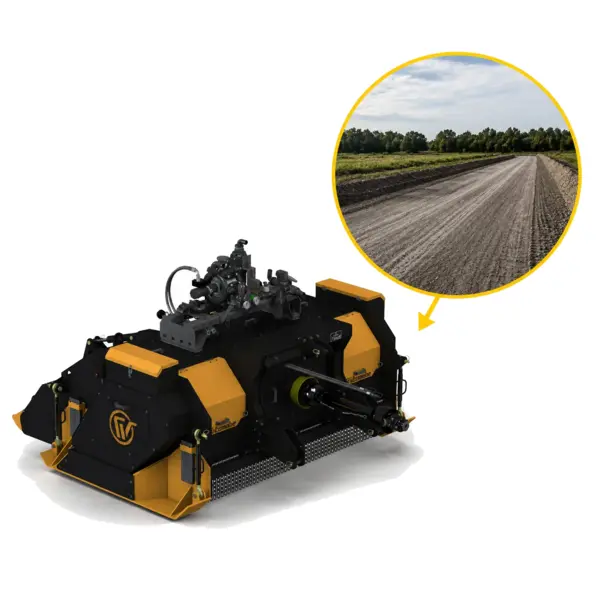
Category 1
Field Access Tracks — Annual Frost-Heave Surface Stone
These are the most common and most easily managed. Korean highland granite frost heave annually brings stones of 3–15 cm to the track surface. The accumulation rate depends on frost severity and track construction history — tracks with good granular base material that was initially THOR-crushed have lower annual emergence rates than original-surface tracks. Stones above 8–10 cm on access tracks cause: tyre punctures on farm vehicles and trucks, damage to delivery vehicles unfamiliar with the track condition, and tractor wheel damage on repeated traversals.
Management: EP-EW-4000 kaya tırmığı + CT-2100 annual surface collection in most years. THOR 2.4 when stones above 40 Kg appear on the track surface after severe winters.
Category 2
Inter-Terrace Passes — Slope Stone Erosion and Accumulation
The slope sections between terrace levels concentrate stone from both uphill erosion (stones carried down by rainwater runoff) and frost heave on the slope face. These sections experience higher stone accumulation rates than flat tracks — and because they are the steepest and narrowest part of the farm access system, stone damage to vehicles crossing them is most consequential. An immovable stone on an inter-terrace pass can block all equipment access to upper field sections.
Management: THOR 2.4 in Kit Drawbar mode for embedded stones on slope passes. EP-EW-4000 for light annual surface accumulation. Annual priority: slopes before flat tracks.
Category 3
Failed Road Base — Rutting, Settlement, Saturated Base
When a Korean farm access road or rural road shows deep rutting (>10 cm), settlement of specific sections, or complete loss of bearing capacity in wet conditions, the problem is not surface stone — it is failed base. Surface stone clearing does not address base failure. Depositing new aggregate on a failed base only temporarily delays further deterioration. Base failure requires full-depth rehabilitation: either conventional (excavate, compact new base) or FDR (in-place stabilisation with THOR ST + DCW 2.2 binder spreader).
Management: THOR ST + DCW 2.2 FDR soil stabilisation system. Surface clearing with THOR 2.4 or rake is not the solution — confirm base failure vs surface stone accumulation before machine deployment.
Decision Framework — Which Machine for Which Road Problem?
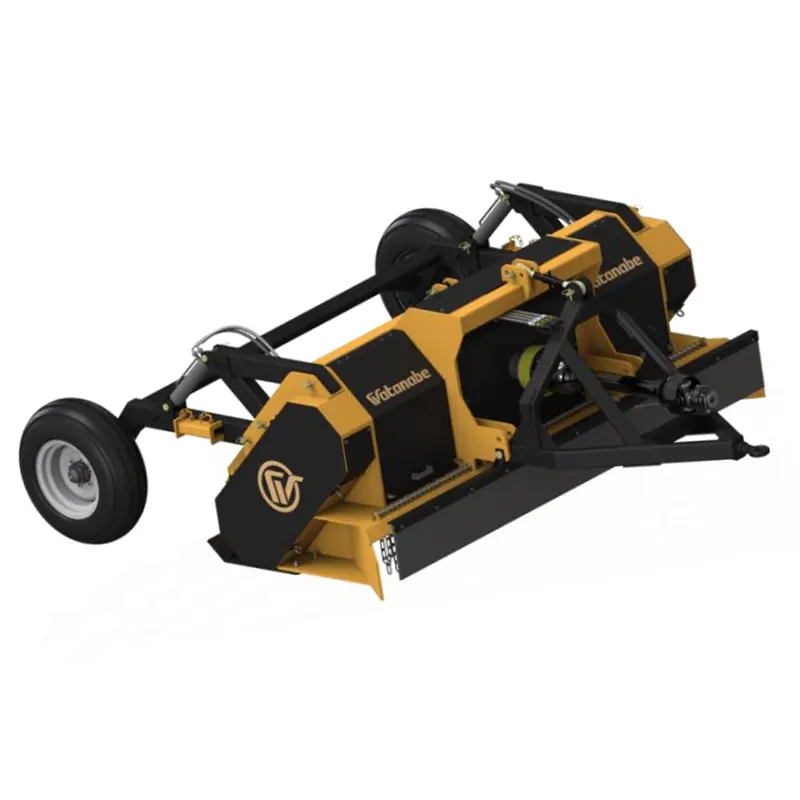
| Road problem description | Doğru makine | What it achieves |
|---|---|---|
| Surface stones 3–15 cm from annual frost heave on flat tracks | EP-EW-4000 tırmık + CT-2100 | Surface cleared; smooth driveable track restored; low operating cost |
| Mixed small and large surface stones (some above 40 Kg) from severe winter | THOR 2.4 + CT-2100 | All stones crushed to below rake/collection threshold and removed |
| Embedded boulders blocking inter-terrace slope pass | THOR 2.4 Kit Drawbar + CT-2100 | Embedded boulders fractured and removed; slope pass restored to safe access |
| Loose surface stones on orchard or pasture access alleys | EP-EW-4000 + CT-2100 | Annual surface maintenance; preserves alley turf; no need for THOR crushing |
| Rural road rutting, settlement, base saturation (failed base) | THOR ST + DCW 2.2 (FDR) | In-place base stabilisation; structural road rehabilitation |
| New farm road construction through rocky highland terrain | THOR 2.4 (formation clearing) + CT-2100 | Rock cleared from road formation before aggregate placement; stone-free base |
Farm Road Stone Management Seasonal Calendar
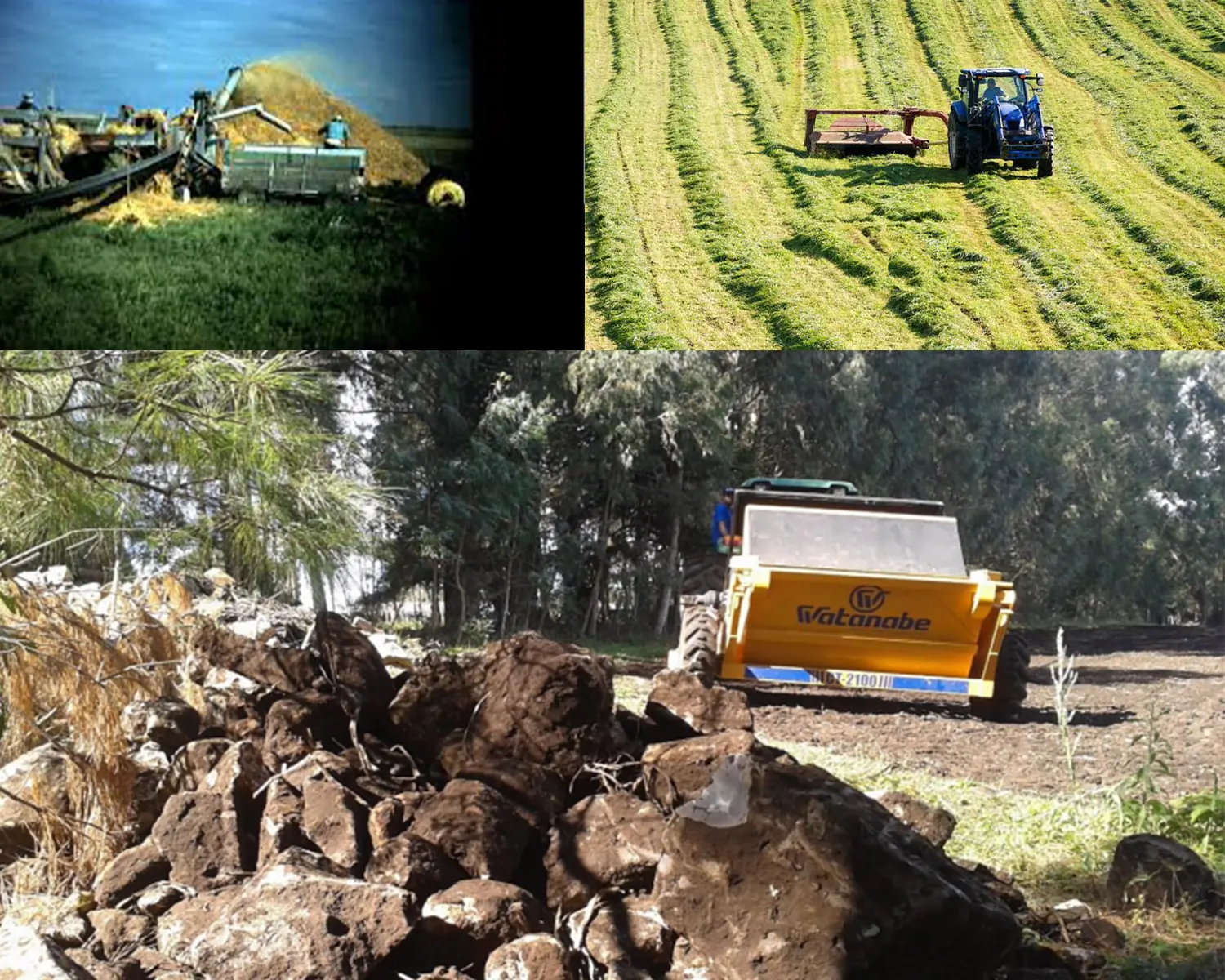
Road stone management on Korean highland farms follows the same seasonal driver as field stone management — frost heave in winter brings new stones to the surface, and these must be cleared before the spring machinery season begins. The road clearing sequence should be integrated with the field clearing calendar:
Cost Efficiency — Avoiding Over-Deployment of the THOR 2.4 on Road Tasks
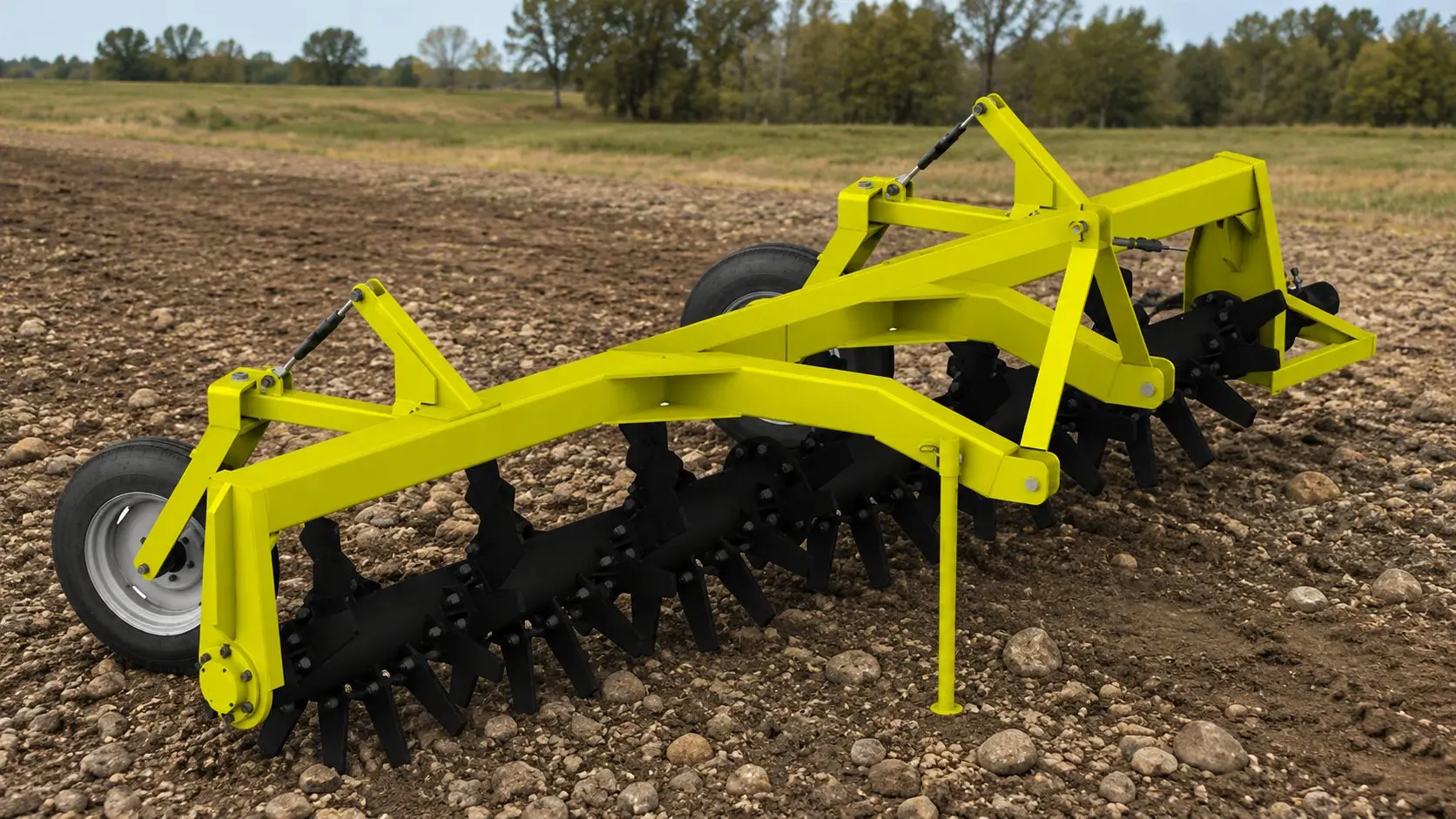
The THOR 2.4 (180 HP minimum) costs approximately 3–4× more per operating hour than the EP-EW-4000 rake (75 HP) in fuel, tractor wear, and tooth consumption. Deploying the THOR 2.4 on flat access tracks with only light frost-heave surface stones is a significant cost over-deployment. The appropriate machine escalation for Korean highland farm roads:
The decision to escalate from Level 1 to Level 2 is the spring assessment walk (described above): if stones above 40 Kg are present, escalate to THOR 2.4. The decision to escalate from Level 2 to Level 3 is the base failure diagnostic: if the road surface bounces or deflects under tractor wheel loading without large surface stones being the cause, the base is failing and surface clearing cannot solve it — Level 3 FDR is the appropriate response, or a county road maintenance budget application for the affected public road section.
THOR 2.4 vs EP-EW-4000 on Farm Roads — Operating Differences
Knowing which machine to use is the decision; knowing how to operate each one on road surfaces rather than agricultural fields is the practical skill. Farm road surfaces differ from field soil in one important way: road surfaces are typically more compacted and may contain construction aggregate (gravel or crushed stone) mixed into the native soil. Both machines require minor setup adjustments for road surface operation compared to field tillage:
THOR 2.4 on road surfaces
Reduce working depth when operating on road surfaces — 10–15 cm is typically sufficient for access track stone clearance, versus 20–25 cm for agricultural field clearance. Deep penetration on road surfaces disturbs the compacted base material unnecessarily, reducing track stability after the THOR pass. The rear hood (output grid) should be set to open (coarser output) when THOR-crushed stone from road clearing will be used as aggregate fill material — and to more closed when fine fragmentation is wanted for smooth track surface reinstatement. Use Kit Drawbar mode on all slope sections above 12% as with field operations.
EP-EW-4000 tırmık on road surfaces
The EP-EW-4000’s tine drum height setting on road surfaces should be slightly higher than field setting — road surfaces are more compacted, so tines that just touch the surface collect stones adequately without digging into the surface. Over-aggressive tine penetration on compacted road surfaces disturbs the road formation and produces loose soil in the collection windrow that contaminates the stone pile. Confirm tine height by the road surface condition: tines should collect surface stones without leaving visible tine grooves in the road surface.
Practical Track Width Considerations for Machine Access
Korean highland farm access track widths vary significantly — some tracks are wide enough for a loaded harvest truck (3.5–4.5 m), while others are narrow single-track routes built for tractor access only (2.5–3.0 m). Machine selection for track stone clearing must account for whether the clearing machine can physically fit within the track width:
| Track width | EP-EW-4000 (3.6m) | THOR 2.4 (2.4m) |
|---|---|---|
| 2,5 metrenin altında | ❌ Çok geniş | ✅ Fits |
| 2,5–3,5 m | ⚠ Partial pass only | ✅ Single pass |
| Above 3.6 m | ✅ Single pass | 1–2 passes needed |
For narrow single-track routes below 2.5 m width, the THOR 2.4 in Kit Drawbar configuration is the only practical stone crusher option — the 2.4 m working width fits within the track while the Kit Drawbar wheels travel in the verge outside the track boundary on wider slope sections. Contact Korea Watanabe to confirm track width requirements and Kit Drawbar operational clearance for your specific access track dimensions. For complete farm road stone management systems — THOR 2.4 kaya kırıcı + CT-2100 taş toplayıcı for heavy-stone slope passes and new track construction, combined with the EP-EW-4000 kaya tırmığı for annual flat track surface maintenance — Korea Watanabe supplies the complete three-machine road management system from Korean local stock. All three machines qualify for Korean agricultural machinery subsidies when used for farmland improvement and access infrastructure purposes. Korea Watanabe prepares subsidy documentation covering all three machines in a single application package on request.
For complete Korean farm road stone management equipment enquiries covering EP-EW-4000 rock rake, THOR 2.4 stone crusher, CT-2100 rock picker, and THOR ST soil stabiliser for base rehabilitation, contact Korea Watanabe directly with your farm location, access track dimensions, and stone problem description.
THOR 2.4 vs EP-EW-4000 on Road Surfaces — Operating Differences and Setup
Knowing which machine to deploy is the decision; operating each one correctly on road surfaces (rather than agricultural fields) requires specific setup adjustments. Farm road surfaces differ from cultivated field soil in one critical respect: they are compacted, may contain layers of previously placed gravel or crushed aggregate, and their structural integrity must be preserved after stone clearing. Both machines need minor configuration changes for road surface work:
THOR 2.4 on road surfaces
Working depth: reduce to 10–15 cm (versus 20–25 cm for agricultural field clearance). Road surface clearing needs only enough depth to fracture stones protruding through the surface and embedded in the upper compacted layer — deep penetration unnecessarily disturbs the compacted base, reducing bearing capacity after the THOR pass.
Hood setting: open (coarser output) when crushed stone will be retained as aggregate fill on the same track. Close the hood when finer fragmentation is needed for smooth surface reinstatement. Use Kit Drawbar on all road sections above 12% slope — same rule as field operations. Forward speed: 3–4 km/h on compacted surfaces to reduce rotor bounce on hard aggregate.
EP-EW-4000 tırmık on road surfaces
Tine height: raise slightly compared to field setting. Road surfaces are more compacted than tilled field soil — tines that just clear the road surface collect stones without digging into the compacted layer. Over-penetration on road surfaces loosens the compacted base unnecessarily and contaminates the stone collection windrow with base material.
Confirmation check: after the first 20 m test pass, look back at the road surface — tines should not have left visible grooves. If grooves are visible, raise the tine height slightly and repeat. Working speed: 4–5 km/h for efficient windrow formation on track surfaces.
Track Width and Machine Access — Practical Compatibility Check
Korean highland farm access tracks vary significantly in width — from wide truck-accessible roads (3.5–4.5 m) down to narrow single-tractor routes (2.5–3.0 m) between terrace walls. Machine selection for stone clearing must confirm that the clearing machine physically fits within the track, including the tractor wheel path outside the implement working width:
| Track width | EP-EW-4000 (3,6 m) | THOR 2.4 (2.4 m) | Practical note |
|---|---|---|---|
| 2,5 metrenin altında | ❌ Çok geniş | ✅ Fits | Narrow inter-terrace passes: THOR 2.4 only. Kit Drawbar wheels can travel on verge outside track boundary on slope sections. |
| 2,5–3,5 m | ⚠ Partial pass | ✅ Single pass | THOR 2.4 clears the full working width in one pass. EP-EW-4000 must make two offset passes leaving an uncollected centre strip — CT-2100 collects both windrows after. |
| 3.6 m and above | ✅ Single pass | 1–2 passes | Wide truck-access tracks: EP-EW-4000 most efficient in light years — covers full width in one pass. THOR 2.4 needs 1–2 passes on wider tracks. |
For farms with a mix of narrow inter-terrace passes (below 2.5 m) and wider main access tracks (above 3.5 m), the machine deployment plan is: THOR 2.4 Kit Drawbar for narrow passes and heavy stone sections, followed by EP-EW-4000 for wide main track annual maintenance. The two machines are complementary on mixed-geometry Korean highland farm road networks — not interchangeable alternatives.
THOR-Crushed Granite as Road Building Material — Closing the Loop
One of the most economically and logistically attractive aspects of THOR stone clearing on Korean highland farm roads is the potential to use THOR-crushed granite aggregate as the road building material on the same tracks. Rather than trucking crushed stone material off-site and separately purchasing imported gravel for track surfacing, the farm produces its own aggregate in place:
①
THOR crushing with rear hood open (coarser output). Set the THOR 2.4 to produce 15–40 mm aggregate (coarser fragment size appropriate for road sub-base). The open hood setting allows larger fragments to exit the crushing chamber after fewer rotor impacts — producing the aggregate size range used for granular road wearing surfaces without additional processing.
②
CT-2100 collection to designated stockpile. Rather than depositing crushed aggregate at the field headland for truck removal, direct the CT-2100 to deposit at a designated stockpile location adjacent to the track sections that will receive surfacing. The stockpile accumulates over multiple THOR clearing passes until sufficient volume is available for track surfacing.
③
Spread and compact aggregate on track surface. A tractor blade or grader blade spreads the stockpiled THOR aggregate to 10–15 cm compacted depth on the prepared track formation. One or two roller passes (tractor wheel rolling in overlapping passes) compacts the aggregate to an interlocked wearing course. Korean highland granite aggregate provides adequate bearing capacity and drainage for agricultural track use without further processing.
This closed-loop approach — converting field stone problem into farm road infrastructure — is particularly compelling for Korean highland farms undertaking initial land clearance, where large volumes of THOR-crushed aggregate are produced during multi-season new land development. The aggregate that would otherwise require removal and disposal instead becomes the surface material for the access track network that the farm needs to serve the newly cleared fields. The economic saving is the entire cost of importing gravel from off-site, which on Korean highland terrain with limited truck access can represent a substantial portion of the total track construction budget.
Road Drainage Management Alongside Stone Clearing
Stone clearing alone does not maintain Korean highland farm access tracks in good condition if drainage problems are not simultaneously managed. Poor drainage is the primary accelerator of road base deterioration on Korean highland granite terrain — water entering the road base from surface runoff, seepage from uphill slopes, or blocked roadside channels saturates the base material, destroys bearing capacity, and accelerates frost heave stone emergence. Integrating drainage maintenance into the annual road management programme extends the life of cleared and surfaced tracks significantly:
Roadside drainage channel clearance
Korean highland roadside channels block with soil, vegetation, and stone debris annually — particularly after typhoon seasons. Blocked channels cause water to flow across the road surface rather than through the channel, saturating the road base. Clear roadside channels in spring (March–April) and post-typhoon (August–September) as routine maintenance. A tractor blade pass along the channel line takes less than an hour per kilometre of track and directly prevents base saturation that produces Category 3 base failure requiring FDR rehabilitation.
Cross-drain pipe inspection
Corrugated steel cross-drain pipes under Korean highland farm tracks frequently block with sediment and stone debris within 3–5 years of installation. Blocked cross-drains cause water to pond at the uphill side of the track — saturating the base below the road surface at the blockage point. Inspect all cross-drain inlets and outlets during the spring road walk (March). Use a hose-fed water pressure to flush partially blocked pipes. Replace fully blocked or crushed pipes before winter — blocked cross-drains are a primary cause of Category 3 base failure on Korean highland farm tracks.
Road crown maintenance
A properly crowned road surface (slightly convex profile, higher at centreline than at shoulders) sheds surface water to the roadside channels rather than allowing it to infiltrate the base. Korean highland farm tracks that have been flattened by vehicle traffic lose their crown — a tractor blade pass restoring the crown profile after each harvest season maintains drainage performance without requiring aggregate addition. This is the lowest-cost road maintenance intervention in the annual programme.
Sıkça Sorulan Sorular
Can the THOR 2.4 be used to build a new farm access road through rocky terrain?
Yes — the THOR 2.4 is well-suited for clearing the formation of a new farm access track through rocky Korean highland terrain. The process: mark the track alignment, then make multiple THOR 2.4 passes along the marked alignment to fracture and clear all embedded stones to the sub-grade level (typically 20–25 cm below finished surface level). CT-2100 collection removes the crushed material. After THOR clearing, the formation is graded and compacted as for any new track construction — the stone-cleared formation provides a significantly more stable sub-grade for the finished granular surface than un-cleared rocky ground. New farm road formation through areas with large embedded boulders above the THOR 2.4’s 30 cm rated maximum will require a mini-excavator to remove oversized boulders before the THOR pass — confirm with Korea Watanabe if your terrain assessment indicates bedrock or boulders above this size range.
How do I distinguish road base failure from surface stone accumulation without specialist equipment?
Two simple field tests distinguish base failure from surface stone accumulation. First, the probe test: push a steel rod (8–10 mm diameter) by hand into the road surface in the failed area — if the rod penetrates more than 15–20 cm without significant resistance, the road base is saturated and failing (not just surface stone accumulation). Second, the loaded vehicle test: drive a loaded truck or tractor slowly over the suspect section and observe — surface stone accumulation produces tyre contact noise and minor vehicle jolting; base failure produces visible road surface deflection (the surface visibly dips under the wheel load). If deflection is visible under normal farm traffic loading, the base has failed. Report base failure sections on public roads to the county road maintenance office — many Korean rural road rehabilitation programs will fund FDR treatment on confirmed base-failure sections.
Is it worth adding a granular stone wearing surface to THOR-cleared farm tracks?
Adding a 10–15 cm layer of granular stone (crushed aggregate or gravel) to THOR-cleared and graded farm track formations significantly improves long-term track durability and reduces annual stone clearing requirement. The granular layer provides better load distribution, prevents wheel rutting in wet conditions, and dramatically reduces the annual frost-heave stone emergence rate — because the gravel layer is not susceptible to frost heave in the same way as granular soil. The long-term economics are favourable for tracks that carry heavy traffic (harvest trucks, chemical spray equipment): the initial granular surface investment pays back through reduced annual track repair costs within 3–5 years. THOR-cleared tracks that are left as earth formation without a granular surface typically require more intensive annual stone management than tracks with proper granular surfacing.
Can the crushed stone from THOR farm road operations be used as road building material?
Yes — THOR-crushed Korean granite aggregate in the 10–40 mm size range (achievable by adjusting the THOR rear hood to coarser output setting) is usable as sub-base aggregate for granular road surfaces. This converts the stone removal problem into a construction material production opportunity: THOR crushing on the field produces aggregate, CT-2100 collection moves it to the headland, and the aggregate is then placed and compacted as the granular wearing surface on the same tracks that were cleared. The granite aggregate quality is adequate for agricultural track use without any processing beyond the THOR crushing. This closed-loop approach — using field stone as track building material — is particularly economical for Korean highland farms that have large volumes of initial clearance material from new land development and need to construct access tracks simultaneously.
Are Korean government farm road improvement programs available for agricultural access track rehabilitation?
Korean agricultural infrastructure improvement programs include farm road () improvement within the broader farmland consolidation and development support scheme (). Farm roads meeting the legal definition of agricultural roads within designated production zones may be eligible for cost support through this program — including both surface stone clearing and base rehabilitation. The Korea Rural Community Corporation () administers farm road improvement programs at the regional level. Eligibility depends on the road’s classification, the farm’s production zone designation, and the current year’s program budget allocation. Contact your county agricultural office ( ) to determine whether your specific farm access tracks fall within the applicable road improvement program scope. Korea Watanabe provides THOR and THOR ST system technical documentation to support applications for machinery-based road improvement cost support.
Farm Road Problem → Right Machine → Korea Watanabe
Road problem description (surface stone / slope pass / base failure) + track length (m) + access width (m) → machine recommendation with operating approach. Korea Watanabe, Ansan-si, Gyeonggi-do.
Editör: Cxm