
The global solar power market has undergone a structural shift from rooftop installations to utility-scale ground-mounted farms that now account for the majority of new capacity additions. The UK’s 50 GW solar target by 2030, the EU’s REPowerEU programme, and South Korea’s Renewable Energy 3020 policy have collectively triggered a wave of ground-mounted solar site development across exactly the types of land where stone in the sub-soil is a major construction obstacle: former agricultural fields, hillside pastures, reclaimed brownfield sites, and semi-arid scrubland.
Every ground-mounted solar installation relies on foundation posts — driven steel piles, helical screw piles, or drilled and poured concrete — that must penetrate to their engineered depth to provide the structural resistance required for panel support, wind loading, and snow load compliance. Stone in the soil above this depth does not merely slow the pile driver. It deflects the pile, misaligns the panel frame, compromises structural certification, and — if undetected — reduces energy generation output for the entire 25-year operational life of the installation. This guide covers the specific rock crusher for solar farm site preparation that eliminates these risks before the pile driver arrives on site.
Why Solar Farms Need Stone Clearing — The Engineering Case Explained
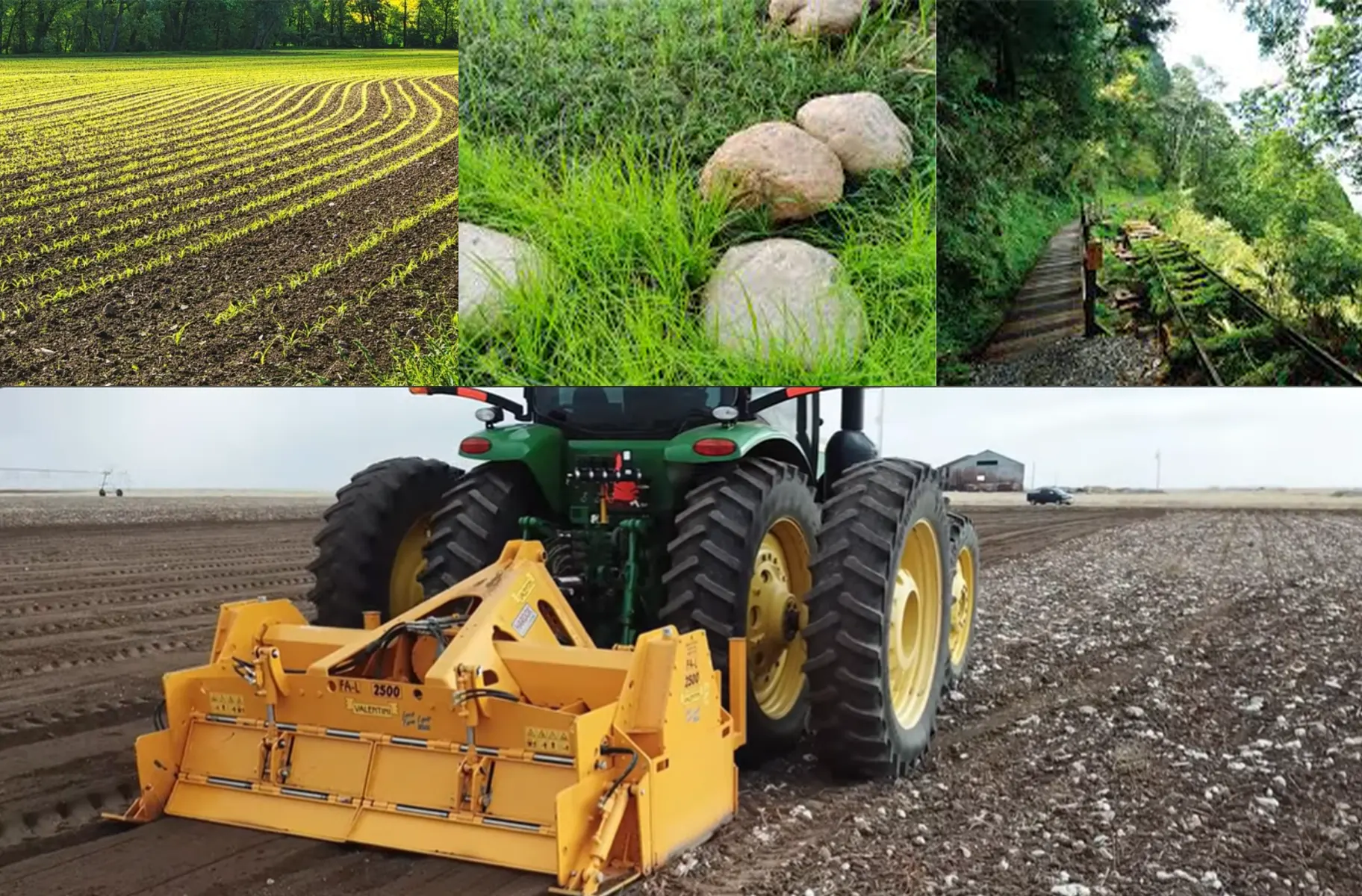
Solar mounting structures are engineered to specific ground reaction specifications. A typical single-axis tracker system or fixed-tilt ground mount requires foundation posts capable of resisting defined vertical uplift and lateral loads under the combination of dead load (panel weight), wind load, and snow load appropriate for the site’s location. The engineering calculation that certifies a mounting system for these loads assumes that the pile has achieved its designed depth with its designed vertical alignment. When a stone deflects the pile from vertical during driving, three independent engineering problems arise simultaneously.
Three Foundation Types — Stone Sensitivity and Clearing Depth Requirements
| Foundation Type | Typical Depth | Stone Sensitivity | Min. Clearing Depth | Why Stones Are Critical for This Type |
|---|---|---|---|---|
| Driven H-pile / I-beam Most common utility solar |
0.8–1.5 m | 🔴 HIGHEST | 40–50 cm | Vibration driving transmits lateral force to pile tip against any stone — deflection begins at first contact. Pile cannot self-navigate around obstacles. Every stone in driving path causes measurable deflection. |
| Helical screw pile Community solar, agrivoltaic |
0.6–1.2 m | 🟠 HIGH | 35–45 cm | Helical blade can break through soft limestone but will stop on dense flint or granite. Torque overload on rotation trips machine safety — requiring extraction and repositioning. Stone above the helix depth causes the same lateral deflection as driven piles. |
| Concrete ground screw Residential, small commercial |
0.5–0.9 m | 🟡 MEDIUM | 30–40 cm | Pre-drilling with augur handles moderate stone, but dense flint or large granite requires over-drilling — costly and time-consuming. Stone clearing reduces augur wear and drilling time by 35–55% on typical rocky UK agricultural soil. |
| Micro-piled concrete Rocky / steep terrain |
1.0–2.5 m | 🟢 LOWER | 30–40 cm (surface / cable zone) |
Rotary percussion drilling used — designed for rock. Stone clearing still required for the cable trench network and access road grid within the site, even where foundation drilling is stone-tolerant. |
Cable Trenching and Internal Access Roads — The Horizontal Stone Problem
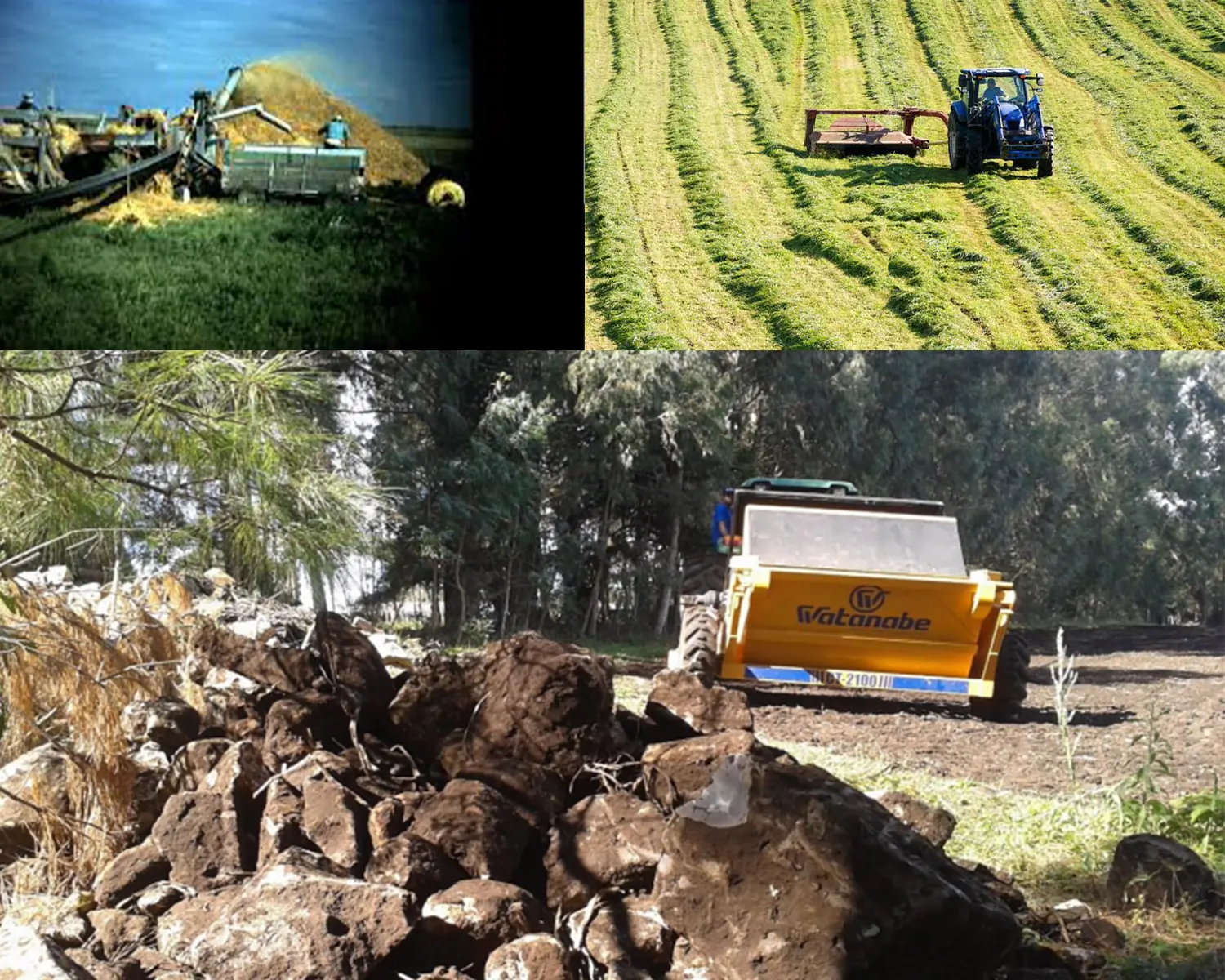
Solar farm sites require two additional stone-clearing considerations beyond the pile foundation zone: the cable trench network and the internal maintenance road grid. Both create stone-related construction risks that are entirely distinct from the vertical pile penetration problem — yet both are addressed by the same machine system that handles the pile zone clearing.
Cable Trench Stone Hazards
Typically 450–600 mm deep, 200–300 mm wide. Stone protruding into the trench base creates point-load pressure on the cable jacket during backfill compaction. UK DNO (Distribution Network Operator) and IEC 60364-7-712 specifications require cable bedding in fine material (<20 mm) — a condition that stone-cleared soil achieves without additional imported sand bedding.
Deeper — typically 600–900 mm. Large MV cable jackets are more resilient to point loads, but stone-cleared trench routes allow mechanical cable-laying trenchers to operate at designed speed rather than stopping repeatedly for stone obstructions. Stone-impacted trenching machinery on un-cleared UK flint sites loses 25–45% of planned productivity — representing significant contractor cost overrun.
Earth tape trenches are typically only 300 mm deep but span the entire site in a grid pattern. This is the trench network most affected by surface and shallow stone — a stone density that a light tractor can tolerate for pile zone clearing may still seriously impede the high-frequency, shallow earthing trench installation. BlackBird rock rake surface passes after deep clearing specifically address this shallow zone.
Internal Maintenance Road Grid
Every solar farm of commercial scale (typically 5 MW+) incorporates a grid of internal maintenance roads to allow inverter access, panel cleaning vehicles, vegetation management, and emergency response. These roads are typically 3.0–4.5 m wide with a compacted stone or geotextile-reinforced surface. The roadbed preparation — regardless of the final surface specification — requires stone-free sub-base to the same standard as any agricultural track: stone protruding through the geotextile creates surface irregularities, punctures the membrane, and creates wheel-trap hazards for maintenance vehicles and AGVs (automated cleaning robots).
A 50 MW solar farm with 8–12 rows of panels typically has 2–4 km of internal roads. Stone clearing the road corridors as part of the general site preparation adds negligible additional cost when the machine is already on site — and eliminates a road maintenance liability that otherwise requires attention within the first 3–5 years of operation.
Agrivoltaics — When Solar Panels and Sheep Grazing Share the Same Cleared Ground
Agrivoltaics — the co-location of solar energy generation and active agricultural use on the same land — has moved from experimental concept to mainstream planning policy in the UK, Germany, France, the Netherlands, Japan, and South Korea. The basic model: ground-mounted solar panels at elevated height (2.2–3.5 m to lowest panel edge) with sheep grazing or low-growing crop production in the inter-row and under-panel spaces.
| Requirement | Solar Function | Agricultural Function (sheep / crops) |
|---|---|---|
| Stone-free to 35–50 cm | Pile installation without deflection; cable trench without obstruction | Prevents hoof injury to grazing sheep; enables grass root zone development for forage productivity |
| Surface stone removal | Maintenance vehicle clearance; automated cleaning robot safe operation | Sheep hoof safety; prevents stones being scattered by sheep into panel support structures |
| Fine-tilth sub-base | Uniform compaction for stable mounting structure — prevents differential settlement under panel frames | Grass seed germination and establishment in inter-row spaces; legume cover crop productivity |
| Improved drainage | Reduces water pooling that causes cable sheath deterioration in low-point trenches | Reduces sheep poaching (hoof-compaction) in wet conditions; improves grass growth in winter |
Global Solar Markets — Stone Challenges Across Five Key Countries

The Solar Farm Machine System — Coverage, Sequence and Project Timeline
| Step | Machine | Operating Depth | Daily Coverage | Purpose |
|---|---|---|---|---|
| 1 | THOR 3.0 rock crusher 230HP, 3.0m, ≤40cm stone |
35–50 cm | 1.2–1.8 ha/day | Fragment all stones in pile zone. Forward speed 1.0–2.0 km/h depending on stone density. Primary pass — most critical step. |
| 2 | CT-2100 rock picker 110HP, 2.5m³, 80Kg max |
Surface collection | 1.5–2.5 ha/day | Permanently remove all fragmented stone. Critical for cable safety and sheep grazing. Stone must leave the site — do not stockpile on cable trench routes. |
| 3 | BlackBird rock rake (if agrivoltaic) 9.5m, 300HP+ |
Surface 5–15 cm | 5–6 ha/day | Surface pass for sheep-safe grazing conditions. Gathers remaining sub-20mm surface fragments after CT-2100 collection. Essential for agrivoltaic sites. |
| 4 | PSW-3200 rotavator (if agrivoltaic) 140HP, 3.0–3.6m |
20–25 cm | 3–5 ha/day | Grass establishment tilth for agrivoltaic inter-row sward. Fine tilth improves germination and reduces weed competition in first-year grass. Optional for non-agrivoltaic sites. |
Project Timeline Reference — 50 MW Solar Farm (80 ha, UK flint/limestone mixed)
THOR 3.0 deep clearing + CT-2100 collection: 80 ha ÷ 1.5 ha/day = approx. 53 combined machine-days. Running both machines in sequence (THOR clears morning, CT-2100 follows afternoon): approx. 30–35 working days.
BlackBird + PSW-3200 (agrivoltaic sites): 80 ha ÷ 4 ha/day combined = approx. 20 additional days. Can run concurrently with CT-2100 on different site sections.
4–6 weeks pre-piling stone clearing window for a 50 MW site. This fits comfortably in the 8–12 week construction mobilisation period before pile driving begins — confirming that stone clearing does not add to the overall project critical path if mobilised immediately after planning consent.
Frequently Asked Questions
Rock crusher for solar farm — what depth is needed and why is it deeper than agricultural clearing?
Solar farm stone clearing requires operating depth of 35–50 cm — significantly deeper than most agricultural applications (22–32 cm for root vegetables; 28–35 cm for UK flint arable). The reason is the pile foundation system: ground-mounted solar panels use driven steel piles or helical screw piles that must reach 0.8–1.5 m depth for structural certification. Any stone in the soil zone that the pile passes through on its way to operating depth can deflect the pile from vertical. This deflection is most critical in the 0–50 cm zone — where the pile has not yet built up enough lateral resistance from surrounding soil to self-correct against stone contact. Clearing to 40–50 cm eliminates stone in this high-deflection-risk zone. Below 50 cm, the pile is typically in cohesive sub-soil where lateral resistance prevents stone-induced deflection. The THOR 3.0 (230HP, ≤40 cm stone capacity) is the standard machine recommendation for this depth requirement, as it handles the combined demand of greater operating depth and the harder stone types (flint, granite) frequently found on UK and European solar sites.
Does agrivoltaic sheep grazing require a different stone clearing specification than a standard solar farm?
Agrivoltaic sites require two clearing specifications that standard solar-only sites do not. First, the surface stone safety requirement: sheep hoof injury from surface flint or stone is a livestock welfare concern and a farm insurance requirement — the ground surface must be cleared of stones above approximately 25 mm for safe grazing. Standard solar-only clearing focuses on the 35–50 cm pile zone and does not necessarily produce a sheep-safe surface. The BlackBird rock rake surface pass (5–15 cm depth, 9.5 m working width) after the THOR 3.0 deep clearing and CT-2100 collection specifically creates the sheep-safe surface condition. Second, the grass establishment requirement: the inter-row and under-panel sward requires fine-tilth soil for grass seed germination — the PSW-3200 rotavator pass (20–25 cm depth) provides this after stone collection. Both of these additional operations are standard components of Korea Watanabe’s agrivoltaic site preparation system and typically add 20–30% to the basic solar stone clearing cost. On a dual-revenue (solar + grazing) financial model, this additional cost is shared between the solar developer and the agricultural tenant.
Can the same tractor rock crusher used for agricultural clearing work on solar farm sites?
Yes — the same THOR rock crusher and CT-2100 rock picker that handles Korean highland potato fields, UK flint arable, or Mediterranean vineyards is the identical machine used for solar farm site preparation. The key operational differences are: (a) operating depth — solar requires 35–50 cm vs agriculture’s 22–32 cm, which may require the THOR 3.0 rather than the THOR 2.4 depending on stone type; (b) coverage pattern — solar farm sites typically have a regular grid pattern corresponding to the panel row spacing (3–6 m between rows), whereas agricultural clearing follows field contours; and (c) programme integration — solar farm clearing must coordinate with the piling and cable contractor mobilisation schedule, requiring more precise timeline planning than agricultural clearing which is driven only by sowing or planting dates. For contractors who already operate agricultural clearing services, adding solar farm preparation to the service offering requires no additional capital investment in the machine — only the calibration of operating depth and the addition of project programme management capability for coordinating with the solar EPC contractor’s mobilisation schedule.
How does stone clearing fit into the solar farm construction programme — and does it add to the critical path?
For a 50 MW solar farm (approximately 80 ha), the stone clearing operation with a THOR 3.0 and CT-2100 combination takes approximately 4–6 weeks. In a standard UK solar farm construction programme, the critical path sequence is: planning consent → grid connection agreement → construction mobilisation (8–12 weeks) → piling (4–8 weeks) → mounting structure → panel installation → electrical works → commissioning. Stone clearing fits within the construction mobilisation period — it can begin immediately after planning consent is received while procurement, equipment delivery, and contractor mobilisation are in progress. If stone clearing is initiated within 2 weeks of planning consent, it is typically complete before the piling contractor arrives on site, meaning it does not add to the project critical path. The construction manager’s key requirement is that the stone clearing machine is mobilised promptly after consent — waiting until the piling contractor is already on site to discover that stone clearing is necessary is the scenario that creates critical-path delays and cost overruns.
Is solar farm stone clearing eligible for any UK government support — and how does the cost compare to the generation revenue benefit?
Direct government grants specifically for solar farm stone clearing do not currently exist in the UK. However, if the solar farm site is also registered for agrivoltaic agricultural use, the agricultural elements of the stone clearing (surface clearing for sheep, grass establishment) may qualify for Countryside Stewardship capital grants under the soil improvement or livestock infrastructure categories — confirm current eligibility with RPA. The more compelling financial calculation is the comparison between stone clearing cost and generation revenue protection. For a 50 MW solar farm: stone clearing programme cost for 80 ha at typical UK rates = approximately £120,000–200,000. Generation revenue loss from 3% pile misalignment (approximately 1.5 MW of misaligned capacity at 6% output reduction × 25-year NPV at £50/MWh) = approximately £480,000–960,000. The clearing programme cost is 15–40% of the generation revenue risk it eliminates. No other single pre-construction expenditure on a solar farm has a higher return on investment relative to the financial risk it mitigates. This is the core commercial argument that Korea Watanabe presents to solar developers, EPC contractors, and project finance teams evaluating the solar site preparation budget.
Rock Crusher for Solar Farm — THOR 3.0 System for Pre-Pile Site Preparation
Site area + foundation type (H-pile / screw pile / drilled) + stone type + agrivoltaic requirement + construction programme start date → Korea Watanabe provides the rock crusher for solar farm specification, depth protocol, programme timeline, and documentation package for your project’s pre-piling construction phase.
Editor: Cxm