The stone clearing investment — the THOR 2.4 rock crusher clearance, the CT-2100 collection, the PSW-3200 fine-tilth preparation — creates the physical environment that a potato planter for tractor can exploit. A correctly matched planter running on a stone-cleared Korean highland ridge places every seed piece at the same depth (8–10 cm), at the same spacing (25–40 cm to the preferred option), with the same soil cover — producing the uniform emergence that eventually becomes Grade 1 proportion above 90%.
Understanding the physical and agronomic requirements of each EP series model — and how they interact with the specific terrain, tractor HP, variety portfolio, and scale of each Korean highland farm — is what this comparison guide provides.
An incorrectly matched planter paired with an insufficient CT-2100 rock picker collection — one that is too heavy for the terrain, too wide for the terrace system, or not configured for cut seed on highland varieties — delivers the opposite: variable depth, inconsistent spacing, and a harvest that underperforms the field’s cleared potential. The Korea Watanabe EP series offers three distinct potato planter configurations for tractor-mounted highland use. Choosing correctly requires understanding the confirmed specifications, the terrain and scale constraints, and the seed type compatibility of each model.
Confirmed Specifications — All Three Models From the Official Watanabe Brochure
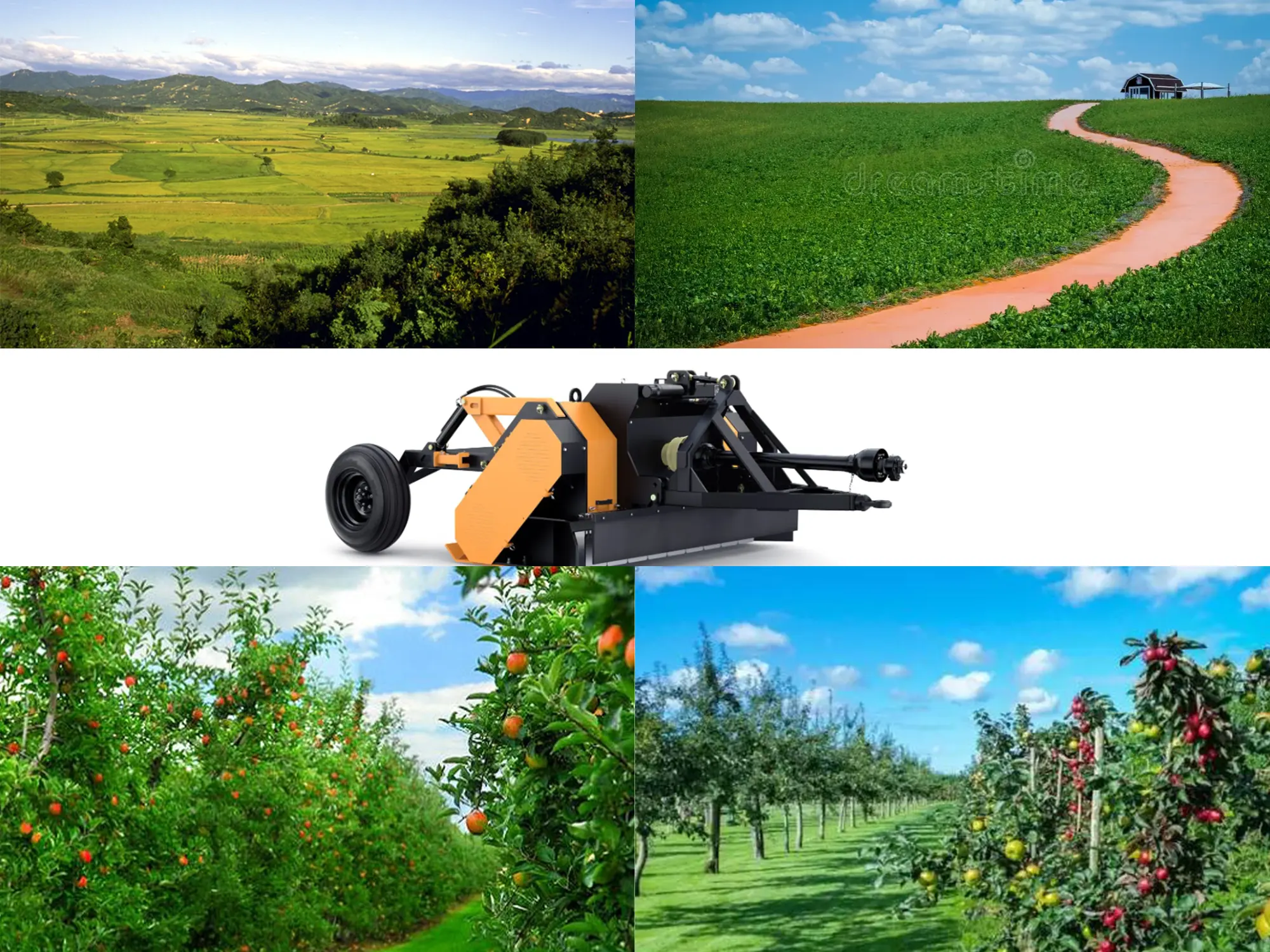
All specifications confirmed from the official Watanabe product brochure. All three models require a Cat. 2 three-point hitch and are designed to operate on the fine-tilth, stone-cleared ridges produced by the Korea Watanabe PSW-3200 and THOR 2.4 system:
EP-PAI-2100 — The Standard Korean Highland Terrace Planter
The EP-PAI-2100 is the most widely operated Korean highland potato planter in the Korea Watanabe potato machinery range. Its 2-row Cat. 2 mounted configuration is specifically matched to the dimensions of Korean highland terrace systems — the 2-row working width fits within the standard terrace bed width without requiring the turns at headland that wider planters need, and the 75 HP minimum tractor requirement aligns with the most common secondary tractor available on Korean highland farms.
The 16-gear spacing advantage
The EP-PAI-2100’s 16-gear spacing adjustment (25–40 cm range) is its defining feature. Unlike planters with 3–5 fixed spacing positions, the 16-gear system allows the operator to match seed spacing precisely to the variety’s specific optimal planting distance — Sumi at 28 cm, Dubaek at 32 cm, Daejima at 35–38 cm for large-tuber production — without compromising seed distribution mechanism engagement. Correct spacing for the specific variety is one of the most frequently overlooked yield determinants in Korean highland potato production, and the EP-PAI-2100’s spacing flexibility eliminates this as a constraint.
Mounted vs trailing — terrain matters
The EP-PAI-2100’s Cat. 2 mounted attachment keeps the planter’s weight over the tractor’s rear axle, maintaining front wheel contact on Korean highland slopes above 10%. A drawbar-towed planter on the same gradient would pull the tractor rear toward the planter’s weight, reducing front-axle steering effectiveness on the approach to terrace headlands. For slopes above 12%, the mounted 2-row configuration is the safer and more practical planting method.
In practice, the EP-PAI-2100 is the machine that covers the critical transition point in Korean highland potato farming — the step from hand-planting or contracted planting (pre-machine investment) to full own-machine mechanised planting with Grade 1 depth consistency. Most farms that acquire the EP-PAI-2100 as their first planting machine keep it as their primary planter for 10+ years, supplementing it with a harvester and other EP series machines as the farm’s revenue base grows.
Best suited for: Korean highland terrace farms at 5–15 ha, slopes above 10%, farms operating with a single 75–100 HP secondary tractor, Sumi and Dubaek as primary varieties. Not suitable for: commercial-scale operations above 20 ha where planting speed is the primary constraint, or Atlantic processing production where seed piece uniformity requirements demand the precision cut-seed mechanisms of larger commercial planters.
EP-PANTHER — The Flexible Configuration Planter for Mixed Systems
The EP-PANTHER’s defining characteristic is its row-count adjustability: it can be configured as a 2, 3, or 4-row planter within a single machine. This flexibility makes it the most versatile planter in the EP range — a single machine investment covers both the narrow-terrace 2-row configuration (for steep highland terrace work) and the wide-field 4-row configuration (for larger, more accessible highland plots accessible to wider planting passes).
When the PANTHER beats the EP-PAI-2100
The PANTHER configuration advantage is most valuable for farms that have a mix of narrow highland terraces (best served by 2-row) and wider lower-altitude fields (where 3–4 row configurations significantly reduce planting time). On a farm that plants both Sumi in highland narrow terraces and Atlantic in wider lower-altitude plots, a single PANTHER covers both without a second planter investment.
PANTHER limitations
The row-count flexibility adds mechanical complexity — configuration changes between 2 and 4 rows require adjustments that take time and mechanical competence. The PANTHER does not offer the EP-PAI-2100’s 16-gear spacing precision, which makes it less suitable for Daejima large-tuber production where spacing precision directly affects Grade 1 proportion. Confirm specific spacing range with Korea Watanabe for the intended variety portfolio before specifying the PANTHER.
Best suited for: Farms planting across multiple field types and scales, farms that will transition from 2-row to 4-row operation as the farm expands, farms growing both highland and mid-altitude varieties in the same season. Not ideal for: single-variety highland specialist operations (EP-PAI-2100 is more appropriate), or commercial scale where a dedicated 4-row machine is more efficient.
EP-PAI-480-AR — The Commercial Scale 4-Row Drawbar Planter
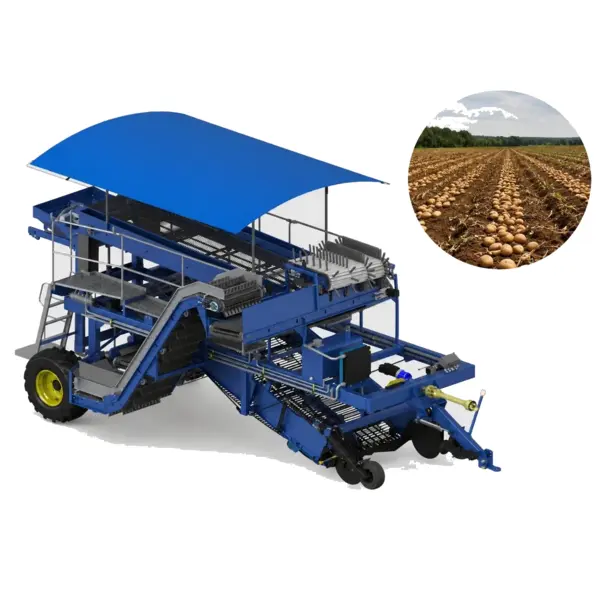
The EP-PAI-480-AR is the commercial-scale planter in the EP range. Its 4-row drawbar configuration and 4,000 Kg seed bunker are engineered for farms where completing the planting operation within a compressed time window is the primary operational constraint.
On a Korean highland farm planting 20 ha, the EP-PAI-2100 (2-row, daily coverage approximately 3–4 ha/day) requires 5–7 operating days to complete planting. The EP-PAI-480-AR (4-row, daily coverage approximately 6–8 ha/day) completes the same area in 3–4 days. The 3-4 day time saving at the narrow optimal planting window (late April to early May at 600 m altitude) is agronomically significant — uniform emergence across the full farm area only occurs if all seed is in the ground within a 3–5 day window, before soil temperature variation across the field becomes significant.
EP-PAI-480-AR Operating Advantages and Constraints
4,000 Kg seed bunker reduces refill stops — critical on large fields where bunker refill travel and time costs accumulate significantly on 2-row machines with smaller bunker capacity.
Drawbar towed configuration allows the tractor front wheels to freely steer for turns on larger field headlands without the rear linkage pivot constraint of mounted planters.
Drawbar configuration is not suitable for narrow Korean highland terraces where the planter’s 4-row width exceeds the terrace planting bed. Check terrace bed width against 4-row planting width before specifying — narrow terrace farms should use EP-PAI-2100 or EP-PANTHER configured as 2-row.
The loaded 4,000 Kg bunker + drawbar configuration requires careful gradient management on highland slopes — loaded descent weight is higher than 2-row mounted planters, and drawbar traction on descents above 12% requires specific tractor-planter combination assessment. Confirm with Korea Watanabe before operating on slopes above 10%.
Best suited for: Commercial-scale farms planting 20+ ha per season, farms with predominantly wider terrace or accessible highland field configurations, operations where completing planting within a tight time window is the primary concern. Confirm tractor drawbar capacity and slope compatibility with Korea Watanabe before purchase.
Planting Depth Consistency — Why the Stone-Cleared Field Changes Everything
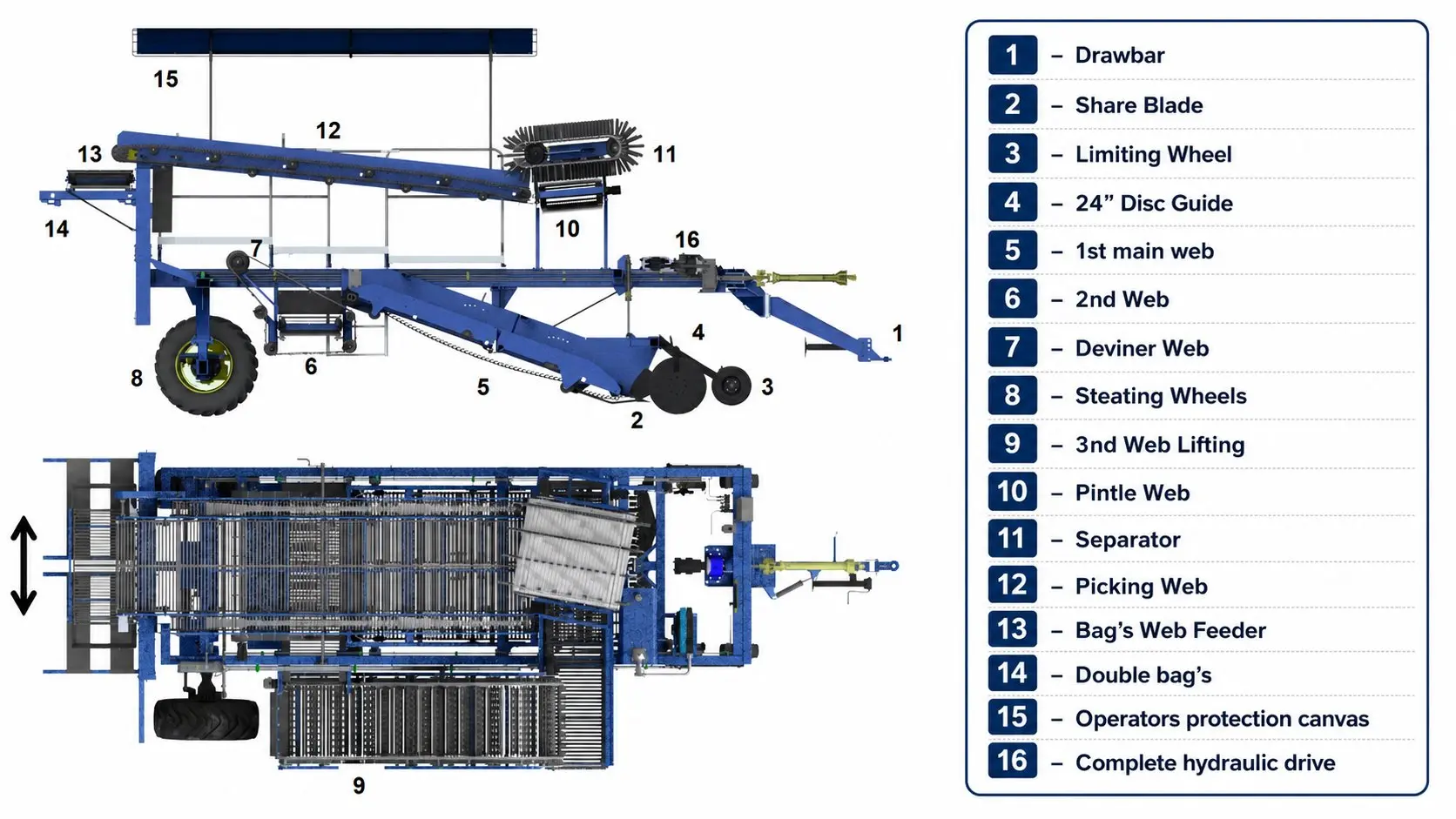
Planting depth consistency — every seed piece placed at the same depth within ±2 cm — is the primary technical specification that separates premium Korean highland planting from standard practice. The stone-cleared field prepared by the THOR 2.4 + PSW-3200 system enables this consistency in a way that un-cleared highland soil cannot. Understanding why makes the link between the stone clearing investment and the planter selection explicit:
Un-cleared soil
The planting disc or furrow opener encounters stones of varying size at varying depths. Each stone encounter briefly lifts or deflects the disc, changing the seeding depth for that seed position. Variable seeding depth across the planting pass produces emergence over a 5–10 day spread rather than a 2–3 day emergence peak — a broader canopy establishment window that produces uneven competition within the plant stand and ultimately uneven tuber sizing.
Cleared soil
The planting disc or furrow opener runs through uniform, stone-free fine tilth without resistance variation. Depth consistency across the full planting pass is within ±1–2 cm. Emergence occurs over 2–3 days rather than 5–10, producing the uniform canopy closure that maximises photosynthetic efficiency during the tuber bulking phase and produces the size uniformity that Grade 1 markets require.
The practical implication: the full value of the EP-PAI-2100’s 16-gear spacing system is only realised on stone-cleared, fine-tilth ridges. On un-cleared ground, the depth variability from stone encounters makes the precise spacing setting largely academic — the planter is delivering inconsistent depth regardless of spacing precision. This is why Korea Watanabe always discusses planter selection in the context of the complete system, starting with stone clearing.
Planter Selection Decision Framework — Which Model for Which Farm
| Farm profile | Annual planting area | Terrace type | Recommendation |
|---|---|---|---|
| Family highland farm, single variety | 5–15 ha | Narrow highland terrace | EP-PAI-2100 ✓ |
| Farm with mixed altitude fields | 8–20 ha | Mix of narrow + accessible | EP-PANTHER ✓ |
| Commercial scale / contractor | 20+ ha | Wide accessible plots | EP-PAI-480-AR ✓ |
| Precision seed spacing required (Daejima) | Any | Any | EP-PAI-2100 (16-gear) ✓ |
| Slope above 12%, tight terrace headlands | Any | Steep narrow highland | EP-PAI-2100 (mounted) ✓ |
| 75 HP tractor (no larger available) | Any | Any | EP-PAI-2100 or EP-PANTHER ✓ |

Frequently Asked Questions
What is the best potato planter for tractor use on Korean highland farms?
For the majority of Korean highland family farms at 5–15 ha planting area, the EP-PAI-2100 is Korea Watanabe’s standard recommendation. Its 2-row Cat. 2 mounted configuration fits the standard Korean highland terrace system, the 16-gear spacing adjustment covers all four main highland varieties’ optimal spacings, and the 75 HP tractor requirement aligns with the most common secondary tractor available on Korean highland farms. The EP-PANTHER is recommended for farms that need row-count flexibility across multiple field types. The EP-PAI-480-AR is the choice for commercial-scale operations where daily planting throughput above 6 ha/day is required. No single model is universally “best” — the correct choice depends on farm area, terrace width, available tractor HP, and the variety portfolio being planted.
How does the EP-PAI-2100 perform with cut seed vs whole seed for Sumi and Dubaek varieties?
The EP-PAI-2100 is designed to handle both whole small-tuber seed (30–50 g range) and cut seed pieces (40–60 g range) from standard Korean highland potato varieties. Whole-tuber seed (the preferred option for certified seed material and for disease management) flows more consistently through the seed cup mechanism and produces lower double-drop rates than cut seed. Cut seed from large-tuber varieties (Daejima, Dubaek at 70+ g) requires more careful cup size setting to avoid bridging at the cup throat — Korea Watanabe recommends confirming the correct cup configuration for cut-seed operations at the pre-season machine setup. Atlantic for processing typically uses cut seed to a specific piece weight requirement (the processor contract specifies minimum seed piece weight); confirm the EP-PAI-2100’s cup configuration compatibility with the specific processing contract’s seed piece specification before ordering the planter for Atlantic production.
Can the EP-PAI-2100 also apply fertiliser during planting, or does it require a separate furrower pass?
The EP-PAI-2100 is a planting-only machine — it does not include a fertiliser application mechanism. Basal fertiliser application for Korean highland potato is provided by the EP-ADB furrower-fertiliser applicator series, which creates the furrow, applies fertiliser at the specified depth and rate, and leaves the seedbed prepared for the EP-PAI-2100 to follow in a subsequent pass. This two-pass approach (EP-ADB furrowing + fertilising, then EP-PAI-2100 planting) is the standard Korea Watanabe system for highland potato establishment. The separation allows the fertiliser to be placed at the optimal depth (typically 10–15 cm, below the seed) rather than in contact with the seed piece — which prevents the fertiliser-burn damage that occurs when seed and concentrated fertiliser are placed in direct contact. Confirm with Korea Watanabe which EP-ADB model pairs correctly with the specific row spacing configuration of the intended EP-PAI-2100 or EP-PANTHER setup.
Does the EP-PAI-2100 require any modification for the narrow row spacing needed for high-density hill planting on NAAS certified seed fields?
The EP-PAI-2100’s 16-gear spacing system provides the narrow spacings (25–28 cm) used for high-density NAAS certified seed field planting. No modification is required — the gear selection covers the certified seed planting density specifications without any physical reconfiguration. The critical certified seed planting requirement that does require attention is seed piece weight uniformity (NAAS specifies seed piece size ranges) and the pre-planting disease inspection protocol. Korea Watanabe provides the NAAS certified seed field planting configuration for the EP-PAI-2100 as part of the certified seed programme documentation support offered to customers participating in the programme.
Which potato planter pairs with which harvester in the Korea Watanabe EP series?
The Korea Watanabe potato machinery range is designed as a matched system: the EP-PAI-2100 2-row planter pairs with the EP-AWB-1600 2-row mounted harvester (75 HP, Cat. 2) for complete farm automation of planting and harvest with a single tractor. The EP-PAI-480-AR 4-row planter pairs with the EP-AWB-3200 4-row trailed harvester (continuous belt elevator) for commercial-scale operations. The EP-PANTHER in 4-row configuration also pairs with the EP-AWB-3200. The row count and row spacing between the planter and harvester must match — the harvester’s picking web width and lifting tine spacing are set to match the specific row spacing used at planting. Confirm the planting row spacing setting and the harvester configuration simultaneously when specifying both machines to ensure the system is correctly matched. Korea Watanabe confirms full system configuration as part of the pre-purchase consultation for any combination of EP series planting and harvesting machines.
Potato Planter + System Configuration — Matched From Stone Clearing to Harvest
Farm area + terrace width + tractor HP + variety portfolio → Korea Watanabe confirms the correct EP-PAI model, row spacing configuration, matching harvester, and seed type compatibility — as part of the complete system consultation.
Editor: Cxm