
Walk into any agricultural showground and you will hear both terms used — sometimes for the same machine on the same stand. A farmer in the Netherlands will call their machine a “potato harvester” while their counterpart in Canada calls a broadly similar piece of equipment a “potato digger.” The terminology varies by country, by generation, and by dealer habit. But underneath the inconsistent language, there are two genuinely different machines that do different jobs, require different levels of investment, and suit different farm sizes and labour situations. Understanding which one you actually need — and why — is one of the more consequential purchasing decisions in a potato operation.
The one-word distinction is collection. A potato digger lifts tubers out of the soil, separates them from the majority of the soil, and leaves them on or near the surface. A potato harvester does everything a digger does and then also collects the tubers into a bag, bunker, or elevator system for direct transfer to a trailer or storage container. That single additional function — collection — changes the economics of the machine completely. It changes the number of people you need at harvest, the speed at which you can work, the quality at which the crop arrives in storage, and the capital cost of the equipment. This guide works through each of those dimensions in detail to give you a clear decision framework for your specific situation.
What a Potato Digger Does — and What It Doesn’t
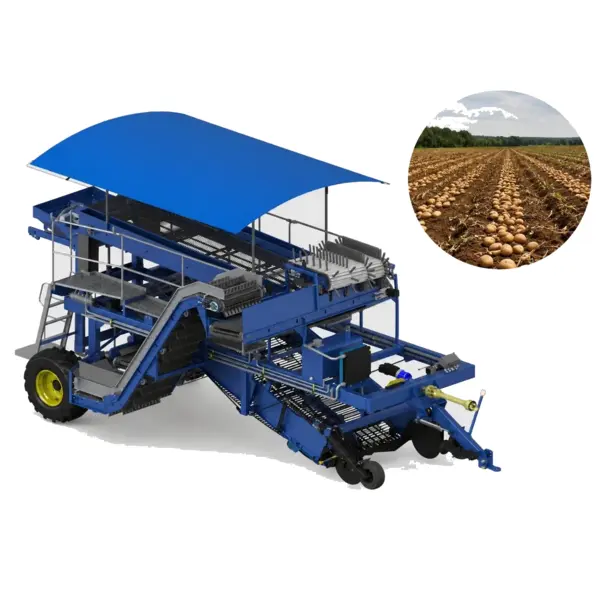
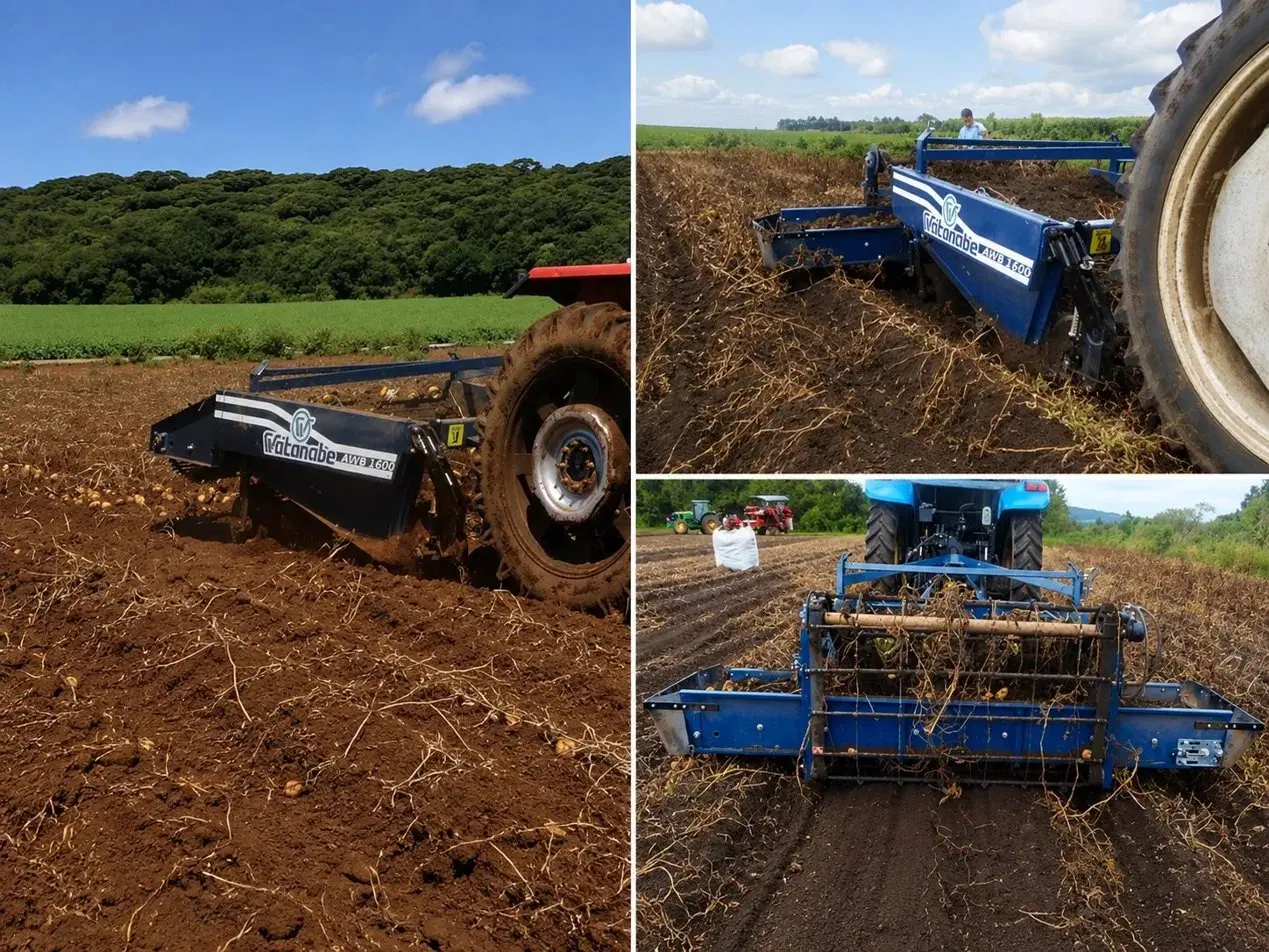
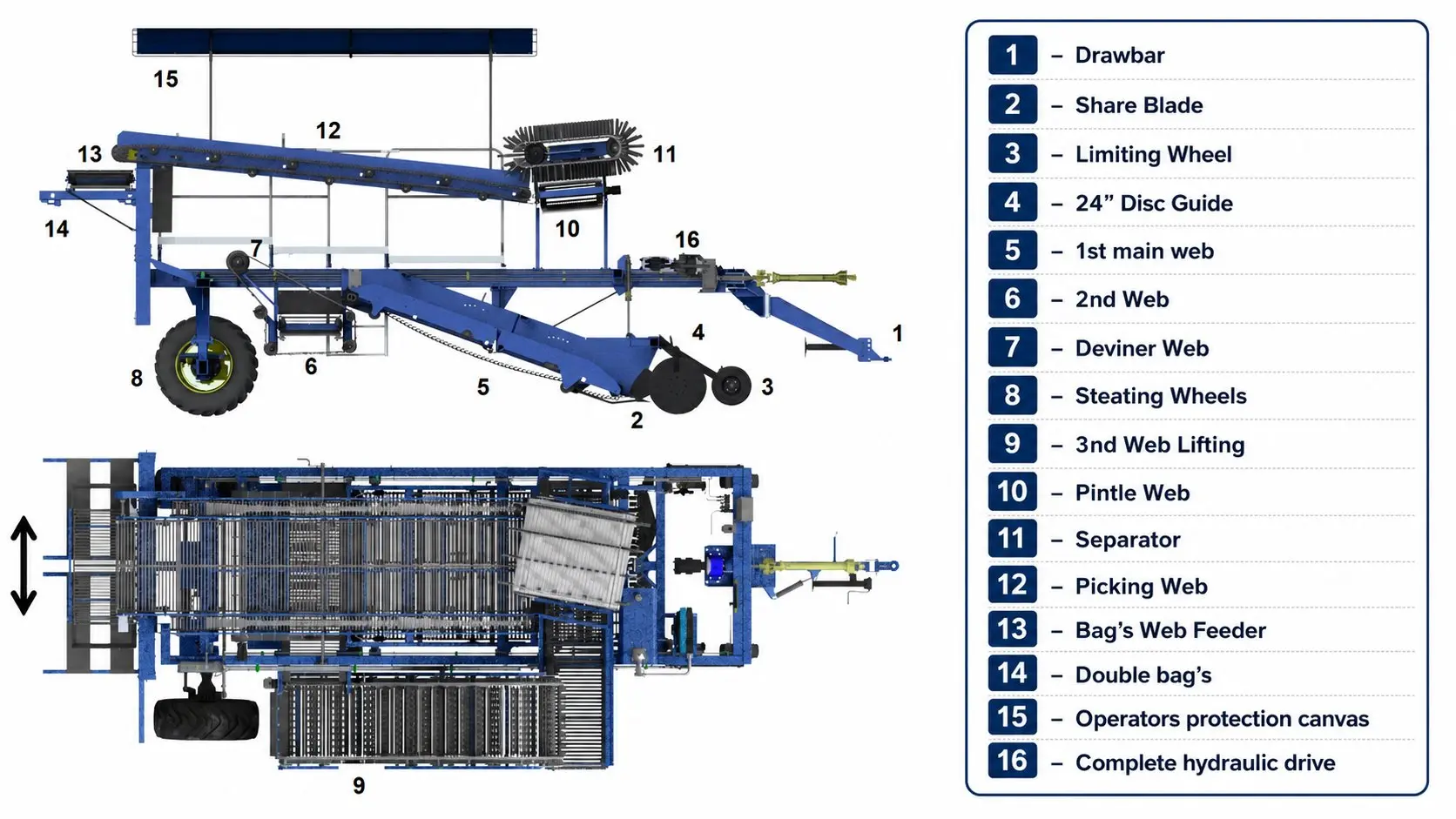
A potato digger is a soil-engagement implement — its job is to interact with the soil and the buried tuber crop, not to handle the harvested crop afterward. The working process follows a fixed sequence. A digging share (a wide, angled blade) penetrates the soil ahead of and below the potato row at a depth of typically 18–28 cm, lifting the entire ridge of soil and tubers together. This lifted mass passes onto an elevator chain — a continuous belt of steel rods or bars with gaps between them — that shakes and vibrates as it travels. The vibration disaggregates the soil and allows it to fall through the gaps between the rods while the larger tubers are carried to the rear of the machine. At the rear, a separator — either a set of rotating star wheels or a riddle frame — makes a final separation of any remaining soil clumps and small stones from the tubers.
What happens next is the defining characteristic of the digger: the tubers exit the rear of the machine and land either directly on the surface of the field or, in some configurations, in a windrow (a gathered row) beside the original potato bed. The machine moves on. The tubers remain. Someone or something else must come and collect them.
This “deposit and collect separately” model is not a design flaw — it is intentional. A digger is mechanically simpler, lighter, and less expensive than a harvester because it is only doing half of the harvest job. For a farm operation where following labour is available — family members, seasonal workers, a contractor crew — the digger is a highly cost-effective way to mechanise the hardest part of potato harvest (the digging) while keeping the collection task within the existing labour structure. The digger also handles difficult conditions — stony ground, irregular field shapes, steep slopes — more tolerantly than a harvester, because it has fewer moving parts, a smaller footprint, and lower minimum tractor power requirements.
🔵 DIGGER — The Operating Model in Three Steps
Step 1: Tractor + digger passes through field — share lifts tubers, elevator and separator remove soil.
Step 2: Tubers land on soil surface or in a row. Machine moves on.
Step 3: Separate collection follows — by hand, by a potato spinner or bunker loader, or by a following collection team.
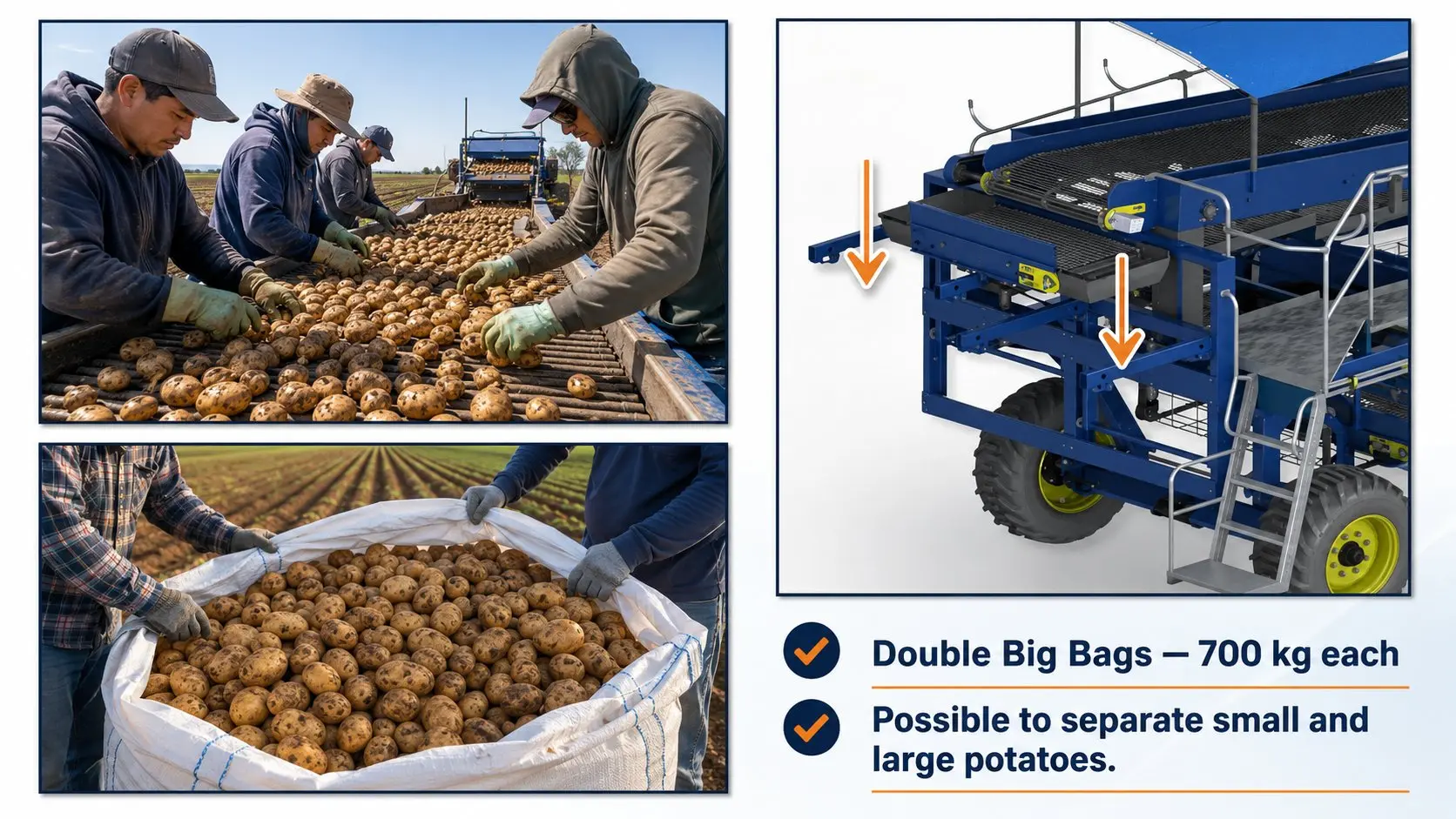
A potato harvester extends the operating sequence to include collection. After the elevator chain and separator have done their work, the tubers continue onto a cross-conveyor and then into a collection system — typically either a big bag (a one-tonne polypropylene bag suspended from a frame), a fixed bunker (a hopper that is emptied into a tractor trailer alongside), or a direct transfer elevator that loads continuously into a chaser trailer running beside the harvester. The machine does not deposit tubers on the ground. It takes them directly from the soil into storage packaging. For this reason, a harvester can operate with dramatically fewer people — often just the tractor driver and one person to manage the bag or monitor the bunker level — while processing the same amount of crop per unit time.
🟠 HARVESTER — The Operating Model in Two Steps
Step 1: Tractor + harvester passes through field — share lifts, elevator removes soil, cross-conveyor delivers tubers to collection system.
Step 2: Full bags or a loaded bunker exit the field on a trailer. No tubers remain on the ground.
The Labour Equation — Why This Is Usually the Deciding Factor
The commercial argument between digger and harvester is almost always a labour argument dressed up as a machinery argument. The capital cost difference is real, but the labour cost difference is often larger over a typical five-year ownership period — particularly as seasonal labour availability tightens and hourly rates increase.
A typical single-row mounted digger operation requires a minimum of three people to function at a reasonable pace: the tractor driver running the digger, and at least two people following on foot or with a picking machine collecting the exposed tubers into sacks or containers. On stony ground or with an older crop that has spread along the bed, a fourth picker is common. Each of those people represents an hourly labour cost, a management overhead, a legal employment obligation in most jurisdictions, and a practical availability constraint — because good seasonal potato pickers are harder to find in most potato-growing regions than they were ten years ago.
Consider a farm harvesting 10 hectares of maincrop potato over a two-week window. At a digger field rate of 0.4 ha per effective working hour (accounting for headland turns, stoppages, and realistic forward speed in heavier soils), the 10 hectares requires approximately 25 digger-hours. With three people needed, that is 75 person-hours of direct harvest labour — plus the tractor driver’s time. In a season where skilled seasonal pickers command the rates they do in the UK, Canada, and Australia in the mid-2020s, the direct labour cost of a two-week 10-hectare harvest can easily exceed the annual finance payment on a small harvester. The crossover calculation — the point at which it becomes cheaper to own a harvester than to employ pickers with a digger — is reached more quickly than most first-time buyers expect.
Harvester operations change the arithmetic fundamentally. A big bag harvester running on the same 10-hectare farm requires two people — the tractor driver and one bag-change operator. Field rate is typically 0.5–0.7 ha per effective hour for a one-row unit (slightly slower than the digger for the same machine width, because more mechanical work is happening). The 10 hectares takes 15–20 harvester-hours. Total person-hours: 30–40. The reduction in labour demand is approximately 50–60% compared to the digger-plus-pickers model, and the quality of the post-harvest product is typically higher because tubers spend minutes in the machine rather than hours on a rain-wet field surface waiting for a picking crew.
| Harvest System | People Required | Person-Hours per 10ha | Tuber Time on Ground |
|---|---|---|---|
| Single-row mounted digger + hand pickers | 3–4 | 75–100 | 30 min–4 hours |
| Two-row mounted digger + mechanical spinner/loader | 2–3 | 40–65 | 15 min–2 hours |
| One-row big bag harvester | 1–2 | 20–35 | None — collected in machine |
| Two-row trailed harvester with bunker | 2–3 | 25–45 | None |
Field Capacity — How Much Can Each System Harvest per Day
Comparing field capacity between a digger and a harvester requires a careful approach. The machines do not compete directly for the same output metric, because a digger’s “output” is exposed tubers on the ground — the collection step is additional — while a harvester’s output is tubers in bags or bunker. A digger can pass through an acre quickly and look efficient, but the tubers are still on the ground. For an apples-to-apples comparison, the relevant metric is not machine field speed but total harvest throughput — the rate at which the entire operation, including collection, delivers potatoes into storage.
Using this total-operation measure, the machines often perform more similarly than the digger’s higher theoretical field speed would suggest. A digger moving fast is actually a liability if the picking crew cannot keep pace — tubers left on the surface for extended periods are at risk of greening (light exposure), soil re-adhesion, bruising from rain or tractor traffic, and quality downgrade. Good digger operation is paced to the picking crew’s rate, not to the machine’s maximum capability.
| Machine Type | Rows | Working Width | Forward Speed | ha / 8hr Day | Min. Tractor HP |
|---|---|---|---|---|---|
| Single-row mounted digger | 1 | 75–90 cm | 3–6 km/h | 2.0–3.5 | 40–60 |
| Two-row mounted digger | 2 | 150–180 cm | 3–5 km/h | 3.5–6.5 | 65–90 |
| Trailed wide digger (4-row) | 4 | 3.0–3.6 m | 3–5 km/h | 7–12 | 100–140 |
| One-row big bag harvester | 1–2 | 75–150 cm | 2–4 km/h | 2.5–5.0 | 60–90 |
| Two-row trailed harvester + bunker | 2–4 | 1.5–3.0 m | 2–4 km/h | 5.0–10.0 | 90–150 |
The table reveals an important truth: a small harvester and a single-row digger operate at broadly similar field speeds. The harvester’s advantage is not primarily speed — it is the elimination of the post-digging collection step. When you account for that elimination, the harvester’s total throughput from field to storage is substantially higher than its headline field rate suggests, because there is no waiting for a picking crew, no weather exposure risk, and no minimum crew size constraint.
Capital Cost and Tractor Compatibility — Setting the Budget Context
Capital cost comparisons between digger and harvester categories must be approached carefully because both categories span a wide range. A single-row mounted digger at the basic end of the market has a low entry point that makes it accessible to small-farm and part-time operators. A full trailed two-row harvester with a bunker, sorting table, and electronic monitoring sits at a level of investment appropriate to a commercial operation with the turnover to service it. Within each category, the range is wide enough to overlap — a high-specification trailed digger can cost more than a basic one-row big bag harvester.
| Category | Typical Configuration | Min. Tractor HP | Relative Investment | Suitable Farm Scale |
|---|---|---|---|---|
| DIGGER | Single-row mounted | 40 HP | ●○○○○ Entry | 0.5–5 ha |
| Two-row mounted | 65 HP | ●●○○○ Mid-low | 3–15 ha | |
| Trailed 4-row | 100 HP | ●●●○○ Mid | 10–40 ha | |
| HARVESTER | One-row big bag harvester | 60 HP | ●●●○○ Mid | 2–15 ha |
| Two-row trailed + bunker | 90 HP | ●●●●○ Mid-high | 15–80 ha | |
| Multi-row trailed + sorting table | 130 HP+ | ●●●●● Premium | 60 ha+ |
The tractor compatibility question is often overlooked in the early stages of comparison. A farm that currently runs a 50HP tractor for general work can add a single-row digger without any tractor upgrade. Moving to a two-row big bag harvester on the same farm requires either a tractor upgrade (60–90HP minimum, preferably with a standard Category 2 three-point linkage rated to 2,000 kg or more) or a decision to work with a larger tractor from another purpose. The cost of the tractor upgrade must be factored into the harvester ROI calculation — it is a real and significant additional investment that can shift the break-even point considerably, and it is frequently underestimated by first-time buyers focused narrowly on the harvester purchase price.
To explore the full range of potato digger and harvester options suited to different farm sizes and tractor configurations, the product category pages include specifications for each machine in the range.
Farm Size and Situation Decision Matrix — Which System for Your Operation
The decision between digger and harvester is not primarily a question of what you can afford — it is a question of what your farm’s operating model actually requires. The three critical variables are farm scale (total hectares harvested per season), labour situation (how many reliable people are available at harvest time), and field conditions (stone level, slope, and irregularity, which affect machine complexity tolerance). Mapping your situation against these three variables provides a clearer answer than any price comparison alone.
| Farm Scale | Labour Situation | Field Conditions | Recommendation |
|---|---|---|---|
| 0.5–3 ha | Family/smallholder, 2–4 people available | Any | Single-row mounted DIGGER — investment proportionate; labour available |
| 3–10 ha | Family + 2–3 seasonal workers; labour reliable | Clean or lightly stony soils | Two-row mounted DIGGER or small big bag HARVESTER — evaluate labour cost |
| 3–15 ha | Labour scarce; difficult to find seasonal pickers | Any | Big bag HARVESTER — labour saving justifies investment even at smaller scale |
| 10–30 ha | Any — scale drives decision | Clean to moderately stony | Trailed HARVESTER with bunker — crossover point where harvester ROI is clear |
| 30 ha+ | Any | Clean fields | Multi-row trailed HARVESTER — digger system cannot maintain harvest window |
| Any scale | Any | Very stony ground (stone clearing not yet done) or steep/irregular fields | DIGGER first — address stones and terrain before upgrading to harvester |
One scenario deserves particular emphasis: the stony ground situation at any farm scale. A harvester’s additional mechanical complexity — cross-conveyor, bag frame, bunker elevator, collection hoppers — creates more surface area for stone impact damage than a simple digger. A stone that passes through a digger and falls harmlessly onto the field surface may jam a harvester’s cross-conveyor, crack a hopper wall, or damage a collection belt. For this reason, potato machinery selection on stony ground should always begin with a realistic assessment of stone level — and, where stone level is high, with a stone management programme before upgrading from digger to harvester.
When the Standard Answer Is Wrong — Exceptions Worth Knowing
The farm-size matrix above gives the right answer for most situations. But there are specific circumstances where the standard recommendation reverses, and understanding these exceptions prevents expensive mistakes.
Frequently Asked Questions
▶
Can I use a potato digger as a harvester by adding a collection attachment?
There is no practical attachment that converts a conventional PTO-driven potato digger into a true harvester, because the two machines have fundamentally different structures behind the elevator chain. A digger ends at the separator — there is no structural provision for a cross-conveyor, bag frame, or bunker. What is sometimes possible is running a separate trailing bunker or potato spinner alongside the digger, driven by a second person and second vehicle, to collect the exposed tubers before they reach the ground — but this is a two-machine, two-tractor operation that negates most of the simplicity and cost advantages of the digger. If the goal is to achieve harvester-level labour efficiency, the practical solution is to buy a harvester (or a big bag unit), not to modify a digger.
▶
Does a harvester damage potatoes more or less than a digger?
This is one of the most common questions, and the answer depends on which element of damage you are measuring. Harvester mechanical handling — the cross-conveyor, elevator, and drop into bag or bunker — creates controlled impact points that can be designed and set to minimum drop heights, typically 20–40 cm, if the machine is properly calibrated. The tubers never touch the ground at all. A digger deposits tubers on the field surface where they are subject to rain, sun exposure (greening risk), soil re-adhesion, and the physical impact of pickers’ boots and hands during collection. Research from the UK Potato Council and comparable bodies in the Netherlands consistently shows that well-operated harvesters with calibrated drop heights produce lower bruising rates than digger-plus-hand-picking operations — primarily because the picking and collection stage of the digger system is the highest-impact event in the post-digging handling chain, and the harvester eliminates it entirely.
▶
At what farm size does a potato harvester typically pay back its additional cost over a digger?
The payback period depends heavily on the local labour cost, the availability of reliable pickers, and the price premium achievable for better-quality harvested potato. As a general industry benchmark in Western European and North American markets: farms harvesting 8–12 hectares or more per season typically find that a one-row big bag harvester pays back its cost differential over a single-row digger within 4–6 seasons, driven primarily by labour cost savings. Farms in regions where seasonal labour costs are exceptionally high or where picker availability is severely constrained may see payback in 2–3 seasons at the same scale. Farms under 5 hectares with reliable family labour available at no cash cost may never reach payback — the digger remains the more economical choice in those specific circumstances.
▶
Is a “potato harvester” the same as a “combine potato harvester” or a “self-propelled potato harvester”?
No — these are distinct categories within the harvester family. A tractor-mounted or trailed potato harvester of the type covered in this guide is PTO-powered and requires a separate tractor. A self-propelled potato harvester is its own powered machine — it carries its own engine, driver cab, and drive system and operates independently of a tractor. Self-propelled machines are found only on the largest commercial operations (100+ hectares) because their capital cost is several times that of even a large trailed harvester. A “combine potato harvester” is not a technically standard term — it sometimes refers to machines with onboard sorting and grading systems (sometimes called harvester-graders), which again are a step up in both capability and cost from standard trailed harvesters. For most farming operations up to 100 hectares, the tractor-driven trailed harvester — with or without a bunker — is the relevant product category.
▶
Should I buy a digger first and upgrade to a harvester later, or go straight to a harvester?
For a farm starting from scratch with limited capital, a digger-first pathway is often sensible — it allows the farm to establish its potato enterprise, understand its soil and field conditions, build its market relationships, and reach a scale where the harvester investment is justified before committing to it. The risk of this approach is that the digger becomes a production bottleneck sooner than expected, particularly if the farm grows quickly or if local labour availability declines (as it has done in most potato-growing regions over the past decade). For a farm that already has a clear business plan showing 8+ hectares of potato within two to three seasons, and whose tractor is of sufficient HP, going directly to a big bag harvester avoids the cost of buying a digger that will need replacing within a few years. Talk to a specialist about your specific field, soil, and labour situation before deciding — the right answer varies more between operations than any generic guide can capture.
▶
My field has a moderate stone problem. Should I clear stones before choosing between a digger and a harvester?
Yes — for stony ground, stone management should be resolved before finalising any potato machinery selection. The reason is that stone level affects not only which machine you can run, but also at what speed, with what maintenance frequency, and with what replacement parts cost. A field at high stone density (>10 stones per square metre, or stones larger than 8 cm in the top 25 cm of the profile) will damage both digger and harvester share blades and elevator chains at rates that significantly change the economics of both options. More importantly, a high-stone field that is incompatible with a harvester today may, after a systematic stone clearing programme with a rock crusher and rock picker, become fully harvester-compatible — which changes the machinery decision entirely. Establishing stone level first, and addressing it where needed, gives you the full range of machinery options rather than a constrained choice dictated by stone conditions that are within your control to change.
Not Sure Which System Fits Your Farm?
Tell us your farm size, current tractor HP, stone level, and labour situation. Korea Watanabe’s potato machinery range covers every scale from 0.5 ha smallholder to 100-hectare commercial operation — a specialist will confirm the right system and specification for your fields.
Editor: Cxm