The potato furrower — also called a ridger or bed former — is the machine that creates the physical structure around which every subsequent stage of potato production is organised. It takes a flat, cultivated seedbed and forms it into a series of raised ridges at a fixed pitch, establishing the row geometry that the planter must match, the depth that the seed is placed at, the drainage profile that determines the tuber’s moisture environment throughout the growing season, and the operating zone that the harvest digger’s share must recover. In a system where six machines must work in sequence, the furrower is the one that commits all the others to its geometry — and therefore the one whose adjustment has the deepest cascade of consequences through the season.
Korea Watanabe’s ジャガイモ加工機械 range includes disc-type furrowers designed for tractor HP from 40 HP upwards, with row pitch settings from 650 mm to 900 mm covering the standard ware, seed, and specialist crop spacings used across UK, Canadian, Australian, and Asian potato markets.
How a Potato Furrower Works — Ridge Formation Mechanics
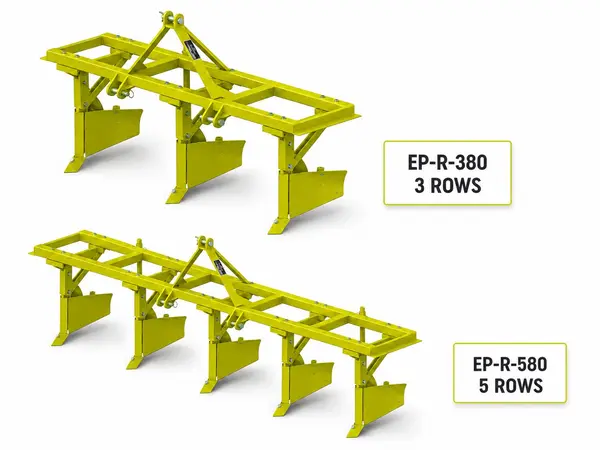
The disc-type potato furrower operates through a pair (or multiple pairs for multi-row operation) of concave discs set at an angle to the direction of travel. As the discs rotate through the cultivated soil, the concave face deflects the loosened soil inward and upward, casting it over the centreline of the row to form a ridge crest. The inter-row furrow — the channel between adjacent ridges — is formed by the soil removal rather than by direct mechanical action: the discs take soil from the furrow zone and deposit it on the ridge, simultaneously lowering the furrow and raising the ridge in a single pass. The height difference between ridge crest and furrow bottom is the net result of this redistribution, and it depends on the disc attack angle, the disc depth setting, the soil’s structure and moisture content, and the forward speed.
Many furrowers also carry mould-board wings behind the discs — flat or curved steel plates that shape the ridge sides into a consistent slope angle as the displaced soil is cast. The wing geometry determines the ridge’s cross-sectional profile: a well-designed wing produces a smooth, consistent 45–55° slope on each ridge side that sheds surface water uniformly into the furrow, preventing waterlogging of the ridge crest zone where the seed tuber sits. A damaged or misaligned wing produces an irregular slope with flat zones that pond water — and water pooling above the seed depth is a primary trigger for seed rot and hollow heart.
A
Disc Entry — Soil Engagement and Depth Setting
The concave disc enters the cultivated seedbed at a set depth below the soil surface — typically 12–20 cm for a standard ridge application. The depth is controlled by the furrower’s gauge wheels, which run on the furrow bottom and maintain a consistent disc penetration depth independent of minor tractor lift arm variation. Disc entry depth and disc diameter together determine how far below the furrow the displaced soil is sourced: a larger-diameter disc draws from deeper in the profile, producing a ridge with denser, more consolidated soil at the base (a structural benefit for root anchorage); a smaller disc draws only from the surface tilth, producing a lighter ridge that is easier for the planter coulter to penetrate but may settle unevenly after rainfall.
B
Soil Transport — Concave Face Displacement and Casting
As the disc rotates (it is a free-spinning, passively-driven disc — not power-driven), the soil that contacts its concave face is lifted and thrown laterally and upward towards the ridge centreline. The throw distance and direction are controlled by the disc attack angle: a disc set at a wider angle to the direction of travel throws soil further and higher, producing a taller, wider ridge; a narrower angle produces a lower, narrower ridge. Forward speed amplifies the attack angle effect — at higher forward speed (above 5 km/h for most furrowers), the soil is thrown with greater kinetic energy and forms a taller but coarser ridge with larger aggregate size at the crest. At lower forward speed (3–4 km/h), the soil is placed more gently, producing a denser, finer-textured ridge crest that the planter can penetrate more accurately.
C
Wing Shaping — Profile, Slope and Surface Finish
The mould-board wings trailing behind each disc act as shaping forms, consolidating the thrown soil into the target ridge profile and smoothing the ridge sides to the specified slope angle. The wing adjustment — angle and height above the furrow — is the final control on ridge shape consistency. Wings set too high produce a ridged, irregular slope that dries out unevenly; wings set too low create an over-consolidated slope that restricts water infiltration into the ridge. The correct wing setting produces a smooth, moist-appearing ridge side with no surface cracking after the first 24 hours — indicating correct consolidation that maintains structure without sealing the surface against rainfall entry.
Ridge Geometry — Height, Width, Profile and Tuber Growth Space
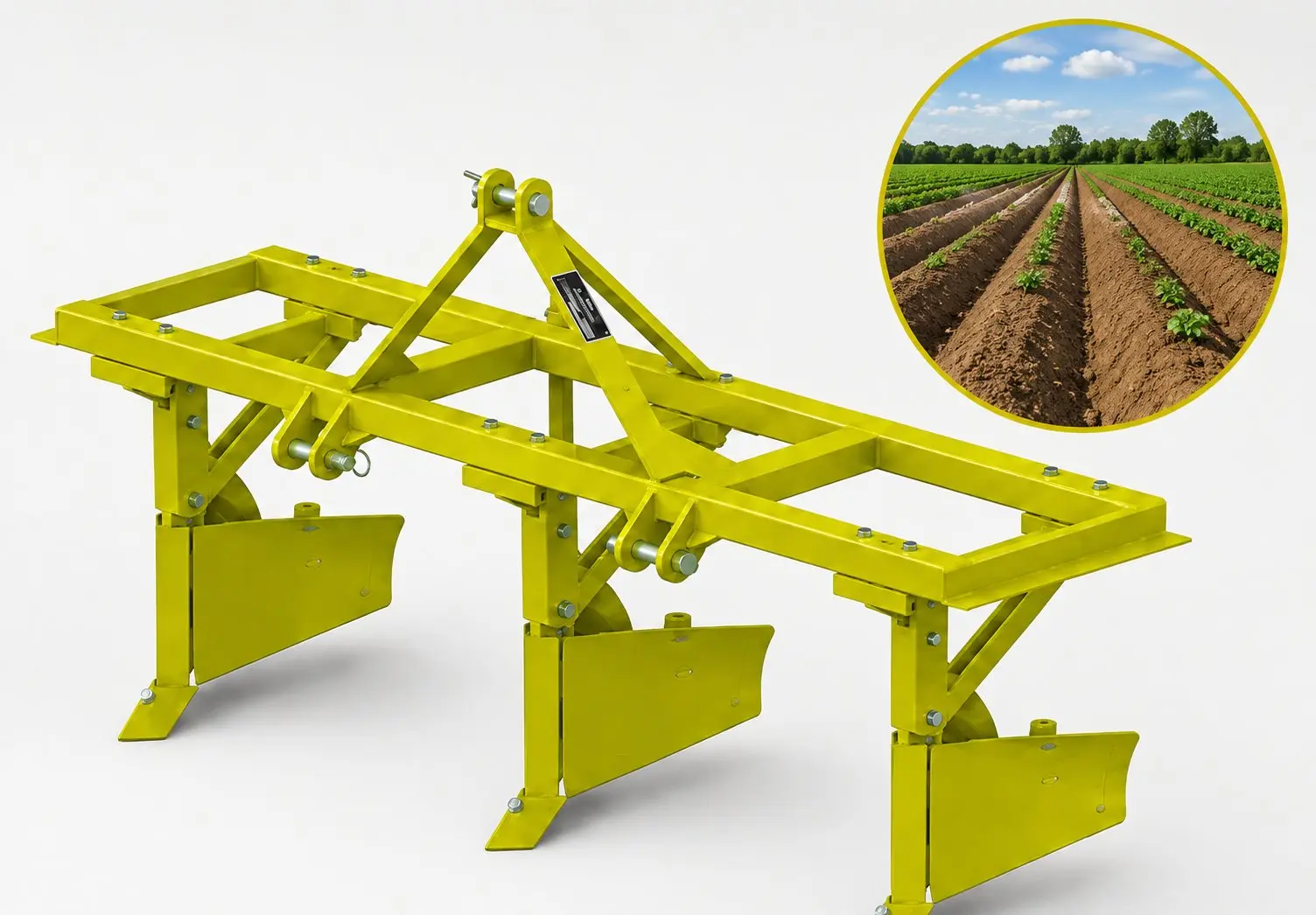
The ridge’s cross-sectional geometry is not an aesthetic specification — it is a direct determinant of tuber size grade distribution at harvest. The soil volume above the seed placement depth and within the ridge profile is the growth space available to the developing tubers. Larger growth space allows tubers to expand to their full genetic potential without coming into contact with each other, neighbouring tubers, or the ridge surface (which causes the compression flattening that produces misshapen Grade 2 potatoes). Smaller growth space — from a low or narrow ridge — forces tubers to compete laterally, producing a grade distribution skewed towards smaller sizes and a higher incidence of irregular shapes at higher plant densities.
H Ridge Height
Standard target: 22–28 cm above furrow level. Height is measured from the furrow bottom to the ridge crest. Every additional centimetre of ridge height provides approximately 30–40 cm² of additional cross-sectional growth space per running metre in a standard 750 mm pitch system. A 25 cm ridge provides approximately 450–480 cm² of growth area; a 20 cm ridge provides approximately 330–360 cm² — a 25–30% reduction that is measurable in final tuber grade distribution on high-set varieties.
Grade implication
Taller ridge → more large-size tubers (60–100 mm grade) → higher proportion meeting Grade 1 size specification for ware markets
W Base Width
Standard: 60–70 cm at the base for a 750 mm row pitch, 70–80 cm for a 900 mm pitch. The base width determines how much soil is available for lateral stolon and tuber development. A narrow ridge (base width less than 55% of row pitch) forces laterally-spreading stolons to emerge at the ridge side surface, where they are exposed to light (greening risk) and mechanical damage from inter-row cultivation. A correct-width ridge keeps all stolon tips and developing tubers fully buried throughout the growing season.
Grade implication
Correct base width → all tubers buried ≥5 cm → zero greening → full Grade 1 eligibility on skin condition
P Profile Slope
Standard slope angle: 45–55° from horizontal for both ridge sides. The slope angle determines drainage velocity during rainfall: a steeper slope (55–65°) drains faster but provides less lateral root development space; a shallower slope (35–45°) retains more moisture in the ridge (beneficial in dry climates) but risks waterlogging in wet UK and northern European conditions. Slope consistency — the same angle across the full ridge length — is as important as the absolute angle, because variable slope produces variable drainage and the waterlogged pockets that cause hollow heart.
Grade implication
Consistent slope → uniform drainage → reduced hollow heart incidence → improved internal quality at pack house inspection
The Bulk Density Target — The Goldilocks Zone for Potato Ridges
Potato ridge bulk density must fall within a specific range for the planter, the developing crop, and the harvest digger to all operate correctly. Too loose: seed tubers sink unpredictably after placement, varying the effective planting depth by ±4–6 cm; the harvest digger share finds inconsistent resistance and misses the deeper-set tubers. Too consolidated: planter coulters deflect off hard zones; root and stolon penetration is mechanically restricted; the digger share requires excessive PTO power to maintain operating depth, increasing fuel consumption and wear.
Too Loose — <1.1 g/cm³
Fast furrowing speed (>6 km/h); very dry seedbed; insufficient wing consolidation. Seed sinks; variable emergence depth; poor ridge stability in heavy rain.
Target — 1.2–1.4 g/cm³
3–5 km/h forward speed on well-prepared fine-tilth seedbed. Planter coulters penetrate cleanly; seed holds position; roots and stolons develop freely; digger share finds consistent resistance.
Too Consolidated — >1.5 g/cm³
Slow speed on wet plastic clay; insufficient seedbed cultivation; stone fragments causing dense packing zones. Root impedance; restricted stolon development; irregular tuber shape from mechanical constraint.
Row Pitch — The System Lock-In Specification
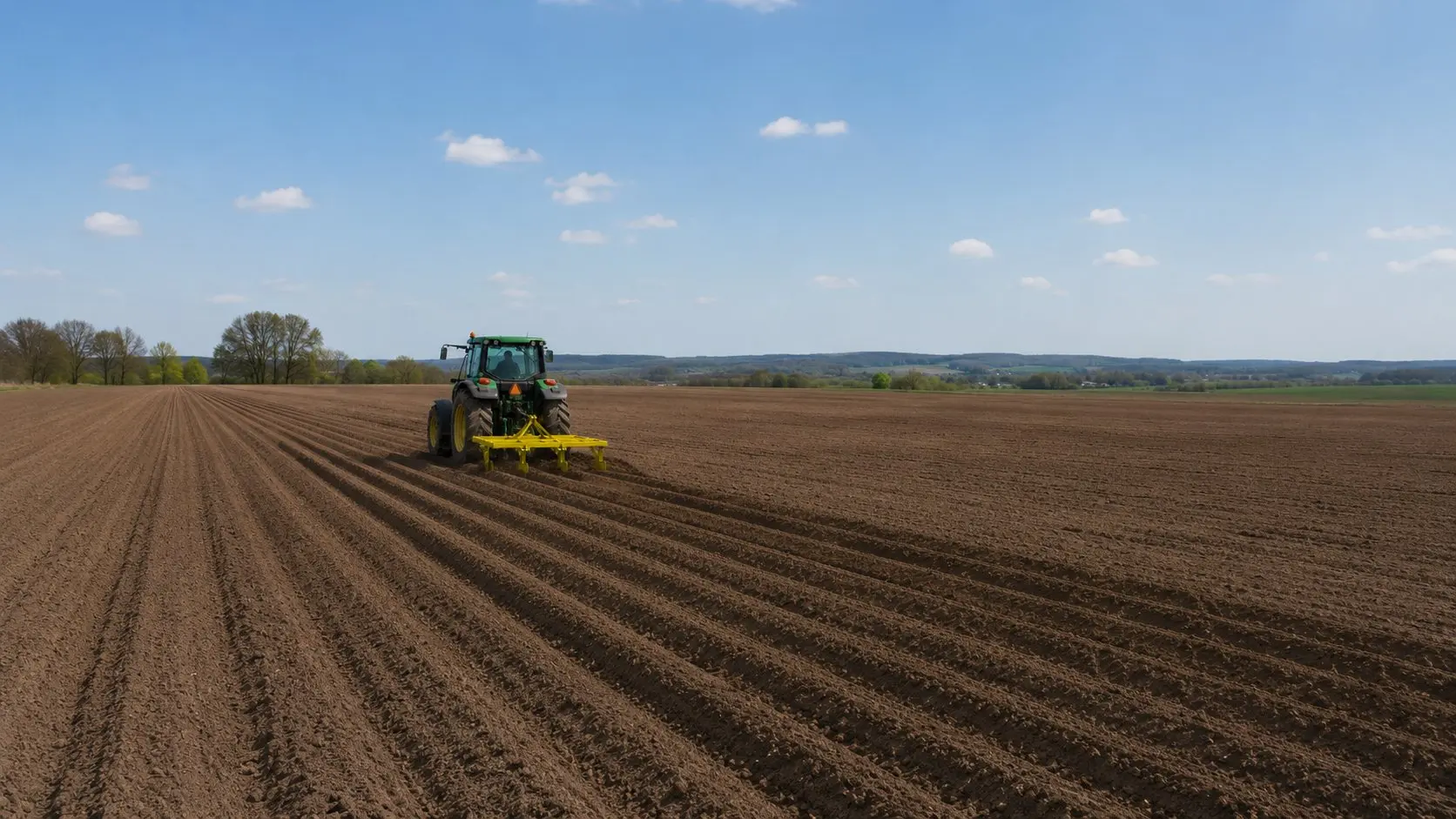
The furrower’s row pitch — the centre-to-centre distance between adjacent ridges — is the master specification that commits every subsequent machine in the potato system. Once the furrower forms ridges at 750 mm pitch across a field, that pitch is fixed in the soil until the field is ploughed. The planter must be set to 750 mm to place seed on each ridge crest. Any inter-row cultivation equipment must run at 750 mm to clear furrows without damaging ridges. And the harvest digger’s share must be set and aligned to 750 mm to undercut each ridge’s full tuber cluster without drifting into the furrow or into the adjacent ridge.
A pitch mismatch of even 30 mm between the furrower and the harvest digger — which can arise from using a different tractor wheelbase for the two operations without rechecking alignment — causes the digger share to run 30 mm off-centre of the ridge axis. At this offset, the share undercutting width covers approximately 85% of the tuber cluster rather than 100%, leaving the outermost tubers on the offset side in undisturbed soil. These unrecovered tubers represent a direct yield loss, and where they are partially damaged by the share passing near them, they also contribute to secondary rot and disease carryover to the next season.
| Row Pitch |
Primary Use |
Markets |
Tuber Density |
| 650–700 mm |
Seed potato, salad varieties |
UK seed, specialist |
High (more rows/ha) |
| 750 mm |
Ware potato, general production |
UK, Australia, Canada |
標準 |
| 800 mm |
Large ware, processing varieties |
Continental Europe |
Medium-low |
| 900 mm |
Processing, large-tuber varieties |
SE Asia, specialist UK |
Low (fewer rows/ha) |
System Alignment Protocol — Before the Season Begins
Before the furrowing pass, measure and record the row pitch of the furrower at its current setting (disc centre to disc centre). Then verify that the planter row spacing, any inter-row cultivator track width, and the potato digger share width are all calibrated to this exact measurement. If any machine differs by more than ±10 mm, adjust before field operations begin. A 15-minute pre-season alignment check prevents the yield loss and quality consequences of an off-centre harvest digger pass on every row of the entire field.
Furrower Adjustment — Disc Angle, Depth and Speed
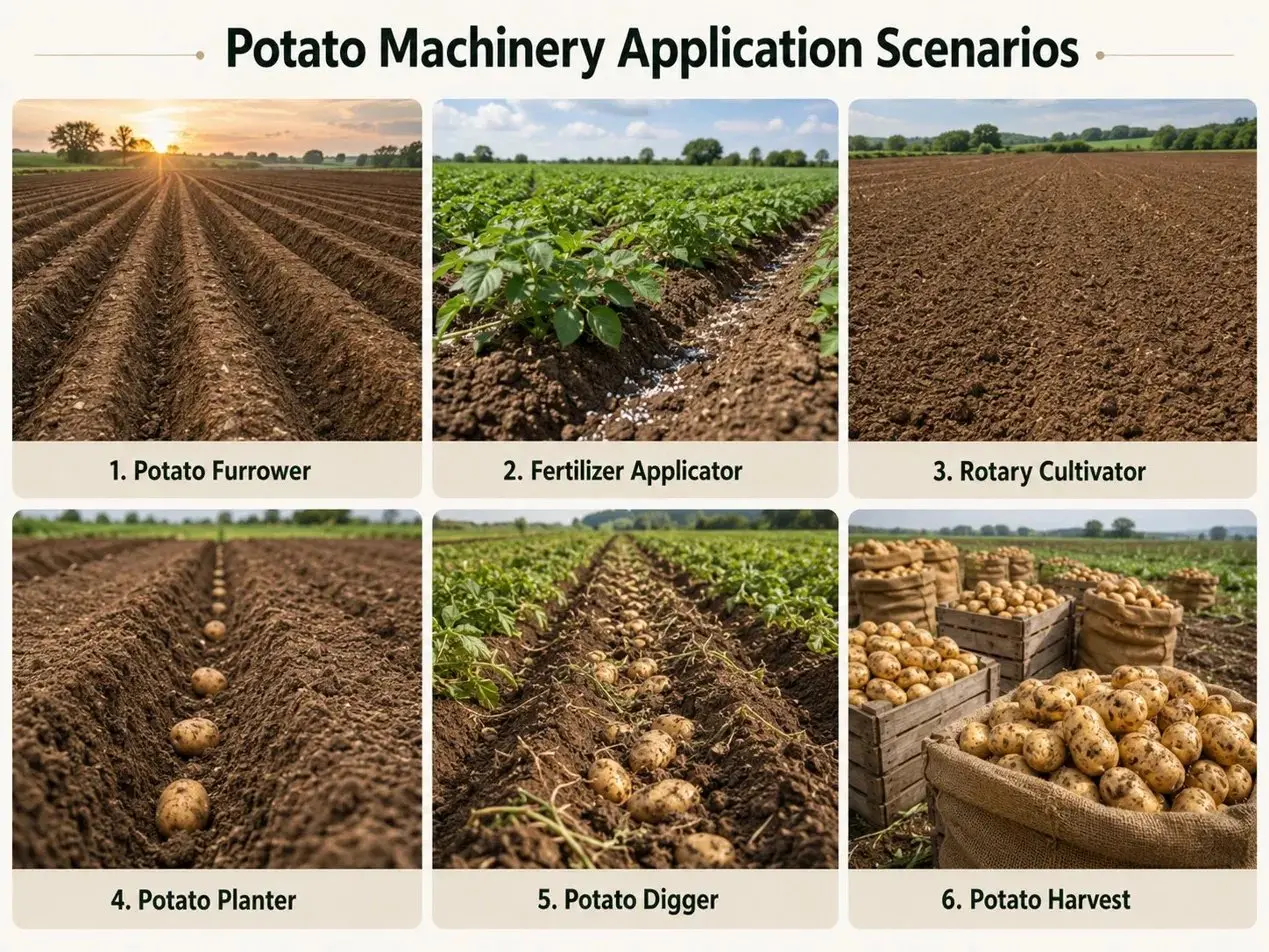
Three primary adjustments determine ridge output quality on a disc furrower: disc attack angle, disc operating depth, and forward speed. Each interacts with the others and with soil conditions, requiring the operator to make a test pass before committing to the full field. The standard starting point for each adjustment in a well-prepared fine-tilth seedbed at typical spring soil moisture (15–22% volumetric) is shown in the table below, with the adjustments needed when ridge output deviates from the target specification.
| Adjustment |
Standard Start |
Ridge Too Low / Narrow |
Ridge Too Loose / Coarse |
| Disc attack angle |
18–22° |
Increase angle by 2–3° |
Reduce angle by 2–3° |
| Disc depth |
14–18 cm |
Increase depth by 2 cm |
Reduce depth by 2 cm |
| 前進速度 |
3.5–4.5 km/h |
Increase speed by 0.5 km/h |
Reduce speed by 0.5 km/h |
| Wing height |
5–8 cm above furrow |
Lower wing by 1–2 cm |
Raise wing by 1–2 cm |
The test pass protocol: after making the initial adjustment settings, run a single 30-metre pass on the field headland. Stop the tractor and measure the ridge at three points along the test pass: ridge height from furrow to crest, base width, and — where practical — check the ridge side slope visually for consistency. If height or width are outside the target range, make one adjustment at a time (never two simultaneously) and re-run the test pass. Most seedbeds require 2–3 test pass iterations before the target ridge specification is reached; attempting to correct multiple parameters simultaneously makes it impossible to identify which adjustment produced the change.
Stone Management — Why Ridge Quality Requires a Stone-Free Seedbed
The furrower’s discs and wings are precision-geometry components that produce a consistent, specified ridge profile only when the soil they are displacing has predictable resistance and structure. Stone fragments in the cultivation zone disrupt both of these conditions. A stone encountered by the disc face deflects the disc by 2–5° depending on the stone size — causing the soil thrown in that instant to land in the wrong position relative to the ridge centreline. The result is a zone of irregular ridge profile: a gap or flat spot on the ridge side where the stone deflection caused reduced soil throw, and a compensating excess deposit where the disc returned to its correct path. In the aggregate, a stony seedbed produces a ridge with 15–30% higher profile variation than a stone-free seedbed at the same adjustment settings.
Beyond the profile irregularity, stone fragments incorporated into the ridge during furrowing create the bulk density hot spots documented in the rotavator section: dense zones adjacent to stone fragments where the surrounding soil has been compacted by the disc’s pressure against the stone, and loose zones where the stone occupies volume that should be fine tilth. These hot spots are the primary cause of localised hollow heart and internal rust spot because they create the waterlogged pockets in the ridge that trigger rapid growth-period moisture fluctuations.
①
ソー・ロッククラッシャー — Pre-Cultivation Stone Reduction
THOR must operate before the rotavator, not between the rotavator and the furrower. The sequence is: THOR fractures sub-surface stone → CT-2100 permanently removes fragments → rotavator creates fine tilth seedbed → furrower forms ridges. Operating THOR after the rotavator would re-compact the fine tilth seedbed with the THOR’s tractor wheels and bring fresh fractured stone fragments to the surface that the rotavator has already processed past. The pre-cultivation THOR pass is the correct insertion point in the system sequence.
②
CT-2100 ロックピッカー — Permanent Stone Removal Before Ridging
CT-2100 operation between THOR and the rotavator pass is the correct sequence. By the time the furrower operates in a THOR + CT-2100 treated field, the cultivation zone has been permanently cleared and the rotavator has created the uniform fine tilth that allows the disc furrower to produce a consistent, geometrically correct ridge. Disc deflection events from stone contacts are eliminated; bulk density hot spots from stone inclusions are eliminated; and the ridge profile variation that causes the waterlogged pockets linked to hollow heart and internal rust spot is reduced to its minimum achievable level for the soil type.
③
ブラックバード・ロックレーキ — Pre-Furrowing Surface Check
On fields that have been previously THOR + CT-2100 treated, the annual BlackBird pass before the furrowing operation removes surface stones that have re-emerged through winter frost heave. On a previously cleared field, this typically takes 2–4 hours for 10 ha and prevents the disc deflection events that would otherwise occur even at low residual stone concentrations. The BlackBird pass is completed before the rotavator in the spring sequence: surface clear → rotavator → furrower → planter.
よくある質問
Q
Can the same furrower be used for both 750 mm and 900 mm row pitch without modification?
Most disc furrowers designed for the 650–900 mm pitch range include an adjustable disc spacer system that allows the operator to change the disc centre-to-centre distance (and therefore the row pitch) without replacing the discs or the toolbar. The adjustment is typically made by repositioning the disc assemblies along a main toolbar using a pin-and-hole or clamping-plate system. For a change between 750 mm and 900 mm: move each disc assembly outward by 75 mm on both sides of the centreline and re-torque the clamping bolts. The wing assemblies must also be repositioned to follow the new disc positions, and — critically — the row pitch of the planter, any cultivation equipment, and the harvest digger must all be reset to the new pitch before field operations resume. A common error when changing pitch mid-season is updating the furrower but forgetting to update the planter row spacing — producing seed placed in the wrong position relative to the ridge crest, with variable depth and spacing consequences that cannot be corrected after planting.
Q
How does a wet spring soil condition affect the furrowing operation compared to a drier seedbed?
Wet soil conditions (above field capacity, soil sticking to boots) affect the furrowing operation in two specific ways. First, wet soil has higher cohesion and plasticity — the disc throws soil in larger lumps rather than the fine, loose particles that form the cleanest ridges. The result is a ridge with a coarser texture, higher aggregate size at the crest, and a heavier, denser surface that can cap (form a hard crust) after the first drying period and restrict emergence. Second, the disc pulls more resistance through wet plastic clay, increasing the fuel consumption per hectare and, on tractors at the lower end of the HP range, causing PTO speed to drop below the level needed for consistent soil throw. The correct response to wet conditions: slow down by 0.5–1.0 km/h (reduces the kinetic energy of the soil throw and allows larger aggregates to fall into place rather than being flung into irregular positions), and delay furrowing until soil moisture drops below field capacity if the field schedule allows. A 24-hour delay in wet conditions typically produces a measurably better ridge than proceeding immediately.
Q
Should inter-row cultivations after planting re-ridge the ridges, and what happens to the row pitch when they do?
Inter-row cultivation after emergence — typically carried out to control weeds, improve drainage, and re-ridge the potato ridges as the crop grows — does move soil back onto the ridges and can increase ridge height by 3–6 cm over the season. This re-ridging is beneficial: it buries developing stolons that have grown close to the ridge surface (preventing greening), improves drainage by rebuilding the ridge profile that rainfall has eroded, and can suppress late-emerging weeds in the furrow zone. The row pitch of the inter-row cultivation equipment must match the original furrower pitch exactly — the furrow bottom position does not change between the initial furrowing pass and the inter-row cultivation, so there is no adjustment required if both machines were set to the same pitch at the start of the season. The most common cause of cultivation equipment running on the ridge crest (and damaging the developing crop) is a pitch mismatch that went uncorrected at the system-setup stage in spring. Post-cultivation re-ridging also has no effect on the harvest digger’s requirement: the digger is still set to the original furrowing pitch, which is the fixed centre-to-centre distance of the ridges, regardless of subsequent ridge height change from re-ridging operations.
Q
How does ridge height affect susceptibility to late blight infection from soil splash?
Late blight (フィトフトラ・インフェスタンス) infection of developing tubers can occur through two pathways: airborne sporangiophore deposition on foliage (the classic foliar epidemic) and soil splash during heavy rainfall events that carry infested soil particles containing sporangia from the surface onto tubers at or near the ridge surface. A taller ridge (25–28 cm) provides a greater depth of soil coverage above the shallowest tubers and places all tubers further from the furrow-level soil surface where the highest sporangium concentration from surface-spore deposition typically occurs. The relationship is not linear — it does not eliminate soil-splash infection at any ridge height — but published research from the British Potato Council (now AHDB) on Scottish production data shows that fields with ridge heights below 22 cm at the time of a heavy rainfall event during active blight pressure have consistently higher tuber blight incidence at harvest compared to fields with ridges above 25 cm, all other disease management factors being equal. This finding has led to a specific recommendation in UK blight management guidelines: re-ridge to a minimum of 25 cm before the period of highest blight pressure (typically late July through August in the UK) on varieties with moderate or low tuber blight resistance ratings.
Q
What are the disc wear indicators for a potato furrower, and how often do discs need to be replaced?
Furrower discs are made from heat-treated boron steel and are designed to wear on the outer edge and the concave face. The two primary wear indicators are: (1) Disc diameter reduction — a new disc is typically 460–510 mm in diameter; when diameter has reduced by more than 20 mm (to 440–490 mm depending on model), the disc no longer reaches its designed operating depth at the standard gauge wheel setting, and the ridge height begins to fall below specification. Measure with a steel tape across the disc face. (2) Concave face flatness — a worn disc that has lost its concavity no longer generates the centrifugal soil throw that creates the ridge. Press the concave face against a straight edge: if contact is made across the full face (indicating a flat disc), the disc has lost its throwing efficiency and must be replaced. Replacement interval: on stone-free fine-tilth seedbeds, disc life is typically 600–1,000 ha of operation. On previously untreated stony seedbeds, disc wear rate increases by 50–150% depending on stone hardness and concentration. A stony seedbed that causes a disc to wear 2× faster than normal is consuming more in disc replacement over a season than the one-time THOR + CT-2100 stone clearance investment would have cost for 5–10 seasons of protected operation — the economic argument for stone clearance applies to furrower disc wear costs as directly as it does to potato digger share wear.
韓国渡辺ポテト機械
Potato Furrower — Specified for Your Row Pitch, Soil Type and System
Your row pitch + soil type + target ridge height + stone assessment → Korea Watanabe specifies the correct furrower disc angle and wing configuration, together with the THOR, CT-2100, and BlackBird seedbed preparation programme that allows the furrower to produce consistent, specification-correct ridges. See the full ジャガイモ加工機械 範囲。
韓国渡辺ロッククラッシャートラクター株式会社 · 京畿道安山市
編集者: Cxm