
The EP-PAI-480-AR trailed potato harvester is one of the scale-change machines in the Watanabe potato machinery range — it is not simply a bigger version of the EP-AWB-1600 2-row mounted digger, but a machine that changes the operational logic of the harvest phase for large-scale Korean potato operations. The four-row simultaneous harvest, the drawbar tow configuration, and the 4,000 Kg bunker capacity address the bottlenecks that constrain 2-row mounted digger operations at 20+ ha scale — specifically the frequency of headland collection stops and the two-pass requirement that limits the EP-AWB-1600’s daily coverage rate on large fields.
This guide covers the EP-PAI-480-AR’s specification, the operational advantages of 4-row trailed versus 2-row mounted harvest at scale, the stone clearing implications of 4-row operation, daily capacity planning, and the Korean highland and lowland potato operation profiles for which the EP-PAI-480-AR is the appropriate system choice.
EP-PAI-480-AR Confirmed Specifications
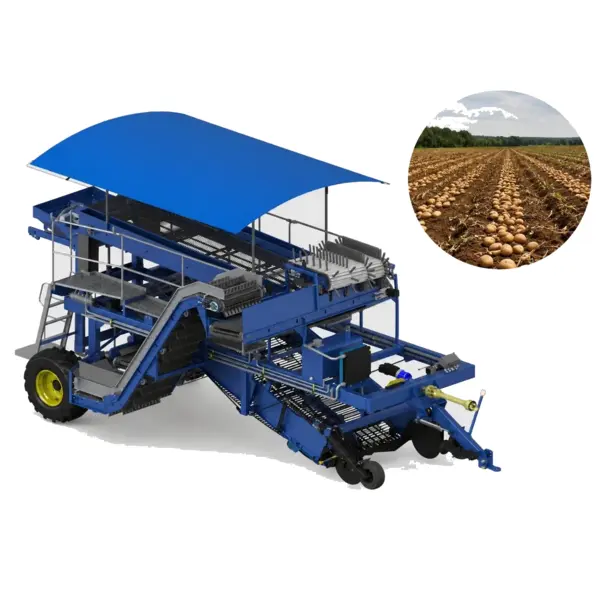
All specifications from the Watanabe official product brochure.
4-Row Trailed vs 2-Row Mounted — Understanding the Operational Difference
The EP-AWB-1600 (2-row mounted, Cat.2 three-point hitch) and the EP-PAI-480-AR (4-row drawbar trailed) represent two fundamentally different operational approaches to Korean potato harvest. The choice between them is not purely about scale — it involves differences in tractor requirement, field suitability, collection logistics, and the relationship between stone clearing quality and machine performance:
| Dimension | EP-AWB-1600 (2-row mounted) | EP-PAI-480-AR (4-row trailed) |
|---|---|---|
| Rows per pass | 2 rows simultaneously | 4 rows simultaneously — 2× the coverage per pass |
| Mounting | Cat.2 three-point hitch (rear) | Drawbar tow — machine on own wheels, wider turning |
| Bunker capacity | Continuous collection (Kit B/C to trailer) | 4,000 Kg onboard bunker — accumulates before discharge |
| Tractor requirement | 75 HP minimum | Higher HP required for 4-row simultaneous digging resistance |
| Suitable farm scale | 5–20 ha (optimal range) | 20–100+ ha (large-scale and contractor) |
| Field size requirement | Flexible — efficient on small and large fields | Better on larger fields (wider turning radius needs headland space) |
| Stone clearing requirement | Zero tolerance — 2 shares in soil | Zero tolerance — 4 shares in soil simultaneously (4× stone encounter probability per pass) |
The 4,000 Kg Onboard Bunker — Why It Changes Harvest Logistics at Scale
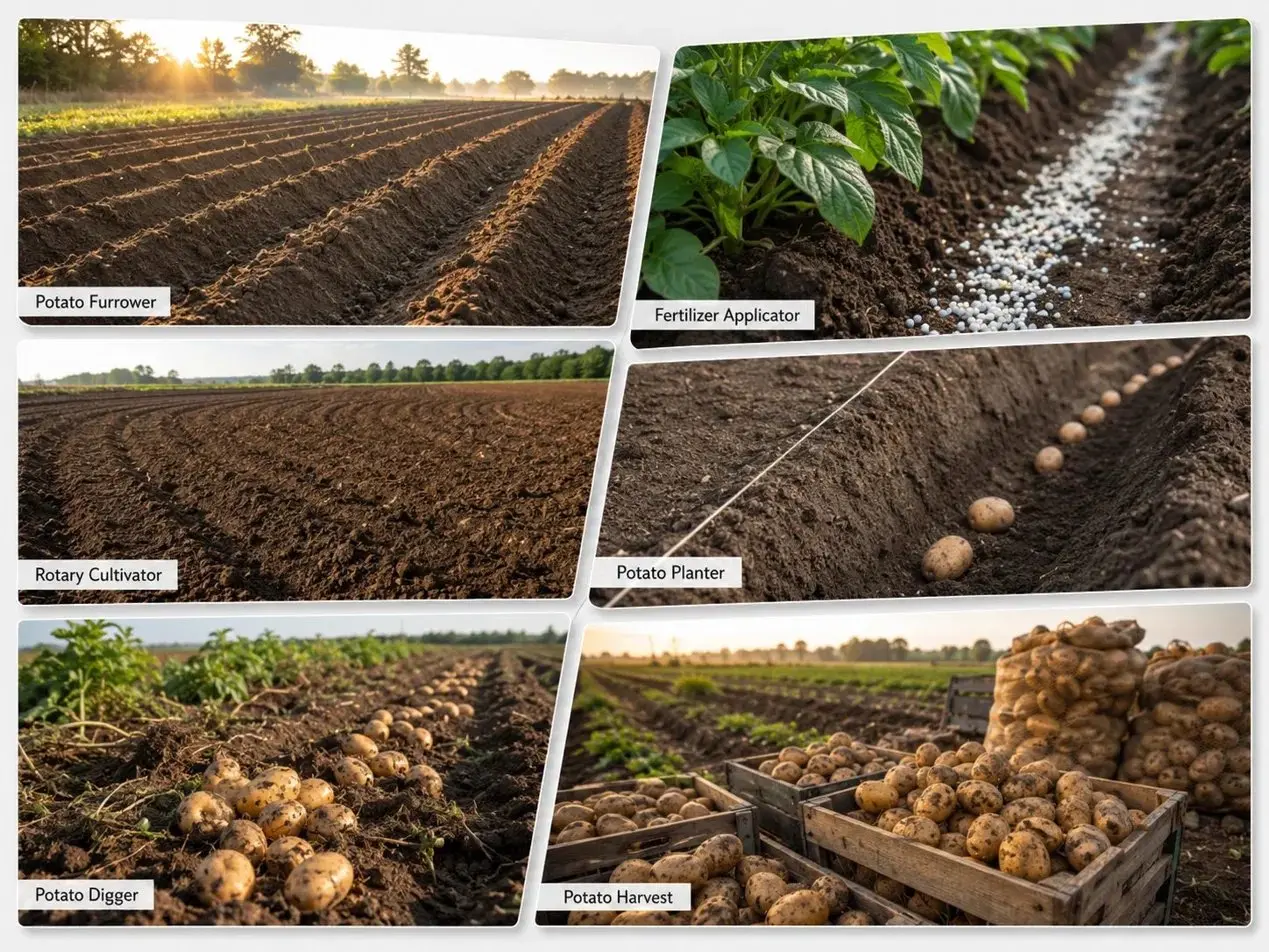
The EP-AWB-1600 in Kit B configuration (rear elevator into towed trailer) produces continuous tuber flow into the collection trailer — which means the harvest pass can only continue as long as the trailer is present and not full. When the trailer is full, the tractor must stop harvesting, the full trailer must be detached and replaced with an empty one (or driven to the headland for unloading), and harvesting resumes. On large fields (300+ m rows), this collection logistics requirement means the EP-AWB-1600 stops harvesting 3–5 times per hectare for trailer management — reducing the proportion of time the machine is actually harvesting.
The EP-PAI-480-AR’s 4,000 Kg onboard bunker accumulates harvested potatoes in the machine’s own bunker during the harvest pass — the tractor and machine continue harvesting until the bunker reaches capacity, then drive to the headland independently for bunker discharge. The harvest pass does not depend on a trailing collection vehicle maintaining pace. This operational independence produces two measurable benefits at large-scale:
Benefit 1: Continuous harvesting at constant speed
The harvesting tractor operates at constant, optimal speed throughout the harvest pass without the intermittent stops and speed variations that accompany trailer exchange logistics. Consistent forward speed produces more uniform tuber flow through the vibrating web separator — reducing the peak impact loading events that cause bruising during the speed-change moments of EP-AWB-1600 trailer exchange stops.
Benefit 2: Reduced collection vehicle requirement
At 4,000 Kg bunker capacity and 30 t/ha yield, each bunker fill represents 0.13 ha of harvested potatoes. At 1.5–2.0 km/h harvesting speed and 4-row width, the bunker fills approximately every 8–12 minutes of harvesting. The headland unloading (drive to headland, discharge, return) takes 3–5 minutes — meaning the harvest tractor is collecting approximately 60–75% of the time versus the 45–60% productive time typical of EP-AWB-1600 with trailer exchange logistics on large fields.
Stone Clearing Implications of 4-Row Operation — Why the Standard Is Stricter
The EP-PAI-480-AR’s four simultaneous shares create a critically important stone clearing implication: each harvest pass simultaneously exposes four separate share-soil contact zones across the four rows being harvested. In stone-probability terms, a single forward pass with the EP-PAI-480-AR has four times the stone encounter probability of a single pass with the EP-AWB-1600. This relationship means that any inadequacy in stone clearing that produces one stone-to-share event per hectare on the EP-AWB-1600 produces approximately four stone-to-share events per hectare on the EP-PAI-480-AR under the same stone density conditions.
The compounding consequence of inadequate stone clearing on 4-row operation
On a 10 ha field cleared to a standard that accepts occasional embedded stones above 5 cm (inadequate for the zero-tolerance standard), an EP-AWB-1600 might contact 2–3 stones per hectare — producing 20–30 share deflection events per season. The same field harvested with the EP-PAI-480-AR would produce 80–120 share deflection events per season under the same stone density — because four shares are simultaneously at risk. Each deflection event produces: share tip wear (accelerating share replacement frequency proportionally), momentary depth variation (producing locally incomplete tuber extraction), and potential tuber-to-stone contact in the share zone (producing bruising in the harvested lot from those sections).
The conclusion for EP-PAI-480-AR operators is unambiguous: the THOR 2.4 + CT-2100 zero-tolerance stone clearing standard is even more important for the 4-row trailed harvester than for the 2-row mounted harvester — because every stone management failure is multiplied by four. Operations that invest in the EP-PAI-480-AR for large-scale efficiency without simultaneously investing in the stone clearing system that makes 4-row operation viable will find that the share wear cost and harvest quality degradation erode the efficiency advantage of the 4-row scale.
Daily Capacity Planning — EP-PAI-480-AR at Full Scale
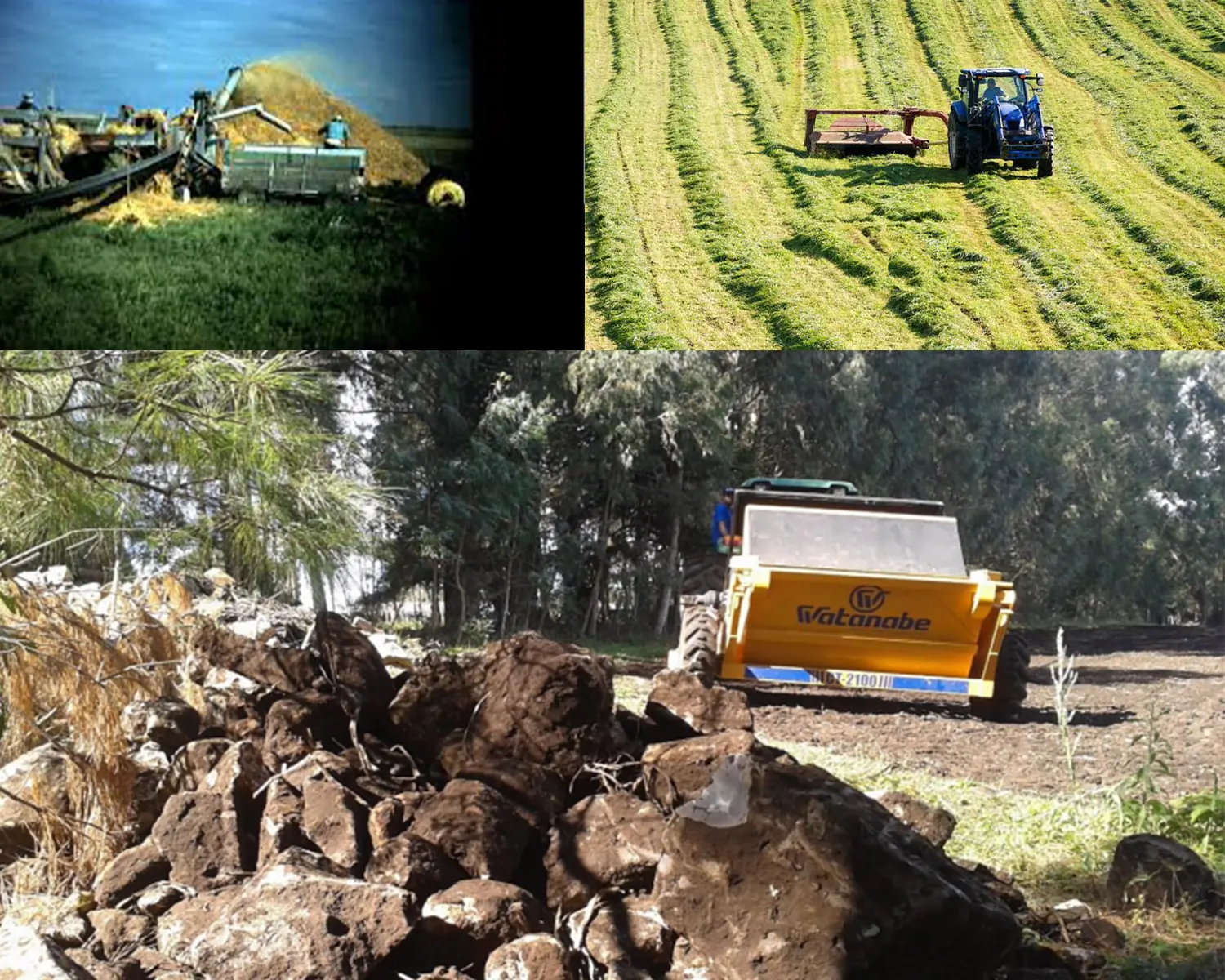
The EP-PAI-480-AR’s daily harvest capacity depends on forward speed, row spacing, and bunker discharge cycle time. At typical Korean highland potato field conditions (70 cm row spacing, 1.5–2.0 km/h working speed, 30 t/ha yield):
Daily capacity calculation — EP-PAI-480-AR on 70 cm row-spacing field:
Compare this to the EP-AWB-1600 (2-row, 1.4 m effective width, 1.8 km/h, 70% field efficiency): approximately 1.6 ha/day on the same field — half the EP-PAI-480-AR’s daily coverage. On a 50 ha operation with a 14-day harvest window before first frost risk, the EP-AWB-1600 requires the full 14 days to harvest 22 ha (under 50% of the total area), while the EP-PAI-480-AR harvests the full 50 ha in 16 days — slightly beyond the window, but achievable with two tractors or extended working hours. The scale case for the EP-PAI-480-AR above 20 ha becomes increasingly compelling as farm area grows and the harvest window remains fixed.
Who Should Choose the EP-PAI-480-AR — Korean Operation Profiles
The EP-PAI-480-AR is not the right choice for every Korean potato farm. Four operation profiles represent the machine’s appropriate deployment context in Korea:
✓
Large-scale integrated crop farm (20–100 ha potato area). The EP-PAI-480-AR’s capital cost is higher than the EP-AWB-1600 — justifiable when the additional daily coverage allows the farm to complete harvest within the available frost window and deliver contracted volumes on schedule. At 20+ ha, the daily coverage difference is the margin between completing harvest and not completing harvest before first frost at highland altitudes.
✓
Agricultural service contractor for potato harvest. A contractor providing potato harvesting services to multiple Korean highland farms needs maximum daily coverage to serve multiple clients within each client’s harvest window. The EP-PAI-480-AR’s 3+ ha/day coverage allows a contractor to serve 3–4 farms per week (versus 1–2 farms per week with the EP-AWB-1600) — significantly increasing annual service revenue from the same investment.
✓
Korean agricultural cooperative bulk supply operation. Cooperative operations supplying supermarket chains or food manufacturers with contracted weekly volumes need to harvest at the rate that matches delivery commitments. The EP-PAI-480-AR’s volume capacity (96+ tonnes/day) matches the bulk supply contracts that require consistent large-volume weekly delivery across the highland harvest season.
✗
Not suitable for: Small highland farm (5–15 ha) with narrow terraces. The EP-PAI-480-AR’s 4-row working width requires a field layout where 4 rows are planted and harvested simultaneously — requiring field headland width sufficient for the wider machine’s turning radius. Korean highland farms with narrow terrace widths (below 15–20 m) or irregular field boundaries may find the EP-PAI-480-AR’s turning requirements impractical. The EP-AWB-1600 remains the correct machine for these field configurations.
EP-PAI-480-AR Maintenance — Four Shares, Four Times the Pre-Season Attention

The EP-PAI-480-AR’s pre-harvest service checklist covers four share positions rather than two — doubling the share inspection and replacement assessment compared to the EP-AWB-1600. Pre-harvest service in July (one month before the August–September harvest window) should include:
4 shares:
Inspect tip profile on all four shares. Replace any share at or below 60% of new tip profile. Any crack in the share body requires immediate replacement regardless of remaining profile. Order replacement shares in January — Korea Watanabe holds EP-PAI-480-AR shares in Korean local stock for 5–10 business day delivery.
Vibrating web:
Inspect web chain tension and chain wear across the full 4-row width — more chain links and more bearing points than the EP-AWB-1600. A worn chain on any section of the 4-row web reduces separation efficiency for tubers in that section while others continue normally — detectable as non-uniform tuber quality across the four harvested row widths.
Bunker hydraulics:
Inspect the 4,000 Kg bunker door hydraulic cylinder for seal condition — a slowly leaking cylinder that cannot hold bunker position during the harvest pass deposits tubers onto the field surface rather than accumulating in the bunker. Test full open and full close cycle before first harvest use of the season.
Drawbar connection:
Inspect drawbar hitch pin and safety clips. The EP-PAI-480-AR operates on its own wheel axle — the drawbar connection carries the full machine draft load throughout the harvest pass. Any wear or play in the hitch connection should be corrected before the season begins.
Frequently Asked Questions
What is the minimum tractor HP for the EP-PAI-480-AR?
The EP-PAI-480-AR requires a tractor significantly more powerful than the EP-AWB-1600’s 75 HP minimum — the simultaneous draft resistance of four lifting shares in Korean highland granite soil requires adequate tractor power to maintain the design forward speed without bogging down or stalling the harvest pass. Contact Korea Watanabe for the confirmed HP specification for the EP-PAI-480-AR — the exact minimum HP is confirmed at purchase consultation to ensure compatibility with the specific tractor being matched to the machine. As a general guide, 4-row trailed potato harvesters with large bunkers in European agricultural applications typically require 130–180 HP tractors at equivalent soil conditions — Korean granite highland soils may require at the higher end of this range due to greater soil resistance from the stone-cleared but still firm granite-derived profiles.
Can the EP-PAI-480-AR harvest on Korean highland terraces at 10–15% slope?
The EP-PAI-480-AR can harvest on moderate slopes (up to approximately 10–12%) — the drawbar tow configuration actually provides better stability on slopes than rear three-point-hitch mounted harvesters, because the machine rests on its own wheels rather than loading the tractor rear axle. On uphill harvest passes, the loaded bunker (4,000 Kg at full capacity) concentrates weight on the machine’s own axle rather than creating a rear tipping moment on the tractor. For slopes above 12%, harvest along the contour (across the slope) rather than up-and-down if possible — this maintains the machine level rather than tilting the bunker laterally. Confirm specific terrace slope and machine configuration with Korea Watanabe for Korean highland terrace applications above 10% gradient.
How does the EP-PAI-480-AR relate to the EP-AWB-3200 — are they the same machine?
Both the EP-PAI-480-AR and EP-AWB-3200 are 4-row trailed potato harvesters in the Watanabe range, but they differ in their specific configuration, bunker capacity, and target application. The EP-PAI-480-AR features the 4-row drawbar configuration with the 4,000 Kg bunker described in this guide. The EP-AWB-3200 is the 4-row trailed digger counterpart to the EP-AWB-1600 mounted digger — sharing the AWB (vibrating web separator) design heritage. Contact Korea Watanabe for a direct specification comparison between the two 4-row models to determine which configuration better matches your specific field conditions, row spacing, and collection logistics. Korea Watanabe holds or can source both models and provides the side-by-side comparison at no charge as part of the pre-purchase consultation.
Is the row spacing on the EP-PAI-480-AR adjustable for different Korean row configurations?
Korean potato planting row spacing varies between farms and cooperatives — standard spacings are 70 cm, 75 cm, and 80 cm depending on regional practice and planter configuration. The EP-PAI-480-AR’s share spacing must match the planting row spacing precisely — shares that are wider or narrower than the planted rows will miss tubers or collect from adjacent rows. Confirm the exact row spacing configuration on your EP-PAI-480-AR at purchase time — Korea Watanabe sets the machine to match your farm’s specific row spacing before delivery. The row spacing setting is determined when the order is placed, not at field setup, so confirming your exact row spacing with Korea Watanabe before purchase is essential. This also means the EP-PAI-480-AR must be matched to the EP-PAI-2100 planter row spacing on the same farm — both machines must use the same row spacing for the harvest to correctly align with the planted rows.
Is the EP-PAI-480-AR eligible for Korean agricultural machinery subsidies?
Yes — the EP-PAI-480-AR qualifies under the Korean agricultural machinery purchase support program in the potato machinery category (specialty crop machinery). Korea Watanabe holds Korean agricultural machinery certification for the EP-PAI-480-AR and prepares full subsidy documentation at no charge. For operations purchasing the EP-PAI-480-AR as part of a complete potato system (THOR 2.4 stone crusher + complete potato machinery range), Korea Watanabe structures the multi-machine subsidy application to maximise total subsidy access in a single or phased application. The January application window applies to the EP-PAI-480-AR as to all other Watanabe machines — contact Korea Watanabe in December to begin documentation preparation for the earliest January submission before county budget depletion.
EP-PAI-480-AR Configuration — Scale, Row Spacing, and Tractor Compatibility
Farm potato area (ha) + row spacing (cm) + existing tractor HP + harvest window constraint → EP-PAI-480-AR vs EP-AWB-1600 comparison with daily coverage estimate and share configuration recommendation. Korea Watanabe, Ansan-si, Gyeonggi-do.
Editor: Cxm