
Step 5 in the Watanabe 7-step Korean highland potato production system is planting — the moment when the seed potato is placed into the furrow ridge at the spacing that determines tuber density, size distribution, and the harvest-machine alignment that must be precisely reproduced at Step 7. The EP-PAI-2100 and EP-PANTHER are Watanabe’s two Korean market potato planter options — and the selection between them is not primarily a quality comparison but a system geometry decision.
Both planters work on the same principle: a seed cup mechanism picks individual seed pieces from the hopper and drops them into the open furrow at a calibrated spacing — covering them as the ridging boards close the ridge over the dropped seed. Both achieve consistent planting depth on stone-cleared, well-prepared seedbeds. The difference is row count, and row count locks the furrower (Steps 3–4), the EP-ERA cultivator (Step 6), and the EP-AWB digger (Step 7) to the same row configuration. This is the decision that must be made correctly once.
Confirmed Specifications — EP-PAI-2100 and EP-PANTHER
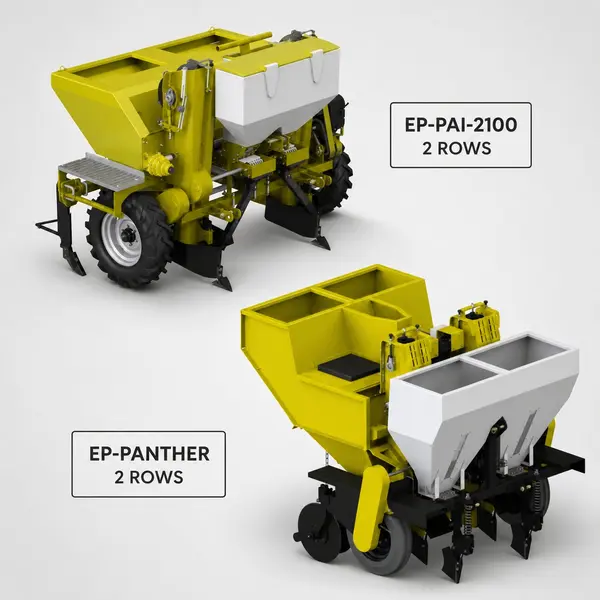
All specifications from the Watanabe official product brochure.
EP-PAI-2100
2-row · 75 HP · Cat.2 · 16-gear spacing · 25–40 cm
- ▸2 rows planted simultaneously
- ▸75 HP minimum — standard Korean farm tractor
- ▸16-gear spacing selector: 25, 27, 29, 30, 33, 36, 40 cm (and intermediate)
- ▸Cat.2 three-point hitch
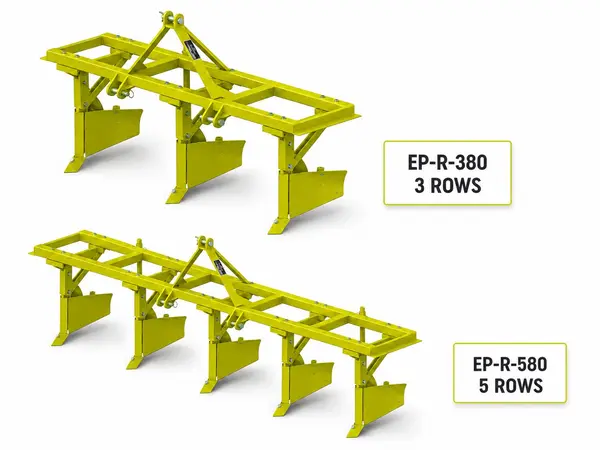
- ▸Works with EP-R-380 furrower (3-row), EP-ERA-2100 cultivator
- ▸Best scale: 2–20 ha, most highland potato farms
EP-PANTHER
2–4 rows · 75–100 HP · Cat.2
- ▸Available in 2, 3, or 4-row configurations
- ▸75–100 HP minimum depending on row count
- ▸Higher planting throughput per tractor pass
- ▸Cat.2 three-point hitch
- ▸Matches EP-R-580 furrower, EP-ERA-5100, EP-AWB-3200
- ▸Best scale: 15+ ha or contracted cooperative systems
The 16-Gear Spacing System — What It Controls and Why It Matters
The EP-PAI-2100’s 16-gear spacing selector controls how far apart the seed cups drop individual seed pieces along the row — the in-row seed spacing that determines:
Tuber set number
Closer spacing (25–28 cm) → more plants per unit area → more total tubers → smaller average tuber size. For fresh market (where 60–150g tubers are premium), tighter spacing from seed potatoes with many eyes.
Tuber size class
Wider spacing (33–40 cm) → fewer plants per unit area → more available ridge soil volume per plant → larger individual tuber size. For processing (Atlantic at 100–200g), certified seed (uniform 28–55g), wider spacing is preferred.
Ridge volume per plant
The hilling pass (EP-ERA, Step 6) builds the same absolute ridge height regardless of seed spacing. Wider seed spacing means each plant has more lateral ridge volume exclusive to its own tuber development — critical for large-tuber processing varieties.
| Target market / variety | Recommended spacing | Reason |
|---|---|---|
| Fresh market (수미, 대지마) | 25–28 cm | Consumer size preference; tighter planting increases smaller tuber proportion |
| Processing (Atlantic 가공용) | 28–33 cm | Crisps manufacturer spec 100–200g; balance of density and individual tuber size |
| Certified seed (씨감자) | 33–40 cm | Seed lot graded 28–55g; wider spacing ensures individual tubers develop within spec weight range |
| Low-altitude single-season | 25–30 cm | Shorter growing season requires density for adequate yield within the season |
The System Matching Rule — Why Row Count Must Be Decided First
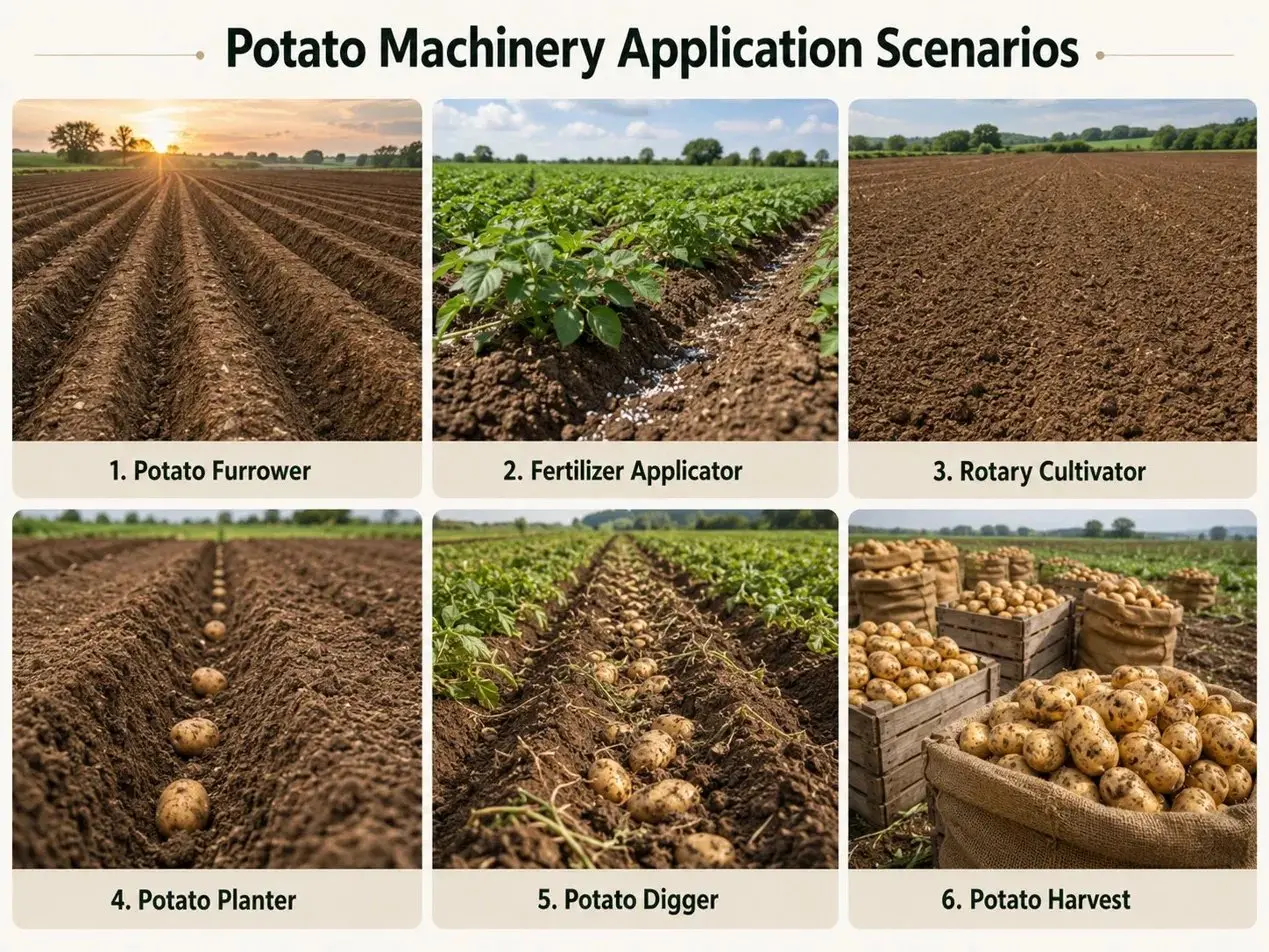
The most important operational rule in Korean potato system selection is that all machines from Step 3 (furrower) through Step 7 (digger) must be configured for the same row count and row-to-row spacing. A 2-row planting system cannot use a 4-row digger without either leaving 2 rows un-harvested per pass or making 2 passes per digger pass — neither is operationally practical at commercial scale. The system lock-in sequence is:
EP-PAI-2100 Calibration — Setting Up for the Season

Before the first planting pass of the season, the EP-PAI-2100 requires calibration on three parameters. Setting these correctly before entering the field prevents inconsistent planting that cannot be corrected mid-season:
Seed Potato Preparation for the EP-PAI-2100 — Chitting, Cutting, and Size
The EP-PAI-2100’s seed cup mechanism is designed for potato seed pieces within a defined size range — typically 28–80g per piece. Seed pieces outside this range either fall through the cup mechanism (too small, creating gaps) or jam the cup mechanism (too large, causing misses and potential machine damage). Korean farmers running the EP-PAI-2100 on certified seed lots should confirm the seed lot’s size distribution matches the planter’s operating range before committing the full seed supply to a planting pass.
Chitting — Should You Pre-Sprout Korean Highland Seed?
Chitting (사전 싹 틔우기 — allowing seed potatoes to develop short shoots of 5–10 mm before planting) is practised by some Korean highland potato producers to achieve earlier and more uniform emergence. Chitted seed that has developed small shoots is more sensitive to mechanical damage during planting — the EP-PAI-2100 cup mechanism must handle the chitted seed without breaking the shoots. For chitted seed, reduce planting speed to 2–3 km/h (slower than the 3–5 km/h typical for un-chitted seed) and confirm the cup mechanism does not snap shoots in the test pass before full-field planting. In most Korean highland potato operations at 500–800 m altitude, the compact growing season does not require chitting — un-chitted certified seed placed at the correct depth in a well-tilled, stone-cleared seedbed achieves emergence times within the acceptable range for the altitude’s frost-free calendar.
When to Upgrade from EP-PAI-2100 to EP-PANTHER
The EP-PANTHER’s higher-row-count configurations add daily planting throughput at the cost of higher system complexity and machine investment. The scale threshold where the EP-PANTHER becomes justified over the EP-PAI-2100:
EP-PANTHER is justified when:
- ✓Farm above 20 ha with a compressed planting window (April 20–May 5 at 600 m)
- ✓Planting window is shared between staggered fields at different altitudes
- ✓The rest of the system is already scaled to 4–5 rows (EP-R-580, EP-ERA-5100)
- ✓Cooperative operation supplying multiple farms in the same planting period
Stay with EP-PAI-2100 when:
- ✗Farm below 15–18 ha — EP-PAI-2100 can plant 15 ha in a 3–4 day window
- ✗Fields are narrow highland terraces where wider planter width creates turning difficulty
- ✗Budget is better allocated to tractor upgrade for THOR 2.4 than to planter scaling
- ✗Existing furrower, cultivator, and digger are all 2-row — upgrading planter only creates mismatch
Planting Speed and Daily Area — How the Planter Affects the Spring Calendar
The EP-PAI-2100’s planting speed directly determines how many days are consumed during the critical April 20–May 10 highland planting window. At typical operating speeds of 3–5 km/h and a 2-row pass width matching a 70–80 cm row spacing, the EP-PAI-2100 covers approximately 0.5–0.8 ha per hour of productive planting time. With 7–8 productive hours per day (accounting for seed hopper refills, headland turns, and start/end-of-day setup), a well-managed EP-PAI-2100 operation plants 4–6 ha per day.
| Farm area | EP-PAI-2100 (4–5 ha/day) | EP-PANTHER 4-row (8–10 ha/day) |
|---|---|---|
| 5 ha | 1–2 days ✅ No pressure | 1 day (no advantage) |
| 10 ha | 2–3 days ✅ Manageable | 1–2 days |
| 15 ha | 3–4 days ⚠ Near window limit | 2 days ✅ Comfortable |
| 25+ ha | 5–7 days ❌ Window at risk | 3–4 days ✅ |
The planting window risk is highest for farms at 15+ ha with a single planting date and a single tractor. If a 2-day rainfall interruption occurs during the planting window, a 15 ha EP-PAI-2100 operation may not complete planting before May 10 — pushing the last-planted sections into the yield-reduction zone for the specific altitude. At 25 ha, the EP-PAI-2100 alone cannot reliably complete planting within the window in a normal year — either a second tractor-planter combination or the EP-PANTHER is required.
Full System Cost Comparison — 2-Row vs 4-Row System
The decision between EP-PAI-2100 (2-row system) and EP-PANTHER (4-row system) is not just about the planter — it cascades to every machine in the system. A full 4-row system requires EP-R-580 furrower, EP-ADB-480 applicator, EP-ERA-5100 cultivator, and EP-AWB-3200 digger — all at the 4-row scale. The incremental capital investment for a full 4-row system versus a full 2-row system is substantial:
2-Row System (EP-PAI-2100)
EP-R-380 furrower + EP-ADB-380 applicator + EP-PAI-2100 planter + EP-ERA-3100 cultivator + EP-AWB-1600 digger. Lower total system capital cost. 75 HP tractor throughout all steps 3–7. Best for farms that will remain at 10–18 ha scale.
4-Row System (EP-PANTHER)
EP-R-580 furrower + EP-ADB-480 applicator + EP-PANTHER (4-row) + EP-ERA-5100 cultivator + EP-AWB-3200 digger. Higher total system capital cost. Requires 100+ HP for some 4-row implements. Justified at 20+ ha or cooperative-scale operation. Switching from 2-row to 4-row mid-operation requires replacing all 5 machines simultaneously.
The irreversibility of the row count decision
Starting with a 2-row system and expanding to 4-row at Year 3 or 4 of production requires replacing all Steps 3–7 machines simultaneously — not just the planter. This mid-operation system change is expensive and disruptive. The row count decision is therefore most economic when made correctly at system purchase — based on the 10-year farming plan rather than the Year 1 farm scale. If expansion above 18–20 ha is likely within 5 years, starting with a 3–4 row system from the outset is more economical than the 2-row-to-4-row mid-operation transition. Contact Korea Watanabe for a complete system cost comparison for your specific farm scale and growth plan.
Korea Watanabe system consultation before ordering
Before ordering any potato machinery from Korea Watanabe, provide your intended farm scale (current and 5-year target), current PSW-3200 working width, and preferred furrower row count. Korea Watanabe confirms the matching planter model (EP-PAI-2100 or EP-PANTHER), the matching cultivator (EP-ERA row count), the matching digger (EP-AWB-1600 or EP-AWB-3200), and the row spacing setting for all machines — ensuring full system compatibility before any machine is ordered. Row spacing mismatches discovered after delivery require re-ordering and re-delivery. Contact Korea Watanabe before January to confirm the complete system configuration for your farm scale and row count — row spacing confirmation and machine compatibility check are provided at no charge as part of the standard pre-purchase service. Pre-order consultation costs nothing and prevents this avoidable mistake. Korea Watanabe is the authorised Korean supplier for the complete Watanabe potato machinery system. All potato machinery range in Korea local stock, Ansan-si, Gyeonggi-do.
Frequently Asked Questions
Can I use the EP-PAI-2100 with a 3-row furrower (EP-R-380) if I plant 2 rows per planter pass?
Yes — this is the most common Korean highland potato system configuration. The EP-R-380 creates 3 furrow rows per furrower pass; the EP-PAI-2100 plants 2 rows per planter pass. To plant all 3 furrowed rows, the EP-PAI-2100 makes 1.5 passes per furrower pass (two EP-PAI-2100 passes cover 4 rows, of which 3 are planted and 1 is a repeat of the edge row — adjust field working pattern to avoid double-planting). In practice, most Korean highland farmers with 3-row furrowers and 2-row planters work in a consistent 2-row-planted / 1-row-skipped or 2-pass / 3-rows-planted pattern that becomes routine over the first season. Korea Watanabe confirms the specific field pattern recommendation for your EP-R-380 + EP-PAI-2100 combination at equipment delivery.
What is the difference between seed spacing and row spacing?
These are two independent dimensions that are easy to confuse: seed spacing (in-row spacing) is the distance between individual seed pieces along the same row — controlled by the EP-PAI-2100’s 16-gear selector. Row spacing (between-row spacing) is the distance between parallel planted rows — controlled by the row-to-row spacing of the furrower (EP-R-380 or EP-R-580). The seed spacing setting on the EP-PAI-2100 does not affect the row-to-row spacing and vice versa. Confirm both dimensions are correct before the first field pass: row spacing by measuring the furrower’s ridge-to-ridge distance after the furrower pass, and seed spacing by the EP-PAI-2100 calibration verification procedure described above.
Are EP-PAI-2100 and EP-PANTHER eligible for Korean agricultural machinery subsidies?
Both the EP-PAI-2100 and EP-PANTHER qualify under the 이식·파종 기계류 (planting machinery) category of the Korean agricultural machinery purchase support program. For the current year’s program, the subsidy rate and eligible price ceiling (기준 가격) for potato planters must be confirmed with your regional agricultural technology center (농업기술센터). If purchasing the planter as part of a complete potato machinery system purchase (stone crusher, rotavator, furrower, planter, cultivator, digger), ask your agricultural technology center whether the system-level 농업기계 패키지 지원사업 can provide more advantageous terms than individual machine applications. Korea Watanabe provides complete technical documentation for EP-PAI-2100 and EP-PANTHER subsidy applications.
Farm Scale + Target Market + Current Furrower Row Count → EP-PAI-2100 or EP-PANTHER
Row count + target seed spacing + farm area (ha) → planter recommendation with complete system row-count confirmation (furrower, cultivator, digger all confirmed to match). Korea Watanabe, Ansan-si, Gyeonggi-do.
Editor: Cxm