韩国高地农场安全——在坡地上安全操作THOR 2.4、CT-2100和马铃薯机械

The THOR 2.4 rotor reaches 1,000 RPM. At that speed, a stone fragment ejected from the rear hood zone travels at over 100 km/h. Safety on Korean highland machines is not a bureaucratic formality — it is the knowledge that determines whether every operating day ends the same way it begins.

Machine Safety Training Enquiry

Korean agricultural machinery accidents cause approximately 2,000 serious injuries and over 100 fatalities annually in Korea. Highland machinery operations — which combine powerful PTO-driven machines, steep slope terrain, and isolation from immediate emergency response — carry above-average risk compared to lowland farming. The specific machines in the Watanabe system that are used on Korean highland farms each have characteristic risk profiles that are not always communicated clearly to new purchasers who may have mechanical experience but no specific training on rotor machine safety.

This guide consolidates the safety knowledge that experienced Korean highland THOR 2.4 and Watanabe system operators have built through operation — the specific hazard zones, the correct operating procedures, the pre-season checks that prevent the equipment failures that cause accidents, and the operator training priorities for anyone new to these machines. It is not a substitute for the operator manual — every machine should be operated only after reading the specific operator manual supplied by Korea Watanabe — but it covers the safety dimensions of highland operation that the manual’s general guidance does not fully contextualise for Korean highland slope conditions.

THOR 2.4 Hazard Zones — Understanding What the Rotor Can Do

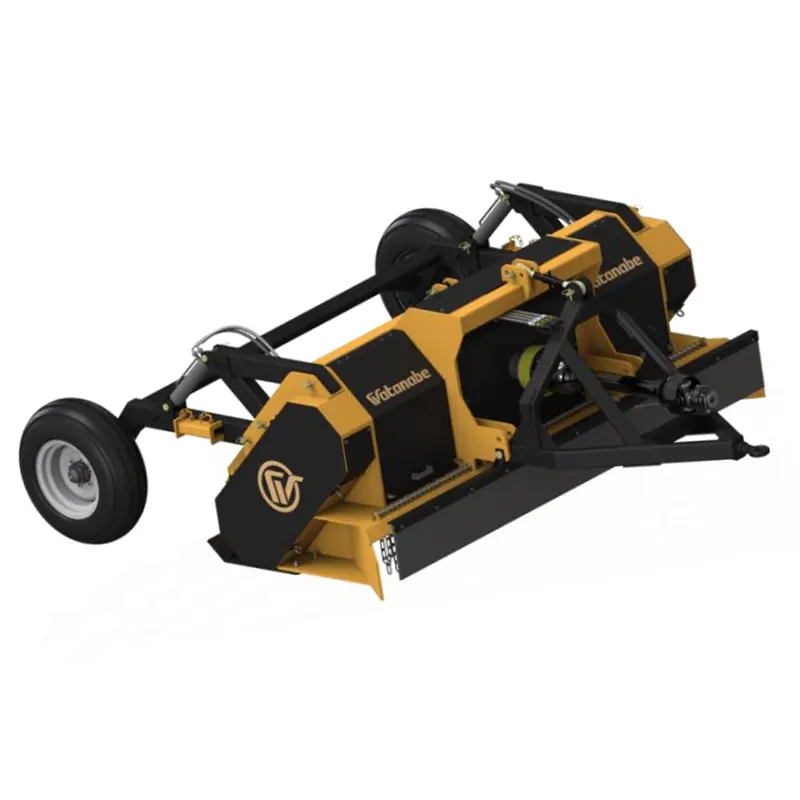
THOR 2.4 stone crusher — the three hazard zones (rotor ejection zone, side throw zone, rotor chamber) each require specific safety clearances during operation

The THOR 2.4’s 550 mm diameter rotor operating at 1,000 RPM creates three distinct hazard zones, each with a different risk mechanism. All three must be understood by any operator or bystander in proximity to the machine during operation:

Zone 1: Rear Ejection Zone (High Hazard)

The rear hood of the THOR 2.4 is designed to retain fragmented stone material within the crushing chamber — but not with 100% retention efficiency, particularly when the hood is partially open for coarser fragment output, when a stone fragment has an unusually high energy trajectory, or when the hood has a gap from a hinge misalignment. Ejected stone fragments from the rear zone travel at high velocity in the direction of machine travel — behind the THOR 2.4 in its normal push-mode, or in front of the machine in the Kit Drawbar pull-mode. The exclusion zone behind a push-mode THOR 2.4 and in front of a pull-mode THOR 2.4 is a minimum of 30 m during operation — no person should be within 30 m of the machine in the trajectory direction during any operating pass. On Korean highland terraces, this 30 m clearance must include considering the downhill slope: a fragment ejected on a down-slope trajectory can travel significantly further than 30 m horizontal distance.

Zone 2: Side Throw Zone (Moderate Hazard)

The THOR 2.4’s rotor arc extends beyond the machine’s side shields — particularly where the cutting zone meets the stone debris that has not yet entered the rear hood. Side-deflected stone fragments can travel 10–20 m lateral to the machine centreline at reduced velocity compared to the rear ejection zone. Any person adjacent to the THOR 2.4 in the side zone during operation is at risk from lateral ejection events. Korean highland farms often have terrace walls or adjacent terrace crops at the side of the THOR’s working path — while stone fragment impact on these structures is a management consideration, the priority is ensuring no person is in the side throw zone during any operating pass. Exclusion zone: 15 m lateral from the THOR 2.4 centreline during operation.

Zone 3: Rotor Chamber — The Absolute Exclusion Zone

No person should ever enter the space below the rear hood or the area directly surrounding the rotor body while the PTO is engaged, the tractor engine is running, or the rotor is in motion. The rotor has significant flywheel inertia — it continues rotating for 3+ minutes after PTO disengagement. The rotor chamber exclusion zone is not just an operating hazard — it is equally dangerous during the post-shutdown period. Procedure: disengage PTO, shut down tractor engine, wait a minimum of 3 full minutes, confirm visually that the rotor is stationary, then block the rotor with a wooden wedge before any person enters the rotor area for inspection or maintenance. Never enter the rotor chamber while another person is in the tractor cab — inadvertent PTO engagement by the cab operator with a person in the rotor chamber has caused fatalities.

Kit Drawbar Slope Safety — When Pull-Mode Becomes Mandatory

THOR 2.4 with Kit Drawbar on Korean highland slope — the Kit Drawbar converts from push mode to pull mode on gradients above 12%, preventing the lateral displacement that pushes the machine off the intended track on steep terrain

The Kit Drawbar pull-mode is described throughout this series as a slope management tool — this section consolidates the safety case rather than the operational case. The risk that the Kit Drawbar prevents is lateral displacement of the THOR 2.4 on gradient terrain, which in the most serious scenario can result in the THOR 2.4 pulling the tractor into a lateral roll:

The lateral displacement risk in push mode on slopes:

In push mode (THOR 2.4 on the rear three-point hitch), the rotor’s reaction force against a stone impact acts as a lateral torque on the machine — pushing the THOR sideways relative to the tractor’s forward direction. On flat terrain, this lateral force is absorbed by the hitch geometry. On cross-slope terrain above 12%, the downhill component of this lateral force combines with the slope’s gravitational pull on the THOR 2.4’s 2,300 Kg mass to create a net lateral force that can exceed the tractor’s rear axle resistance, causing the tractor to track sideways down the slope. In extreme cases on steep Korean highland terraces with narrow flat sections, this sideways displacement can bring the tractor to the terrace edge.

Kit Drawbar pull-mode resolves the lateral force direction:

In pull mode (THOR 2.4 towed from the drawbar), the lateral force from the rotor now acts on the THOR body, which is behind the tractor’s rear axle and connected at the drawbar. The tractor’s forward traction resists the lateral force rather than the rear axle’s lateral stiffness. The tractor steers into and through the lateral force, maintaining its intended track. The same 12% gradient that was dangerous in push mode is manageable in pull mode. Mandatory rule: above 12% cross-slope gradient, use Kit Drawbar pull mode. On gradients above 20%, consult Korea Watanabe before any THOR 2.4 deployment regardless of mode.

CT-2100 Tipping Risk on Wet Slopes — Load Management and Speed Limits

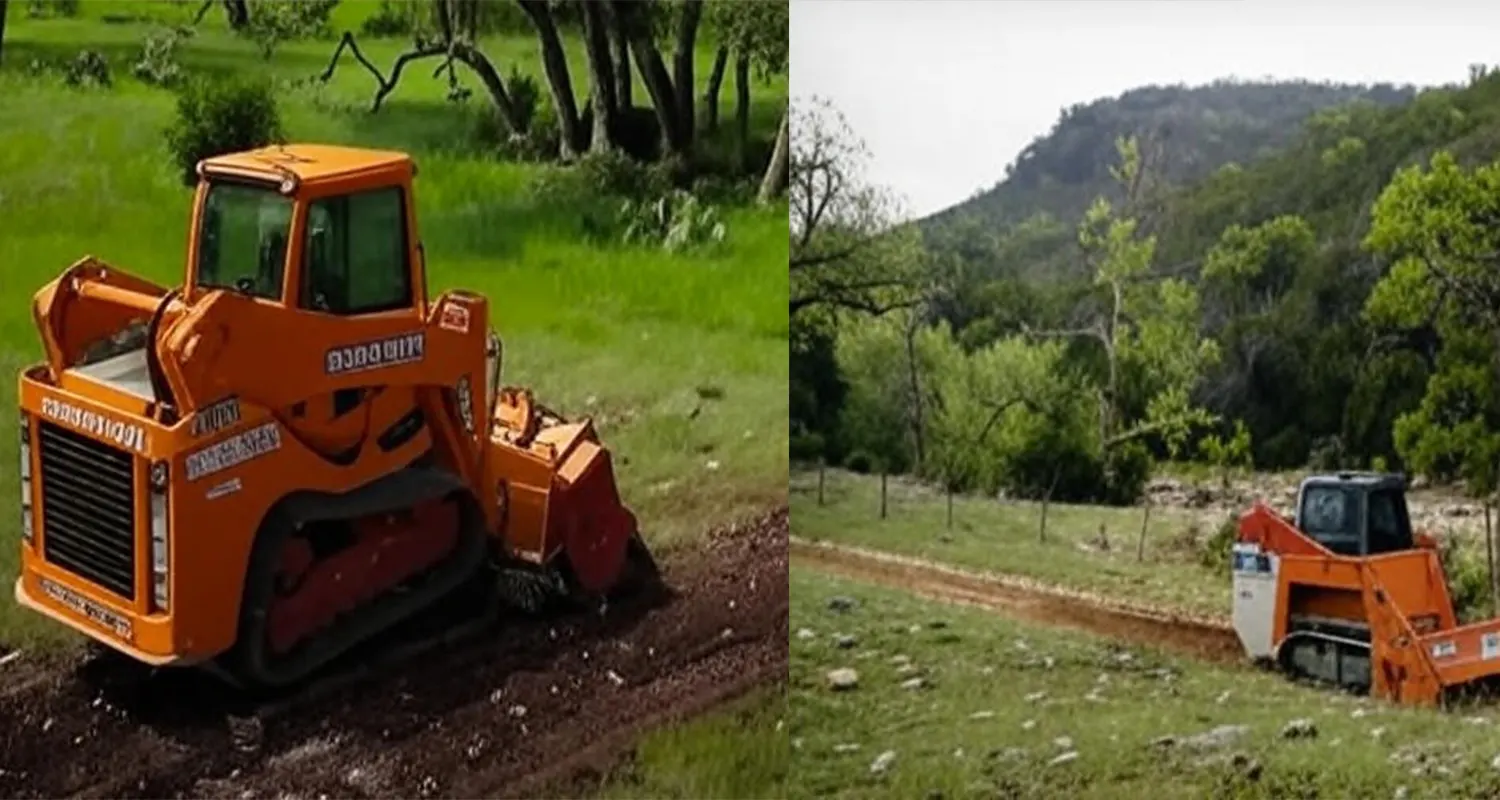
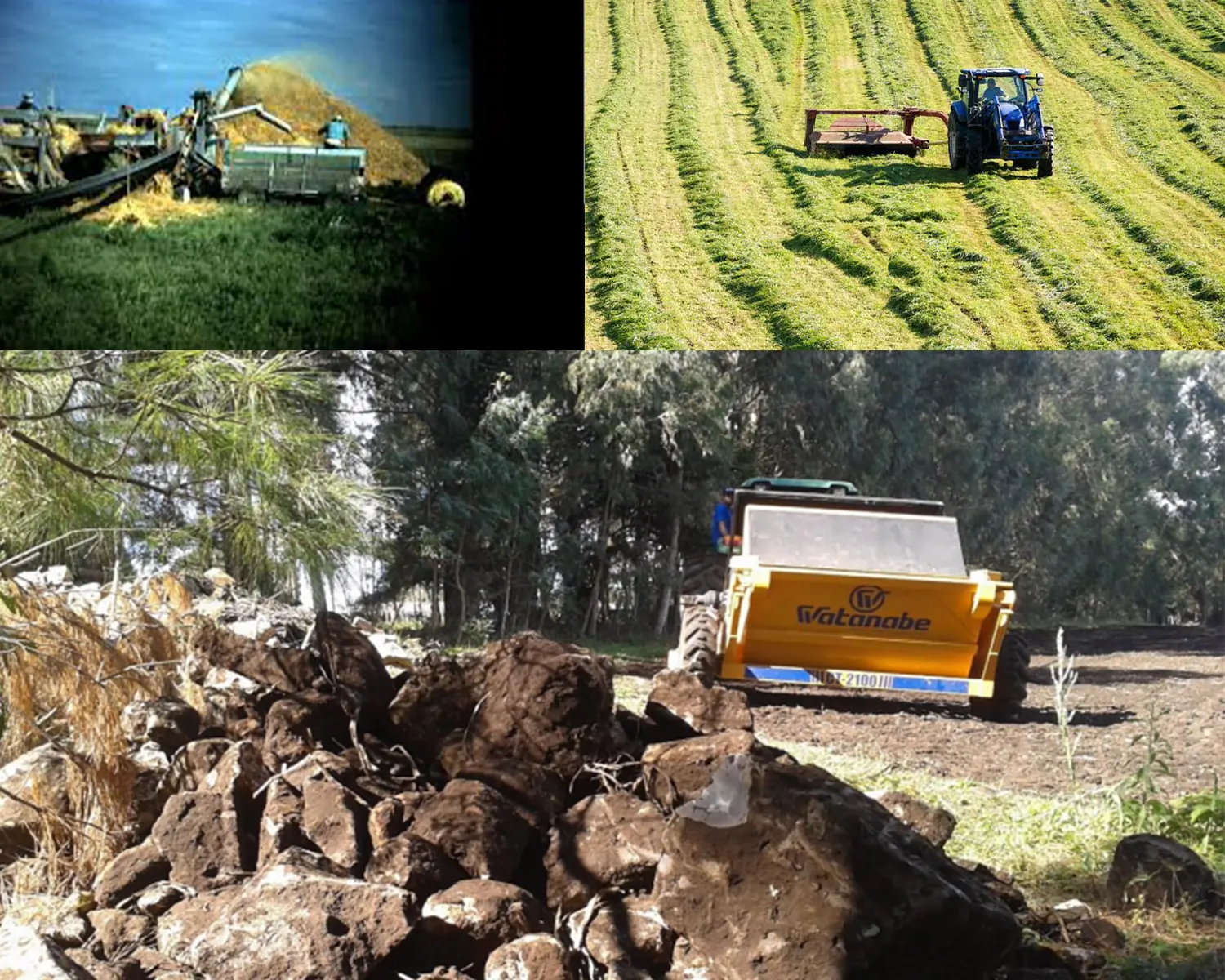
CT-2100 rock picker on Korean highland field — the loaded CT-2100 raises its centre of gravity significantly above the unladen height; operating on wet slopes with a full bunker requires reduced speed and terrace-edge awareness

The CT-2100 at full bunker load (2.5 m³ of basalt or granite aggregate, approximately 6,000–8,000 Kg total machine weight when loaded) has a significantly raised centre of gravity compared to its unladen condition. This elevated centre of gravity creates a specific tipping risk on Korean highland slope terrain that is not present at flat-field or gentle-slope operations:

Maximum loaded cross-slope:

The CT-2100 loaded with a full bunker should not traverse a cross-slope gradient above 8% (approximately 4.6°). This is significantly lower than the unladen CT-2100’s safe operating gradient — the elevated centre of gravity from the full stone load reduces the stability margin on cross-slopes. On Korean highland terraces, the approach from one terrace section to the next headland typically involves a brief cross-slope traverse along the terrace access track — confirm this traverse gradient is below 8% before the full-load descent from the operating terrace to the headland deposit zone.

Wet-condition tipping risk amplification:

Korean highland granite soils become highly unstable on slopes in wet conditions — particularly during and after spring snowmelt (March) and after typhoon rainfall (July–August). The CT-2100’s tyres can slip on wet Korean granite grit surfaces even on gradients that are safe in dry conditions. Never operate a fully loaded CT-2100 on wet cross-slope terrain above 5% gradient. If the full bunker must be moved across a wet slope, reduce to below half load before the cross-slope traverse and complete two smaller loads rather than one full load.

Headland deposit zone selection:

Plan the stone deposit zone at the headland to be accessible by a low-gradient approach from the operating terrace. A deposit zone that requires a steep cross-slope traverse from the operating terrace should be relocated to a flatter approach before the CT-2100 begins the full-load deposit cycle. This planning step takes 10 minutes at the start of the field day and prevents the loaded tipping scenario.

Pre-Season Safety Checks — The February Inspection That Prevents Accidents

The February pre-season machinery service described in the annual operations calendar is also the primary accident prevention opportunity. The mechanical failures that cause accidents are not random — they are almost always preceded by a detectable deterioration that a thorough pre-season inspection would identify and correct before field deployment. The safety-specific checks beyond the standard service items:

机器 Critical safety check Failure mode if not checked
雷神 2.4/3.0 Confirm all tooth retaining bolts are torqued to specification. Inspect rear hood hinge condition and close-latch function. Confirm Kit Drawbar pivot pin condition and hydraulic cylinder seals. Loose tooth bolt → tooth ejected at operating speed (high-energy projectile). Hood hinge failure → hood opens during operation releasing rotor zone. Drawbar pivot failure → loss of directional control on slopes.
CT-2100 Inspect bunker hydraulic cylinder for leaks and extend/retract test. Confirm bunker latch security (prevents unintended discharge during transport). Check tyre condition and pressure (underinflated tyres on loaded cross-slope significantly increase tipping risk). Hydraulic cylinder failure → uncontrolled bunker discharge during transport. Tyre pressure low → reduced cross-slope stability margin on loaded descent.
PTO shaft (all machines) Inspect PTO shaft protective guard condition. Confirm guard rotates freely around shaft. Check cardan joint play — more than 5° of play in any joint indicates replacement is needed. Missing or damaged PTO guard is the leading cause of agricultural machinery entanglement injuries. Worn cardan joint can shear under high load, creating a whipping hazard.
EP-AWB-1600 Confirm share locking mechanism is secure (share cannot rotate or fall during transport). Inspect web separator tension (a over-tensioned web can break under load, creating a recoil hazard). Share rotation or fall during transport or at headland can cause serious injury to anyone in proximity. Web separator failure mid-operation can produce a high-tension recoil.

Operator Training Priorities — What New Machine Operators Must Learn Before the First Field Day

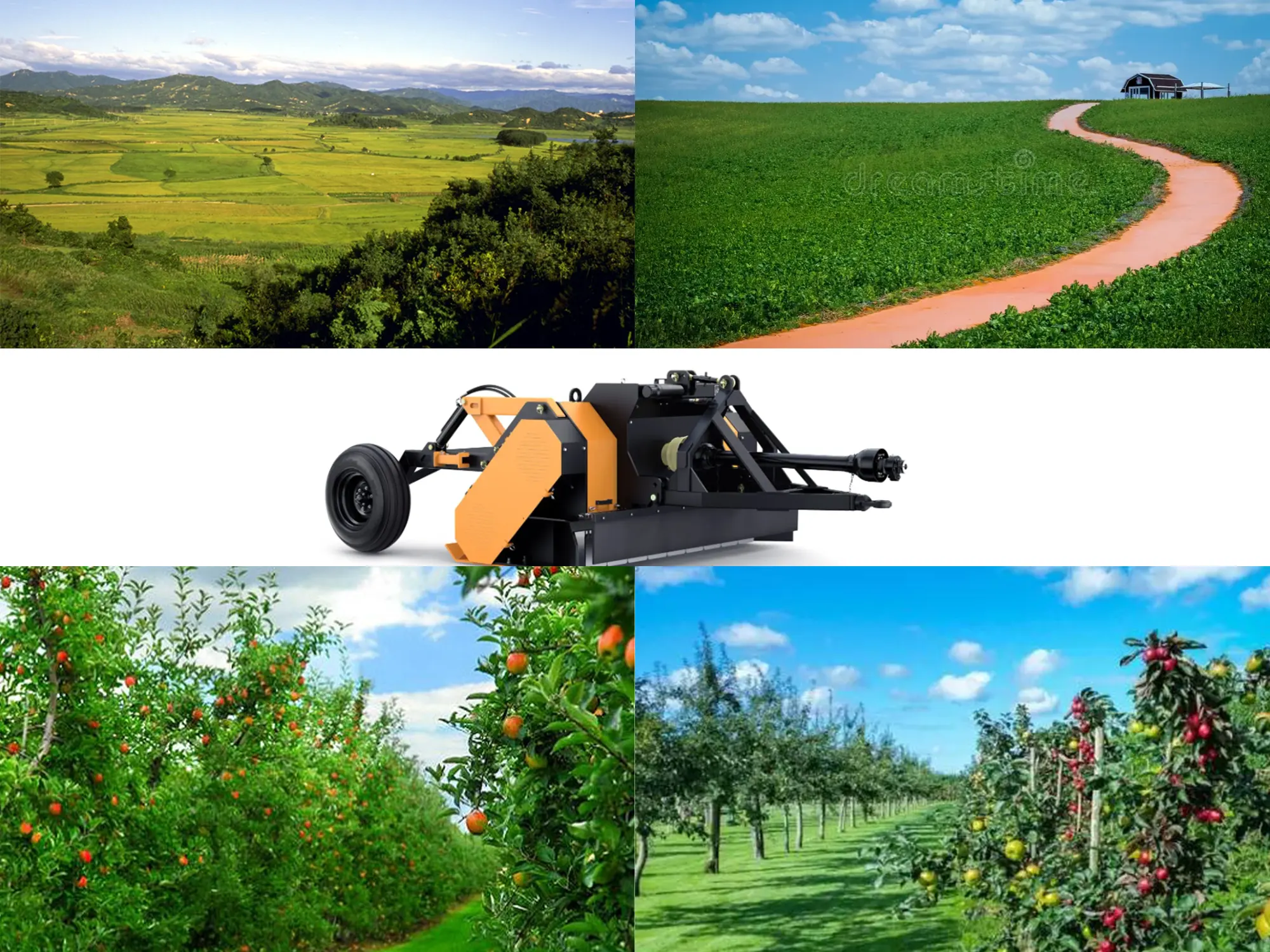
THOR 2.4 operation on Korean highland field — new operators must complete the hazard zone briefing, pre-start check procedure, and emergency stop procedure before the first field operating pass

Korea Watanabe provides operator training for all new machine purchases — the training covers the operation and maintenance procedures described throughout this series. This section summarises the safety-specific training points that new operators most frequently identify as knowledge gaps after their first field season:

Training priority 1 — Emergency PTO disengagement:

Every operator must be able to disengage the PTO immediately and without hesitation from the tractor cab under any stress condition. The emergency stop sequence (PTO lever, clutch, brake) must be practiced until it is a conditioned reflex — not a recalled procedure. New operators should practice the emergency stop sequence 10–15 times before the first field operation, including practicing it while the machine is in motion (at low speed in a clear flat area) to build the muscle memory response that replaces panic-driven hesitation in an actual emergency.

Training priority 2 — Exclusion zone management with bystanders:

Korean highland farms often have family members, farm workers, and casual visitors present in the field area during machine operations. Every person in the operating area must be briefed on the hazard exclusion zones before the first pass. A brief 2-minute explanation of the 30 m rear exclusion zone, the 15 m side zone, and the absolute rotor chamber exclusion is adequate for any adult who will be in proximity to the operating THOR 2.4. The operator is responsible for confirming that all persons are clear before each operating pass begins.

Training priority 3 — Gradient assessment before each new terrace section:

Korean highland terrace gradients vary significantly within a single farm — a terrace that is safe for THOR 2.4 push-mode may be immediately adjacent to a steeper section that requires Kit Drawbar pull-mode. New operators must learn to assess terrace gradient by visual inspection and confirm the Kit Drawbar deployment requirement before beginning each new terrace section rather than assuming the previous section’s gradient applies to the next.

Training priority 4 — Recognition of overload symptoms:

The THOR 2.4 operating at excessive forward speed for the stone density being encountered produces characteristic sounds (higher pitch, irregular thuds) that indicate the rotor is being overloaded — stones are not being adequately fragmented before the next stone contact. New operators should learn to recognise these sounds as a signal to reduce forward speed — not as normal operating noise to be tolerated. Overloaded operation accelerates tooth wear, increases ejection energy of partially-fragmented stones, and stresses the rotor bearing. Reduce speed until the rotor sound returns to the lower-pitched, rhythmic operating norm.

常见问题解答

Is there a Korean government mandatory safety training requirement for THOR 2.4 operators?

Korean agricultural machinery operators are not currently required by law to hold a separate operator’s certificate for PTO-driven machinery such as the THOR 2.4 beyond the standard agricultural tractor driving licence requirement. However, the Korean agricultural machinery safety promotion programme (nonggi anjeon gyoyuk) administered by the Korea Agricultural Safety Authority provides voluntary operator training courses for agricultural machinery including PTO-driven implements, with course completion certificates that qualify operators for enhanced insurance terms and in some counties for preferential consideration in subsidy applications. Korea Watanabe strongly recommends completing this training for any new THOR 2.4 or THOR 3.0 operator, and can provide information on the training schedule for Gyeonggi-do and Gangwon-do regions on request. Machine purchase from Korea Watanabe includes an operational safety briefing at time of delivery as standard.

What personal protective equipment (PPE) is recommended for THOR 2.4 operation?

The THOR 2.4 operator is in the tractor cab during all operating passes — the cab provides protection from stone ejection fragments as long as all cab windows are closed during operation. Korean agricultural tractor cabs with safety glass provide adequate fragment protection during normal operation within the defined exclusion zones. The primary PPE requirements apply during the non-operating phases: (1) During pre-start checks and post-operation maintenance — safety footwear (steel-toed boots) for all persons in proximity to the machine; (2) During tooth inspection and replacement — heavy leather work gloves to protect from tooth edge contact and from residual stone fragment edges in the rotor chamber; (3) During PTO shaft inspection — never handle a PTO shaft while the engine is running, regardless of PTO engagement state. No additional specialist PPE is required during operation from the tractor cab — keeping the cab closed is the primary protection.

What is the correct response if the THOR 2.4 contacts bedrock or a very large embedded stone during operation?

Immediate response: disengage PTO (do not simply reduce forward speed — the rotor must be stopped before any assessment is made). The bedrock or massive stone impact event produces a characteristic sudden deceleration and loud impact that is distinctly different from normal stone-crushing operation. After PTO disengagement and rotor full stop (3+ minutes): inspect all tooth positions in the impact zone for damage (chipping, cracking, displacement); inspect the rear hood hinge and latch for any impact-induced distortion; check the rotor shaft visually for any signs of lateral displacement; confirm the Kit Drawbar (if deployed) hydraulic connections are intact. If any component shows visible damage from the impact, do not resume operation — contact Korea Watanabe for assessment before the next operating pass. An undamaged post-impact inspection confirms the machine is safe to continue. Attempting to continue operation without inspection after a confirmed bedrock contact event risks operating with a damaged tooth that will fail progressively and unpredictably.

Are the THOR 3.0 safety requirements different from the THOR 2.4?

THOR 3.0 岩石破碎机‘s safety requirements follow the same principles as the THOR 2.4 but with amplified hazard magnitudes from its higher energy operating parameters. The rear ejection exclusion zone extends to 35 m (versus 30 m for the THOR 2.4) due to higher rotor energy at the same 1,000 RPM but larger 600 mm diameter rotor. The 2,800 Kg machine weight compared to 2,300 Kg for the THOR 2.4 increases the slope tipping consequence if tractor control is lost on steep terrain — the 230 HP tractor required for the THOR 3.0 has correspondingly higher stability margins, but the higher mass means that a tractor-over event with the THOR 3.0 is more severe than with the THOR 2.4. The 2-valve hydraulic requirement means the operator has more active control variables during slope operation — Kit Drawbar hydraulic and rear hood adjustment simultaneously — requiring higher operator attention and training proficiency. Korea Watanabe provides enhanced safety briefing for all THOR 3.0 purchases specifically addressing the additional hazard magnitudes compared to the THOR 2.4.

What is the recommended first aid preparedness for remote Korean highland farm operations?

Korean highland farms are often located 20–40 minutes from the nearest hospital emergency service, and mobile phone coverage can be unreliable on remote terrace sites. Minimum first aid preparedness for THOR 2.4 and CT-2100 operations on remote Korean highland sites: (1) a fully stocked agricultural first aid kit in the tractor cab at all times, with specific inclusion of wound packing materials and triangular bandages for potential laceration injuries from stone fragments; (2) confirmation that at least one mobile phone in the operating party has the Korean emergency services number (119) pre-entered and that the site’s GPS coordinates (or the nearest road address) are known for emergency dispatch communication; (3) a second person within earshot of the operation or within visual range of the tractor, not as an operating participant but as an emergency notification resource. Single-operator THOR 2.4 operation on remote terraces without any other person in communication range is a risk management decision that each operator makes, but it should be made consciously with awareness that emergency response time in remote highland conditions is significantly longer than at accessible locations.

THOR 2.4 and Watanabe System Safety Training

New machine purchase + operator experience level + slope terrain characteristics → operator safety briefing covering hazard zones, emergency procedures, and pre-season safety check protocol. Korea Watanabe, Ansan-si, Gyeonggi-do.

立即联系我们

编辑:Cxm

标签: