O CT-2100 taş toplayıcı is described in most Korean agricultural discussions as the completion machine for the THOR stone crusher — the machine that picks up what the THOR has crushed and deposits it at the field headland for truck collection. This framing is correct but incomplete. The CT-2100 is also the machine used for light-year surface collection after the EP-EW-4000 rock rake, the annual maintenance collection pass on orchard alleys, and the surface stone collection on fields where the THOR was not needed. Understanding the CT-2100’s full range of Korean highland applications — and how to plan its daily capacity against the THOR and rake systems it follows — is the practical knowledge that keeps the stone clearing sequence moving efficiently.
CT-2100 Confirmed Specifications
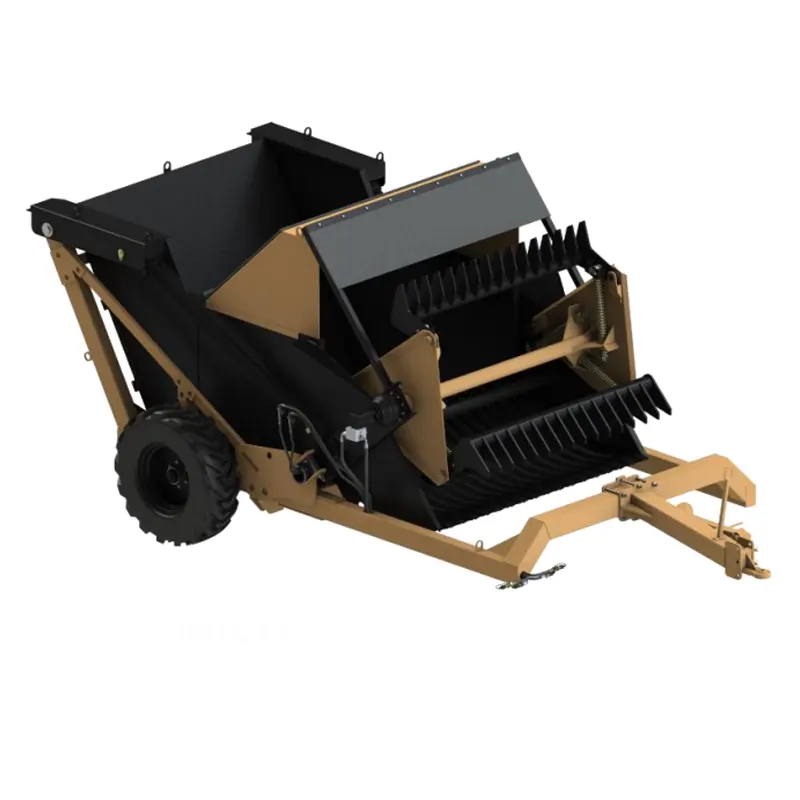
Watanabe resmi ürün broşüründeki tüm özellikler.
How the CT-2100 Works — Pick-Up Reel, Grader, and Bunker
The CT-2100 operates on a simple but mechanically robust principle: a rotating tine drum (pick-up reel) at the front of the machine lifts stones from the surface and elevates them into the bunker through a steel cross-bar grader system. The grader bars allow soil to fall back through while retaining stones — producing a bunker load of stones with minimal soil contamination. The hydraulically-operated rear door discharges the full bunker load at the field headland at the touch of the remote valve control from the tractor cab.
Daily Capacity Planning — How Many CT-2100 Passes per THOR Pass?
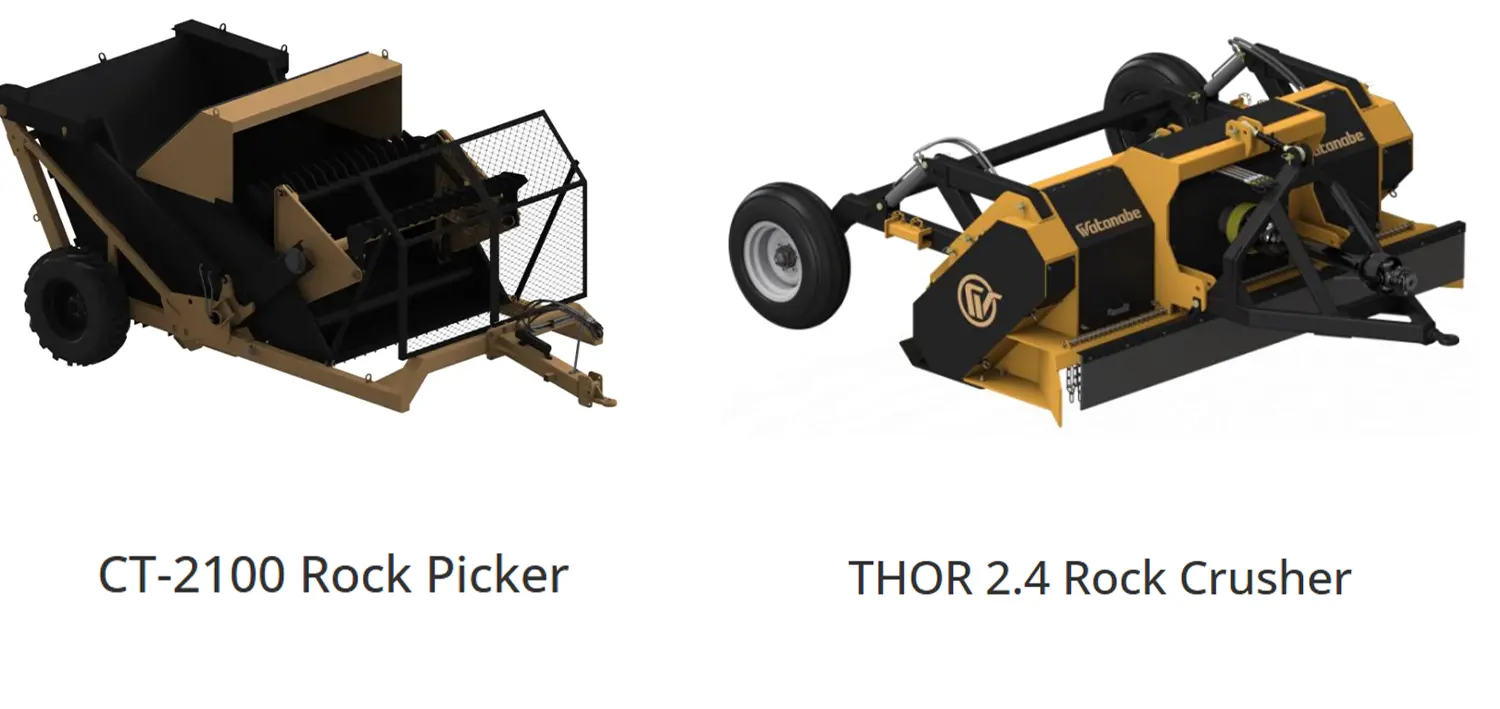
The most important capacity planning question for a Korean highland stone clearing operation is: how many CT-2100 collection passes does a single THOR 2.4 crushing pass require? This determines whether a single tractor-and-CT-2100 combination keeps pace with the THOR 2.4, or whether the collection becomes a bottleneck that slows the overall clearing rate.
| Stone density / field type | CT-2100 passes per THOR pass | Implication |
|---|---|---|
| Light frost-heave (established field) | 1 CT-2100 pass per THOR pass | Single tractor-CT-2100 keeps pace with THOR; one operator each |
| Moderate stone (typical established field) | 1–2 CT-2100 passes per THOR pass | CT-2100 may need to make 2 passes per THOR pass in some sections; operator can assess per section |
| Heavy stone (new land or severe winter) | 2–4 CT-2100 passes per THOR pass | Consider a second CT-2100 to maintain pace with THOR on heavy-stone new land |
| After EP-EW-4000 rake (light year) | 1 CT-2100 pass per rake pass | Rake windrows are well-defined; CT-2100 follows directly in the windrow line |
The 2.5 m³ bunker fills in approximately 300–600 linear metres of collection pass on typical Korean highland stone density — varying with stone size and density. On a 300 m field at 1 pass per row spacing, the CT-2100 fills approximately every 1–2 passes before needing headland discharge. Each discharge takes 2–3 minutes (drive to headland, discharge, return to field). Planning discharge points at both ends of the field (rather than one end only) reduces the average non-productive headland travel distance and improves overall CT-2100 utilisation.
CT-2100 Operating Setup — Getting the Configuration Right Before the First Pass
Pick-up reel height setting. Set the pick-up reel height so the tines just touch the soil surface without digging in. Too high (tines clear the soil) and smaller stones are missed. Too low (tines dig into the soil) and the CT-2100 picks up excessive soil volume, rapidly filling the bunker with soil rather than stones, and potentially overloading the pick-up reel mechanism on compacted soil. The correct setting is confirmed on the first 20 m test pass — look back at the collection zone to confirm stones are being picked up cleanly without excessive soil disturbance.
Working speed selection. The CT-2100’s operating speed of 3–5 km/h is the range for effective collection. At the lower end (3 km/h), the pick-up reel has more time to engage smaller stones — improving collection completeness on fine-stone passes. At the upper end (5 km/h), throughput is higher but small stone collection completeness is reduced. For post-THOR collection where crushed material is primarily in the 3–10 cm range, 4–5 km/h is appropriate. For post-rake collection of mixed surface stone sizes, 3–4 km/h ensures better completeness on smaller surface stones.
Hydraulic remote valve connection and discharge test. Before the first field pass, connect the hydraulic hoses to the tractor’s rear remote valve ports and confirm the hydraulic flow direction is correct for the discharge operation. With the CT-2100 on level ground and the bunker door closed, cycle the hydraulic control through its full range — the door should open fully and close fully without hydraulic pressure limitation. If the door operates sluggishly, check tractor hydraulic flow output against the CT-2100’s 60 L/min requirement — some lower-specification 110 HP Korean tractors may have hydraulic output below this requirement, slowing discharge operation.
CT-2100 Maintenance Schedule
| Aralık | Görev | Sign of problem if neglected |
|---|---|---|
| Before each session | Check tine condition; inspect bunker door seals; confirm hydraulic connections secure | Missing tines = stones not collected; loose hydraulic connection = oil spill and slow discharge |
| Her 8 çalışma saatinde bir | Lubricate pick-up reel bearings; lubricate bunker door hinge pins; check drive chain tension | Dry bearings squeal under stone impact load and fail rapidly; loose chain skips and damages grader bars |
| After each season | Replace worn pick-up tines; inspect grader bars for wear and straightness; hydraulic hose condition check; clean and dry before storage | Worn tines = poor small-stone collection in next season; bent grader bars = soil contamination in bunker |
| Annual (or 200 hours) | Drive chain replacement; full bearing inspection; bunker door hydraulic cylinder seal check | Chain fatigue failure mid-season; leaking hydraulic cylinder = slow or incomplete bunker discharge |
CT-2100 in the Korean Stone Clearing System — Three Operating Scenarios
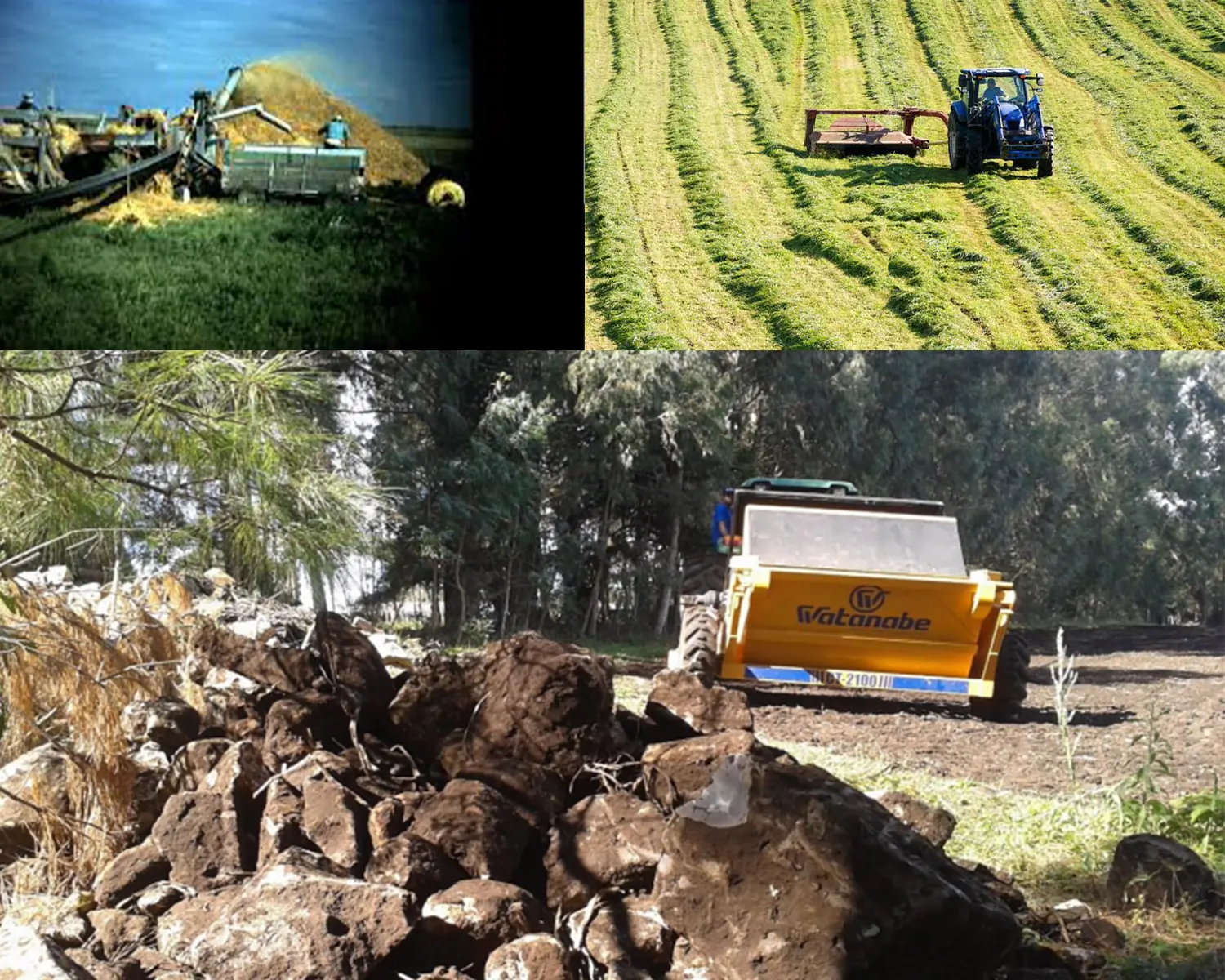
The CT-2100 serves three distinct operating roles in the Korean stone clearing system, each with a different preceding machine and collection pattern:
Scenario 1: Post-THOR Collection (Primary Role)
The THOR 2.4 crushing pass deposits crushed stone material across the working width. The CT-2100 follows on the same pass lines, collecting the crushed output. On heavy-stone new land, the THOR may need to complete a full field pass before the CT-2100 begins collection — allowing the stone to settle and the crushed material to be clearly defined in position. On lighter stone, the CT-2100 can follow immediately behind the THOR in the same working session, alternating THOR and collection passes row-by-row. Working speed: 3–4 km/h for thorough post-THOR collection.
Scenario 2: Post-Rake Collection (Light-Year Role)
O EP-EW-4000 kaya tırmığı windrows surface stones into linear piles across the field. The CT-2100 follows in the windrow lines, picking up the concentrated stone windrowed by the rake. This is the most efficient CT-2100 operating scenario — the stones are already concentrated into a narrow band by the rake, so the CT-2100 pick-up reel engages a high stone density per metre of travel and fills the bunker quickly. Working speed in windrow lines: 4–5 km/h. The CT-2100 is so efficient in windrow collection mode that a single tractor-CT-2100 combination can easily keep pace with a 3.6 m EP-EW-4000 rake in most Korean highland stone conditions.
Scenario 3: Direct Surface Collection (Orchard and Pasture)
In orchard alley or pig pasture annual maintenance where neither THOR crushing nor rake windrowing was used, the CT-2100 operates as a direct surface collector — picking up frost-heave surface stones in a single pass along the alley or pasture. This application requires the slowest working speed (3 km/h) and the lowest pick-up reel height setting to maximise collection of the varied-size surface stones that have emerged from winter frost heave. Bunker fill rate is slower in direct surface collection than in windrow following because stones are scattered across the surface rather than concentrated.
CT-2100 in Korean local stock
Korea Watanabe holds the CT-2100 rock picker in Korean local stock at Ansan-si, Gyeonggi-do. Standard delivery to Korean farm addresses is 5–10 business days from order confirmation. Subsidy documentation (certification document, specification sheet, and price quotation) is prepared within 2–3 business days and provided at no charge. Contact Korea Watanabe in January for the upcoming season to ensure delivery before the late-March stone clearing start date at Gangwon-do highland altitudes.
Sıkça Sorulan Sorular
Can the CT-2100 collect stones on sloped Korean highland terraces, or is it limited to flat fields?
The CT-2100 can operate on Korean highland slopes up to approximately 15–20% gradient — which covers the majority of Korean highland agricultural terrace gradients. On slopes above this range, the bunker load shifts toward the downhill side during collection, affecting pick-up reel depth uniformity and potentially causing operational issues during the uphill return pass with a full bunker. The practical slope limit for safe CT-2100 operation is similar to that for any loaded tractor-and-implement combination — confirm that the combined tractor and CT-2100 loaded weight (tractor + approximately 3,000–4,000 Kg bunker stone load when full) is within the tractor’s slope stability limit. For steep Korean highland terraces where the CT-2100 cannot safely operate at full load, collect at 50–60% bunker fill to reduce the dynamic load on the slope before discharging.
What happens to the stones collected by the CT-2100 at the field headland?
The CT-2100 discharges its bunker load at the field headland — a designated collection point at the edge of the field that truck access allows. From the headland, stones are loaded into dump trucks by front-end loader or excavator and transported to: (1) off-site disposal (dedicated stone collection sites, road fill material, or aggregate recycling); (2) on-farm stone walls or drainage channel fill (traditional Korean highland stone utilisation that also reduces disposal logistics); or (3) temporary farm stockpiles for later removal. For operations where stones are crushed fine enough by the THOR to be left as aggregate (road-building operations), the CT-2100 headland deposit pile can be the final disposition without further trucking. For agricultural clearing where zero residual stone is the goal, all headland deposits must be removed from the field edge before field operations begin — a stone pile left at the headland can be disturbed back onto the field by subsequent tractor traffic if not promptly removed.
Why is the CT-2100’s maximum stone size rated at 80 Kg — what happens if larger stones are encountered?
The 80 Kg maximum stone size specification is the maximum single stone weight that the CT-2100’s pick-up reel mechanism can reliably engage and transfer into the bunker without overloading the pick-up reel drive and structural components. Stones above 80 Kg can be engaged by the pick-up reel tines but may stall the reel mechanism, potentially bending tines or overloading the reel drive chain. In practice, the CT-2100 following a correctly operated THOR 2.4 should encounter no stones above 80 Kg — the THOR is rated to crush all stones up to 30 cm diameter (approximately 35–70 Kg for granite of that dimension) before they reach the CT-2100. If the CT-2100 encounters stones above its collection capacity, it indicates that the preceding THOR pass was operated too fast, at insufficient depth, or on stones outside the THOR 2.4’s 30 cm rated maximum — signalling a need to revisit the THOR pass parameters on those sections.
What tractor HP is needed to run the CT-2100 independently from the THOR 2.4?
The CT-2100 requires a minimum 110 HP tractor — significantly lower than the THOR 2.4’s 180 HP minimum. This means the CT-2100 can be operated by a standard Korean domestic brand tractor (Daedong/Kioti, LS, TYM) in the 110–130 HP class, while the THOR 2.4 requires an imported European tractor at 180+ HP. Korean highland farms that own a 180+ HP European tractor for THOR 2.4 operation and a 110–130 HP Korean domestic tractor for general field work can operate the CT-2100 on the Korean domestic tractor — keeping the 180 HP European tractor dedicated to the THOR 2.4 crushing passes. This two-tractor operational model (one tractor per machine) is the most efficient approach for farms clearing above 5–10 ha per season, as it allows the THOR and CT-2100 to work simultaneously on different sections rather than sequentially.
CT-2100 modeli Kore tarım makineleri sübvansiyonlarından yararlanabilir mi?
Yes — the CT-2100 qualifies under the Korean agricultural machinery purchase support program ( ) in the farmland improvement machinery category ( ), the same category as the THOR 2.4 stone crusher. Korea Watanabe holds the Korean agricultural machinery certification ( ) for the CT-2100 and provides full subsidy documentation (, , ) at no additional charge for CT-2100 purchases. For farmers purchasing both the THOR 2.4 and CT-2100 in the same application year, both machines can be included in a single subsidy application — subject to the per-farmer annual subsidy cap. Korea Watanabe assists in structuring multi-machine applications to optimise subsidy access across both machines. Contact Korea Watanabe in January to begin the documentation preparation process for the earliest application window.
CT-2100 Availability and Configuration — Confirm for Your Korean Farm
Farm area (ha) + existing tractor HP + intended use (post-THOR / post-rake / direct surface) → CT-2100 operating configuration recommendation with daily capacity estimate and Korean local stock confirmation. Korea Watanabe, Ansan-si, Gyeonggi-do.
Editör: Cxm