Clay soil potato production is practised on some of the world’s highest-value potato farmland — the marine polders of Flevoland, the Holderness plain of East Yorkshire, the West Flanders coastal clay, the glacial till of Black Isle Scotland. These soils, despite their machinery challenges, consistently produce high-yielding, high dry-matter potato crops suited to processing contracts. The challenge is that clay soil’s physical properties — high draft resistance, soil adhesion to steel, clay bridging on elevator chains, slow drainage after rain, and compaction accumulation under harvest traffic — demand machinery specifications and operational protocols that are substantially different from those adequate on lighter soils. A machine correctly specified for sandy loam will fail on heavy clay; a machine correctly specified for heavy clay will harvest it reliably.
This guide covers the complete heavy clay potato machinery specification — from tillage through to harvest — and identifies the regional heavy clay potato zones where this guide’s specifications most directly apply.
Clay Soil Physical Properties — How They Drive Machinery Requirements
| Soil Property | Machinery Implication | Required Specification / Adjustment |
|---|---|---|
| High clay fraction (>25%) — cohesive | Clay adheres to steel; bridges elevator rods; wraps star of soil around tubers | Star wheel separator mandatory; maximum elevator agitation bars; anti-blockage chain wipers |
| High draft resistance (3–5× sandy loam) | Digger share requires 3–5× more tractor pull force than sandy loam equivalent | Minimum 80HP single-row; 140HP+ trailed two-row; 30–40% HP margin above minimum |
| Slow drainage — wet conditions persist | Field surface becomes unworkable in wet conditions; soil near field capacity = maximum blockage risk | Wait 3–7 dry days after rainfall before harvest; ball test and smear test protocol before field entry |
| High compaction susceptibility when moist | Heavy harvest traffic compacts to 35–40cm depth; pan restricts next season roots | Wide flotation tyres; maximum pressure reduction; CTF system strongly recommended for repeated clay harvest |
| Ridge slumping after rain | Well-formed ridge loses shape in heavy rain; requires higher initial height to account for slump | Form ridges at 30–35cm height; use powered bedformer for best ridge consolidation on heavy clay |
Star Wheel Separator — Why Clay Soil Cannot Be Harvested Without It
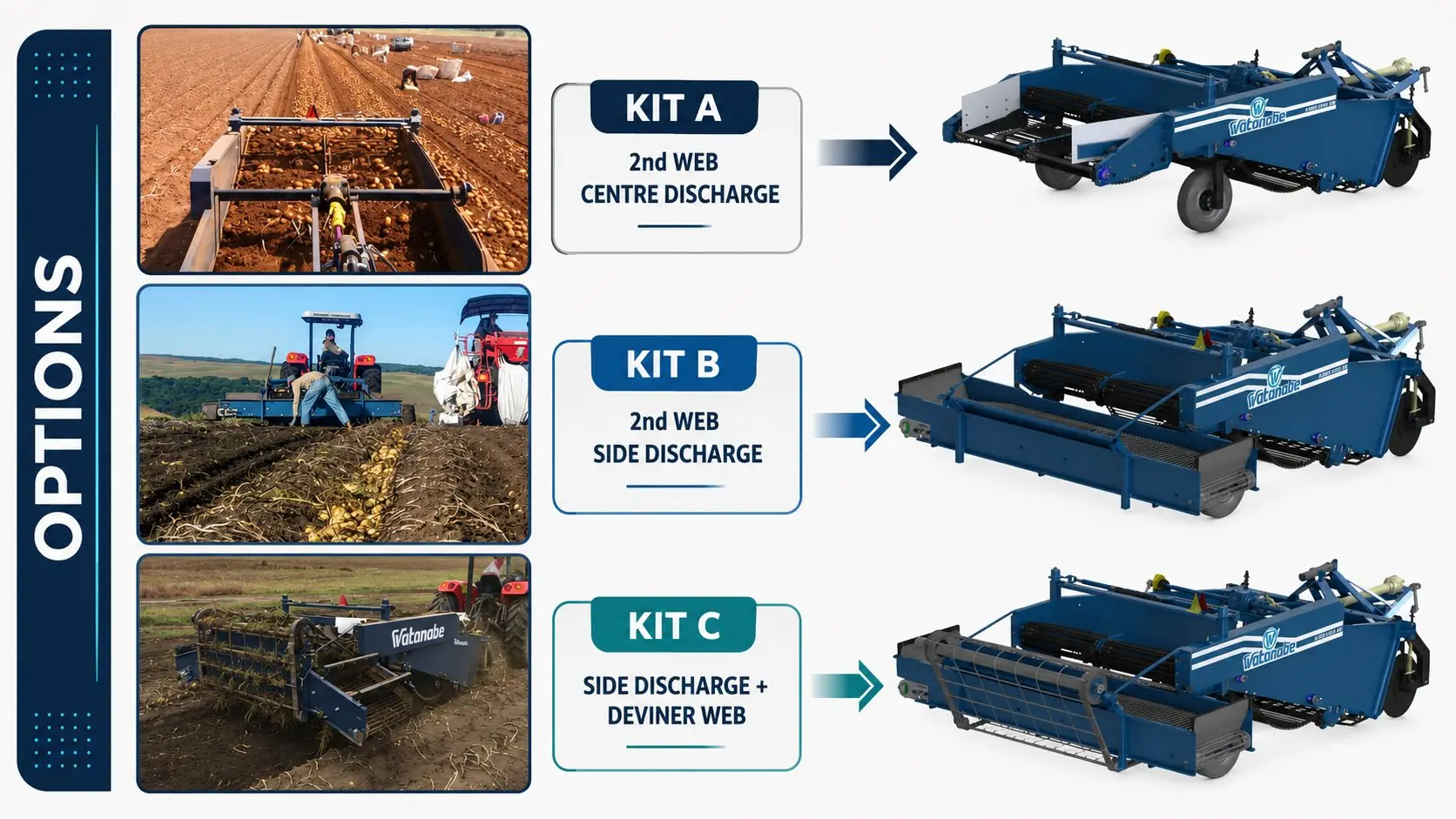
The reason a riddle frame separator produces unacceptable results on clay soil is chemical as much as mechanical. Clay particles (aluminium silicate phyllosilicate minerals) carry electrochemical surface charges that attract them to the rough, starch-coated surface of a freshly-dug potato tuber. The bond between clay and tuber skin is strong enough that gravity and the vibration of the elevator chain cannot break it reliably — the clay remains adhered to the tuber as it exits the elevator and enters the separator zone. On a riddle frame, these clay-coated tubers simply roll over the stationary rods as intact, clay-coated units: nothing in the passive frame mechanism provides the shearing force needed to separate the clay from the skin. The result is high soil carry-over on the crop — tubers arriving at the collection point still coated in clay, requiring mechanical cleaning at a subsequent step or producing below-spec contamination in the processing intake.
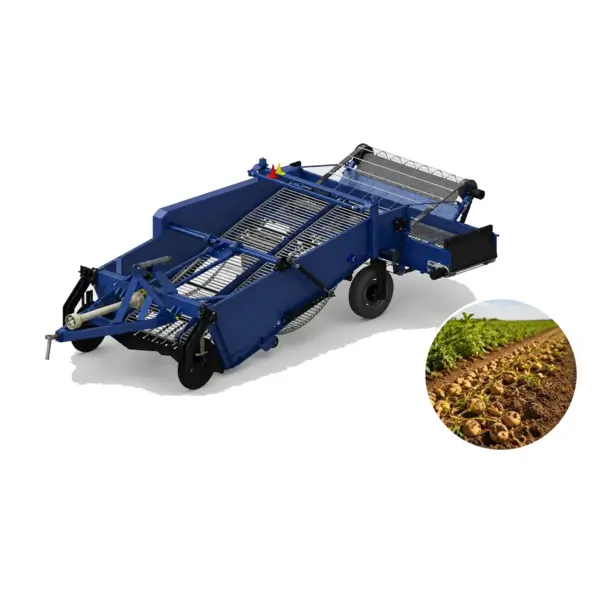
The star wheel’s rotating projections provide the shearing force the riddle frame cannot. Each rubber or steel projection, rotating at the designed speed, contacts the clay-tuber surface and peels clay from the skin in a scrubbing action. The clay drops through the gap between the wheel bodies; the tuber, too large to fit between the wheels, exits cleanly. On heavy Holderness clay or Flevopolder marine clay at moderate moisture, correctly-specified star wheels produce tubers with 90–95% surface clay removal — a specification compatible with most processing intake quality standards. A riddle frame on the same soil at the same conditions produces perhaps 40–60% clay removal — below most commercial processing thresholds.
Clay contact accelerates bearing degradation more than sandy soil operation. The clay particles penetrate bearing seals and act as a grinding medium — bearing failure rates on star wheels in clay operations are 2–3× higher per operating hour than on sandy loam. Inspect all star wheel bearings at mid-season (after the first half of the harvest area is complete) and replace any bearing showing roughness or excessive play. Rubber projection condition must also be checked: clay’s higher mechanical demand on the projection tips accelerates hardening. Apply silicone-based rubber conditioner to rubber projections at the start of each season and after every 60 hours of clay-condition operation.
Horsepower Requirements — Draft Resistance on Heavy Clay
Clay soil’s high draft resistance is the most immediate constraint on tractor selection for potato machinery. Draft force — the horizontal pull required to move the implement forward through the soil — is directly proportional to the soil’s shear strength, which increases steeply with clay content. A single-row mounted potato digger that requires 40 HP on clean sandy loam may require 70–90 HP on heavy clay at the same forward speed and depth — because the share is not only lifting the ridge mass but also shearing through the cohesive clay matrix that binds the surrounding soil into a continuous, resistant body.
| Digger Type | Sandy Loam Minimum HP | Clay / Heavy Land Minimum HP | Clay Adjustment Note |
|---|---|---|---|
| Montato a fila singola | 40–50 CV | 75–95 HP | HP margin of 30–40% above minimum recommended on heavy clay for peak load events |
| Montato a due file | 70–90 HP | 120–150 HP | Turbocharged tractor essential; two-row on clay near field capacity is at the limit of most 100HP tractors |
| Trailed two/four-row digger | 100–130 HP | 160–200+ HP | Commercial clay-soil trailed digger operations routinely use 180–220 HP tractors; under-powered = forward speed too slow, reducing daily output below viable level |
A tractor that is marginally adequate on clay — just meeting the minimum HP for the implement — will be over-throttled continuously, running at maximum fuel consumption, at elevated engine temperature, and with no reserve for the variable soil conditions (harder dry patches, clay concentrations) that occur across any real field. The correct specification for clay includes a 30–40% HP margin above the minimum — so a single-row digger that requires 75 HP minimum on heavy clay should be paired with a 95–105 HP tractor to maintain adequate reserve across variable field conditions.
Key Clay Soil Potato Regions — Specification by Market
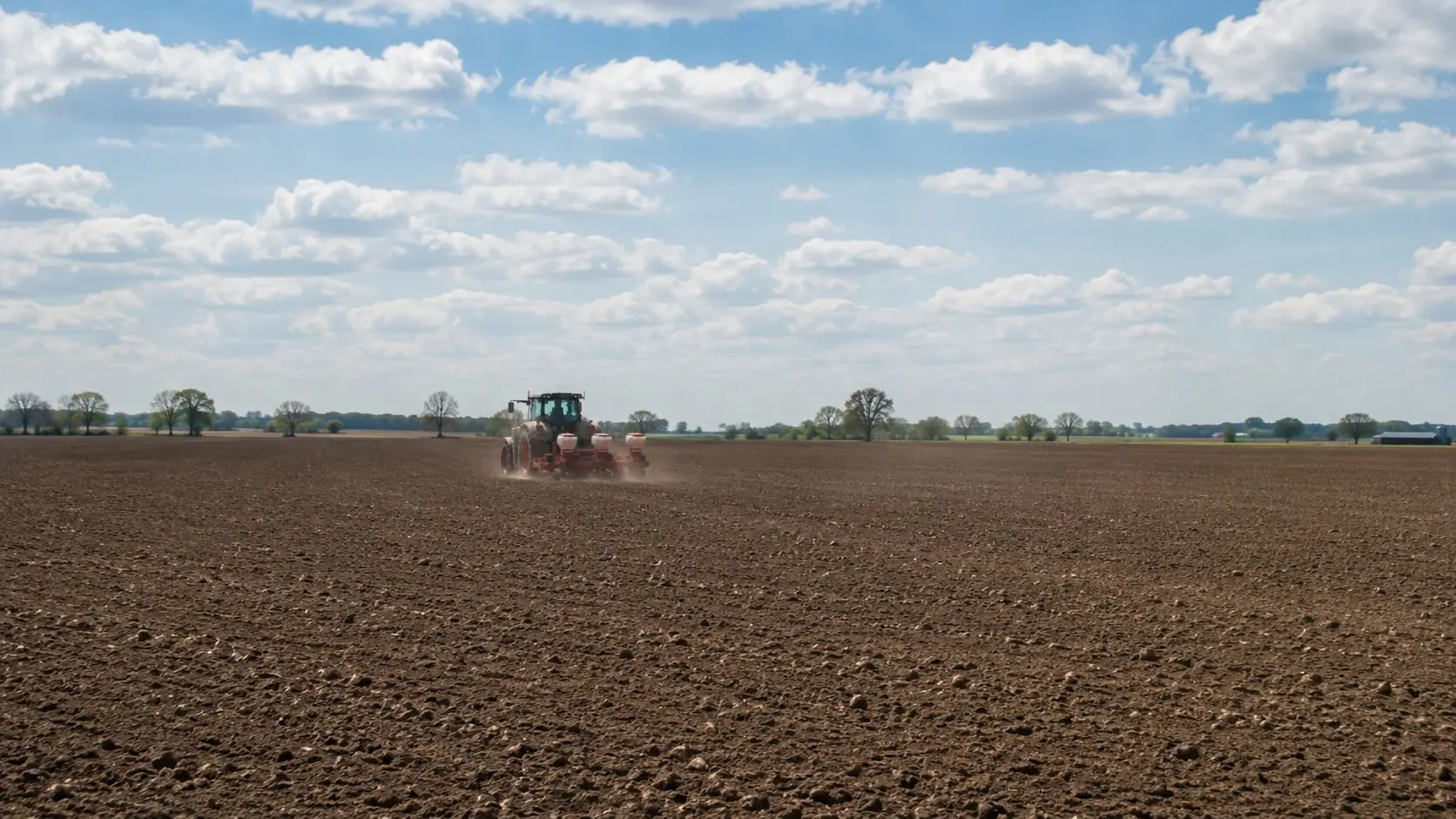
UK — Holderness Clay, East Yorkshire: The Holderness plain south of Scarborough and Bridlington is one of the heaviest clay potato soils in Northern Europe — Jurassic marine clay with 40–55% clay content in the topsoil and a characteristic dark, plastic consistency. Commercial potato farms here run 180–220 HP tractors with trailed four-row diggers; star wheel is universal; shear bolt events are a normal part of the harvest day; and soil moisture timing is the primary determinant of harvest feasibility more than any other factor in the UK. The Holderness is also one of the few UK zones where CTF (controlled traffic farming) is extensively practised in potato because the clay compaction consequences of unmanaged wheel traffic are so severe.
Netherlands — Flevopolder Marine Clay: The Flevopolder — reclaimed from the Ijsselmeer in the 1950s and 1960s — is some of the most productive arable land in Europe, and also some of the heaviest. The marine clay of Flevoland’s Dronten and Lelystad zones has 35–50% clay fraction and very high organic matter from the former lakebed sediment. Dutch commercial operations on Flevopolder clay run sophisticated machinery systems with hydraulic agitation, CTF, and CTIS (central tyre inflation) as standard — investment levels driven by the high land values and high potato market returns of this zone.
Belgium — West Flanders Maritime Clay: The Westhoek coastal zone and parts of the Polderland behind the Belgian coast have heavy maritime clay similar in character to the Dutch Flevopolder, though typically slightly less organic. Belgian heavy land potato growers are among Europe’s most technically sophisticated operators, with high adoption of GPS guidance, CTF, and trailed four-row digger systems. For enquiries on potato machinery for clay soil specifications, Korea Watanabe can confirm star wheel availability and agitation bar configuration for each machine and confirm HP minimum requirements for specific soil conditions.
Domande frequenti
▶Is there a minimum clay fraction at which star wheel becomes mandatory, or can a riddle frame work adequately in light clay conditions?
The transition from riddle frame to star wheel separator is not at a single precise clay fraction threshold — it depends on soil moisture at harvest. On a clay-loam soil (20–28% clay fraction) harvested after 5–7 dry days when the soil is well below field capacity, a riddle frame can achieve adequate separation because the clay aggregates dry enough to break apart and fall through the rods under vibration. The same soil at 90% of field capacity after rain produces clay aggregates that cannot break apart on the riddle frame and pass the separator as intact clay-coated tubers. As a practical guide: below 20% clay, riddle frame is appropriate in almost all harvest conditions; 20–30% clay, riddle frame is workable in dry conditions but star wheel is safer for variable or wet seasons; above 30% clay, star wheel is the correct specification regardless of harvest timing because even dryish heavy clay rarely breaks down adequately on a riddle frame. If in doubt about a soil at the 20–28% boundary, specify star wheel — it performs acceptably on lighter clay-loam and its aggressiveness can be managed by adjusting rotation speed, whereas a riddle frame’s inadequacy on heavy clay cannot be corrected by any adjustment.
▶How does clay soil affect potato quality in ways that machinery must address beyond separation?
Clay soil affects potato quality through three additional pathways beyond the separation challenge. First, blackspot bruise risk: clay’s adhesive cushioning effect on the elevator chain can be a slight protective factor for tubers against direct rod impact — clay aggregates around tubers absorb some impact energy that would otherwise reach the tuber. But clay soil is typically harvested at lower pulp temperatures than sandy soil (clay soil retains cold longer into the autumn), and below 10°C pulp temperature, blackspot risk is very high regardless of cushioning. Clay-country operators must check pulp temperature before each day’s harvest more carefully than sandy-soil operators. Second, skin finish quality: tubers from heavy clay often emerge from washing with some residual clay in the tuber eyes and irregular skin patches — not quality failures per se, but visible through washing. Processing buyers in clay zones typically accept a slightly higher soil tare (the weight of soil remaining on the tubers at intake) than sandy soil buyers. Third, second growth / hollow heart: clay soil’s more variable season-long moisture availability (dry stress between rain events on slow-draining clay) can drive second growth in late-maturing varieties — a quality issue related to growing conditions rather than harvest machinery.
▶Should the clay-soil potato harvest use a trailed digger rather than a mounted digger — and why?
For commercial-scale clay soil operations, a trailed digger is generally preferable to a mounted digger for several reasons. First, weight distribution: a mounted digger places its working weight on the tractor’s rear linkage, which must also bear the implement plus the soil and tuber load on the chain. In heavy clay, this loading can exceed the tractor’s rear linkage capacity, reducing depth control accuracy and creating rear-axle overloading. A trailed digger runs on its own wheels, carrying its own weight independently from the tractor — the tractor’s linkage only provides power (PTO) and guidance, not load-bearing. Second, HP efficiency: trailed diggers are typically more efficient in their power transmission on heavy soils because the implement’s own ground wheels provide some tractive force contribution. Third, throughput: trailed diggers are generally larger (two or four rows) and provide the higher daily hectarage that the compressed harvest window on clay (typically worse than sandy loam for sustained dry-day sequences) demands. The mounted digger’s advantage — simplicity, lower cost, easy coupling/decoupling — is most relevant on smaller farms and lighter soils where the trailed digger’s advantages are not needed.
▶What rotary cultivator settings produce the best seedbed on heavy clay, and how many passes are typically needed?
Heavy clay seedbed preparation is the most demanding rotary cultivator application in potato production. The ideal outcome — a fine, uniform seedbed without smeared layers, excessive compaction, or large clods — requires correct timing above all else. Clay at optimum moisture for cultivation “crumbles” rather than smearing or fragmenting into hard lumps — the ball-in-the-hand test applies here as well: roll a handful of topsoil between your palms; at the correct moisture, it forms a crumbly aggregate that falls apart under light pressure. At this moisture, a heavy clay typically needs two rotary passes to achieve adequate seedbed tilth: a first, deeper pass (22–25 cm) that breaks the primary clod structure and loosens compaction from the previous season, followed by a second, shallower pass (15–18 cm) that refines the surface layer. A third pass is rarely beneficial and risks over-consolidating the surface. On soils that have been subsoiled and are therefore already loosened at depth, a single deep rotary pass may be adequate. The most common clay cultivation error is attempting to work too wet — smearing the topsoil into a horizontal layer that later cracks to a hard, irregularly-structured surface as it dries. Accept a delay of several days after rain before attempting clay cultivation.
▶Does the choice between clay and sandy soil significantly affect the economic return from potato machinery investment?
Yes — the total cost of machinery ownership on clay-soil potato production is consistently higher than on sandy loam, for several compounding reasons. First, higher HP tractor requirement: the additional HP needed for clay means a more expensive tractor (typically 30–50% more capital for clay-adequate HP versus sandy loam minimum). Second, faster wear rates: share tips, elevator chains, star wheel bearings, and gearbox components all wear faster under clay-soil conditions than under sandy loam, increasing annual maintenance expenditure by 30–60% for equivalent operating hours. Third, more frequent compaction management: clay soil compaction requires more frequent subsoiling intervention than sandy loam — adding a cultivation cost cycle that sandy loam operations avoid. Fourth, downtime risk: clay operations have a higher probability of mid-harvest blockage events, shear bolt failures, and weather-enforced pauses than sandy loam, reducing average daily output and increasing the risk of unharvested crop if the harvest window closes before completion. These additional costs are typically outweighed by the higher potato yields achievable on fertile clay soils (Holderness clay yields of 50–70 tonnes/ha are common in good years) and the processing premiums available for the high dry matter and specific gravity characteristics of clay-soil-grown potato. But the machinery investment and operating cost on clay must be calculated at the correct clay-soil specification — not at sandy loam equipment costs.
Heavy Clay Potato Machinery Enquiry?
Share your soil clay fraction estimate, farm scale, and current tractor HP. Korea Watanabe will confirm the star wheel separator specification, agitation bar configuration, and HP minimum requirement for the correct scavapatate for your clay-soil conditions.
Corea Watanabe Rock Crusher Tractor Co., Ltd. — Ansan-si, Gyeonggi-do
Redattore: Cxm