The potato planter is the machine that translates the agronomist’s recommendations — seed rate, planting depth, row spacing — into physical positions of individual seed tubers in the soil. It is the most precision-dependent machine in the potato system: a furrower that produces a ridge 2 cm lower than specified produces a proportionally smaller tuber set, but it does so consistently across the field. A planter that varies depth by ±5 cm produces a field where emergence is spread over 10–15 days, canopy interception efficiency falls, weed pressure increases disproportionately in the late-emergence zones, and the harvest digger encounters a tuber cluster that spans a 10 cm depth range rather than a 3 cm range — with corresponding increases in missed tubers, share wear, and bruising risk. The planter is where point-by-point consistency determines the season’s outcome.
This guide covers the two primary planter metering mechanisms, the seed rate calculation that determines tuber grade distribution, the chit damage argument for chitted seed, the planting depth accuracy argument for emergence uniformity, and the seedbed stone management requirement that underpins all of them. Korea Watanabe’s आलू बनाने की मशीनरी range includes single-row and multi-row planters for 40–120 HP tractors.
Metering Mechanisms — Cup-Type vs Belt-Type Planters
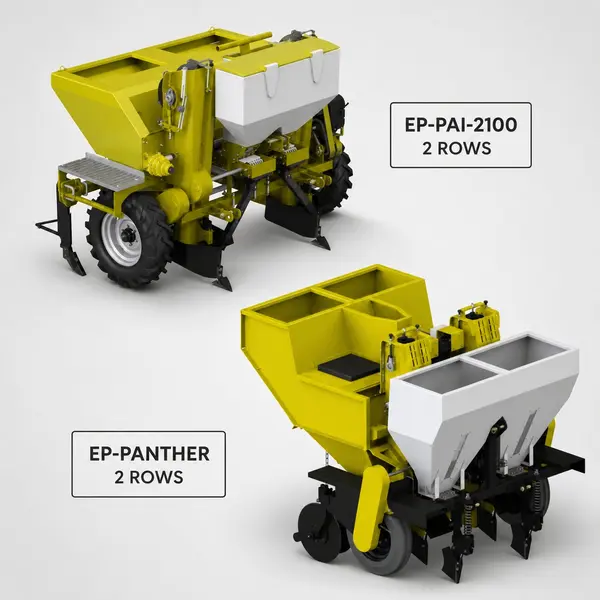
All potato planters share the same basic function: they take seed tubers from a hopper, deliver them individually to a coulter assembly that opens a slot in the ridge crest, and release the tuber into the slot at the correct depth. The mechanism that picks individual tubers from the hopper and delivers them to the coulter — the metering mechanism — is the primary differentiator between planter types and the component that most determines spacing accuracy, chit damage rate, and suitability for different seed sizes.
🥄 Cup-Type Metering Mechanism
The cup mechanism consists of a rotating belt or wheel carrying a series of individual cups — concave recesses sized to hold one seed tuber. As the belt rotates through the hopper, each cup picks up one tuber and carries it around the rotation cycle to the delivery point above the coulter. The cup releases the tuber, which falls into the furrow opened by the coulter below. Cup spacing on the belt determines seed spacing in the row — a cup every 28 cm of belt delivers seed every 28 cm in the field at a fixed belt speed relative to forward speed. Cup-type planters are the most widely used on small to medium farms because of their mechanical simplicity, their tolerance for irregular seed tuber shapes and sizes, and their ease of adjustment (changing seed spacing requires swapping the cup belt or adjusting the drive ratio).
Advantages
- ▸Handles irregular shapes
- ▸Simple maintenance
- ▸Wide seed size range
Limitations
- ▸Double-planting risk if small seed fits two per cup
- ▸Cup drop height may damage chits
⚙ Belt-Type Metering Mechanism
The belt mechanism uses a continuous flat belt with protruding fingers or cleats that agitate the seed tubers in the hopper and carry individual tubers forward to the delivery chute, from which they slide (rather than drop) into the furrow at a lower release velocity than a cup mechanism. The controlled slide-delivery significantly reduces chit damage on pre-sprouted seed because the tuber reaches the furrow at a lower speed and makes contact with the furrow wall at a lower impact angle. Belt planters typically operate at 30–40% higher forward speeds than cup planters for the same seed spacing — a throughput advantage on large farms — but are more sensitive to seed size variation and require seed grading to a narrower size range for consistent spacing accuracy.
Advantages
- ▸Lower chit damage on sprouted seed
- ▸Higher throughput speed
- ▸More consistent spacing
Limitations
- ▸Requires closer seed size grading
- ▸More complex adjustment
Seed Rate Calculation — Spacing, Row Pitch and Grade Distribution
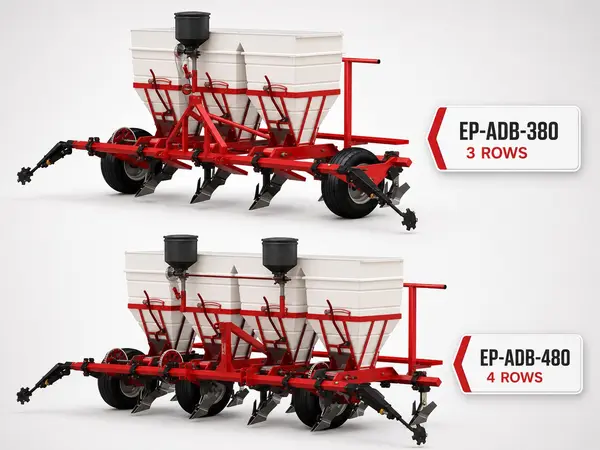
The seed rate — number of seed tubers planted per hectare — is not directly set on the planter. It is the mathematical consequence of two settings: the seed spacing along the row (set on the planter) and the row pitch (set by the furrower in the previous operation). Understanding this calculation before adjusting the seed spacing setting is essential, because the seed rate determines both the seed cost for the season and the expected tuber grade distribution at harvest — and these two consequences pull in opposite directions. Closer spacing raises seed cost and shifts the harvest grade towards smaller tubers; wider spacing reduces seed cost and shifts the harvest grade towards larger tubers, but increases the risk of missing the Grade 1 ware window at the top end.
Seed Rate Formula and Grade Distribution Matrix
Formula: Seeds/ha = 10,000 ÷ (row pitch in metres × seed spacing in metres)
| Seed Spacing |
Seeds/ha
750 mm pitch |
Expected Grade Shift |
Best Suited For |
| 22–25 सेमी |
53,000–61,000 |
More small tubers (35–55 mm) → seed grade |
Seed potato production |
| 28–32 सेमी |
41,700–47,600 |
Balanced distribution → ware Grade 1 peak |
Standard ware production ✓ |
| 35–40 cm |
33,300–38,100 |
More large tubers (70–100+ mm) → over-size risk |
Processing, crisping varieties |
The grade distribution consequence of spacing adjustment is not instant — it operates through competition for photosynthate between developing tubers. Closer spacing means more tubers competing for the same photosynthate supply per hectare; each individual tuber receives a smaller share → smaller final size. The total yield per hectare may be similar across a range of spacings, but the grade distribution — which determines the commercial value of the yield — shifts predictably with spacing.
The practical implication: the seed spacing adjustment on the planter is the primary agronomic lever for managing grade distribution to meet pack house specifications. A contract that requires a high proportion of 50–70 mm tubers (a typical fresh market ware specification) is best served by a moderate spacing of 28–32 cm on a 750 mm pitch. A seed production contract that pays a premium for 35–55 mm certified seed requires a closer spacing of 22–25 cm. Before each season, confirm the target grade specification with the pack house or seed merchant and set the planter spacing accordingly — the adjustment is made before any seed enters the ground and cannot be corrected afterwards.
Chitted vs Unchitted Seed — Drop Height, Speed and Chit Survival
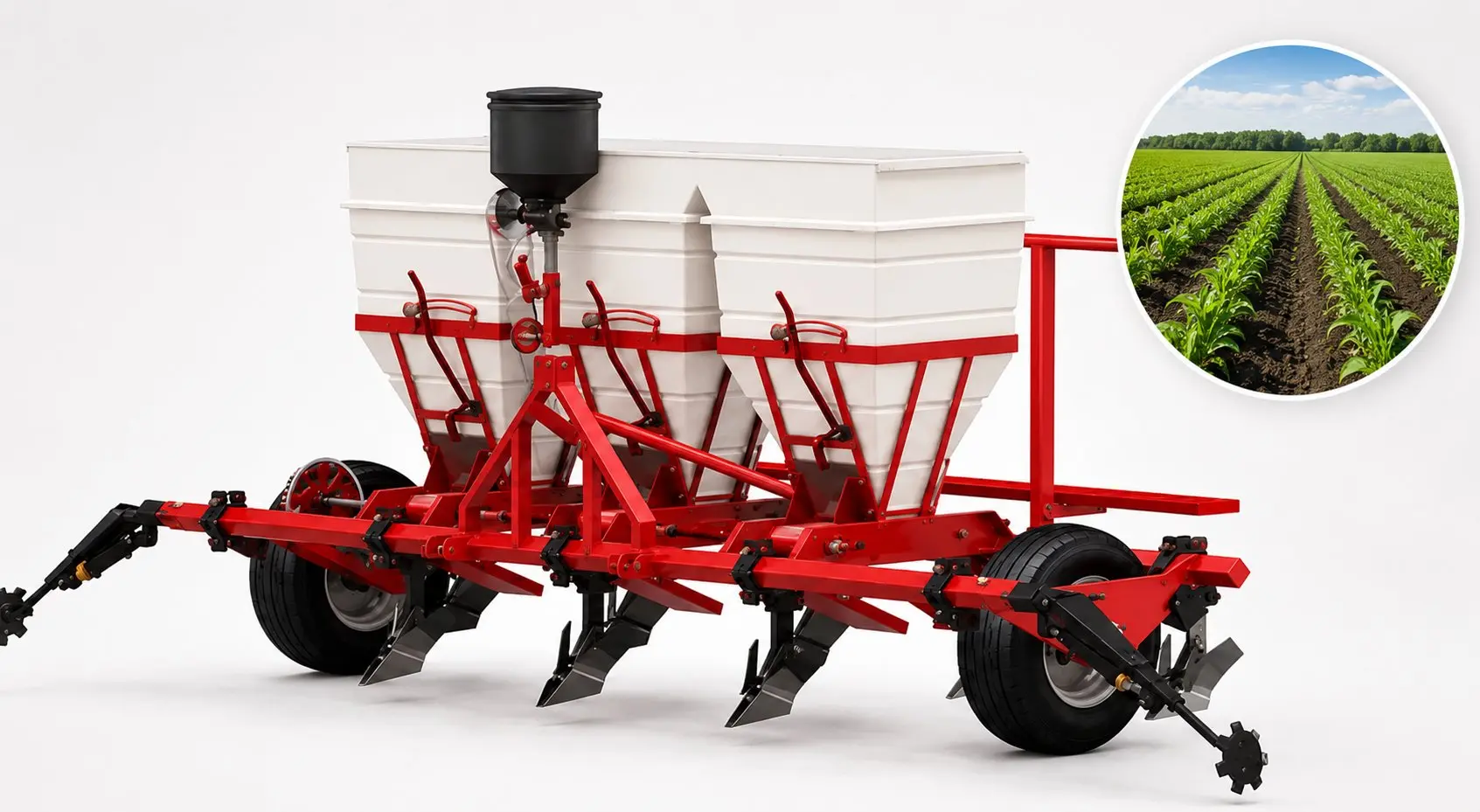
Pre-sprouting (chitting) is practised in UK and some Canadian potato production to advance the crop by 10–21 days relative to unchitted seed — by allowing sprouts (chits) to develop on the seed tuber before planting, the crop emerges faster, canopy closure is earlier, and the effective growing season is extended without changing the planting date. Each chit that survives planting intact produces one stem, and the number of stems per plant is the primary determinant of stolon count and therefore potential tuber set number. A four-chit seed tuber that is planted with all four chits intact produces significantly more stolons and sets more tubers than a four-chit tuber that loses two chits during planting and effectively becomes a two-stem plant.
The planter’s two primary chit damage mechanisms are drop height and forward speed. Drop height: in a cup-type planter, the seed tuber is released from the cup at the top of the coulter assembly and falls freely to the furrow bottom — a drop distance of 30–50 cm at typical coulter heights. A chitted tuber falling 40 cm onto a compacted furrow wall contacts the wall at approximately 2.8 m/s. At this velocity, chits longer than 10 mm are subjected to a bending force that exceeds their tensile strength and fractures them at the base. Forward speed amplifies this damage because higher forward speed causes the tuber to contact the forward wall of the furrow (rather than the base) at a higher approach angle — increasing the fracture force on any chit projecting forward relative to the planting direction.
①
Drop Height — The Primary Chit Damage Control
The vertical distance from the cup release point to the furrow bottom should not exceed 20–25 cm for chitted seed. Cup-type planters with long coulter assemblies may exceed this limit at standard settings. Where the coulter length allows it, raise the seed release point by installing a shorter intermediate chute section above the coulter entry. Some planters offer an adjustable baffle inside the coulter that reduces the effective drop height by providing a soft-contact intermediate surface. On belt-type planters, the slide-delivery mechanism inherently provides a lower delivery speed — belt planters are the preferred mechanism for chitted seed precisely because the tuber reaches the furrow via a controlled slide rather than a free fall.
Field check
After the first planting pass, excavate 20 consecutively-planted seed tubers and count the broken chit count. Acceptable: fewer than 1 broken chit per tuber on average. Above 1.5 broken chits per tuber: reduce forward speed by 0.3 km/h or address drop height before continuing.
2
Forward Speed — Chitted vs Unchitted Operating Range
Unchitted seed has no fragile projecting organs and can be planted at the full operating speed range of the planter (typically 4–7 km/h for a cup-type and up to 8 km/h for belt-type). Chitted seed with chits above 8 mm should be planted at 3–4 km/h on a cup-type planter to reduce the furrow-wall impact velocity. The throughput penalty — approximately 40–50% reduction in forward speed — is one reason some farms delay chitting until chit length is at a controlled stage (6–10 mm) immediately before planting, rather than allowing chits to develop to 20–30 mm in the chitting house before the planting date. Chit length at planting of 6–10 mm balances: early establishment advantage (shorter chit loses less time recovering from any impact damage before growing onwards) against chit survival rate (shorter chit has lower fracture moment at same impact velocity).
Unchitted Seed
4–7 km/h
cup-type; 5–8 belt-type
Chitted Seed (>8 mm)
3–4 किमी/घंटा
cup-type; 4–5 belt-type
Planting Depth — Emergence Uniformity and the Canopy Efficiency Argument
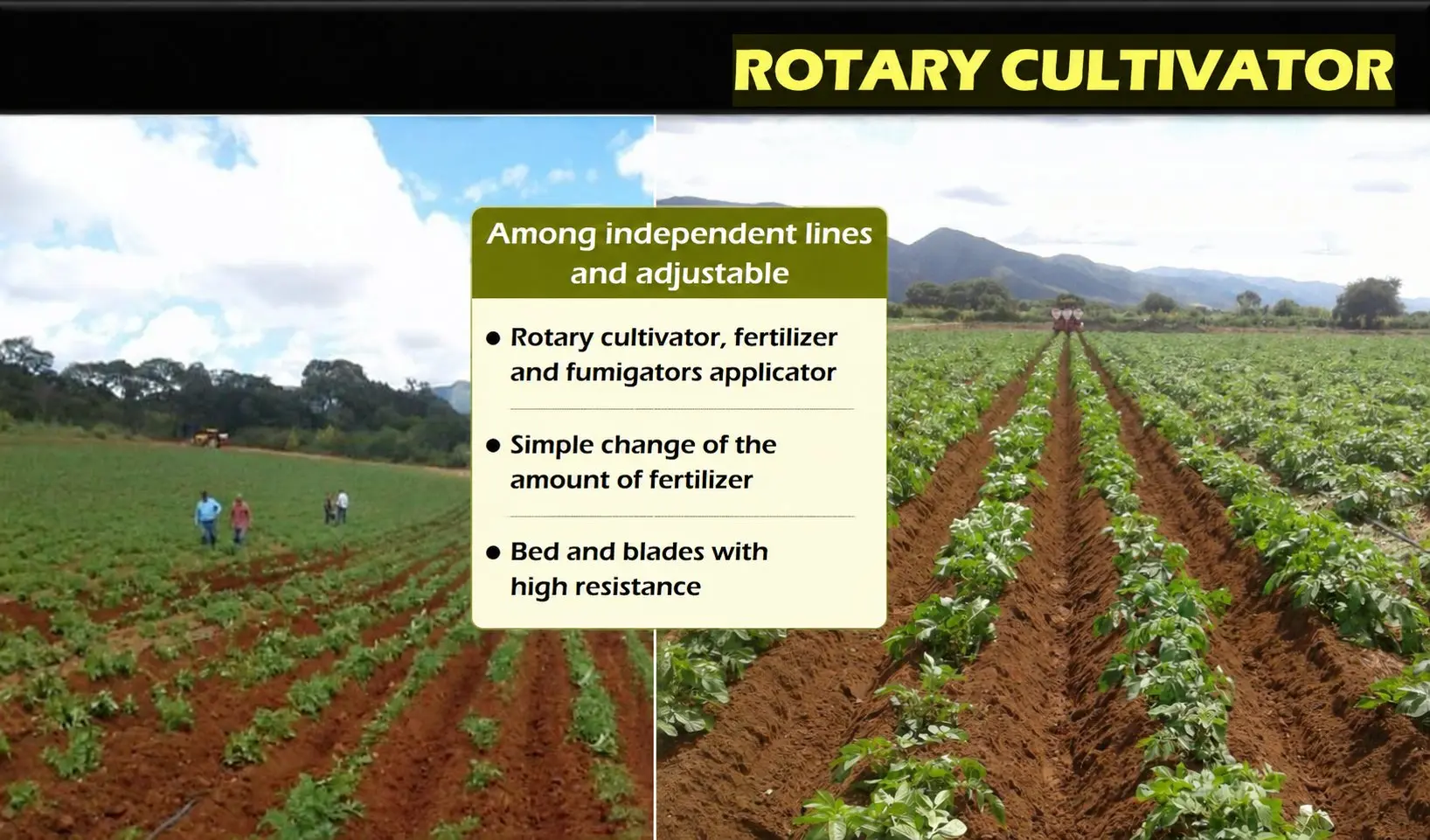
Planting depth accuracy — the degree to which every seed tuber is placed at a consistent depth below the ridge crest — is the most commercially consequential planter setting and the one most affected by seedbed quality. The target is ±1.5 cm around the specified depth for any cultivar and market (typically 8–14 cm below the ridge crest, with 10–12 cm being the most common specification for ware varieties). When the actual variation exceeds ±3 cm, the consequences cascade through the full growing season in a way that no subsequent management intervention can reverse.
The mechanism: seed tubers at different depths experience different soil temperatures in the spring establishment period. Soil temperature at 8 cm is typically 1–2°C warmer than at 14 cm in early spring, due to the faster surface warming of shallow soil layers. This temperature differential delays the onset of sprout growth in the deeper-set seed relative to the shallower. For every additional 1 cm of depth below 10 cm, emergence is delayed by approximately 1.5–3 days depending on soil type and spring temperature trajectory. A field where depth varies ±5 cm therefore shows an emergence spread of approximately 15–30 days — effectively three distinct emergence cohorts that form separate canopy layers.
| Depth Variation |
Emergence Spread |
Early fPAR Loss |
परिणाम |
| ±1.5 cm (target) |
3-5 दिन |
नगण्य |
Uniform canopy; minimal weed opportunity |
| ±3 cm |
8–12 days |
−8–12% |
Patchy canopy; increased weed intervention cost |
| ±5 cm or more |
15–30 days |
−20–30% |
Three emergence cohorts; severe harvest depth variation |
fPAR — The Canopy Efficiency Metric That Connects Planting Depth to Yield
The fraction of photosynthetically active radiation intercepted by the crop canopy (fPAR) is the primary determinant of total dry matter production during the linear growth phase (typically weeks 4–12 after emergence). A uniform canopy achieves full fPAR (close to 1.0) approximately 3–4 weeks after emergence of the last plant; a patchy, uneven canopy with a 15-day emergence spread may not achieve full fPAR until week 6–7 after first emergence — losing 2–3 weeks of maximum photosynthetic efficiency. Published AHDB Potato Programme data shows that each additional week of sub-maximum fPAR in the linear growth phase costs approximately 0.5–0.8 t/ha of final tuber yield at standard UK planting densities. The planting depth accuracy argument is not an agronomic refinement — it is a measurable yield and quality loss that traces directly back to whether the seedbed was in the correct condition to allow the planter coulter to penetrate consistently.
Seedbed Stone Management — Depth Accuracy Requires Stone-Free Fine Tilth
The planter’s coulter — the blade or disc that opens the slot in the ridge crest into which the seed tuber is placed — is the component most sensitive to seedbed stone content. A stone in the planting zone causes the coulter to deflect laterally by 1–5 cm depending on stone size and hardness, and vertically by 2–4 cm as the coulter tip rises over or drops into the void beside the stone. Each deflection event creates one incorrectly-placed seed tuber at a non-standard depth or lateral offset. On a stony seedbed where stone contacts average once every 3–5 running metres, a 750-metre field length at 750 mm row pitch has approximately 50–80 deflection events per row — meaning 7–11% of seed tubers are placed outside the depth specification before any machine wear or adjustment error is considered.
The pre-planting stone clearance sequence — THOR, CT-2100 permanent removal, BlackBird annual surface pass, and PSW-3200 rotavator fine-tilth creation — is the prerequisite that allows the planter to achieve ±1.5 cm depth accuracy consistently. Each machine in that pre-planting sequence can be cross-referenced to the Korea Watanabe चट्टान कोल्हू और पत्थर बीनने वाला specifications; the rotavator to the PSW-3200 रोटावेटर specification.
Coulter Deflection by Stone Size — Field Evidence
<25 mm Stone
Lateral deflection: ≤1 cm. Depth variation: ±0.5 cm. Consequence: within ±1.5 cm target — acceptable if stone concentration is low (<3/m²).
25–50 mm Stone
Lateral deflection: 2–3 cm. Depth variation: ±2–3 cm. Consequence: outside ±1.5 cm target — emergence spread begins. Clearance required at this size range.
>50 mm Stone
Lateral deflection: 3–6 cm. Depth variation: ±4–6 cm. Consequence: seed placed outside ridge zone in extreme cases — root damage, greening risk, harvest miss. THOR clearance mandatory before planting.
अक्सर पूछे जाने वाले प्रश्नों
क्यू
How should the planter be calibrated before the season to verify that the seed spacing setting delivers the target seed rate?
The calibration procedure for seed spacing accuracy: (1) Mark a 30-metre length of firm, flat ground with tape. (2) Drive the planter along the marked length at planting speed with the metering mechanism engaged and the seed hopper loaded. (3) Stop and measure the distance between consecutively-placed seed tubers at 10 randomly selected positions. (4) Calculate the mean spacing and compare against the target. If the mean spacing is more than ±2 cm from the target: adjust the drive ratio (chain sprocket selection on most models) until the target spacing is achieved. (5) Repeat with the specific seed size and weight that will be used in the field — seed rate calibration with a different-sized seed from the one planned will give inaccurate results because cup-fill efficiency changes with seed size. Calibration takes approximately 30 minutes and should be completed before entering the first field each season and repeated after any change in seed size grade.
क्यू
What causes double-planting (two tubers in the same cup position) and how is it diagnosed and corrected?
Double-planting in a cup-type planter occurs when seed tubers are small enough for two to fit in a single cup simultaneously. The primary cause is a mismatch between the cup size (which is fixed for a given cup belt) and the seed tuber grade: a cup designed for 45–55 mm seed will sometimes double-fill when planted with 30–40 mm seed, because the smaller seed leaves enough residual cup volume for a second tuber to partially enter. Diagnosis: after a planting pass, excavate 50 consecutively-planted positions and count the frequency of two tubers in the same position. More than 3–5% double-planting rate represents a meaningful seed cost waste. Correction options: (1) Change to a smaller cup size belt that matches the seed grade being planted. (2) Grade the seed to a narrower size range that consistently fills but does not overfill the existing cup size. (3) On belt-type planters, adjust the belt speed relative to forward speed to reduce the probability of simultaneous contact between two tubers and one belt slot. Most planter manufacturers publish a cup-size-to-seed-grade matching chart that should be consulted before beginning a season with a new seed size.
क्यू
Is there a meaningful agronomic difference between planting at 10 cm depth versus 14 cm depth, all other factors being equal?
Yes — a 4 cm depth difference produces measurably different outcomes in several areas: (1) Emergence speed: 10 cm depth emerges approximately 4–8 days earlier than 14 cm in UK spring conditions, which is commercially significant in short-season situations. (2) Greening risk: shallower planting (10 cm) places tubers closer to the ridge surface, increasing the risk of greening if the ridge erodes or is disturbed by heavy rainfall. A higher ridge (25+ cm) partially offsets this risk at shallow planting depth by maintaining adequate soil cover above the seed. (3) Tuber exposure to late blight spores: deeper-set tubers are further from the soil surface where late blight sporangia concentrate after foliar infection and wash-down, reducing late blight tuber infection incidence at 14 cm versus 10 cm in high-blight-pressure seasons. (4) Temperature in a cold spring: 14 cm soil is typically 1–2°C cooler than 10 cm in the early spring period, meaning seed set deeper emerges later AND may experience seed rot risk if spring temperatures are unusually cold. The standard recommendation — 10–12 cm depth in UK conditions for most ware varieties — balances these factors for average conditions; deviation from this range should be intentional rather than accidental.
क्यू
Can the potato planter be operated on the same tractor pass as the furrower, and if not, what is the minimum settlement time between the two operations?
Combining the furrower and planter in a single pass is practised on some operations — particularly on sandy free-draining soils in dry conditions — but is generally not recommended for clay-containing soils. The reason: a freshly-formed ridge has not had time to settle to its equilibrium bulk density. Immediately after furrowing, the ridge crest is at its lowest density (most loosely structured) — the disc action throws soil upward with kinetic energy that creates a temporarily loose structure at the crest that is above the target bulk density of 1.2–1.4 g/cm³. In this freshly-thrown state, the planting coulter encounters variable resistance: in very loose zones the coulter penetrates deeper than the gauge wheel setting; in zones with embedded clods or stones it deflects upward. The result is depth variation greater than the ±1.5 cm target even at correct gauge wheel settings. On sandy soils, this loose structure collapses rapidly (within 2–4 hours in warm, dry conditions) to a stable bulk density that allows the coulter to run consistently. On clay loam or clay soils, full settlement may take 12–24 hours after furrowing. The practical recommendation: where possible, allow 12–24 hours between furrowing and planting on clay-containing soils; same-day planting is acceptable on sandy soils only if the ridge has had at least 4–6 hours to settle before the planting pass begins.
क्यू
How does planting speed affect seed spacing accuracy, and what is the maximum speed before spacing error becomes commercially significant?
Spacing accuracy on a cup-type planter is a function of the ratio between cup belt speed and forward speed — and this ratio is maintained by the planting speed drive mechanism, which links the metering mechanism to the tractor’s PTO or a ground-drive wheel. For a correctly configured drive, spacing accuracy should be consistent across the planter’s operating speed range (typically 4–7 km/h) provided the metering mechanism is not being asked to operate faster than its mechanical capability. Where accuracy begins to deteriorate: (1) Cup-type planters show increased spacing irregularity above approximately 6 km/h because the cup must fill from the hopper, pass the brush stripper (that removes excess tubers), and release the tuber at the delivery point in a shorter time period — at speeds above 6 km/h, the fill-and-release cycle becomes marginal and occasional missed cups (empty cup positions) create gaps in the row at twice the nominal seed spacing. Gaps of 60–70 cm in the row (double-spacing events) are visible at canopy closure as windows of reduced density that allow weed breakthrough and reduce overall fPAR. (2) Belt-type planters have higher maximum operating speeds (up to 8 km/h) before spacing irregularity increases to commercially significant levels. The practical test for speed-related spacing errors: excavate 30 consecutive planted positions at each speed increment and measure the spacing variance. Increase speed in 0.5 km/h steps until the spacing variance (standard deviation of the measured spacings) exceeds 4 cm — that step is the practical speed limit for your seed size and planter configuration.
कोरिया वातानाबे आलू मशीनरी
Potato Planter — Specified for Your Seed, Row Pitch and Market Grade
Your seed size grade + row pitch + target spacing + chitted or unchitted + stone assessment → Korea Watanabe specifies the correct potato planter metering mechanism, cup size, coulter specification, and the complete pre-planting seedbed preparation programme.
कोरिया वतनबे रॉक क्रशर ट्रैक्टर कंपनी लिमिटेड · अंसन-सी, ग्योंगगी-डो
संपादक: सीएक्सएम