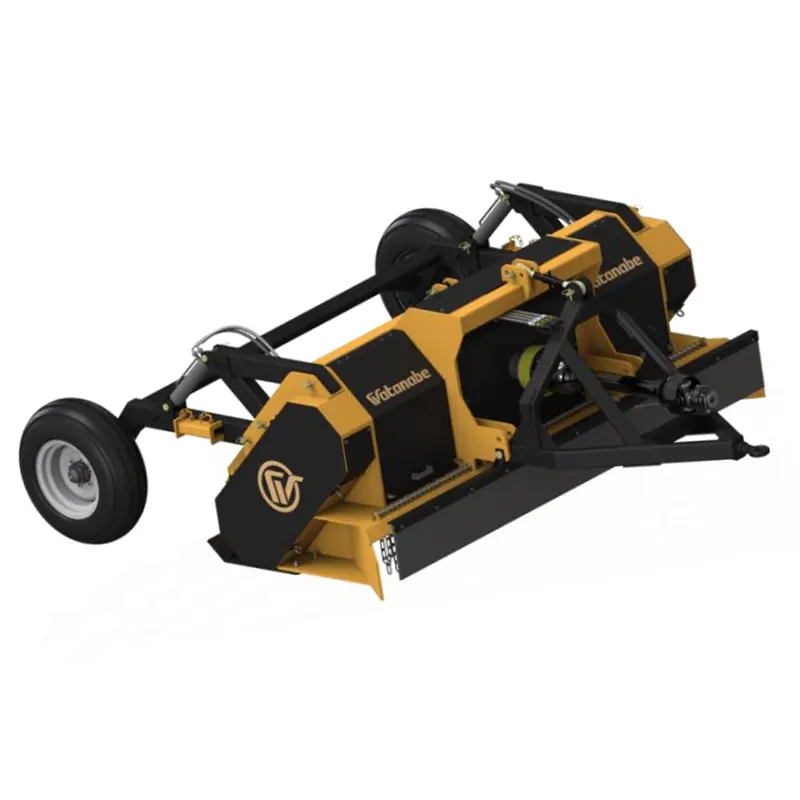
The Kit Drawbar is one of the most important features of the Watanabe Concasseur de pierres THOR 2.4 for Korean highland use — and one of the least understood by farmers who have not operated on slope terrain. Most stone crushers sold globally are designed for flat field operation: mounted on the rear three-point hitch, the machine is pushed forward by the tractor. This mounting configuration works well on flat ground. On Korean highland terraces at 15–35% gradient, it creates a tip-back stability problem that the Kit Drawbar specifically solves.
This guide explains the physics of the tip-back problem on slopes, how the Kit Drawbar converts the load path to eliminate that problem, when to switch between three-point-hitch mode and Kit Drawbar pull-mode, and what the gradient thresholds are for safe operation in each configuration on Korean highland terrain.
The Tip-Back Problem — Why Rear-Mount Stone Crushers Are Dangerous on Korean Slopes
When a 2,300 Kg stone crusher is mounted on a tractor’s rear three-point hitch, its weight is added to the rear axle load. On flat ground, the front axle remains on the ground because the front of the tractor and any front ballast counteracts the rear weight moment. The tractor remains stable because the combined centre of gravity of the tractor-plus-implement system falls between the front and rear axle contact points.
On an uphill slope, the geometry changes. The gradient tilts the tractor and implement system backward — moving the effective centre of gravity toward the rear axle. As slope angle increases, there comes a point where the centre of gravity moves behind the rear axle contact point — the tractor begins to tip backward. This is the tip-back threshold, and it can be reached at surprisingly modest slope angles when a heavy rear implement is involved:
Korean highland terrace fields — particularly in Taebaek, Jeongseon, Pyeongchang, and the ginseng-growing highland zones of North Gyeongsang — regularly feature individual terrace slopes of 15–35%. Farmers who have attempted to operate conventional rear-mounted stone crushers on these slopes report front-axle lift events (front wheels coming off the ground during uphill passes), steering loss (front wheels off the ground provide no steering), and in worst cases, tractor tip-back with the implement acting as the fulcrum. These events cause machine damage, field damage, and serious operator injury risk.
How the Kit Drawbar Works — Converting Rear-Push to Drawbar-Pull
The Kit Drawbar converts the THOR 2.4 from rear three-point-hitch mounting to drawbar tow. In this configuration, the THOR is no longer mounted on the tractor’s rear hitch links — it rests on its own ground wheels (the Kit Drawbar wheels) and is connected to the tractor’s drawbar point. The PTO shaft still transmits power from the tractor to the THOR rotor. The fundamental change is the load path:
Rear three-point-hitch (standard mounting)
THOR weight is a moment arm acting on the tractor rear axle. On uphill slopes, this moment arm attempts to rotate the tractor backward around the rear axle contact point — tipping the front of the tractor upward. The longer the implement and the heavier it is, the greater the tipping moment at any given slope angle.
Kit Drawbar pull-mode
THOR weight rests on the Kit Drawbar wheels, which are on the ground behind and below the tractor. The drawbar connection point transmits only the forward towing force (horizontal draft) — not a vertical lifting moment. The THOR weight no longer loads the tractor’s rear axle. The front axle retains full ground contact and steering authority. On uphill slopes, the drawbar pull force actually pushes the tractor’s front axle into the ground rather than lifting it — the opposite of the rear-mount tip-back tendency.
This load path reversal is why the Kit Drawbar is not merely a convenience feature — it is a fundamental change in the machine’s slope stability physics. A tractor that could not safely operate the THOR 2.4 in rear-mount mode on a 20% slope can operate it safely in Kit Drawbar mode on the same slope, because the stability-threatening load path has been eliminated.
When to Use Each Mode — Decision Guide for Korean Highland Operators
| Conditions de terrain | 3PH Rear-Mount | Kit Drawbar Pull-Mode |
|---|---|---|
| Flat field (0–8% slope) | ✅ Standard mode | Acceptable but no advantage |
| Gentle slope (8–12%) | ⚠ Adequate with front ballast | ✅ Recommended |
| Moderate slope (12–20%) | ❌ Dangerous — not recommended | ✅ Obligatoire |
| Steep slope (20–35%) | ⛔ Must not operate | ✅ Standard mode for steep terraces |
| Road transport between fields | ✅ Preferred for short-distance road moves | Acceptable for transport |
| Working in confined terrace width | ✅ Shorter overall machine length | ⚠ Longer overall — confirm terrace width |
Switching Between Modes — Field Procedure
On Korean highland farms where the same THOR 2.4 must work both flat access road sections and steep terrace sections on the same day, mode switching between three-point-hitch mount and Kit Drawbar pull-mode must be performed efficiently and correctly. The procedure:
Move to a flat, stable surface to perform the mode switch — not on the slope itself. Lower the THOR to its resting position on the ground.
Disengage the PTO. Remove the PTO shaft from the tractor PTO stub. Place the PTO shaft in the rest position (secured to the machine frame — never allow it to drag on the ground).
Disconnect the three lower hitch links from the THOR mounting brackets. Lower the three-point-hitch links to the lowered rest position out of the way.
Deploy the Kit Drawbar wheels from their transport position (folded up) to working position (supporting the machine weight). Confirm the Kit Drawbar wheel height setting provides the correct working depth for the field conditions.
Connect the drawbar hitch pin from the tractor drawbar to the THOR Kit Drawbar tow point. Confirm pin secured with retaining clip.
Reconnect the PTO shaft to the tractor PTO stub. Confirm PTO shaft length is within operating range for the Kit Drawbar geometry — the longer distance from tractor to THOR in pull-mode may require an extended PTO shaft. Confirm with the THOR operator manual for your specific configuration.
Kit Drawbar pull-mode ready. Confirm by forward-moving 5 metres on level ground and checking THOR tracking and PTO shaft operation before entering the slope.
Measuring Slope Gradient on Korean Highland Fields
Korean highland farmers who are unsure whether their field slope requires Kit Drawbar mode can measure it simply before starting work. Slope gradient (expressed as percentage) is the vertical rise divided by horizontal run, multiplied by 100:
Simple field slope measurement method:
THOR 3.0 and Kit Drawbar — The Same Principle at 2,800 Kg
Le THOR 3.0 (230 HP, 3.0 m, 2,800 Kg) has the same Kit Drawbar capability as the THOR 2.4, but its 500 Kg additional weight means the tip-back threshold on slopes is reached at slightly lower gradients than for the THOR 2.4. The slope thresholds in the table above apply with a conservative 2–3% downward adjustment for the THOR 3.0 — meaning the 12% Kit Drawbar recommendation for the THOR 2.4 effectively becomes 9–10% for the THOR 3.0.
Additionally, the THOR 3.0’s larger working width (3.0 m vs 2.4 m) and longer overall machine length in Kit Drawbar configuration requires confirming that the Korean highland terrace width is sufficient to accommodate the full machine width plus appropriate side clearances to terrace walls and field boundaries. Confirm terrace width and Kit Drawbar clearance requirements with Korea Watanabe before ordering the THOR 3.0 for slope terrace use.
Kit Drawbar and Orchard Slope Operations — Additional Applications
Beyond highland potato and vegetable field clearing, the Kit Drawbar configuration also serves orchard slope clearing operations — apple, pear, and persimmon orchards planted on terraced Korean hillsides require annual alley stone management on slopes that are equally problematic for rear-mounted implements. For orchard operations on slopes above 12%, the Kit Drawbar mode is the standard working configuration — allowing the THOR stone crusher range to access the full slope gradient of the orchard terrace rather than being restricted to the lower sections accessible in rear-mount mode.
The Kit Drawbar’s secondary benefit in orchard operations is its reduced overall height in working position compared to the rear-mount configuration, which can be relevant for orchards with low-hanging branch canopies. In rear-mount mode, the THOR’s raised position when transported between rows can contact low branches. In Kit Drawbar mode, the machine sits lower and further behind the tractor, reducing the risk of branch contact during inter-row access moves.
Korean ginseng production land also benefits significantly from Kit Drawbar mode on sloped fields. Ginseng growing areas in the highland zones of North Gyeongsang and southern Gangwon-do are frequently on sloped land (10–25%) where the multi-year ginseng bed preparation requires thorough stone clearing — precisely the zero-residual standard that the THOR 2.4 at correct depth provides, and precisely the slope terrain where Kit Drawbar mode is required for safe operation. The Kit Drawbar is therefore as important for highland ginseng land clearance as for highland vegetable production.
Foire aux questions
Does the Kit Drawbar affect the THOR’s stone crushing performance?
No — the Kit Drawbar pull-mode does not affect the THOR’s stone crushing performance. The rotor still receives the same 1000 RPM PTO power from the tractor via the PTO shaft (now extended by the drawbar distance), the rotor speed and tip energy remain identical, and the hood adjustment controls the same fragment size output as in rear-mount mode. The only operational difference is in the working depth control: in rear-mount mode, working depth is controlled by the tractor’s three-point hitch position. In Kit Drawbar pull-mode, working depth is controlled by the Kit Drawbar wheel height setting (a mechanical depth-stop that maintains the rotor at the set depth below the Kit Drawbar wheel level). Working depth in Kit Drawbar mode is set before the working pass begins, and adjusted by stopping, resetting the wheel height, and continuing — unlike rear-mount mode where the tractor operator can adjust depth on-the-go from the cab. This minor operational difference in depth control has no effect on crushing performance.
Is the Kit Drawbar included as standard with the THOR 2.4, or is it a separate purchase?
The Kit Drawbar is included as standard with every THOR 2.4 supplied through Korea Watanabe — it is not an optional extra or separate purchase. This is a deliberate decision reflecting the reality of Korean highland farming conditions: the majority of Korean highland land suitable for stone clearing has sections at slope angles that require Kit Drawbar operation. Supplying the THOR 2.4 without the Kit Drawbar would leave most Korean highland buyers unable to access a significant portion of their fields safely. The Kit Drawbar is part of the THOR 2.4’s standard specification for the Korean market — its inclusion is one of the features that Korea Watanabe has established as standard for Korean highland use, recognising that it is not optional for the Korean terrain context even if it may be optional in flatter European or South American agricultural contexts.
Can I operate the THOR 2.4 on cross-slope terraces (operating across the slope face rather than up-and-down)?
Cross-slope operation (traversing the slope face horizontally) presents a different stability risk — side-slope rollover rather than tip-back. Both rear-mount and Kit Drawbar mode create additional lateral instability on cross-slope operation compared to up-and-down slope operation, because the machine’s mass is offset from the tractor’s longitudinal axis when operating across a side slope. For cross-slope operation on slopes above 8–10%, the tractor’s stability limit on side slopes is typically lower than the up-slope tip-back limit — meaning cross-slope limits are more restrictive. Korean highland terrace fields where rows run along the contour (cross-slope rows) require particular attention to tractor side-slope stability limits. Consult the tractor’s operator manual for the side-slope stability angle limit, and confirm that the field gradient does not exceed that limit before operating across the slope face rather than up and down it.
What is the maximum slope angle for safe THOR 2.4 Kit Drawbar operation?
The practical maximum slope for THOR 2.4 Kit Drawbar operation on Korean highland terrain is approximately 30–35% (approximately 17–19 degrees). Above this gradient, tractor traction and stability considerations become limiting — the tractor itself may not maintain adequate drive wheel traction on steep, potentially muddy spring granite soil, regardless of the THOR mounting configuration. Additionally, Kit Drawbar operation on very steep slopes (above 30%) can create a situation where the Kit Drawbar wheels dig into the slope surface on downhill passes — requiring additional care in approach angle and working speed. Korea Watanabe recommends confirming with your tractor dealer the maximum operating slope angle for your specific tractor model in agricultural field conditions before operating the THOR 2.4 on slopes approaching 25–30%.
How much time does mode-switching between rear-mount and Kit Drawbar take in the field?
An experienced Korean highland THOR operator can complete the mode-switch from rear-mount to Kit Drawbar (or back) in approximately 10–15 minutes per switch — once the procedure has been practiced and the required tools (hitch pin, retaining clip tool) are kept in the tractor cab for immediate access. For farms where most field sections require Kit Drawbar mode (predominantly sloped land), operators typically deploy in Kit Drawbar mode for the entire working day and transport to and from the field in that configuration — avoiding the need for frequent mode switches. For farms with mixed flat and sloped sections, scheduling the flat-section work together and the slope sections together minimises the total number of mode switches per working day. In either case, the 10–15 minute switch time is a minor fraction of a full working day — it does not represent a meaningful operational constraint for typical Korean highland stone clearing schedules.
What Slope Is Your Field? — Kit Drawbar Configuration Consultation
Maximum field slope (%) + tractor model + field width → Kit Drawbar vs rear-mount recommendation with PTO shaft extension requirement and working depth setup guidance. Korea Watanabe, Ansan-si, Gyeonggi-do.
Éditeur : Cxm