
A potato digger that works flawlessly in sandy loam can become completely unmanageable in clay — not because anything has broken, but because clay soil’s physical and chemical properties create a completely different interaction with the elevator chain than any other soil type. Farmers who discover this mid-harvest, with a blocked elevator chain, a severed shear bolt, and a trailer half-filled with clay-covered potatoes that cannot get to the field, face one of the most frustrating and expensive single machinery problems in the potato calendar. Understanding why clay blocks and what changes — in the machine, in the soil, and in the timing — prevent it from blocking is the knowledge that separates a harvested crop from a crisis.
This guide works through the clay blockage mechanism from first principles, identifies the six most common specific causes, and provides a priority-ordered set of fixes — from the immediate adjustments that can change the situation in the next 100 metres of travel to the pre-season decisions that determine whether the field is harvested that day at all.
How Clay Soil Creates Elevator Blockage — The Chemistry of Adhesion
Clay blockage is not simply a matter of too much soil arriving on the chain. It is a different type of soil-chain interaction driven by clay’s unique physical properties. Clay minerals are phyllosilicates — sheet-structured aluminium silicate compounds (kaolinite, illite, smectite) whose particle geometry is plate-shaped rather than spherical. These plates have electrochemical charges on their surfaces and edges that create both inter-particle attraction (clay particles stick to each other) and adhesion to other charged surfaces — including steel. When wet clay contacts a steel elevator rod, some of the clay particles adhere electrostatically rather than sliding off under gravity. As the chain carries these adhered clay particles forward, more clay contacts the adhered layer, building up a film that eventually spans the gap between adjacent rods. This is the “soil bridge” or “arch” that creates blockage: once a clay film spans a rod gap, further clay cannot pass through the gap, and instead presses against the bridge from behind. Within a few seconds, a multi-rod clay arch forms that the chain cannot pull through — the chain drive system stalls, and either the shear bolt severs to protect the gearbox or, in the absence of a correctly specified shear bolt, the chain or drive components sustain damage.
This mechanism is moisture-dependent: dry clay has lower particle surface charge activity and is less adhesive to steel. As clay approaches field capacity (the moisture content at which water just fills all soil pores), adhesion to steel surfaces reaches its maximum. Above field capacity (waterlogged conditions), adhesion actually decreases slightly as the free water lubricates the clay-steel interface — but at this moisture level the clay flows rather than separates, producing a different problem (soil carry-over onto the crop) without necessarily causing a hard blockage. The practical worst case for elevator blockage is clay at approximately 80–95% of field capacity — moist enough to be highly adhesive but not so wet as to be self-lubricating. This is the condition that typically applies in the day immediately after rainfall or in a field that drains slowly — and it is the condition that makes harvesting on that day the decision that determines whether the day is productive or a mechanical rescue operation.
Six Most Common Clay Blockage Causes — Diagnosis and Priority Order
Chain Speed on Clay — The Balance Between Blockage Prevention and Tuber Bruise
The most common operator response to clay blockage is to increase chain speed — and this is sometimes the correct response. But it is the second adjustment to make, not the first, and there is a ceiling beyond which increasing chain speed creates a different quality problem without solving the blockage. The correct adjustment sequence for clay conditions is strictly ordered:
The fundamental tension between anti-blockage chain speed and bruise-limiting chain speed is real and cannot be fully resolved by machine settings alone when the soil is too wet. This is why soil moisture timing is discussed last in the adjustment sequence but is actually the most important decision of the day: the operator who checks soil moisture before entering the field avoids both blockage and excessive bruise risk simultaneously.
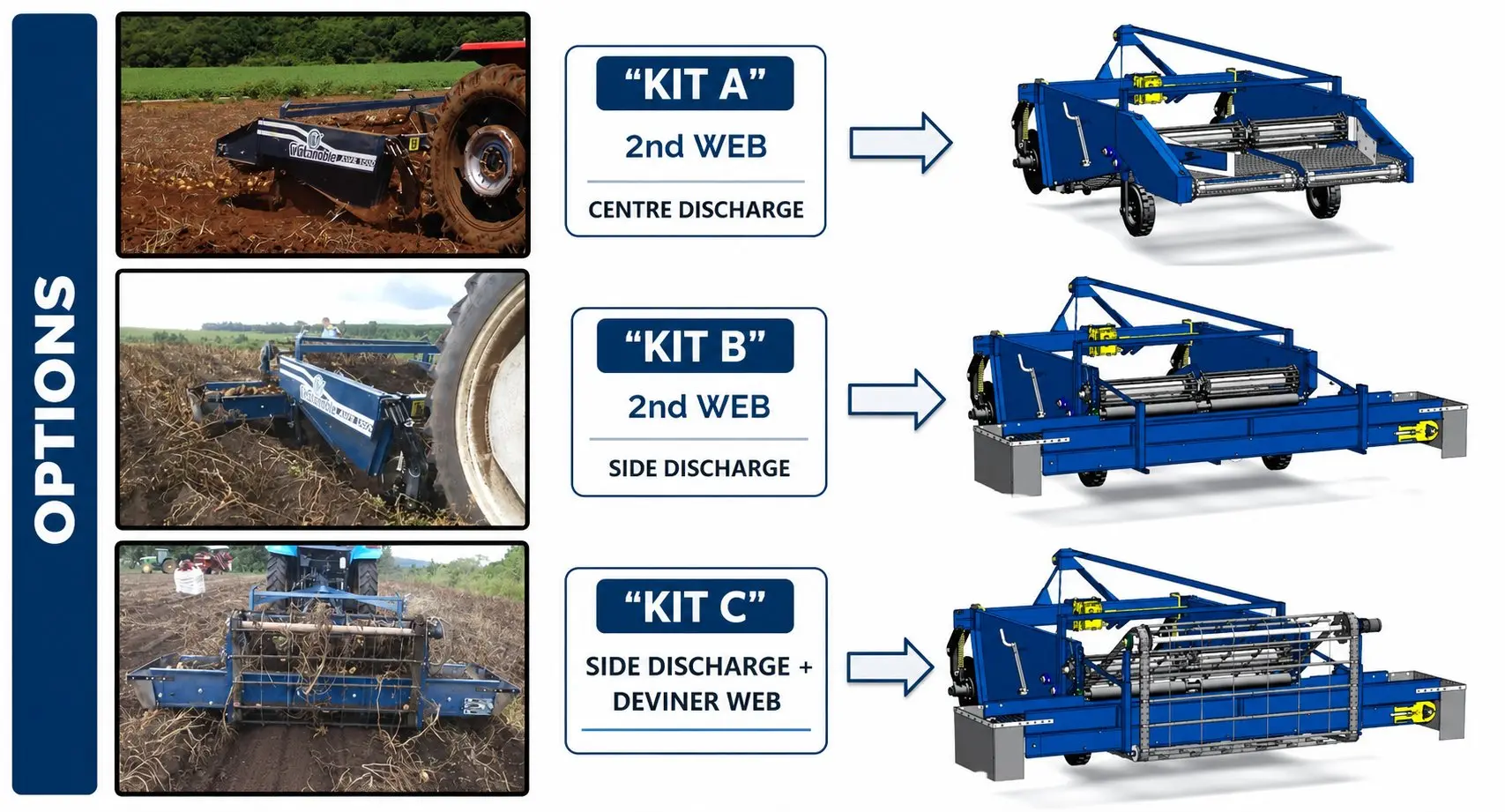
Agitation Bars, Anti-Clog Devices, and Hardware Modifications
Where clay conditions are a recurring feature of a field or farm — not a seasonal exception but an annual challenge — hardware modifications to the elevator system can reduce the frequency and severity of blockage events. These modifications do not substitute for correct operating settings or correct harvest timing, but they extend the range of clay conditions within which the digger can operate acceptably.
Agitation bars are cross-bars mounted transversely on the elevator chain frame (not on the chain itself — they are fixed to the side walls or intermediate supports of the elevator section). As the chain moves, clay bridging across the rod gaps is disrupted by the fixed agitation bars, which physically shear the clay bridges before they fully span the rod spacing. Most diggers are supplied with a base agitation bar set designed for sandy-loam conditions. For heavy clay, the manufacturer’s maximum agitation bar configuration should be fitted — typically 2–3 additional bars added to the lower half of the elevator where clay bridges form most readily. Fitting more bars than the manufacturer specifies risks reducing clearance and creating alternative blocking points; stay within the machine’s specified range.
Rubber-tip wipers are flexible rubber fingers or strips fitted to the underside of the elevator frame, positioned so that they contact the steel rods as they pass at the bottom of the chain’s return loop. Their function is to mechanically scrape clay that has adhered to the rod surface during the elevator pass before the rod returns to the receiving end of the chain. Without wipers, a clay film builds up progressively on the rods across the harvest day; with wipers, each rod returns to the entry point cleaned of most adhered clay. Wipers are a low-cost, retrofit modification widely used in UK heavy land potato country and are available from most agricultural engineering suppliers as aftermarket accessories.
Hydraulic agitation systems — available on some higher-specification trailed diggers and harvesters — provide an oscillating or vibrating secondary bar arrangement that actively disrupts clay bridges at a frequency matched to the chain speed. These systems are most effective on the heaviest clay soils (Flevoland polder clay, East Anglian chalky boulder clay, West Flemish maritime clay) where static agitation bars are insufficient. They add mechanical complexity and are not necessary for moderate heavy land — but for farms that regularly harvest very heavy, moist clay, the investment in a machine with hydraulic agitation is often recovered in reduced blockage downtime within two seasons.
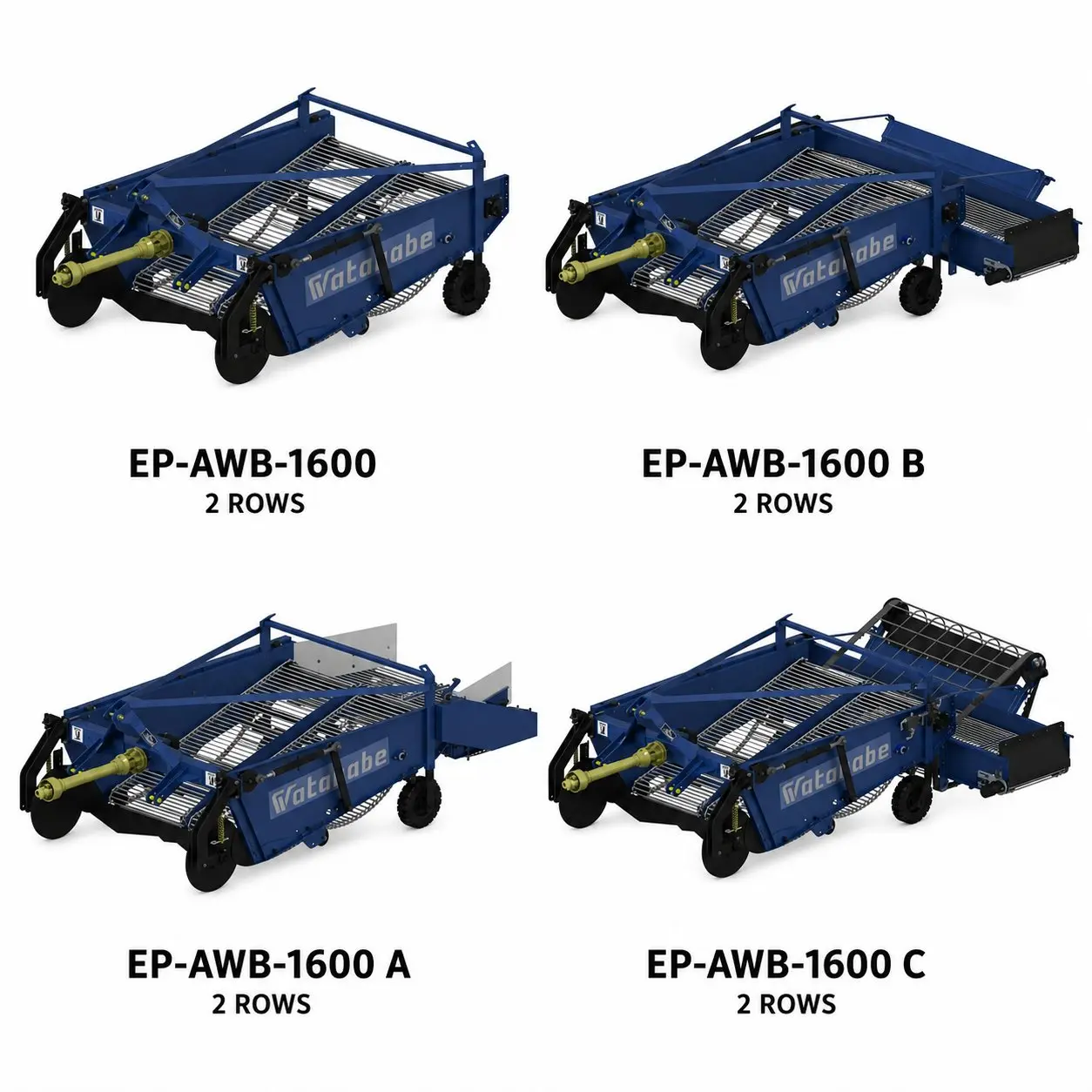
For enquiries on potato digger configurations with heavy land agitation options, Korea Watanabe can confirm agitation bar specifications and compatibility for each machine in the range.
Soil Moisture Timing — The Field Tests That Make the Go or No-Go Decision
No combination of machine settings produces acceptable elevator performance in clay soil at or above field capacity. The soil moisture decision — made before the tractor enters the field, not after the first blockage confirms the problem — is the single most important clay-blockage prevention measure available. Two field tests, requiring no specialist equipment, provide reliable go/no-go moisture assessment for clay soils.
After significant rainfall on clay soils, the waiting period before harvest conditions become acceptable typically ranges from 3–5 days in warm, dry, windy conditions to 7–10 days in cool, overcast conditions. Penetrometer testing at 25 cm depth provides quantitative confirmation: readings above 1.0 MPa at digging depth typically indicate acceptable clay moisture for digger operation; readings below 0.8 MPa indicate high blockage risk. These thresholds vary by clay type and should be calibrated against actual harvest experience on each specific field for the first season, then used as the site-specific threshold in subsequent years.
الأسئلة الشائعة
▶The digger works fine for the first two hours on clay then starts blocking every 20 minutes — what is causing the pattern?
This time-progressive pattern is one of the most common clay blockage presentations and has three possible causes operating simultaneously. First: chain tension decreases as the chain warms and stretches slightly under load — a chain that is correctly tensioned at the start of the day can be 5–10 mm loose by mid-morning, creating the slack that allows clay accumulation. Check and re-tension every 2–3 hours in clay conditions. Second: soil moisture in the field is not uniform — the low-lying or north-facing areas that were still moist at the start of the day become the areas where the digger reaches after the first two hours’ progress. The moisture variation across a clay field can be significant enough to take conditions from acceptable to problematic within a single field. Third: the digger’s agitation bars and wipers accumulate their own clay build-up during the first two hours, reducing their effectiveness progressively. Stop at the two-hour mark, check the bar and wiper condition, clear any clay from the bar faces, and re-tension the chain before continuing.
▶Should I increase chain speed or decrease forward speed when clay starts building on the elevator — which is more effective?
Decrease forward speed first — this is consistently more effective as a first response. The reason: increasing chain speed moves clay that is already on the elevator faster, but does not reduce the rate of new clay arriving. If the rate of clay arrival exceeds the chain’s clearing rate, increasing chain speed only delays the blockage event rather than preventing it. Reducing forward speed directly reduces the rate of arrival — delivering less clay per unit time gives the existing chain capacity and speed adequate time to process the load before the next batch arrives. In practice, halving forward speed (from 4 km/h to 2 km/h) typically doubles the chain’s available processing time per unit of clay delivered, which is the equivalent of doubling chain speed without the tuber bruise penalty. Once forward speed is at the minimum practical level (typically 1.5–2 km/h — slower creates other problems including ridge collapse and uneven digging), a moderate chain speed increase is the correct second adjustment.
▶Does a riddle frame separator perform better or worse than star wheels in clay blockage conditions?
Star wheels perform better in clay for the separator function (final separation of adhered clay from tubers) because their active rotation physically breaks clay aggregates that have survived the elevator. However, the blockage problem on clay occurs primarily in the elevator section — before the separator — where neither star wheels nor riddle frames are present. The separator type is therefore secondary to the elevator design for clay blockage prevention: a machine with excellent star wheel separation can still block in the elevator section if the clay is too wet. The elevator design — rod spacing, agitation bar number and position, chain speed range — is the relevant specification for clay blockage tolerance. For separator selection on clay soils, star wheels are strongly preferred for the separation quality reason; for elevator design, the relevant specifications are rod spacing (wider = less bridging risk; 30–35 mm preferred for heavy clay) and agitation bar provision.
▶Can a stone management programme reduce clay blockage as well as stone damage?
Not directly — stone management removes stones from the soil profile but does not change the clay mineral content or moisture behaviour of the clay fraction. However, there is an indirect connection: on soils that are both clay-heavy and stony (some Scottish black soils, chalky boulder clay in East Anglia, some Midlands clay fields with periglacial stone), the stones in the elevator stream act as natural agitation agents — tumbling against clay aggregates on the chain and helping break them apart. Removing all stones through an aggressive stone clearance programme on such soils can, paradoxically, slightly reduce natural agitation and increase pure clay blockage tendency, because the agitation contribution of the stones is eliminated. In practice this effect is small compared to the machinery damage and safety benefits of stone removal, and the solution — fitting additional agitation bars after stone clearance on clay fields — is straightforward. The recommendation: proceed with stone clearance on any soil type where stone density warrants it, then assess agitation bar configuration in the first post-clearance harvest season and add bars if clay separation performance has declined.
▶Is there a shear bolt specification guidance for clay soil to prevent chain damage when blockage does occur?
Yes — the shear bolt (or shear pin) fitted in the digger’s PTO drive line is specifically designed to fail before the chain, gearbox, or drive shaft sustains damage when a blockage occurs. The shear bolt’s failure torque must be correctly specified: too strong, and the chain or gearbox is damaged before the shear bolt fails; too weak, and it fails unnecessarily under normal heavy-soil operating loads (not just blockage events). Most manufacturers specify shear bolt grade and diameter for standard soil conditions, and a separate specification for heavy clay/high-torque conditions. In clay country, fitting the manufacturer’s heavy-soil shear bolt specification — not a generic substitute — is strongly recommended, because the clay blockage event produces a torque spike that can be significantly above normal operation but below the chain’s damage threshold; the correctly specified bolt will intercept this event. Carrying a stock of the correct shear bolt (and the tools to replace it in the field within 5 minutes) is standard practice for any UK or Belgian clay-country potato operation — budget for 2–3 shear bolt events per harvest season on heavy clay.
Clay Blockage on Your Farm?
Share your soil type, clay fraction estimate, current agitation bar configuration, and typical harvest moisture. Korea Watanabe will confirm the correct agitation specification and chain settings for your حفار بطاطس on heavy land.
شركة كوريا واتانابي لكسارة الصخور المحدودة - أنسان سي، جيونجي دو
المحرر: Cxm