EP-DESTROYER堆肥棚曝气机 – 2米和3米,75-80马力
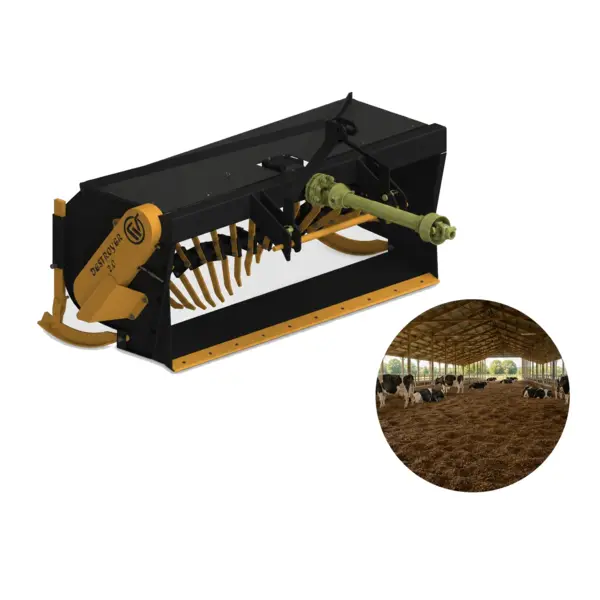
Turns and aerates compost barn bedding to 80 cm depth — deep enough to reach the active fermentation zone and restore full aerobic activity. Daily aeration keeps bedding dry, ammonia under control, and cattle comfortable.
Available in 2 m (75 HP, 460 Kg) and 3 m (80 HP, 660 Kg). Category 2 hitch, PTO 540 RPM. Designed for regular operation inside livestock barns.
Keep the Fermentation Working — Dry Bedding, Low Ammonia, Comfortable Animals
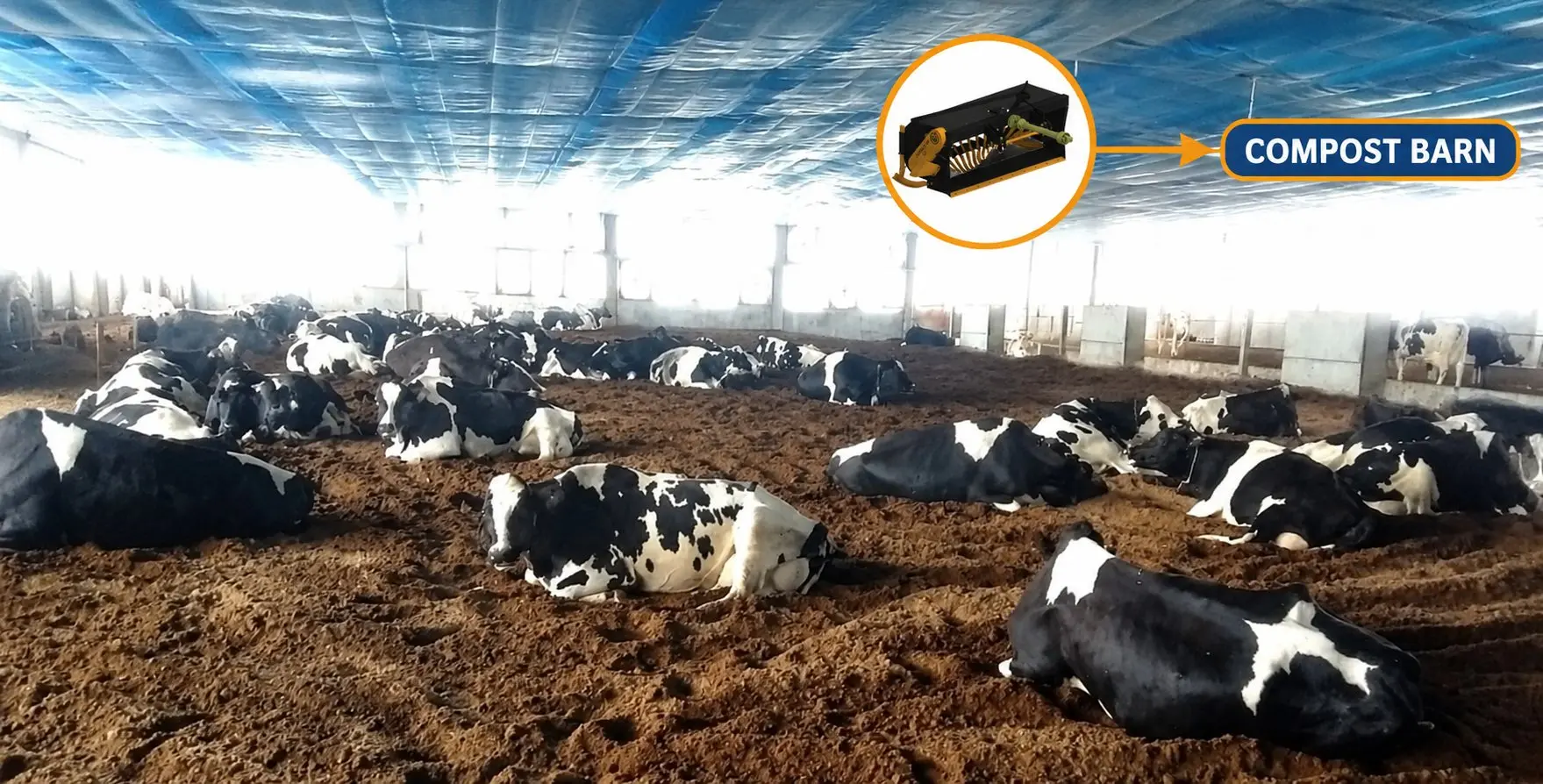
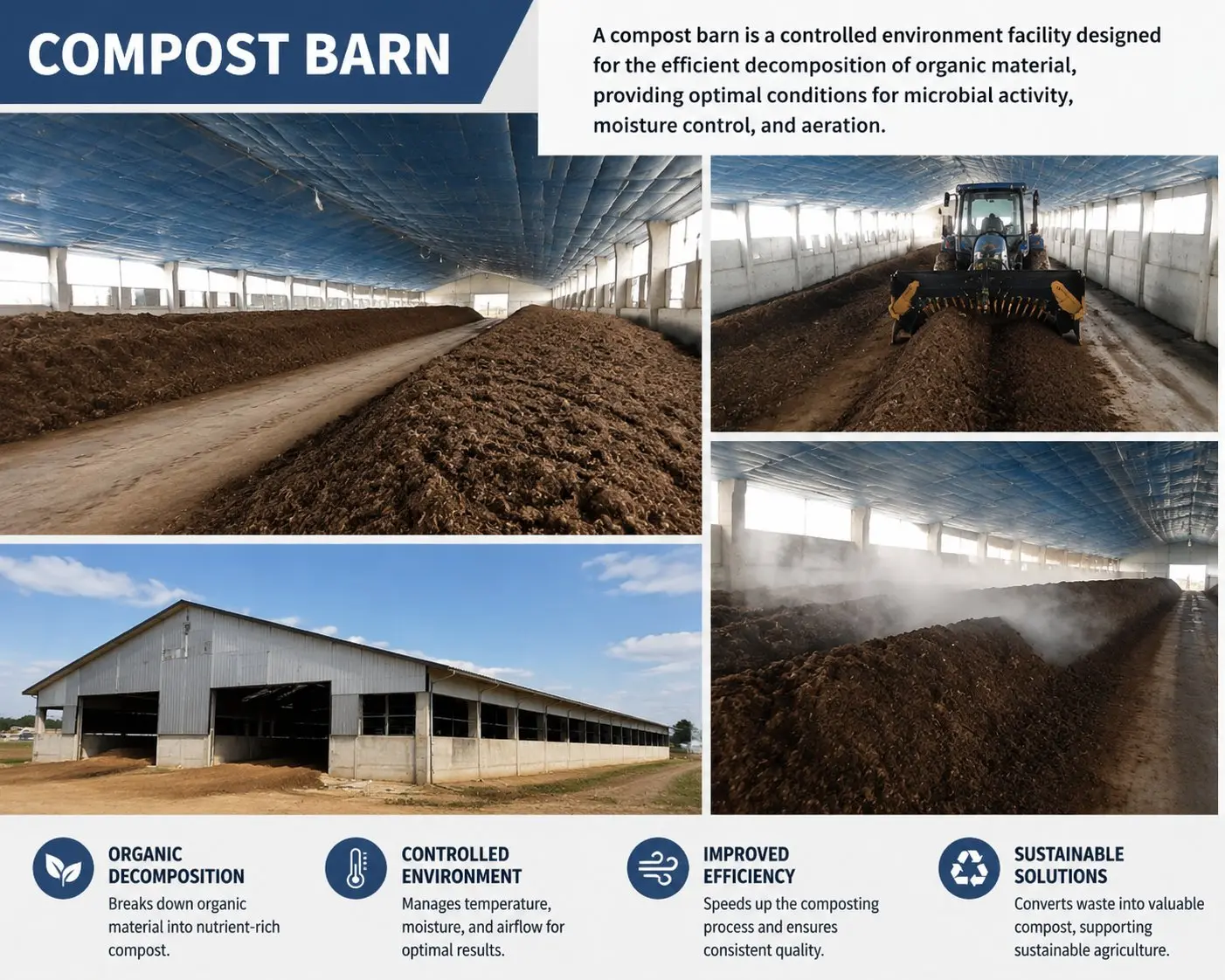
A compost barn (발효우사) replaces concrete floors with a deep carbonaceous bedding layer — sawdust, rice husks, or wood chips — that continuously decomposes through aerobic fermentation. When active, fermentation generates enough internal heat to keep the surface dry year-round without daily manure removal, giving cattle a warm, clean resting environment and the farm a valuable composted byproduct. When aeration is neglected, compaction shuts off the oxygen supply, fermentation shifts anaerobic, ammonia rises, the surface turns wet — and the system's core value disappears.
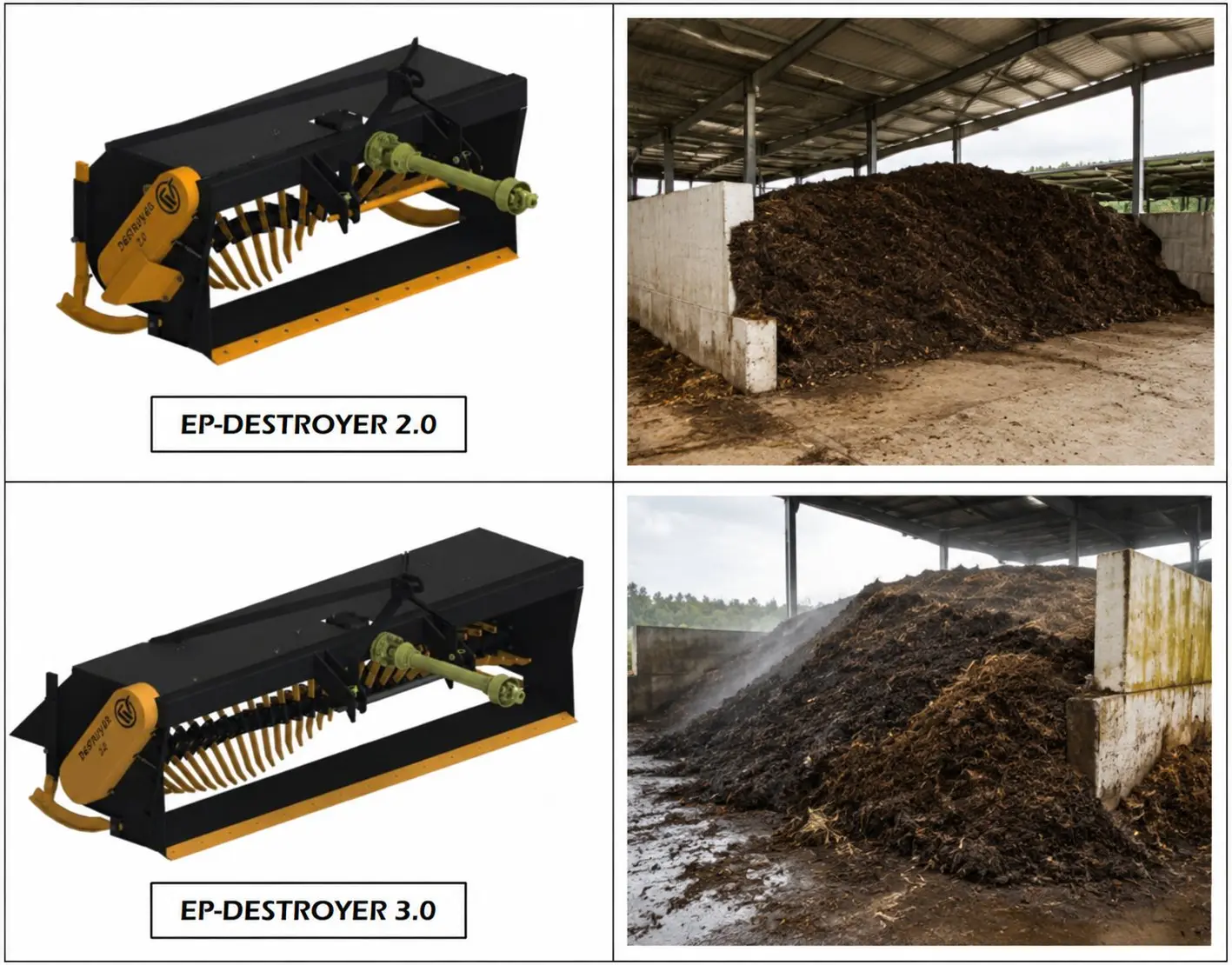
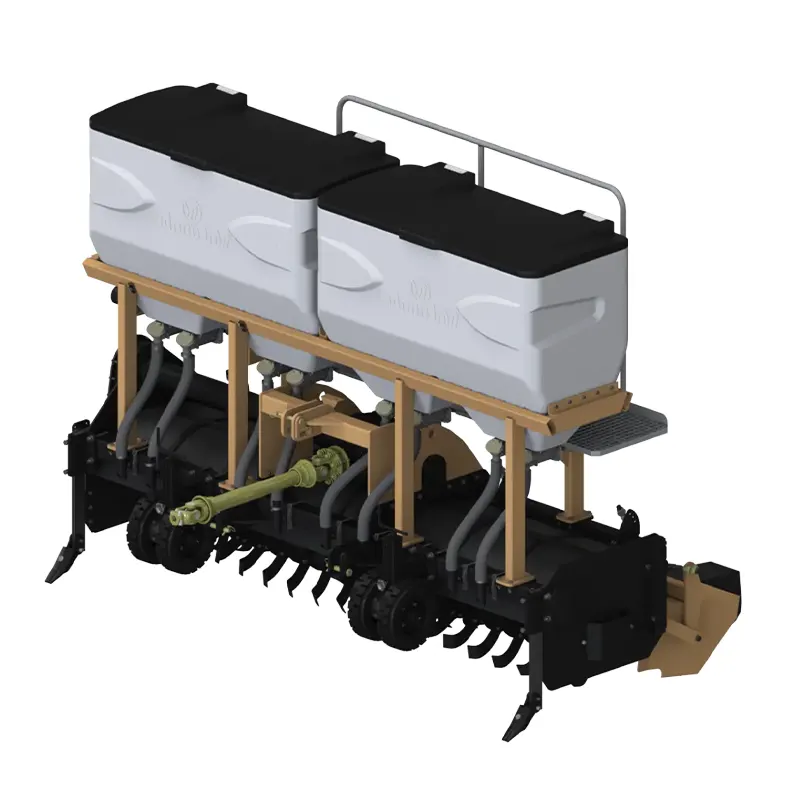
The Watanabe EP-DESTROYER compost barn aerator is what keeps fermentation active. Connected to the tractor's rear Category 2 hitch and driven by the PTO at 540 RPM, it tills bedding material to a depth of 80 cm — reaching the active microbial zone, turning the material, and reintroducing oxygen throughout the full bedding profile. Two widths serve different barn layouts:
▶ EP-DESTROYER 2.0 — 2-Meter
460 Kg, 75 cv minimum. Compact and light — suited to smaller dairy or beef barns, narrow walking alleys, and farms running tractors in the 75–85 HP range. Easier to maneuver in tight barn aisles.
▶ EP-DESTROYER 3.0 — 3-Meter
660 Kg, 80 cv minimum. For larger barns, wider bays, and herds where faster daily coverage reduces the daily aeration time commitment. The 1-meter additional width cuts the number of passes required by roughly a third.
The EP-DESTROYER is classified under Watanabe's Livestock's Machinery category — separate from the potato implement line, but built on the same engineering foundation: Category 2 three-point hitch, standard 540 RPM PTO, and the quality standards that define the rest of the Watanabe product range. On mixed crop-and-livestock Korean farms, this means the same tractor already running Watanabe potato implements during the growing season can run the EP-DESTROYER for daily barn aeration without any additional hookup complexity.

Technical Specifications – EP-DESTROYER 2.0 & EP-DESTROYER 3.0
Both models share the same 80 cm working depth and 540 RPM PTO input. Working width is the sole selection factor for most buyers. All data sourced from the Watanabe official product brochure.
| 技术数据 | EP-DESTROYER 2.0 | EP-DESTROYER 3.0 |
|---|---|---|
| Weight & Linkage | ||
| 重量 | 460 Kg | 660 Kg |
| Bottom Linkage Category | 2 | 2 |
| Working Parameters | ||
| 工作宽度 | 2 m | 3 m |
| Working Depth | 80 cm | 80 cm |
| Tractor Requirements | ||
| Engine Power (min.) | 75 cv | 80 cv |
| Cardan Shaft Input Speed | 540 RPM | 540 RPM |
ⓘ cv = metric horsepower. 75 cv ≈ 73.9 HP; 80 cv ≈ 78.9 HP. No working speed is specified in the Watanabe brochure — barn operation is conducted at slow walking speed (typically 1–3 km/h) determined by barn aisle conditions and operator preference. Both models: PTO-driven (Cardan shaft), Category 2 three-point hitch. All data from the Watanabe official product brochure.
⚠ Check barn entrance and aisle clearance before ordering
Confirm entrance width, entrance height (for tractor + implement), internal beam or feed rack clearances, and aisle width against the implement's working width before placing the order. Provide these four measurements when you contact us — we will confirm which model is physically compatible with your barn before any commitment is made.
Understanding the Compost Barn — Why Depth and Frequency Matter
How a Compost Barn (발효우사) Works
In a compost barn, cattle live on a 50–80 cm deep layer of high-carbon bedding material. Their manure and urine mix with the bedding and, under the right aerobic conditions, undergo continuous microbial decomposition — the same process as hot composting, sustained in place beneath the herd. Active aerobic fermentation generates internal heat that keeps the surface dry despite constant manure input. Properly managed, the bedding surface stays warm and dry year-round without daily scraping — improving cattle welfare, reducing leg and hoof stress, and lowering mastitis risk in dairy cows compared to concrete or slatted floor systems.
What Happens When Aeration Stops
As cattle move through and rest on the bedding, they compact the surface layer progressively. A compacted zone limits oxygen diffusion into the bedding below. Without oxygen, aerobic bacteria are replaced by anaerobic bacteria — which produce ammonia and hydrogen sulfide rather than the carbon dioxide and water vapour of aerobic decomposition. The surface becomes wet, barn ammonia concentrations rise, and the conditions that made the compost barn system valuable reverse within one to two weeks of neglected aeration. Restoring aerobic function requires mechanical intervention — the EP-DESTROYER turns and re-oxygenates the full bedding profile before the anaerobic shift becomes established.

Why 80 cm Depth Is Critical
The active aerobic fermentation zone in a mature bedding system sits at 30–60 cm depth. Tilling only the surface to 20–30 cm — the depth a standard rotary cultivator reaches — loosens the crust but leaves the hot fermentation layer below undisturbed and progressively depleted of oxygen. Within a few days, surface compaction returns and the problem recurs. The EP-DESTROYER's 80 cm working depth reaches and disrupts the full active layer — bringing hot, oxygen-depleted deep material to the surface, re-oxygenating it, and giving the aerobic microbial population throughout the profile the fresh oxygen supply it needs to sustain fermentation activity. This is why the depth specification matters: a shallower machine running on the same schedule simply cannot maintain the same fermentation quality in an established barn.
Aeration Frequency Guidelines
General guidance for Korean compost barn management — confirm with your local agricultural extension service (농촌진흥청) for specific recommendations:
- High stocking density (>6 m² per cow): Daily aeration, or every second day in dry periods.
- Moderate density (8–10 m² per cow): Every 2–3 days under normal conditions; daily during Korea's monsoon season (July–August) when external humidity reduces bedding evaporation capacity.
- After fresh bedding addition: Aerate immediately after adding new material to incorporate it into the active layer.
- Monitoring indicator: Press your foot onto the bedding surface. If it feels wet or compacted, increase aeration frequency. If it remains dry and loose after 2–3 days, current frequency is adequate.
How the EP-DESTROYER Aerates the Bedding

PTO-Driven Rotary Action at Full Depth
Connected to the tractor's rear hitch and driven via Cardan shaft at 540 RPM, the EP-DESTROYER's rotor blades penetrate the bedding material as the tractor moves slowly through the barn aisle. At 80 cm working depth, the blades reach the full active fermentation zone — turning the deep material upward and mixing it with the surface layer in a single pass. The mechanical result: compacted material breaks up, fresh air incorporates throughout the 80 cm depth, temperature distribution re-equalizes, and microbial populations redistribute from their stratified zones into a more homogeneous mix. In a healthy bedding system, internal temperatures typically begin recovering toward their optimal range within 12–24 hours of thorough aeration — a visible confirmation that aerobic conditions have been re-established.
Design for Confined Barn Environments
The compact frame widths — 2 m on the DESTROYER 2.0, 3 m on the DESTROYER 3.0 — fit standard Korean compost barn aisle widths without requiring full herd removal. The Category 2 hitch mounting allows the tractor to raise the implement quickly for turns at barn end walls, minimizing the turning space required. The DESTROYER 2.0's 460 Kg weight places minimal additional load on the tractor's rear axle — important when operating on compacted bedding that may have uneven load-bearing characteristics across the barn floor.
Using the Same Tractor for Both Barn and Field Work
On mixed crop-and-livestock farms — a common profile across Korean highland holdings in Gangwon-do and North Chungcheong — the EP-DESTROYER's Category 2 hitch and 540 RPM PTO are the same connection standard as Watanabe's entire potato implement range. A farm running the EP-ERA Rotary Cultivator or EP-EW-4000 岩石耙 in the potato fields during the growing season can switch to the EP-DESTROYER for daily barn aeration on the same tractor and hitch, with an implement swap taking under 10 minutes. The daily barn aeration session — typically 20–50 minutes depending on barn size and model — fits naturally around field work schedules without scheduling conflicts.
Why the EP-DESTROYER Suits Korean Livestock Operations
■ 80 cm — Full Fermentation Depth
The active microbial zone in mature bedding sits at 30–60 cm. Shallow cultivators leave it untouched. The EP-DESTROYER's 80 cm depth is the specification that makes the difference between cosmetic surface loosening and genuinely functional bedding management that sustains fermentation across seasons.
■ Reduces Ammonia and Odour
Active aerobic fermentation suppresses ammonia production. Regular aeration keeps barn ammonia concentrations within acceptable ranges for both cattle health and worker conditions — increasingly relevant as Korean livestock farm regulations tighten on indoor air quality standards.
■ Drier Surface, Better Udder Health
Fermentation heat evaporates moisture from within the bedding. Aeration brings hot dry lower-zone material to the surface, keeping the resting surface drier — which directly reduces udder hygiene contamination, mastitis incidence, and somatic cell count in dairy operations supplying to Korean dairy cooperatives with SCC contract limits.
■ Starts from 75 HP
The DESTROYER 2.0's 75 cv minimum means the same tractor handling other farm tasks — feeding, yard work, field implements — can run the compost barn aerator without a dedicated barn tractor. On Korean livestock farms where one or two tractors handle all operations, this low power entry avoids additional capital investment.
■ Category 2 — Universal Hitch
Universal on all Korean farm tractors above 60 HP manufactured after 1990. Connects, aerates, and disconnects using the same hitch as every other implement in your shed. On mixed crop-and-livestock farms, the same connection as all Watanabe potato implements — no barn-specific tractor setup required.
Where the EP-DESTROYER Gets Used
🍶 Dairy Cow Compost Barns — SCC and Mastitis Management
Korean dairy production is concentrated in Gyeonggi-do, North Chungcheong, and South Gyeongsang. Dairy cows spend 10–14 hours per day lying, and the cleanliness of the resting surface directly affects udder health. Wet or compacted bedding accumulates mastitis-causing pathogens at the teat end, raising somatic cell counts above the limits specified in milk purchase contracts with cooperatives such as Seoul Dairy and Namyang. Regular EP-DESTROYER aeration keeps bedding dry enough that standard teat dipping protocols can maintain SCC compliance — making compost barn aeration a milk quality management tool with a direct, measurable economic return, not just an animal welfare measure.
🐄 Beef Cattle Housing — Comfort and Performance
Beef cattle operations — particularly Korean Hanwoo (한우) finishing — increasingly use compost barn systems for their animal welfare benefits and reduced veterinary costs. Comfortable dry resting conditions reduce stress-related energy expenditure, making more dietary energy available for weight gain during the finishing period. The EP-DESTROYER 3.0's 3-meter width is better suited to wider beef barn bays where individual animal space requirements are greater than in dairy housing. For Hanwoo operations where a single animal's weight gain trajectory over a 20–30 month finishing period directly determines sale price at the Hanwoo auction, the accumulated performance benefits of good housing quality across the finishing period represent a meaningful return on the aeration investment.
🏫 Mixed Crop-and-Livestock Farms — One Tractor, Both Operations
In Gangwon-do and North Chungcheong, potato and cattle farming frequently coexist on the same family holdings. A farm already running Watanabe potato machinery — the EP-EW-4000 rock rake, the EP-ERA rotary cultivator — has everything needed to run the EP-DESTROYER on the same tractor and hitch without any additional capital. Daily barn aeration — 20–50 minutes depending on model and barn size — schedules easily around field operations: early morning before fieldwork starts, or late afternoon when field light fades. The implement swap takes under 10 minutes and requires no tools.

EP-DESTROYER 2.0 or 3.0 — How to Choose
Both models deliver identical 80 cm depth at 540 RPM. Working width is the only selection factor — matched to your barn aisle dimensions and the available tractor clearance:
| Factor | EP-DESTROYER 2.0 | EP-DESTROYER 3.0 |
|---|---|---|
| 工作宽度 | 2 m | 3 m |
| Weight / Min. power | 460 Kg / 75 cv | 660 Kg / 80 cv |
| Suited aisle width | 2.5–4 m aisles | 4 m+ open bays |
| Barn type | Small dairy, narrow aisles | Larger dairy or beef barn |
| Daily aeration time | More passes → more time | Fewer passes → faster coverage |
Practical check: Measure the clear aisle width between cubicle posts or feed fencing and the opposite wall. If the clear width is 3 m or above and the barn entrance accommodates tractor + 3-meter implement, the DESTROYER 3.0 covers each aisle in fewer passes. If aisles are narrower or entrance clearance is tight, the DESTROYER 2.0 is the safer fit. Contact us with your barn dimensions — aisle width, entrance height, number of aisles — and we will estimate daily aeration time and confirm model suitability before you commit.

Watanabe Engineering — Year-Round Livestock Use Standard


The EP-DESTROYER is manufactured in Castro, Paraná, Brazil — where compost barn and deep-litter livestock housing systems are widely used across dairy and beef operations in conditions comparable to Korea's highland livestock zones. Compost barn aerator rotor blades operate year-round in abrasive bedding material, including manure, compacted organic matter, and occasionally stones carried in from outside. Watanabe specifies blade steel hardness for this year-round high-frequency operating environment — a higher-abrasion specification than standard seasonal field rotary tiller blades.
Year-round operation means blade inspection should be part of a routine monthly maintenance check, not an annual pre-season review. Replacement blades for both models are stocked locally through our Korea operation in Ansan-si, Gyeonggi-do — available for next-day dispatch on request so that unavoidable blade replacement does not cause a multi-day aeration gap in the barn management schedule.
✓ Barn Fit Verified Pre-Sale
We check your barn aisle width and entrance clearance against the selected implement before the order is placed — the most common mistake on this product is ordering a 3-meter machine for a barn that physically cannot accommodate it.
✓ Blades Stocked Locally
Replacement rotor blades for both DESTROYER 2.0 and 3.0 are stocked in Ansan-si. Year-round operation places higher blade wear demand than seasonal field use — local stock availability prevents extended aeration interruptions when blades need replacement.
✓ Aeration Schedule Support
We provide initial aeration frequency guidance based on your barn dimensions, stocking density, and bedding material type before the first season of operation. Getting the schedule right from day one prevents the bedding management issues that new compost barn operators most commonly encounter.
Frequently Asked Questions – EP-DESTROYER Compost Barn Aerator
What is a compost barn and why does it need a mechanical aerator?
A compost barn (발효우사) houses livestock on a deep carbonaceous bedding layer that decomposes through aerobic fermentation under the herd. Fermentation heat keeps the bedding surface dry without daily manure scraping. As cattle compact the surface, oxygen diffusion into the deep layer is cut off and fermentation shifts from aerobic to anaerobic — producing ammonia and wet surfaces. A mechanical aerator with sufficient working depth restores oxygen access throughout the bedding profile and re-establishes aerobic conditions before the shift becomes established. Without an effective aerator, compost barn management depends on labour-intensive manual turning that rarely achieves consistent 80 cm depth.
Why does working depth matter — couldn't a standard rotary hoe manage the bedding?
A standard rotary hoe or cultivator working at 20–30 cm depth loosens only the surface crust, leaving the active fermentation zone at 30–60 cm depth completely undisturbed. The loosened surface re-compacts within a few days under cattle traffic, and the fermentation zone below continues running out of oxygen. Farms that have tried using shallow-depth implements consistently report bedding deterioration continuing despite regular surface tilling — because the effective treatment depth is not reaching the zone that needs it. The EP-DESTROYER's 80 cm depth is specifically sized to reach and disrupt the full active bedding profile.
How often should the barn be aerated?
At high stocking densities (above 6 m² per cow), daily aeration is typical. At moderate densities (8–10 m²), every 2–3 days under normal conditions, with increased frequency during Korea's monsoon season (July–August) when external humidity reduces bedding evaporation capacity. The practical monitoring indicator is the bedding surface feel — if it is wet or sticky underfoot, increase frequency. Your local agricultural extension service (농촌진흥청) can advise on frequency guidelines tailored to your specific barn layout, stocking rate, and regional climate.
Do I need to move cattle out of the barn before aerating?
Standard practice is to aerate when cattle are at the feed fence — the period after morning feeding when most animals are standing and eating rather than lying in the bedding. This typically gives 1–2 hours of unobstructed access without requiring full herd removal. For barns where feeding and bedding areas are not separated during the daily routine, progressively working one section of the barn while cattle are herded to an adjacent section allows coverage without full removal. Never operate the machine with cattle in the immediate working zone.
What bedding materials work in a Korean compost barn?
Sawdust and wood chips are most commonly used in Korea — both are available as timber processing byproducts in Gangwon-do and North Gyeongsang. Rice husks (왕겨) are an alternative in some regions. The ideal material has high carbon content, good water absorption, and sufficient structure to maintain internal aeration pathways. Avoid using wet or high-moisture content materials — fresh green wood chips or wet sawdust will not establish aerobic fermentation reliably. Your regional bedding supplier and local extension service can advise on the best available materials for your area.
Can I use the EP-DESTROYER on the same tractor as Watanabe potato implements?
Yes — this is one of the most practical aspects of the EP-DESTROYER for mixed farms. It uses the same Category 2 three-point hitch and 540 RPM PTO as the full Watanabe potato implement range. A 78–85 HP Korean farm tractor already running the EP-EW-4000 岩石耙, EP-ERA rotary cultivator, or other EP implements is fully capable of running the EP-DESTROYER 2.0 without any modification. The implement change takes under 10 minutes. Daily barn aeration — 20–50 minutes per session — schedules naturally around field operations without conflict.
How do I verify my barn can physically accommodate the implement?
Measure: (1) entrance clear width — must exceed total tractor width including mirrors; (2) entrance clear height — must exceed tractor cabin roof height with the implement in lowered position; (3) internal clearances — any low beams, feed rack overhangs, or dividers the tractor must pass under or alongside; (4) aisle clear width — compare against the implement's 2 m or 3 m working width. Share these four measurements with us when you contact — we will confirm which model is viable and estimate the number of passes and daily aeration time for your barn layout before any order commitment.
How often should blades be inspected and replaced?
Inspect monthly for tip wear, bending, or cracking. Year-round daily operation in abrasive bedding material places more blade demand than seasonal field use — a typical replacement interval is 1–2 seasons depending on stone content in the bedding and operating speed. Replace any blade showing visible cracking immediately, and replace blades whose tips have worn significantly before they become so blunt that they push rather than cut the material — the quality of aeration deteriorates noticeably before a blade breaks completely. Replacement blades are available through our Korea local stock and can typically be dispatched within 1–2 business days of inquiry.
Can the EP-DESTROYER be used for other deep-tilling applications outside the barn?
The EP-DESTROYER's working width and tilling configuration are optimised for the compost barn bedding environment. In principle, the 80 cm depth rotary action could be applied to other organic matter mixing tasks — composting windrows, deep straw incorporation in covered yards, or poultry hoop-barn bedding. For standard field tillage, however, a purpose-built rotavator such as the PSW-3200 is the appropriate machine — the DESTROYER's barn-width working dimensions are not suited to field-scale coverage.
What Our Customers Say
Chae Byeong-su — Dairy Farm (60 Holstein cows), Icheon, Gyeonggi-do (2024–2025)
★★★★★
"We converted from concrete floors to a compost barn two years ago. The EP-DESTROYER 3.0 on our 80 HP Daedong covers the main aisle in two passes — full barn in about 40 minutes including moving the herd away from the bedding. You can feel the heat coming up from below within about an hour after turning, which tells you the fermentation is still active. Mastitis cases dropped noticeably compared to our old barn. SCC is consistently within the cooperative's contract limits. The Korea team helped confirm the 3-meter model would fit our barn entrance before we bought — that pre-sale check saved a potentially difficult situation."
Shin Yeon-ok — Hanwoo Beef Farm (45 head, finishing), Goesan-gun, North Chungcheong (2024)
★★★★★
"Running the EP-DESTROYER 2.0 in our Hanwoo finishing barn — entrance is 2.4 meters wide, fits the 2-meter implement with about 20 cm clearance on each side, manageable with a careful driver. We aerate every second day normally, daily during July and August when the humidity in our area gets high and the bedding surface starts to feel tacky. The ammonia smell dropped significantly compared to before we had the machine — we had been trying to turn the bedding with a front loader bucket, which couldn't reach anywhere near 80 cm. The actual depth is what makes the difference."
Go Tae-seon — Mixed Potato and Dairy Farm, Hoengseong-gun, Gangwon-do (2025)
★★★★★
"We run the EP-DESTROYER 2.0 and the EP-ERA-3100 rotary cultivator on the same 82 HP LS tractor — both Category 2, both 540 RPM. Barn aeration is the first task every morning before field work. Implement swap takes about 10 minutes. For a mixed farm where one tractor handles everything, the fact that Watanabe's potato and livestock implements share the same connection standard is genuinely valuable. No second tractor needed for the barn side of the operation. The aeration routine is now as automatic as feeding — 25 minutes in the morning, then out to the fields."
Nam Ji-soo — Dairy Farm Manager (80 cows), Anseong, Gyeonggi-do (2024)
★★★★★
"The EP-DESTROYER 3.0 has been running daily in our 80-cow barn since we converted to compost barn management 18 months ago — about 50 minutes of aeration per day. What I didn't fully anticipate was how consistent the routine would become: it's now as regular as milking, just part of what the morning looks like. The Korea service team helped plan the aeration schedule before the barn went live, which saved us from the early-stage bedding management mistakes that some nearby farms made when they converted without proper guidance on frequency and depth."
Yoon Seung-hee — Small Dairy Farm (28 cows), Yangpyeong-gun, Gyeonggi-do (2025)
★★★★★
"Small farm, narrow barn, 2.3-meter entrance — the EP-DESTROYER 2.0 was the right fit. The 2-meter implement covers each aisle in one centered pass with the tractor, no clearance issues. Daily aeration takes about 20 minutes total. It replaced a manual bedding rake job that took one person 45 minutes — so the time saving is real and the depth improvement is not comparable. The replacement blade arrived in two days from the Korea team when I needed one after the first full year of daily use. Simple maintenance, good ongoing support."
Park Jae-woo — Livestock Farm Advisor (compost barn systems), Chungcheong Region (2024–2025)
★★★★★
"I advise livestock farms on compost barn design and management across the Chungcheong region. The EP-DESTROYER is the implement I most consistently recommend specifically because of the 80 cm working depth — which is the correct specification for established bedding systems in this region where bedding layers of 60–80 cm are standard. I have seen farms try 30 cm rotary hoes from general agricultural suppliers; the results are consistently poor because the fermentation zone is not reached. The DESTROYER 2.0 and 3.0 are the right tool for this job. The Korea team responded helpfully when I contacted them about a group recommendation for farms converting to compost barn systems."
Other Watanabe Implements for Your Farm
Whether your operation is livestock, crops, or both, Watanabe provides the full implement range for Korean highland farm management. These commonly complement the EP-DESTROYER on mixed-use farms:

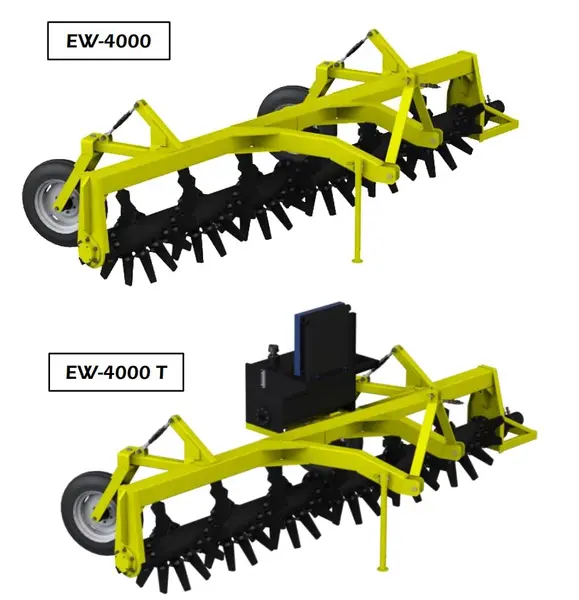
EP-EW-4000 岩石耙
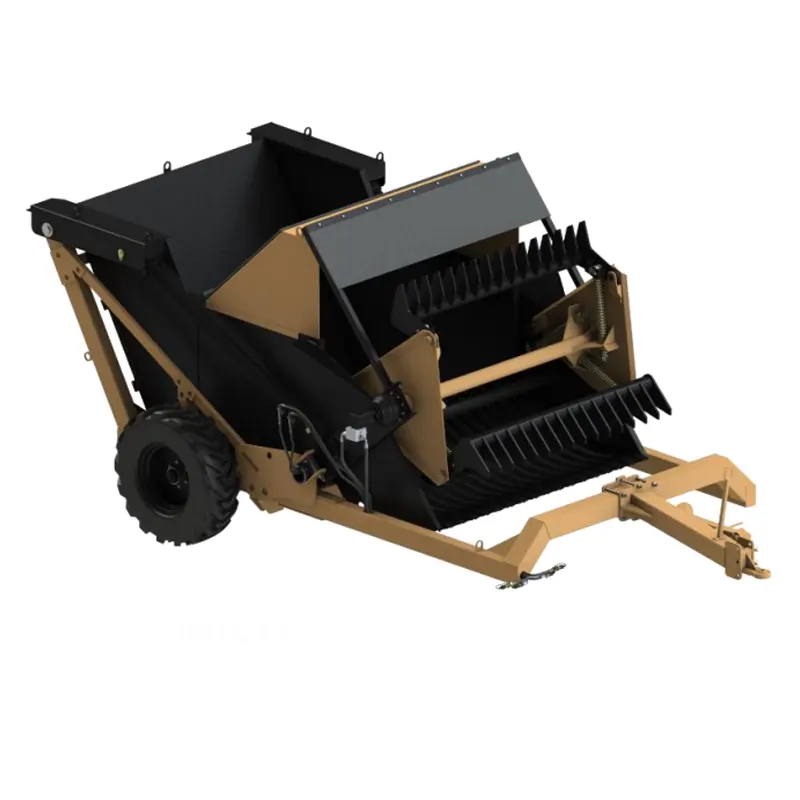
Clears surface stones from fields and farm sites before tillage or construction. 3.6 m width, from 75 HP. Same Category 2 hitch and power range as the EP-DESTROYER 2.0.

CT-2100 岩石拾取器
Collects stone windrows into a 2.5 m³ bunker. 110 HP, 1.95 m working width. Works together with the rock rake for complete farm-site stone clearance with no manual handling.

PSW-3200 旋耕机
Primary tillage rotavator for the crop side of mixed farms. 3.0–3.6 m width, 140 HP. Prepares seedbeds for forage crops, potatoes, or winter cereals alongside the livestock enterprise.
Keep Fermentation Active — Every Day, Every Season
Tell us your barn aisle width, entrance height, tractor model, and herd size — we will confirm the right model, verify the barn fit, and provide a daily aeration time estimate for your layout within one business day.
Running a mixed crop-and-livestock farm? Ask about the full Watanabe range — potato machinery for the field side, EP-DESTROYER for the barn — all on the same tractor and Category 2 hitch.
其他信息
| 编辑 | CXM |
|---|