
Every potato farm that starts with a single-row mounted digger reaches the same inflection point eventually: the farm has grown, the harvest window is getting tighter, the tractor is more capable than when the first digger was purchased, and the question becomes whether to upgrade to a wider mounted unit or make the step to a trailed machine entirely. It is not a simple decision, because the two machine architectures solve different problems. A wider mounted digger gives you more rows per pass while preserving the simplicity and maneuverability of three-point hitch operation. A trailed digger opens the door to substantially greater working widths, but at the cost of a heavier investment, a larger tractor requirement, more complex headland management, and a machine that needs its own storage and transport consideration.
Understanding which suits your operation requires clarity on three things: how the two machine types actually differ in their attachment and drive systems; what your tractor can realistically support on its three-point hitch versus what it can tow; and what your fields look like in terms of size, shape, and headland space. This guide works through each of those questions with the technical specifics needed to make a confident decision.
How Mounted and Trailed Diggers Differ in Structure and Drive
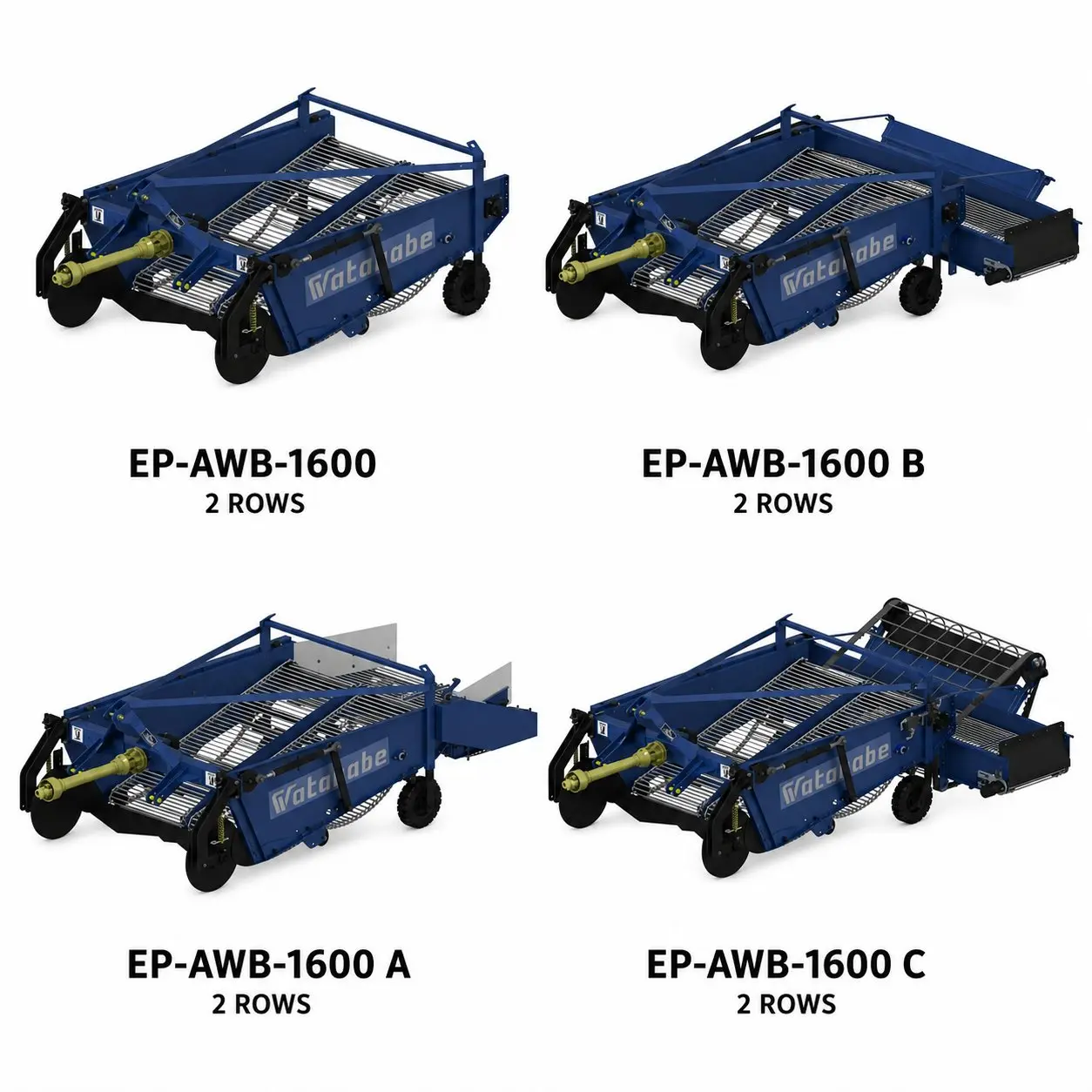
A mounted potato digger connects to the tractor using the three-point linkage system — two lower links and one upper link (the top link), which together hold the machine rigidly to the tractor’s rear. The tractor’s hydraulic system raises and lowers the entire machine. When the linkage is fully raised, the digger’s digging share, elevator chain, and separator wheels all lift clear of the ground, allowing the tractor to turn on the headland, reverse, or travel on the road without the machine touching the ground. The machine’s entire weight — typically 150–500 kg for a single or two-row unit — is carried by the tractor’s rear axle when raised and by the machine’s own depth wheel when working. Power is supplied through the PTO shaft, which drives the elevator chain and separator through a gearbox mounted on the digger’s mainframe.
A trailed potato digger has its own running gear — a frame mounted on independent wheels that carry the machine’s weight both in transport and at the headlands. The machine is connected to the tractor via the drawbar (or a specialist hitch point), not the three-point linkage. The depth of the digging share is controlled by the machine’s own depth adjustment system, typically set via a hydraulic ram connected to the tractor’s external hydraulic circuit. The PTO shaft runs from the tractor to the machine along a longer driveline. Because the machine’s weight rests on its own wheels rather than on the tractor’s three-point linkage, there is no hitch lift capacity constraint — the machine can be built substantially heavier and wider than any mounted unit. A trailed digger’s working width can extend from two rows to four, six, or even more, limited by field size and the power needed to run it, not by hitch lift capacity.
One further structural distinction affects how the harvested tubers leave the machine. A mounted digger typically deposits tubers in a loose spread behind the machine across the full elevator width — they land close to where they were growing. Some mounted diggers include a side-delivery chute or deflector that concentrates tubers toward the furrow for easier picking, but the general model is scatter-and-pick. A trailed digger, particularly the wider multi-row units, often has a cross-elevator or windrow-forming system that channels tubers from all rows into a single consolidated windrow beside the tractor’s travel path. This windrow deposit concentrates the crop and makes following collection with a mechanical bunker loader significantly more efficient. The trailed digger with windrow delivery is effectively a halfway step toward a harvester: it does not collect, but it organises the crop in a way that mechanical collection can follow efficiently.
Mounted Digger — Where It Wins and Why
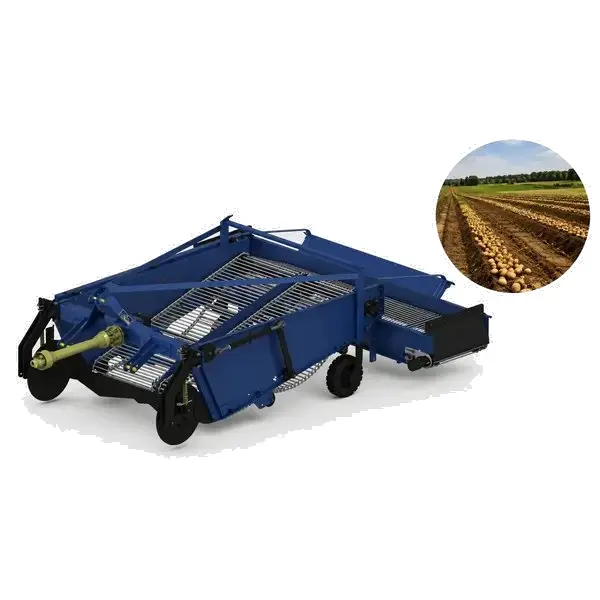
The mounted digger’s primary advantages are simplicity, maneuverability, and cost. A mounted single-row unit requires only the tractor and the machine — no separate trailer, no additional hydraulic connections beyond the PTO, and no road transport complexity. For farms with irregular field shapes, small fields under five hectares, narrow gateways, or steep terrain that makes wide machinery hazardous, the mounted digger’s compact footprint and ability to be raised fully off the ground for headland turns is a genuine operational advantage that a trailed machine cannot match.
The headland management comparison is particularly significant on smaller fields. A mounted digger requires a minimum headland width equal approximately to the tractor’s turning circle — typically 4–6 m for a standard farm tractor. A trailed four-row digger, with its own wheels set behind the tractor and a frame extending 3–4 m back from the hitch point, requires a headland arc of 8–12 m to complete a smooth turn without jack-knifing or running the outer wheel onto the crop. On a 3-hectare field with 150m row length, losing 10–12m of headland space on both ends reduces the effective working length by 16% compared to a mounted machine that needs only 5m. On very small or irregular fields, this headland loss makes the trailed digger genuinely inefficient — the time and space spent turning matches or exceeds the time saved by the wider working width.
Mounted diggers also have a lower entry cost at every width point. A single-row mounted unit represents the lowest capital cost in the potato digger market. Even a two-row mounted unit with its additional chain width and separator system costs significantly less than an equivalent-width trailed unit, because the trailed machine requires its own frame, axle, wheels, and running gear on top of the digging and separation system.
Finally, mounting allows rapid attachment and detachment. A mounted digger can typically be fitted and removed from the tractor in 10–15 minutes by one person using the three-point hitch quick-coupler system. This matters for farms where the tractor serves multiple purposes — a mounted digger can come off and a front loader, grass mower, or other implement can go on in minutes. A trailed digger requires unhitching the drawbar, disconnecting hydraulics and PTO, and moving the machine on its own wheels to a storage position, which takes longer and requires a hard surface for the machine’s own wheels to rest on.
Trailed Digger — Where It Wins and Why
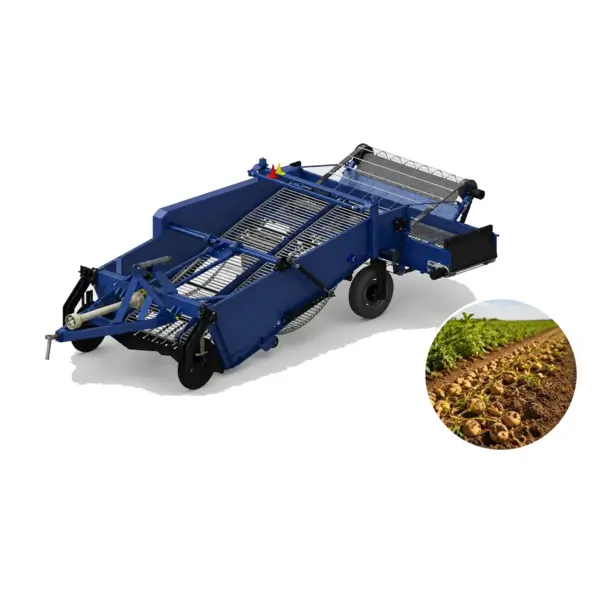
The trailed digger’s dominant advantage is working width — and everything that follows from it. Because the machine’s weight is borne by its own wheels, there is no three-point hitch lift capacity constraint. A four-row trailed digger covers 3.0–3.6 m of potato bed per pass. Compared to a single-row mounted digger working at 75–90 cm per pass, the four-row trailed unit covers four to five times as much ground in the same number of passes. For a farm harvesting 20, 30, or 50 hectares of potato within a narrow harvest window, that multiplication factor is the critical number — it determines whether the harvest is completed before the first autumn frosts, before the crop quality degrades in the ground, or before the labour window closes.
The trailed machine is also more stable when digging at depth in heavier soils. Because the machine rides on its own wheels and is not subject to the pendulum effect that a fully mounted heavy implement can create on the tractor’s rear axle, it can hold a consistent digging depth more reliably across varied soil hardness and profile depth. The independent depth wheels on a trailed digger sense and respond to ground contour separately from the tractor’s travel — the machine effectively floats at its set working depth without constant tractor operator correction of the three-point linkage position.
For wider trailed diggers with windrow delivery systems, the crop concentration benefit is substantial. A four-row trailed digger consolidating tubers from four rows into a single windrow allows a following bunker loader or mechanical elevator to operate at high efficiency — the crop is presented in a dense, consistent line rather than scattered across four individual row positions. This is the operational model used on large commercial operations throughout the Netherlands, France, and Canada, where trailed diggers feeding windrows into following bunker loaders represent the dominant harvest system for 10–100 ha potato enterprises.
| 规格 | Mounted (1–2 row) | Trailed (2–6+ row) |
|---|---|---|
| Attachment system | 3-point hitch Cat 1/2 | Drawbar / hitch pin |
| 机器重量 | 150–500 kg | 500–2,500 kg |
| Working width (rows) | 1–2 rows (max ~180 cm) | 2–6+ rows (up to 5.4 m+) |
| Depth control | Tractor linkage + depth wheel | Independent depth wheels + hydraulic ram |
| Headland turn requirement | 4–6 m (tractor turning circle) | 8–14 m (machine + trailing frame) |
| Headland — machine fully clear? | Yes — raised off ground | No — trailing wheels remain on ground |
| Tuber deposit pattern | Scattered / row-spread | Scattered or windrow (wider units) |
| Attachment / detachment time | 10–15 min, 1 person | 20–30 min, 1–2 people |
| Relative capital cost (same row count) | Lower | Higher (own frame + running gear) |
Tractor Compatibility — HP, Hitch Category, and Ballast
Tractor compatibility is not simply a question of whether the engine has enough power. For mounted diggers, the three-point hitch category and its certified lift capacity are equally important constraints. For trailed diggers, the question shifts to whether the tractor has sufficient rear ballast weight, adequate rear tyre size for traction on potato beds, and a correctly positioned and rated drawbar for the towing load.
| Machine Configuration | Min. Engine HP | 挂钩类别 | Min. Linkage Lift | Front Ballast Needed? |
|---|---|---|---|---|
| Single-row mounted digger | 40 HP | Cat 1 or 2 | 800 kg | Recommended on sandy |
| Two-row mounted digger | 65 HP | Cat 2 essential | 1,500 kg | Yes — 80–120 kg front |
| Two-row trailed digger | 80马力 | Drawbar only | N/A (own wheels) | Rear ballast / tyre weight |
| Four-row trailed digger | 100马力 | Rated drawbar + ext. hydraulics | N/A (own wheels) | Rear ballast essential |
| Six-row trailed digger | 130 HP+ | High-rated drawbar + hydraulics | N/A (own wheels) | Yes — ballast critical |
Ballast — the overlooked requirement for mounted diggers. When a mounted digger is raised on the three-point linkage, its weight acts as a rear counterbalance for the tractor. On flat ground this rarely causes problems. But when digging on a slope or on soft, wet soil, the rear-heavy tractor with a raised digger can develop light front-axle steering — the front wheels lose adequate ground contact and steering precision suffers. The standard remedy is front ballast: cast-iron weights fitted to the tractor’s front weight carrier, or a loaded front bucket. As a general rule, fitted front ballast should equal 20–25% of the rear-mounted implement weight. For a 400 kg two-row mounted digger, that means 80–100 kg of front ballast — not a large amount, but one that is frequently absent on farms that have not thought through their tractor configuration for potato work.
For trailed diggers, the equivalent concern is rear ballast and tyre loading for traction. A trailed digger is pulled, not lifted, so the three-point linkage is not loaded — but the tractor’s drive wheels must provide enough traction to pull the machine through the soil at the required share depth. On wet soil or in heavy clay, a lightly ballasted tractor will wheel-slip at the PTO loading peaks of the elevator chain. Adding rear ballast weights (suitcase weights on the rear weight carrier or fluid-ballasted tyres) addresses this and is standard practice on trailed digger operations.
Farm Size and Field Shape — Decision Matrix
| Farm Scale (ha potato) | Field Shape and Size | Tractor Available | 推荐 |
|---|---|---|---|
| 0.5–3 ha | Any — including small or irregular | 40 HP+ | MOUNTED single-row — optimum match for scale and tractor |
| 3–10 公顷 | Regular rectangles, adequate headland (>8m) | 65 HP+ | MOUNTED two-row — doubles capacity, tractor manageable |
| 3–10 公顷 | Irregular, narrow, steep, or short row length | 任何 | MOUNTED — trailed machine loses turning advantage on complex fields |
| 10–25 ha | Regular fields, rows >150m, adequate headland | 80–100 HP | TRAILED two-row — harvest window justifies trailed investment |
| 25–60 ha | Large regular fields, 10m+ headlands | 100–130 HP | TRAILED four-row — required throughput to meet harvest window |
| Any scale | High stone density (>10 stones/m²) not yet cleared | 任何 | MOUNTED until stones cleared — less mechanical complexity at risk |
One situation deserves emphasis in the matrix: the transition zone at 8–15 hectares where both mounted and trailed options are technically viable. In this range, the right answer is determined less by scale and more by the specific characteristics of the fields. A farmer with ten hectares of long, regular, clean-soil fields is an excellent candidate for a two-row trailed digger that will make short work of the harvest in long, efficient passes. A farmer with the same ten hectares spread across six small, irregular fields with limited headland will find the mounted two-row digger faster, easier, and less frustrating than the trailed machine’s turning demands would allow. In this transitional range, visiting both types of machine working in realistic field conditions — not just at a show — is the most valuable thing a buyer can do before committing.
To compare the full mounted and trailed potato digger specifications available from Korea Watanabe across both categories, the product pages include working widths, PTO requirements, and lift capacity data for each configuration.
常见问题解答
▶Can my 55HP tractor run a two-row mounted digger, or do I need to go trailed at that power level?
A 55HP tractor is marginal for a two-row mounted digger and the answer depends on soil type. On sandy loam or light soil where the PTO load is moderate and the three-point hitch is not working at its maximum lift capacity, a 55HP tractor with a Cat 2 hitch and adequate rated lift capacity (1,200 kg or more at full linkage extension) can manage a two-row mounted digger in most conditions. On heavy clay or stony soils where the share must work harder and the elevator chain carries more load, 55HP will be underpowered — the PTO will labour, forward speed will need to drop significantly, and the harvest operation will be slow. In this situation, upgrading to a 70HP+ tractor is a better investment than compromising on a digger that runs poorly. A two-row trailed digger at 55HP is generally not recommended — the towing load plus PTO demand exceeds what most 55HP tractors can deliver without overheating or transmission stress.
▶Does a trailed digger need a hydraulic connection to the tractor as well as PTO?
Yes — virtually all trailed potato diggers require an external hydraulic supply from the tractor in addition to the PTO drive. The hydraulic connection is used to control the digging share depth, to adjust the machine’s working angle, and on some wider units to control the windrow delivery system or the position of the outer shares. Most trailed diggers require one or two external hydraulic circuits (spool valves) on the tractor, each providing hydraulic flow to the machine’s rams. Before purchasing a trailed digger, verify that your tractor has the appropriate number and type of external hydraulic outlets (also called remote valves or spool valves) — entry-level tractors may have only one or two, which may be insufficient for all the functions required. High-pressure hydraulic flow rate (typically minimum 35–50 litres per minute) is also specified by the digger manufacturer and should be checked against the tractor’s hydraulic pump output.
▶Is a two-row mounted digger more efficient than a one-row trailed digger for the same farm size?
On large regular fields, a two-row mounted digger and a one-row trailed digger have similar theoretical field throughput per hour — the width advantage of the mounted two-row versus the trailed one-row is minimal when the row spacing is the same (typically 75 cm). The more meaningful comparison is in headland management and transport: a mounted two-row digger handles headland turns as easily as a single-row unit (raised off the ground, short turning radius), while a one-row trailed digger requires its own headland turning arc even for a single-row width. On small or irregular fields, the mounted two-row is faster in practice because headland time is lower. On large, regular fields where headlands represent a small percentage of total field time, the trailed unit’s advantages in depth stability and potential windrow delivery may make it the better choice despite similar raw capacity figures.
▶What is the road transport situation for trailed diggers — do they need a separate trailer or a road permit?
Transport regulations for trailed agricultural machinery vary significantly by country and local road authority, but the general principles are consistent. A trailed digger that folds to within standard road width limits (typically 3.0 m in most countries, 2.55 m on some restricted roads in EU) can be towed on public roads without a permit, provided the machine meets lighting requirements (rear lights, reflectors, and in some jurisdictions a slow-moving vehicle sign). Wide trailed diggers — four-row and above — typically exceed standard road width when in working configuration and must be fitted with foldable outer sections or transported on a flat-bed trailer. Some four-row machines fold hydraulically for transport, reducing to 2.8–3.0 m wide. Six-row units almost always require a transport trailer or an escorted wide-load permit. When purchasing a trailed digger that must travel regularly on public roads, confirm its transport width, the lighting equipment included as standard, and any local permit requirements before delivery.
▶Does a stony field change the trailed vs mounted decision?
Yes, significantly. Stone density is one of the most important variables in the choice between mounted and trailed diggers. The reason is not that one machine type handles stone better than the other in principle — both have equivalent share, elevator, and separator systems — but that a trailed machine represents a substantially higher investment and a more complex mechanical system than a mounted unit. On stony ground where stone-to-blade impacts are frequent, wear rates on share tips, elevator rods, and separator wheels are higher than on clean soils. The maintenance and parts cost on a trailed machine is proportionally higher because there is simply more machine to maintain. For a farm with high stone density that has not yet implemented a systematic stone management programme, choosing a mounted digger first — simpler, less expensive, easier to maintain — and then upgrading to a trailed unit after the stone problem has been addressed, is the correct sequence. The same principle applies to upgrading from digger to harvester: address the stones before adding mechanical complexity.
▶Can a trailed digger’s windrow delivery be used to feed a bunker loader, and how does that compare to buying a harvester?
Yes — this is a standard operational model on commercial potato farms in the Netherlands, France, and eastern Canada. A four-row or wider trailed digger with cross-elevator windrow delivery deposits all tubers from four rows into a single concentrated line. A mechanical bunker loader (also called a windrow elevator or potato elevator) follows the digger, travels along the windrow, and lifts the tubers into a trailing farm trailer or a bunker system. This two-machine system — digger plus bunker loader — achieves collection efficiency comparable to a dedicated harvester, but at lower capital cost and with greater flexibility (the digger and loader can be used in other roles, while a harvester is single-purpose). The trade-off is that two machines mean two operators or very disciplined single-operator timing management, and the windrow is exposed to weather for the period between digging and loading (typically 15–60 minutes). Where harvest weather is reliable and labour for two machines is available, the trailed digger plus bunker loader is a highly cost-effective middle path between a simple digger and a full one-pass harvester.
Mounted or Trailed — Get the Right Specification for Your Fields
Share your farm size, field shape, current tractor HP, and soil type. Korea Watanabe’s team will confirm the mounted or trailed potato digger that matches your operation exactly — including three-point linkage compatibility and ballast requirements.
编辑:Cxm