Suku Watanabe penghancur batu range contains two categories of machine that are easy to confuse from spec sheets alone: the standard agricultural THOR range (THOR 2.4 and THOR 3.0, conventional transmission compatible, agricultural and road clearing focus) and the THOR FLM — a purpose-built silviculture and forestry variant that shares the THOR name but serves a distinctly different operational niche. The critical difference: the THOR FLM requires CVT tractor operation in the same way as the THOR ST soil stabilizer, operating at very low continuous forward speeds that conventional transmission tractors cannot achieve while maintaining full PTO output.
This guide explains exactly what the THOR FLM is, what makes its application profile different from the standard THOR agricultural models, which Korean operators should consider it, and how to assess whether the CVT tractor requirement is already met by your existing equipment or represents an additional investment decision.
What Is the THOR FLM — and What Does “FLM” Mean?
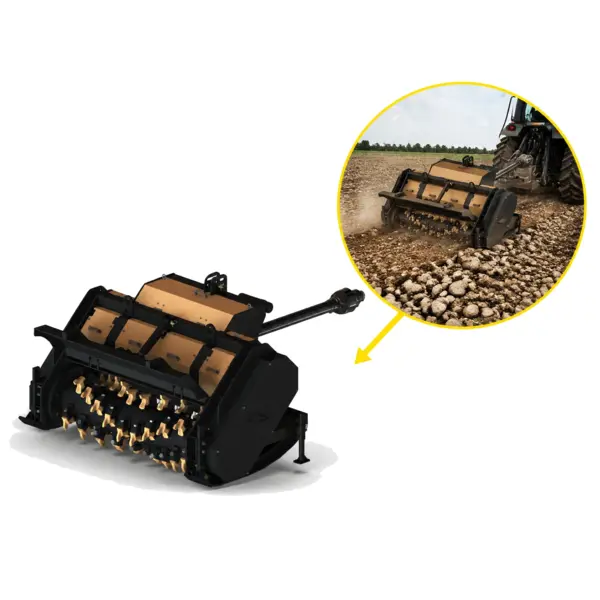
“FLM” designates the forestry and silviculture variant of the THOR stone crusher line. The machine is structurally derived from the same impact-crushing rotor concept as the THOR 2.4 and THOR 3.0 — carbide-tipped teeth on a PTO-driven high-speed rotor, oil-cooled transmission, wear-resistant steel housing — but with significant modifications to the rotor geometry, tooth configuration, and operating speed profile that suit it specifically to the vegetation density, stump processing demands, and terrain conditions of Korean forestry work.
In silviculture operations — the cultivation and management of forest growth — stone crushing equipment is used for a specific set of tasks that differ from agricultural land clearing:
- ▶
Forest floor preparation for replanting — processing surface rock, root systems, and woody debris after timber harvest to create a planting-ready surface for the next rotation - ▶
Stump and root processing — reducing harvested stumps and the associated surface root network to below-ground level, which agricultural stone crushers are not designed to handle reliably - ▶
Firebreak and forest road construction — clearing vegetation, surface rock, and embedded stone from new forestry access road alignments in Korean mountain forest zones - ▶
Plantation management — inter-row processing in young plantation stands to control competing vegetation and manage surface debris without damaging root systems of planted trees
Why These Tasks Require a Different Machine
The fundamental difference between silviculture crushing and agricultural stone crushing is the material being processed. Agricultural stone crushing is primarily rock — hard, mineral, predictable in its resistance to rotor impact. Silviculture processing involves rock, woody root systems, stumps (which are a combination of dense hardwood and embedded rock), brushwood, and organic debris in varying combinations. The stump-and-root combination is the most mechanically demanding: a freshly harvested stump retains the elasticity and fibrous toughness of living wood while being anchored by a root system that can extend 2–3 metres in all directions and is intergrown with surface soil and rock.
Standard agricultural stone crusher rotors — optimised for impact fracture of mineral rock — encounter higher shock loading variation when processing stumps and root systems. The THOR FLM rotor configuration addresses this through modified tooth geometry and spacing, and through the very low CVT working speed that allows the operator to manage rotor engagement rate with dense material — avoiding the overload spikes that would occur if a standard machine was driven at agricultural stone-clearing speed through dense stump-and-root combinations.
The CVT Tractor Requirement — Why It Is Essential for Forestry Work
⚠ CVT Tractor Is Mandatory for the THOR FLM
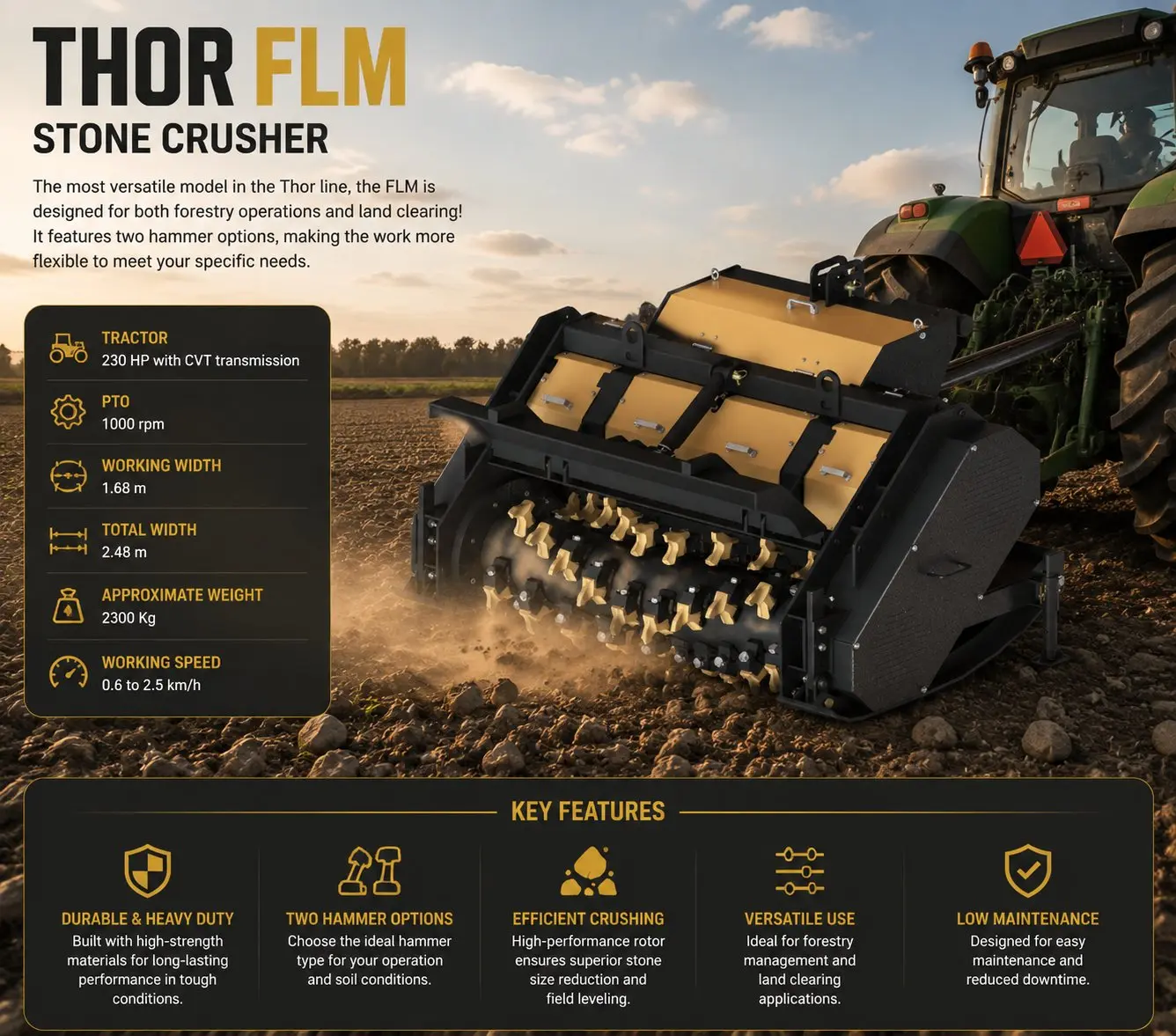
The CVT (Continuously Variable Transmission) tractor requirement for the THOR FLM is the same non-negotiable requirement as for the THOR ST soil stabilizer. The THOR FLM must operate at working speeds that conventional-transmission tractors cannot achieve while maintaining full 1000 RPM PTO output. Confirm your tractor’s CVT capability before ordering.
The CVT requirement for the THOR FLM in silviculture operations is driven by fundamentally different logic than the CVT requirement for the THOR ST in road stabilization, but the technical constraint is identical. In forestry work, the operator must be able to:
- 1
Approach stump material at near-zero speed — when the rotor first contacts a large stump or dense root network, the forward speed must be controllable down to 0.2–0.5 km/h so the rotor can begin processing the material without being driven into it at agricultural stone-clearing speed (1.0–2.5 km/h), which would create overload shock loads on the rotor shaft and gearbox.
- 2
Maintain full PTO output throughout the creep-speed pass — rotor speed must remain at rated 1000 RPM even at 0.2–0.5 km/h forward speed. Only a CVT tractor can decouple ground speed from engine and PTO speed to achieve this.
- 3
Accelerate smoothly through variable material density — forestry terrain transitions rapidly between open ground (where higher speeds are appropriate) and dense material zones (requiring near-zero advance). Only CVT provides the continuous speed adjustment between these extremes without changing tractor gears.
THOR FLM Key Technical Features
🌲 Forestry Rotor Configuration
Modified rotor tooth geometry and spacing for processing mixed stump, root, rock, and organic debris — different from the agricultural stone-only rotor configuration. Designed to handle the fibrous woody material that would clog or damage agricultural-spec rotors.
⚙ Transmisi Berpendingin Oli
The same oil-cooled dual transmission design validated on the THOR agricultural range — necessary for sustained stump and rock processing in Korean highland forestry conditions where ambient temperature and continuous heavy load combine to push splash-lubricated gearboxes to thermal limits.
📷 Adjustable Depth Hood
Hydraulic hood adjustment from the tractor cab controls rotor penetration depth. For stump processing, deeper hood setting allows the rotor to work below the stump surface level; for surface debris clearing, shallower settings produce finer output for plantation floor preparation.
🛠 Field-Replaceable Teeth
Bolt-mounted carbide teeth individually replaceable in the field without rotor removal — essential for remote Korean mountain forestry sites where workshop access may require hours of travel. Carry spare teeth on site during multi-day operations.
Who Needs the THOR FLM — Korean Forestry Operator Types
✅ Forestry Bureau Contractors (산림청 용역업체)
Contractors working Korea Forest Service (KFS / 산림청) contracts for forest rehabilitation, plantation establishment, and fire prevention clearance programs. KFS programs regularly include post-harvest forest floor preparation on areas of 10–50 hectares requiring stump processing and replanting preparation. The THOR FLM’s silviculture-specific rotor and CVT operation are matched to these contract requirements.
✅ Private Plantation Managers
Korean private pine, cypress, and broadleaf plantation operators in Gangwon-do, North Gyeongsang, and North Chungcheong conducting inter-rotation replanting. After harvest, the planted area requires stump processing and surface preparation before the next rotation can be established. The THOR FLM handles this preparation in a single pass — processing stumps, rock, and organic debris simultaneously.
✅ Forestry Road Construction Contractors (임도 시공업체)
Building or rehabilitating 임도 (forest roads) in Korean mountain terrain involves clearing vegetation, processing surface rock and stumps along the road alignment, and producing a working surface. The THOR FLM handles the mixed rock-and-stump clearing that forest road alignment work involves — without the need for separate stump-grubbing equipment before the penghancur batu pass.
❌ NOT for standard agricultural stone clearing
If your primary application is clearing rocky highland farmland (ginseng plots, potato fields, orchard terraces) — without significant stump or root material — the THOR 2.4 or THOR 3.0 is the correct and more cost-appropriate choice. The THOR FLM’s CVT requirement and forestry specification represent specifications you pay for whether you use them or not. Match the machine to your actual primary application.
THOR FLM vs THOR 2.4 — Choosing the Right Model
The most common question from Korean operators considering the THOR range is whether the THOR FLM or the Penghancur batu THOR 2.4 is more appropriate for their work. The distinction is clearest when framed around three questions:
| Question | → THOR FLM | → THOR 2.4 |
|---|---|---|
| Do you process stumps and root networks? | Frequently — THOR FLM | Rarely / Never — THOR 2.4 |
| Do you need very slow working speed (0.2–0.5 km/h)? | Yes — THOR FLM | No — THOR 2.4 |
| Is your primary terrain open rocky farmland? | No → THOR 2.4 instead | Yes — THOR 2.4 |
| Do you have or plan to acquire a CVT tractor? | Yes — THOR FLM viable | Not required — THOR 2.4 |
| Kit Drawbar for orchard/slope work needed? | Not primary use | Standard inclusion — THOR 2.4 |
The Overlap Zone — When Either Model Could Work
Korean operators clearing mountain farmland that contains both rocky soil and areas of scrub vegetation with root networks are in the genuine overlap zone. Both the THOR FLM and the THOR 2.4 handle surface stone and scrub vegetation. The differentiating factor is stump size and root density — if the scrub vegetation is primarily annual growth or small shrubs below approximately 10 cm stem diameter, the THOR 2.4 handles this vegetation mulching alongside rock crushing without requiring the THOR FLM specification. If the scrub includes established brushwood with significant root networks, old orchard remnants with large root systems, or recently harvested timber stumps, the THOR FLM’s forestry specification is justified.
For Korean highland operators in the overlap zone — orchard redevelopment, old ginseng plot clearance with legacy tree roots, mountain terrace conversion — contact Korea Watanabe with your specific site description. We can confirm which model better fits the material mix you will encounter on your site.
Korean Forestry Context — Where the THOR FLM Fits
Korea’s Forest Land Area and Silviculture Programs
Korea is approximately 64% forested — one of the highest forest coverage rates in Asia. The Korea Forest Service (산림청) administers an extensive annual silviculture program covering plantation management, post-harvest rehabilitation, forest road expansion (임도 확충 계획), and fire prevention infrastructure. Annual forestry machinery contracts through KFS and provincial forestry bureaus represent a substantial and consistent market for specialised forestry clearing equipment.
Key Korean forestry regions where the THOR FLM finds applications: Gangwon-do (largest forested province, pine and mixed woodland, extensive KFS plantation programs); Gyeongsangbuk-do (oak and pine in Taebaek foothills, private plantation areas); Jeollabuk-do (active reforestation programs in highland interior); North Chungcheong (cypress and pine plantation zones, rural-urban fringe forestry operations).
임도 (Forest Roads) — A Growing Program
Korea’s Forest Road (임도) network — unpaved maintenance and extraction roads through forested areas — has been expanding significantly as part of KFS’s mountain disaster prevention and sustainable forestry management programs. New 임도 construction and rehabilitation of existing tracks involve exactly the mixed rock-and-vegetation clearing that the THOR FLM handles: the road alignment must be cleared of surface rock, embedded stone, tree stumps from cleared roadside vegetation, and root systems before a stable road surface can be established.
For contractors bidding on KFS 임도 construction and rehabilitation contracts, the THOR FLM’s combined rock-and-stump processing capability reduces the equipment mobilisation requirement compared to bringing a stone crusher and a separate stump grinder to the same site. One machine handles both material types — reducing mobilisation cost on remote mountain sites where each piece of equipment requires individual transport.
Tractor Requirements — CVT Models Compatible with THOR FLM
The THOR FLM requires a CVT tractor. The tractor HP requirement is confirmed at purchase based on the specific THOR FLM model configuration — contact Korea Watanabe for the specific HP minimum for the THOR FLM variant relevant to your application.
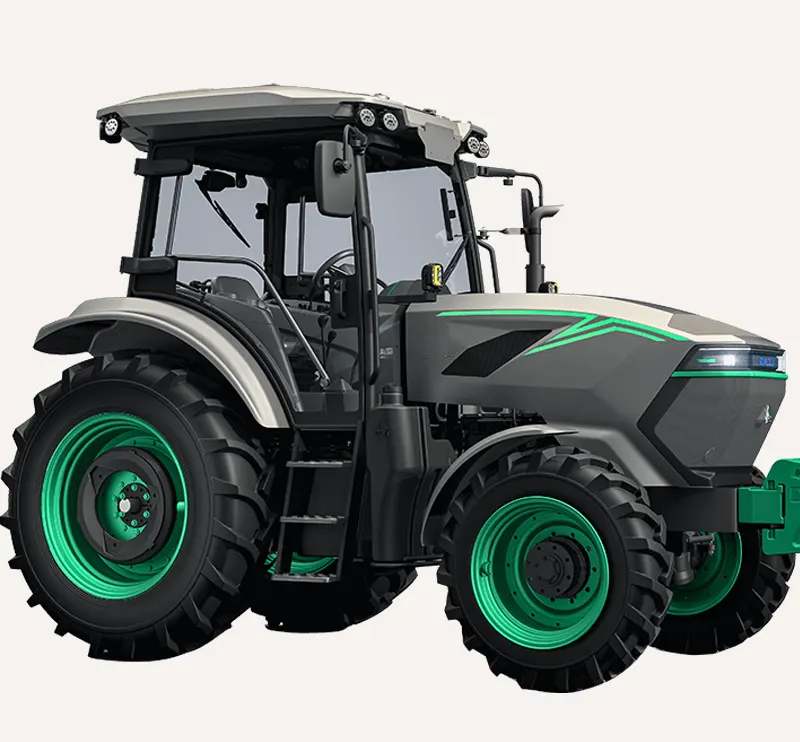
CVT tractors available in the Korean commercial sector in the relevant power class:
Fendt Vario
700/800 Vario series
Full CVT (Vario transmission)
New Holland AutoCommand
T7 AutoCommand series
CVT with full creep speed
John Deere DirectDrive / IVT
6R/7R IVT models
Infinitely variable transmission
Case IH Optum CVX
Optum CVX series
Continuously variable
CLAAS AXION
800 series with CMATIC
Full CVT transmission
The Complete Watanabe Stone Crusher Range — Finding Your Position
The four Watanabe stone crusher models cover the full range of Korean agricultural, forestry, and road construction applications:
180 HP · Standard tractor · 2.4 m · Kit Drawbar
Orchards, ginseng, mountain slopes, farm roads, mixed agricultural clearing — the most versatile Korean model
230 HP · Standard tractor · 3.0 m · Drawbar Kit
Large open farmland, land development contracts, government projects — maximum throughput on open terrain
CVT mandatory · Forestry rotor · Stump & rock
Silviculture, plantation management, 임도 construction, stump processing — forestry-specific applications
250 CV CVT · 0–200 mm milling · Road stabilization
Rural road rehabilitation, soil stabilization — road construction specialist, not a stone crusher
Frequently Asked Questions — THOR FLM
Can the THOR 2.4 process stumps if I don’t have a CVT tractor?
The THOR 2.4 can process small stumps (below approximately 20–25 cm diameter) and light root networks — particularly from scrub vegetation, shrubs, and saplings. It was not designed for processing large timber stumps (above 30–40 cm diameter) or dense root networks from established forest stands. Operating the THOR 2.4 on large stumps at speeds above the THOR FLM’s designed creep-speed approach creates overload shock conditions the agricultural machine was not designed for. For operations with occasional small stumps mixed into primarily agricultural stone clearing, the THOR 2.4 is adequate. For operations where stump and root processing is a significant proportion of the work, the THOR FLM is the appropriate machine.
Are Korean KFS silviculture contracts eligible for machinery support programs?
Korea Forest Service and provincial forestry bureau contracts (임도 공사, 산림 정비) are government-funded programs that typically specify equipment requirements in the contract specification rather than providing direct machinery subsidy to contractors. However, contractors pursuing these contracts may be eligible for separate machinery leasing support through forestry contractor programs (산림사업 종합자금 융자) administered by KFS or the Korea Federation of Forestry Cooperatives (산림조합중앙회). Eligibility and loan terms change annually — confirm current program availability with your regional forestry cooperative before bid submission. We can provide THOR FLM technical documentation to support forestry equipment financing applications.
Is the THOR FLM in Korea local stock?
Contact Korea Watanabe directly for current THOR FLM stock status. Given its specialised application — forestry and silviculture rather than mainstream agricultural stone clearing — stock levels and delivery lead times differ from the THOR 2.4 and THOR 3.0 agricultural models maintained in regular local inventory in Ansan-si. For forestry season project planning, initiate stock confirmation and ordering 8–12 weeks before intended field deployment, particularly for KFS contract timelines that may have fixed project start dates.
How does the THOR FLM handle Korean winter forestry conditions?
Korean highland forestry work — particularly in Gangwon-do and North Gyeongsang — is conducted in temperatures ranging from -15°C to 30°C across the operational calendar. The oil cooling system that maintains the THOR FLM’s transmission at correct operating temperature in hot summer conditions also serves to maintain oil viscosity in cold conditions: cold-start operation in winter requires warming up the machine (idling PTO at low speed before applying full working load) to allow the oil to reach operating viscosity before full stump-processing demands are placed on the transmission. This cold-start protocol — standard for all oil-lubricated heavy equipment in Korean winter conditions — prevents cold-oil viscosity-related transmission wear at startup.
Forestry or Silviculture Operation? Let’s Confirm the Right Model.
Describe your site (stump density, tree species, terrain slope, typical stone content) and your CVT tractor model — we confirm whether the THOR FLM or the standard THOR 2.4 is the appropriate specification for your specific Korean forestry or silviculture application.
Editor: Cxm