Australia is the fifth-largest potato-producing country in the southern hemisphere and home to three distinct potato-growing landscapes, each with its own geological character, irrigation dependency, and farm-scale profile that determines which machinery specification is appropriate. Tasmania — producing over 30% of national supply from the Northern Midlands, Circular Head, and Huon Valley — is the most mechanically demanding environment for potato machinery in Australia, and arguably the most demanding in the southern hemisphere, because of the Jurassic Tasman dolerite formation that underlies the productive flat country of the Northern Midlands potato belt. Mainland production centres in South Australia (Kangaroo Island, Virginia, Paringa), Victoria (Thorpdale, Koo Wee Rup), and Queensland (Atherton Tablelands) each present different stone types and profiles that require different equipment specifications. Understanding the geology is the prerequisite for specifying the correct Korea Watanabe mesin kentang and stone clearing system for each Australian growing context.
This guide covers the three aspects of Australian potato machinery specification that are specific to the country’s conditions: the dolerite stone challenge and its consequences for machinery selection, the long-term economics of stone clearing in a low-frost-heave environment, and the interaction between irrigation-dependent production and sub-surface stone management. It concludes with a tractor-to-machinery matching guide for the 40–120 HP range most common on Australian small to medium potato farms.
Tasmanian Dolerite — The Hardest Commercial Potato Stone in this Guide
The Tasmanian dolerite is a Jurassic-age mafic intrusive rock that forms the tabletop plateaus and cliff faces that characterise the island’s highland landscape — most visibly in the Organ Pipes formation near Hobart and the Walls of Jerusalem in the Central Highlands. The same geological formation that created these iconic features also underlies the agricultural flat country of the Northern Midlands potato belt between Launceston and Campbell Town: the thin red clay soils over shallow dolerite bedrock, with dolerite fragments at 8–20 cm depth across the majority of the cultivated area. At Mohs hardness 6–7, Tasmanian dolerite is harder than all limestone (Mohs 3–4), harder than sandstone (Mohs 4–5), harder than most granite (Mohs 6–6.5), and equal to quartz — which is the threshold above which hardened boron steel begins to lose material progressively on each contact event rather than deflecting the stone as it does with softer rock types.
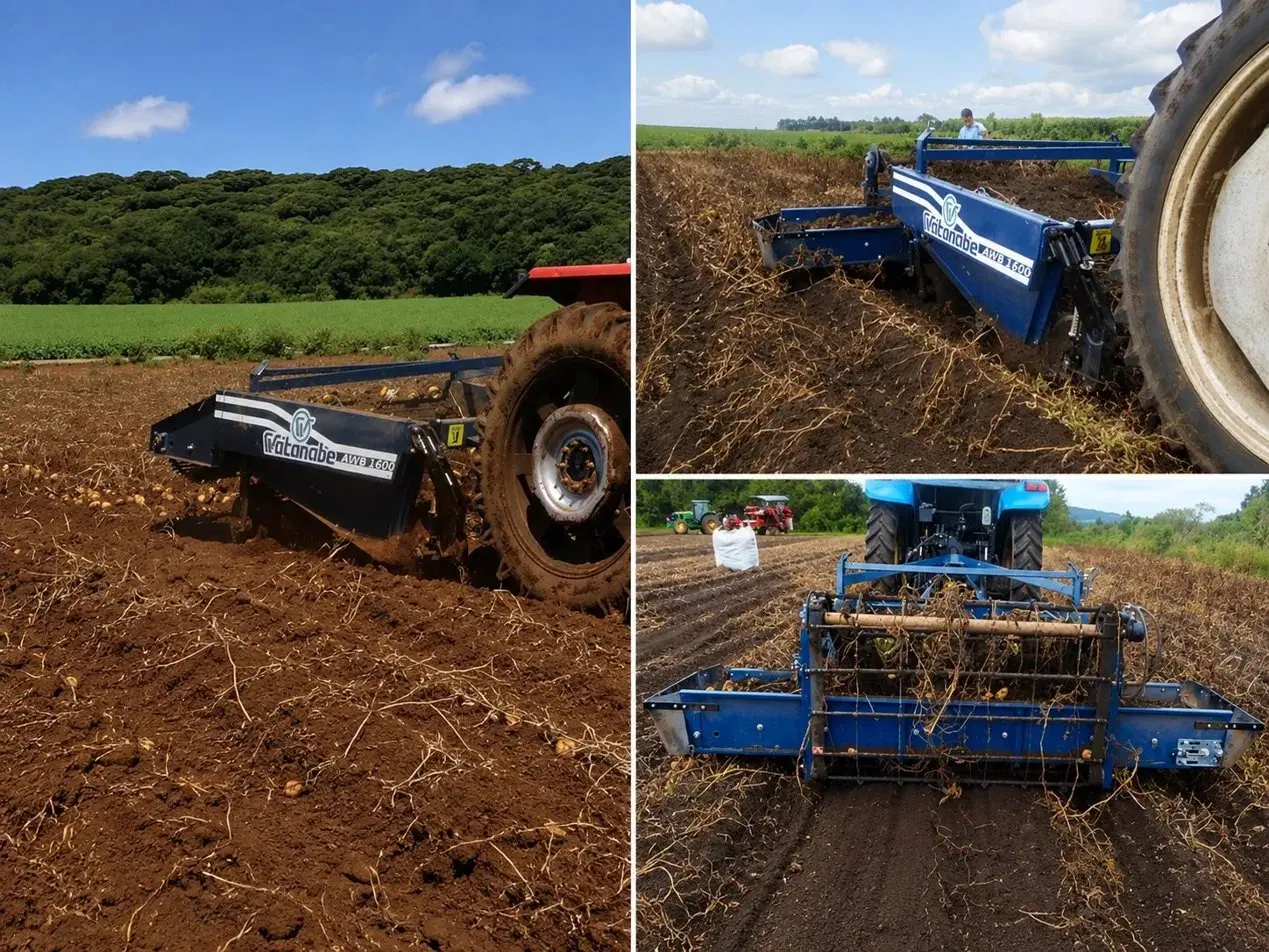
The practical consequence for potato digger operation on Tasmanian dolerite land: digging share replacement every 5–10 ha, compared to 60–100 ha on cleared sandy loam. The 5–10 ha figure — documented by Northern Midlands potato producers and confirmed by the Tasmanian Institute of Agriculture’s machinery agronomy studies — is the most extreme share wear interval in the global potato machinery guide series. It is the result not just of the stone’s hardness but of the fragment geometry: dolerite breaks into angular fragments with sharp fracture faces (conchoidal fracture pattern) rather than rounded forms, and it is these angular edges that cut into the share’s leading face progressively at each contact event.
| Wilayah |
Jenis Batu |
Mohs |
Severity |
THOR Spec |
| Tas. Northern Midlands |
Jurassic dolerite |
6–7 |
Extreme |
THOR 3.0 @ 20–28 cm |
| Tas. Circular Head |
Dolerite + basalt |
5–7 |
Tinggi |
THOR 3.0 @ 20–28 cm |
| SA Kangaroo Island |
Laterite + quartzite |
5–7 |
Tinggi |
THOR 3.0 @ 20–26 cm |
| Vic. Thorpdale |
Basalt + andesite |
5–6 |
Elevated |
THOR 2.4 @ 18–26 cm |
| Qld. Atherton Tableland |
Volcanic basalt |
4–6 |
Sedang |
THOR 2.4 @ 18–24 cm |
Why THOR 3.0 is Mandatory for Tasmanian Dolerite — Not Optional
THOR 2.4 limitation on dolerite
THOR 2.4 is rated for stones up to Mohs 6. At the hard end of the Tasmanian dolerite range (Mohs 6.5–7), THOR 2.4 teeth experience accelerated wear and may deflect rather than fracture large dolerite blocks. Operating THOR 2.4 in hard dolerite requires more passes and produces less consistent fragmentation than THOR 3.0.
THOR 3.0 specification
THOR 3.0 at 230 HP minimum, 600 mm rotor, 108+8 teeth — rated to ≤40 cm stone diameter at full Mohs 7 hardness. On Tasmanian dolerite: single-pass fragmentation to below 30 mm at 20–28 cm working depth. Minimum tractor: 180 HP recommended on dolerite for consistent operating speed without RPM drop through the hard zones.
Investment justification
On dolerite land: digger share replacement every 5–10 ha. A farm harvesting 20 ha/year replaces shares 2–4 times per season vs once every 3–5 seasons on cleared land. The share replacement saving alone, over a 10-year period, typically covers the THOR 3.0 investment within 3–4 years on a farm above 15 ha.
No Frost Heave — Why Clearing Lasts Longest and Costs Least in Australia
The economics of stone clearing investment are more favourable in Australia than in any other country discussed in the Korea Watanabe stone management guide series. The reason is geological and climatic: frost heave — the upward movement of sub-surface stones driven by freeze-thaw cycles in the soil — is the primary mechanism by which cleared fields in northern climates replenish their surface stone load after THOR + CT-2100 treatment. In northern Europe, Canada, and highland Asian regions, frost cycles of 50–120+ days per year push stones from depth at 1–3 cm per year, requiring THOR repeat treatments every 3–10 years depending on frost intensity. In Australia’s potato-growing regions — including Tasmania — frost events are infrequent (averaging 10–30 frost days per year in the Northern Midlands, compared to 70+ in equivalent European potato zones) and are not sufficiently sustained or deep to generate significant frost heave in the potato-growing soil profile.
The practical consequence: a THOR + CT-2100 stone clearing treatment on a Tasmanian or South Australian potato field persists for 10–15 years before annual BlackBird surface passes become insufficient to maintain the cleared condition and a repeat THOR pass is warranted. Over a 15-year period, the total clearing investment (THOR + CT-2100 one time, BlackBird annually) amortises to approximately one-third of the equivalent investment in a Canadian PEI context where THOR must be repeated every 3–5 years. This combination — the highest machinery damage cost from the hardest stone type, plus the lowest annualised clearing cost from the longest treatment persistence — creates the most compelling ROI case for stone clearing investment of any country in the guide series.
Without Stone Clearing — Tasmanian Dolerite Farm
- ▸Digger shares: 2–4 sets per season (every 5–10 ha)
- ▸Elevator chain incidents: 3–6 per 100 ha
- ▸Gearbox shock risk: moderate–high every season
- ▸Tuber bruising: elevated (stone-potato elevator contact)
After THOR 3.0 + CT-2100 — Same Farm
- ▸Digger shares: 1 set per 3–5 seasons (60–100 ha)
- ▸Elevator chain incidents: 0–1 per 100 ha
- ▸Gearbox shock risk: very low
- ▸Treatment persistence: 10–15 years before re-THOR
Annual Maintenance — BlackBird Surface Pass
Even without frost heave, Australian potato fields resurface small stones through cultivation disturbance and irrigation erosion each season. An annual Penggaruk batu BlackBird pass before the spring cultivator and a second pass 4–6 weeks before harvest are sufficient to maintain the cleared condition between THOR cycles. At 9.5 m working width and 10–12 km/h, a 10 ha field is covered in under 3 hours per pass.
Irrigation-Dependent Production — How Stone Interacts With Water Management
Australian potato production is more irrigation-dependent than in any other country in this guide. Tasmania’s Northern Midlands receives 450–600 mm of annual rainfall — well below the 650–900 mm required for consistent potato yield without supplemental irrigation — and most mainland production zones are drier still. Overhead irrigation (centre-pivot and linear move sprinklers) and sub-surface drip systems are standard across the industry. This irrigation dependency creates two specific stone management challenges that are largely absent from rain-fed potato production in Europe and Canada.
1
Stone Concentration by Irrigation — Progressive Surface Accumulation
Overhead irrigation in stony potato fields creates a gradual stone concentration problem that worsens each season. When a sprinkler applies 25–40 mm of water over a stony surface, the water mobilises fine soil particles — clay, silt, and fine sand — and moves them through the soil profile via preferential pathways between the larger stone fragments. The stones themselves are immobile. Over multiple irrigation cycles across multiple seasons, the cumulative effect is a progressive reduction in the fine fraction around each stone surface and a relative increase in stone concentration in the inter-stone matrix. On fields that were initially at 5–7 stones/m² at the warranty threshold boundary, irrigation-driven fine-fraction leaching can bring the surface concentration above the 10/m² critical threshold within 5–8 seasons of irrigation without intervening stone management. A field that was initially borderline for digger safety progressively crosses into the warranty-voiding zone without any new stones entering the field — the existing stones simply become more concentrated near the surface as the fine fraction is washed around them.
Management response
Annual BlackBird surface pass before harvest removes the concentrated surface layer that irrigation has assembled. On fields with overhead irrigation and initially moderate stone density, the BlackBird pass frequency may need to increase to twice annually (pre-planting and pre-harvest) to maintain surface stone below the warranty threshold.
2
Preferential Water Flow Along Stone Surfaces — Uneven Tuber Moisture
The second irrigation-stone interaction operates at the sub-surface level and affects crop quality rather than machinery. When drip or sub-surface irrigation applies water to a stony profile, the water preferentially follows the surface of each stone rather than distributing uniformly through the soil matrix — because water moves along the stone-soil interface by capillary flow at a rate faster than through the bulk soil pore system. This creates uneven moisture distribution in the potato tuber zone: the zones immediately adjacent to larger stones receive water earlier and at higher volume than the zones between stones. The developing tubers are not uniformly spaced relative to these moisture heterogeneities. The agronomic consequence: tuber clusters that develop in high-moisture zones adjacent to stones grow faster in the early bulking phase (when moisture is the primary growth rate control) and then experience a relative drought when the drip cycle ends and the high-conductivity stone-surface water moves away. This intermittent moisture cycle — rapid wetting then rapid drying at the stone interface — is the documented cause of growth crack formation in the potato tuber skin and hollow heart (internal void development from rapid cell expansion followed by shrinkage). Both defects are Grade 1 failures at the pack house and are irreversible once formed. Stone clearing by THOR + CT-2100 removes the stones that create the preferential flow pathways, restoring uniform moisture distribution in the drip-irrigated tuber zone.
Quality defects prevented
Growth cracks (skin rupture from uneven expansion) and hollow heart (internal void from moisture cycling) — both Grade 1 failures, both caused by the stone-surface preferential water flow in sub-surface drip-irrigated fields. Both prevented by sub-surface stone clearing with THOR + CT-2100.
Tractor Matching — Australian Farm Scales and HP Range
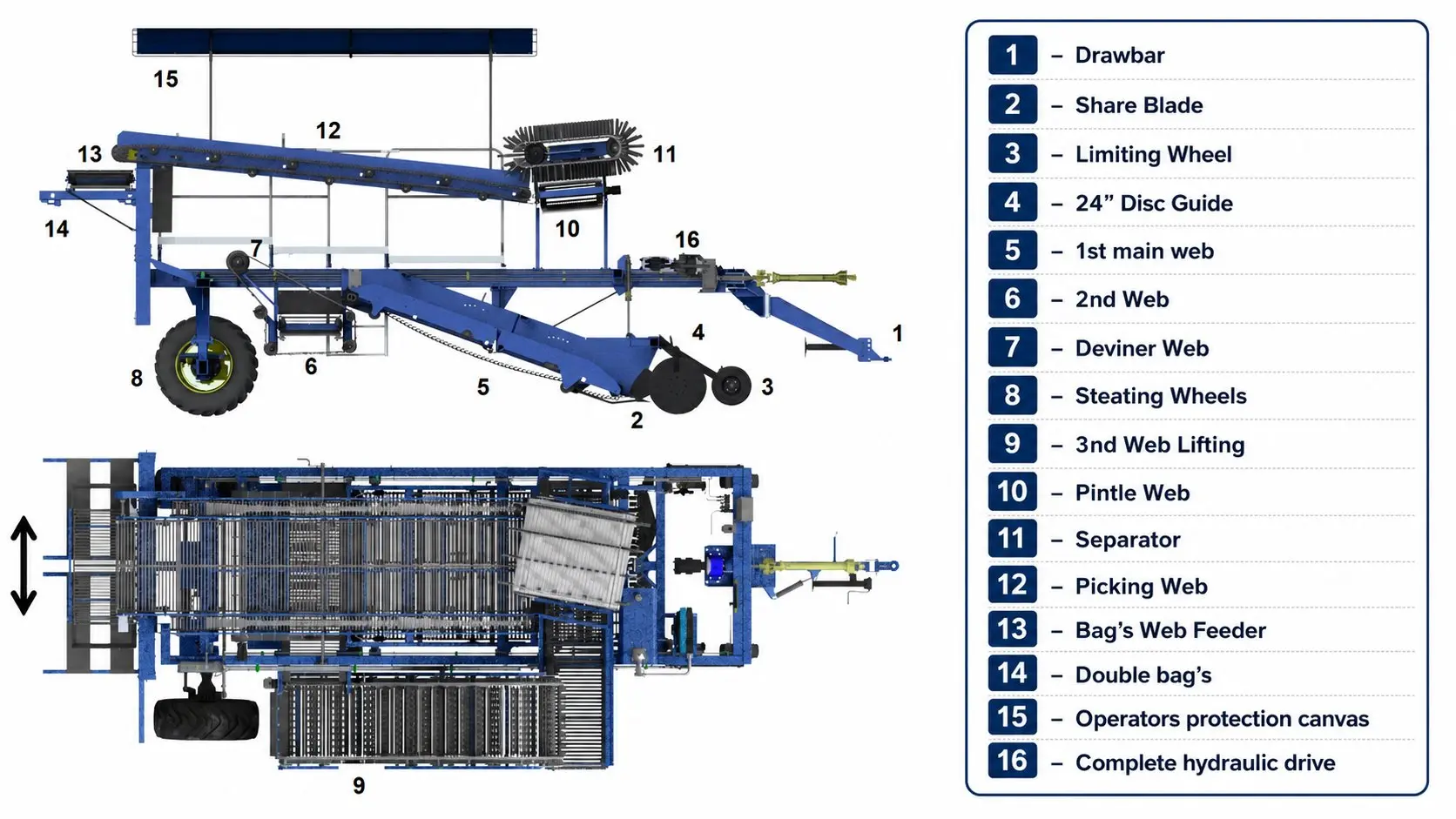
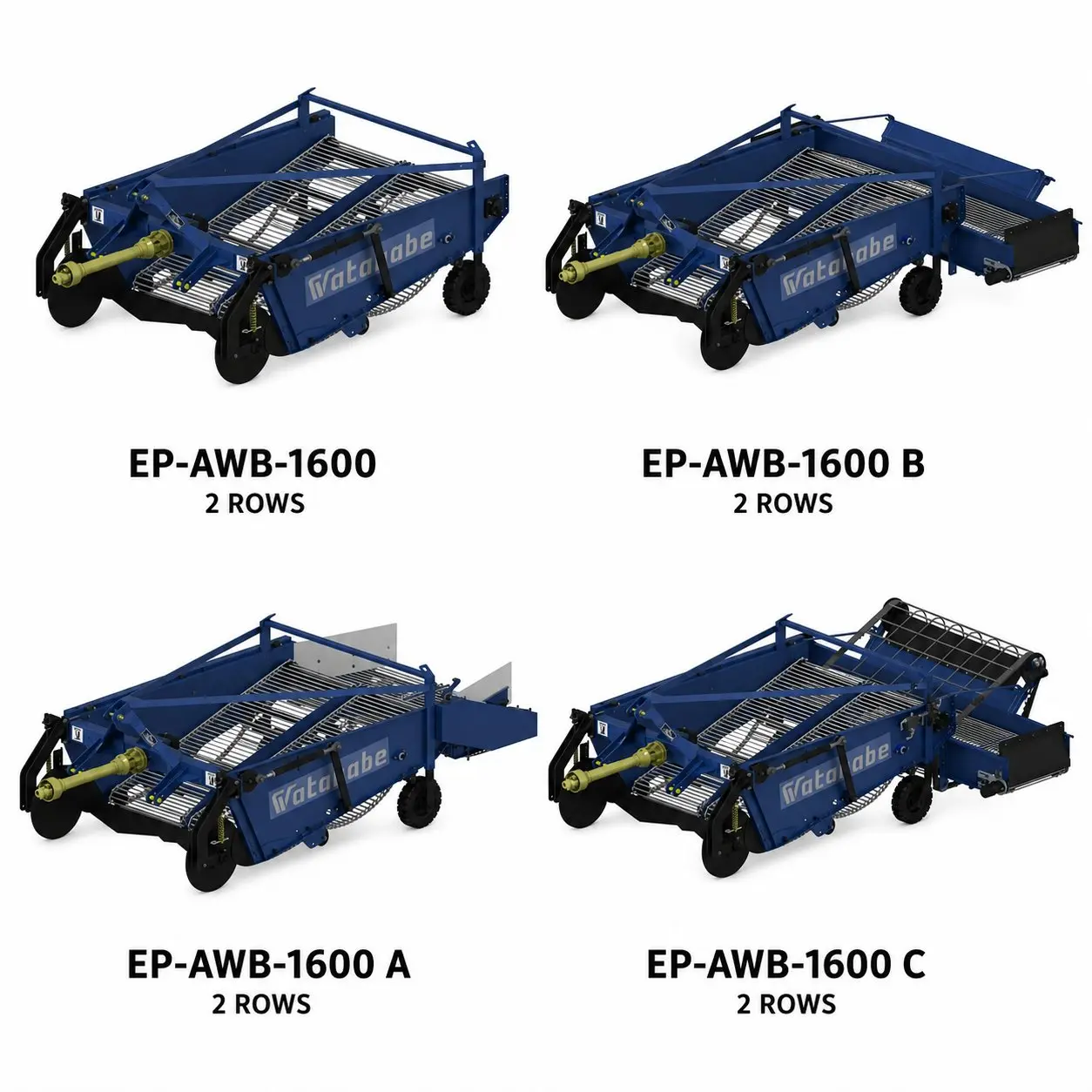
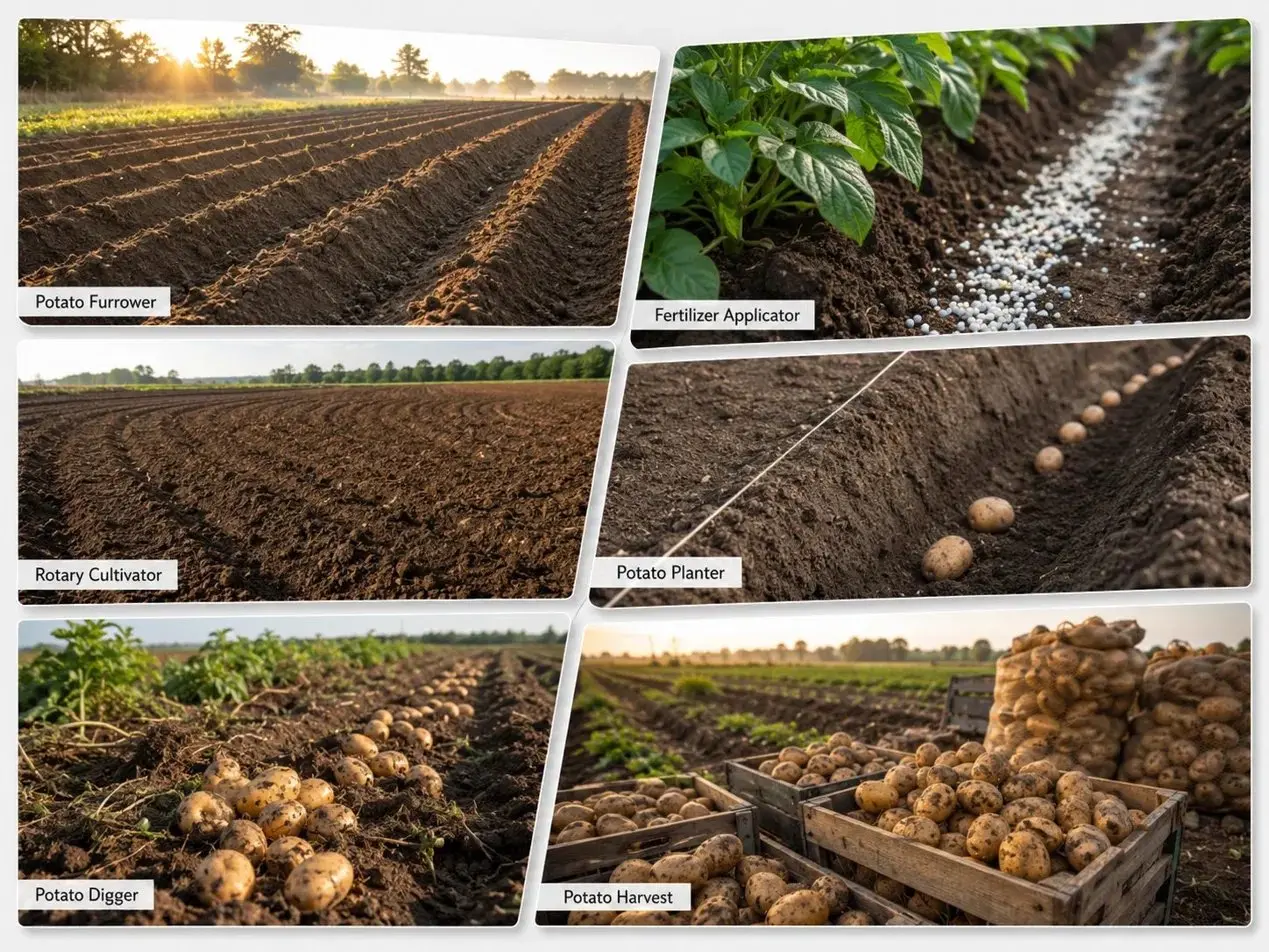
Australian small to medium potato farms are characterised by a broader HP range than equivalent European operations of the same planted area. The legacy of Australian farm mechanisation — where multi-purpose tractors handle both cropping and livestock operations — means that the tractor used for potato planting on a 15 ha Tasmanian farm is often a 100–130 HP machine sized for the grazing operation, which more than adequately covers all Korea Watanabe potato machinery requirements. The following matching guide is calibrated to the common tractor sizes encountered across Australian potato farms:
| Traktor HP |
Potato Machines Covered |
Stone Clearing |
Skala Pertanian |
| 40–60 HP |
Rotary cultivator, furrower, fertiliser applicator, planter, mounted digger |
BlackBird + CT-2100 only. THOR requires larger tractor — contractor hire recommended |
1–5 ha |
| 60–90 HP |
All planting and harvest machines. Mounted digger optimal |
THOR 2.4 operable for limestone/basalt zones. THOR 3.0 on dolerite requires contractor or tractor upgrade |
5–12 ha |
| 100–140 HP |
Full system including trailed digger. Recommended for 15 ha+ in Tasmania |
THOR 2.4 full specification. THOR 3.0 marginal — 140+ HP recommended for dolerite |
12–25 ha |
| 150–200 HP |
Full system. Trailed digger preferred. Tasmanian dolerite standard specification |
THOR 3.0 full specification on dolerite and all hard stone types. Recommended minimum for Tasmanian Northern Midlands |
25 ha+ |
Pertanyaan yang Sering Diajukan
Q
Does the Huon Valley in southern Tasmania have the same dolerite stone problem as the Northern Midlands, or is the geology different?
The Huon Valley’s potato and mixed horticulture land sits on a different geological profile from the Northern Midlands. The Huon Valley is underlain primarily by Precambrian schist and quartzite (the Tyennan Basement complex) with dolerite intrusions occurring as dykes and sills rather than the broad tabletop formations of the Northern Midlands. The resulting stone type in the Huon Valley agricultural soils is predominantly quartzite and schist fragments (Mohs 5–7) with angular profiles — similar hardness to Northern Midlands dolerite at the hard end of the quartzite range, but different fracture geometry. Quartzite tends to produce flatter, plate-like fragments rather than the angular conchoidal-fracture fragments of dolerite, which causes a different pattern of share wear (edge dulling predominantly, rather than tip chipping). The THOR 3.0 specification applies to both regions; the CT-2100 permanent collection is important in both. Huon Valley farms should have a geology-specific consultation with Korea Watanabe before specifying clearing depth, as the depth of the quartzite-schist stone layer varies considerably across Huon Valley sub-catchments.
Q
For a small Tasmanian farm of 8–12 ha without a 150+ HP tractor, is it practical to hire THOR 3.0 clearing as a contracting service?
Agricultural contracting for specialist stone clearing is a well-established service model in Australian potato growing regions, particularly in Tasmania where the dolerite stone challenge is widely understood by the farming community. Korea Watanabe’s dealer and service network in Tasmania can advise on contractor availability for THOR 3.0 stone clearing services in the Northern Midlands and Circular Head regions. The contracting model is particularly suitable for small farms (5–15 ha) that need THOR 3.0 capability for the one-time deep clearing operation but do not justify farm ownership of a 150+ HP tractor solely for the clearing task. Because the THOR + CT-2100 treatment persists for 10–15 years in the Australian low-frost-heave environment, the contracting cost is amortised over a 10–15 year period — which typically makes the per-hectare per-year cost of contracted clearing comparable to or lower than annual machinery repair costs on uncleared dolerite land. For the CT-2100 permanent collection and the annual BlackBird surface passes, the farm’s own tractor at 60–100 HP is fully adequate — these operations do not require the tractor HP that the THOR 3.0 demands.
Q
How does South Australia’s Kangaroo Island stone profile compare to Tasmania, and is the same equipment specification appropriate?
Kangaroo Island’s agricultural soils sit on a different geological base from Tasmania — the island’s potato-growing country occupies the plateau country in the west and centre, underlain by Precambrian basement granite and Cambrian quartzite with a laterite surface cap in the plateau zones. The quartzite and laterite combination at Mohs 5–7 creates a stone profile that is somewhat softer than Northern Midlands dolerite on average but still in the High severity category requiring THOR 3.0 specification. The key difference: Kangaroo Island has a much lower total stone volume per hectare than the Northern Midlands — the stone is present at similar depth but at lower density within the soil profile. This means THOR 3.0 is required for hardness reasons but the CT-2100 bunker fills less frequently per hectare than on equivalent Tasmanian farms. The per-hectare investment in clearing is somewhat lower on Kangaroo Island than in Tasmania. The irrigation interaction argument (Section 3) is particularly relevant on Kangaroo Island, where the island’s semi-arid climate (400–550 mm annual rainfall) makes irrigation more intensive and the stone-to-irrigation-water interaction more pronounced than in wetter Tasmanian conditions.
Q
What is the correct harvest window management for Australian potato farms, and does the trailed vs mounted digger decision apply differently than in northern hemisphere operations?
Australian potato harvest seasons operate in the southern hemisphere summer and autumn — typically January through May for main-crop production in Tasmania and South Australia, with Queensland Atherton Tablelands harvesting from June through September. The harvest window principle (14–21 days after haulm destruction for skin set before harvest) applies identically to Australian production as to northern hemisphere operations. The key difference that affects the trailed vs mounted digger decision: Australian summer harvest weather is drier on average than UK or Canadian harvest conditions, and the risk of harvest interruption by rainfall-induced soil moisture excess is lower. This means the wet-soil operating advantage of the trailed digger (its ability to continue harvesting in high soil moisture conditions where the mounted digger stops) is less commercially important in most Australian harvest seasons than in Scottish or Canadian conditions. The throughput argument for the trailed digger (1.5–2.5 ha/h vs 0.5–0.8 ha/h) remains fully applicable — 15+ ha operations benefit from the trailed digger’s harvest window margin regardless of weather. But the decision threshold for upgrading from mounted to trailed is driven more by scale (area per season) than by soil moisture risk in Australian conditions, which is the opposite emphasis from the UK market guide.
Q
Are there any Australian or Tasmanian government programmes that support stone management equipment investment on small potato farms?
Australian agricultural support programmes for machinery investment have varied significantly between federal budgets and state government agricultural development programmes. At the federal level, the Australian Taxation Office’s Instant Asset Write-off provisions have historically allowed small to medium businesses (including farms) to immediately deduct the cost of eligible depreciating assets rather than claiming depreciation over multiple years — the specific threshold and eligibility criteria change each budget cycle and should be confirmed with a tax adviser in the current year of purchase. At the state level, the Tasmanian Department of Natural Resources and Environment Tasmania (NRE Tas) and the Tasmanian Institute of Agriculture (TIA) periodically run productivity improvement grant programmes for the potato industry, some of which have been explicitly targeted at infrastructure and equipment investment for small farms. Agri-food businesses in South Australia can enquire with the Primary Industries and Regions SA (PIRSA) about the Agricultural Industry Development Fund. Korea Watanabe recommends that Australian buyers contact their state’s primary industries department for current programme information before finalising equipment purchase timing, as the grant calendar often creates periods of higher funding availability that align well with the autumn clearing and pre-planting equipment procurement window.
Korea Watanabe — Australia
Australian Potato Machinery — Specified for Your Region, Stone Type and Farm Scale
Growing region + stone type + tractor HP + irrigation system + farm area → Korea Watanabe specifies the correct penghancur batu, pemetik batu, Dan mesin kentang combination for Australian conditions, including the dolerite-specific THOR 3.0 clearing programme for Tasmanian farms.
Korea Watanabe Rock Crusher Tractor Co., Ltd. · Ansan-si, Gyeonggi-do
Editor: Cxm