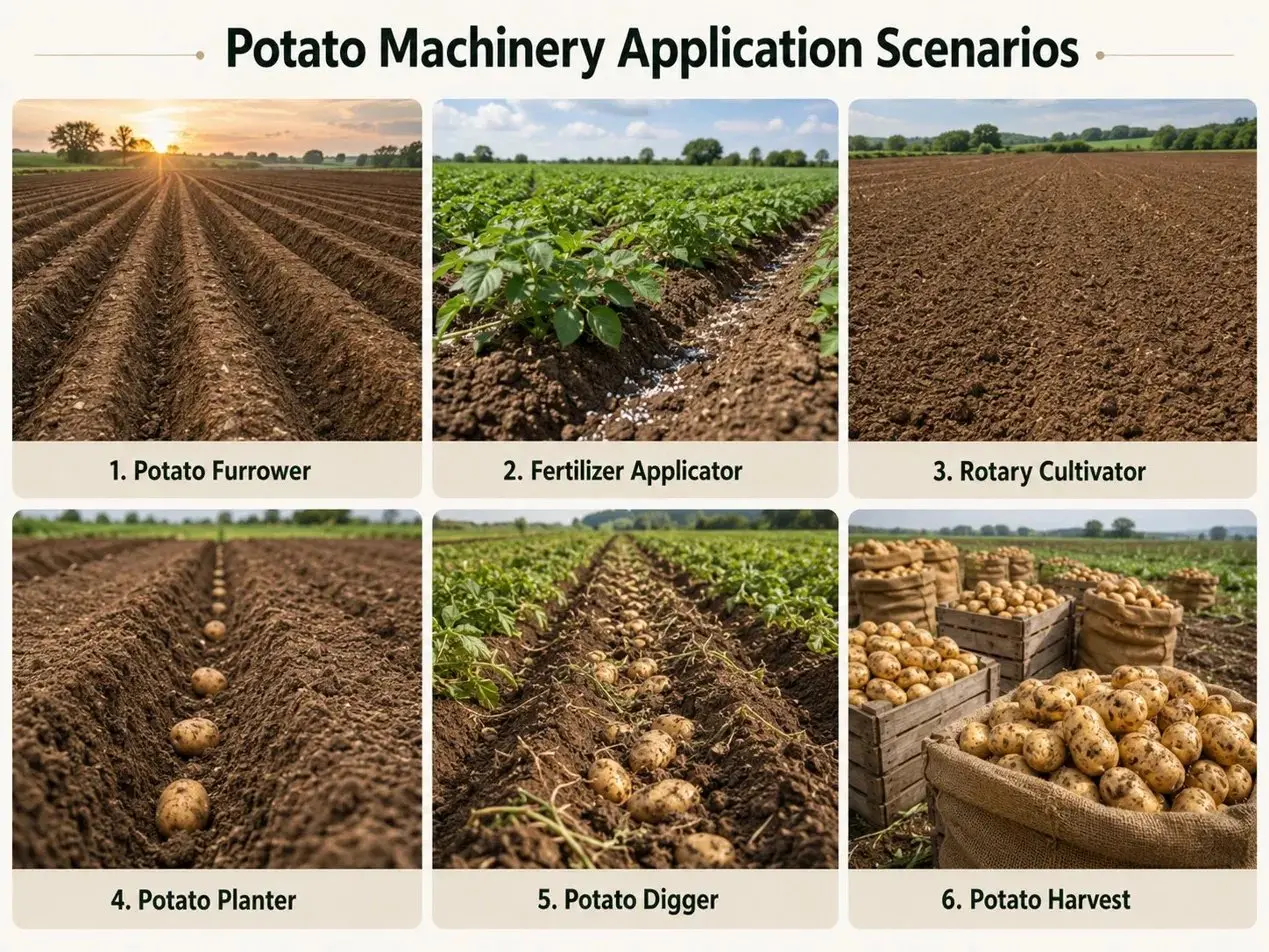
Potato production is the most mechanically sequential of all root vegetable crops. Unlike cereals — where a single drill can combine seedbed preparation and seeding — the potato requires a distinct machine for each production stage: the seedbed must be prepared to a specific fine tilth, the ridges formed to an exact geometry, the seed placed at a calibrated depth and spacing, the fertiliser placed in the correct position relative to the seed, and the mature tubers lifted and cleaned in a single smooth harvest operation. Each machine’s output is the input condition for the next machine’s performance. A rotary cultivator that leaves large clods creates irregular beds that cause the furrower to slip; a furrower that produces inconsistent ridge heights causes the planter’s depth sensors to lose track of the soil surface; a planting depth error of 3 cm changes the digger’s share depth requirement — which, uncorrected, causes tuber losses in the harvest. This sequential dependency is why potato machinery works best when selected and specified as a coordinated system.
This guide covers Korea Watanabe’s complete आलू बनाने की मशीनरी range — six machines across five seasonal stages — alongside the stone management prerequisite that determines whether all six perform at their designed specification.
The Six-Machine System — One Season at a Glance
1
Rotary Cultivator
Autumn or early spring
Prepares the seedbed to a fine, even tilth — 0–30 mm clod size — that the furrower can form into uniform ridges. Working depth 18–25 cm at 540 RPM PTO. Poor tilth here propagates errors through every subsequent stage.
2
Potato Furrower
Pre-planting
Forms planting ridges with consistent height, width, and row spacing. Ridge geometry determines tuber growing space, drainage, and — critically — the digger’s depth reference at harvest.
3
Fertiliser Applicator
Pre-planting or at planting
Places basal fertiliser at the correct depth and offset from the seed. Placement precision — not application rate — is the primary quality variable at this stage. Often combined with furrowing in a single pass.
4
Potato Planter
Planting season
Places seed potatoes at calibrated depth and in-row spacing with low miss-plant and double-plant rates. Spacing consistency determines stand uniformity and final yield distribution across the field.
5
Potato Digger — Mounted
Harvest — up to 15 ha
Single-row PTO-driven mounted harvester at 40–80 HP. Share, elevator chain, and side riddle perform three-stage soil-tuber separation. Optimal for farms up to 15 ha where the 14-day harvest window can be met.
6
Potato Digger — Trailed
Harvest — above 15 ha
High-capacity trailed harvester at 1.5–2.5 ha/h with offset tractor path and independent running gear. Extends usable harvest days in wet clay. Essential for operations above 15 ha to maintain harvest window margin.
The Dependency Chain — Why Sequence Matters
Tilth Quality
→
Ridge Geometry
→
Planting Depth
→
Fertiliser Position
→
Digger Share Depth
→
Grade 1 Output
A 3 cm error at any step propagates forward. Machines specified and calibrated together eliminate accumulated error across the chain; machines purchased and configured independently accumulate it.
Stage 1 — Soil Preparation: Rotary Cultivator
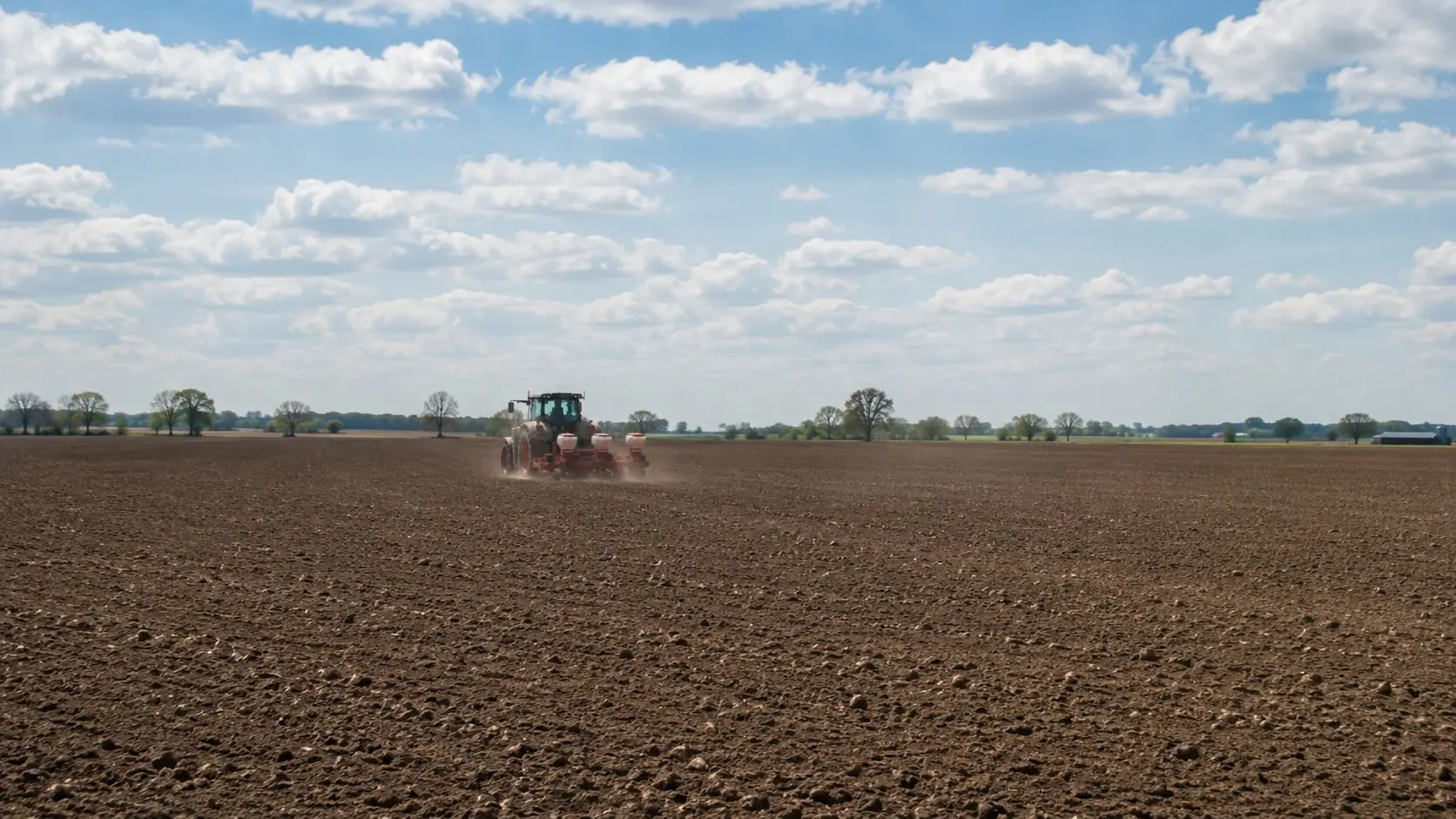
The rotary cultivator is the first machine in the potato production sequence and the one whose output quality most amplifies or limits every subsequent machine’s performance. A seedbed that meets target specification — 85% of aggregates at 0–30 mm, maximum 50 mm, working depth 18–25 cm — gives the furrower a homogeneous medium to form consistent ridges from. A seedbed with large clods (>50 mm) and variable depth creates irregular ridge profiles that translate into planting depth variation, waterlogged zones within ridges, and — most significantly — harvest depth variability that causes tuber losses at the digger share. The Korea Watanabe rotary cultivator is designed for the 40–80 HP range at 540 RPM PTO across working widths from 1.5 m through to 2.5 m.
Rotor speed and forward speed are the two primary operating adjustments. High rotor speed at low forward speed produces the finest tilth but the highest power demand — appropriate for heavy clay or compacted soils. Moderate rotor speed at moderate forward speed is standard for sandy loam and structured clay soils in spring condition. Stone risk at this stage matches the harvest stage: rotary cultivator tines operating at 18–25 cm through stony soil chip, break, and shear in the same way as digger shares and elevator chains. A THOR + CT-2100 stone clearing operation completed in autumn protects the cultivator in spring, the furrower at planting, and the digger at harvest — a single clearing investment that benefits all three machines in the sequence.
Stage 2 and 3 — Bed Formation and Fertiliser Placement
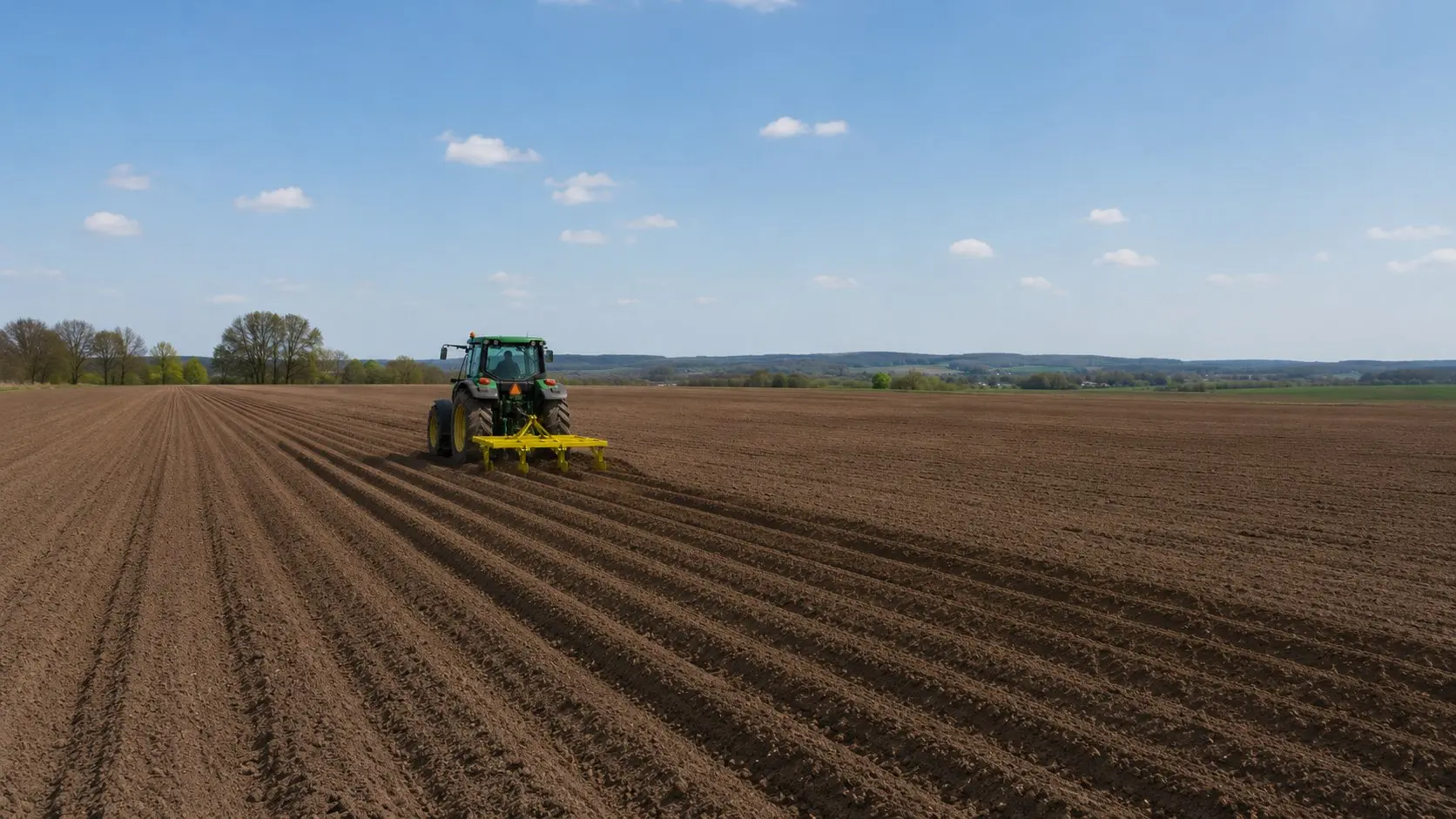
Potato Furrower — Ridge Geometry and Digger Reference
The furrower forms ridges whose geometry — height, crown width, shoulder slope angle, and row spacing — determines every subsequent machine’s operating parameters. Standard commercial ware potato ridge: height 20–25 cm, crown width 180–220 mm, shoulder slope 45–55°, row spacing 750 mm, 850 mm, or 900 mm (match to variety and market spec). The ridge crown height recorded at formation is the direct reference for the digger’s gauge wheel depth setting at harvest. Record the measured crown height in writing at planting; a missed or incorrect reference at harvest is the most common cause of operator-induced tuber loss on systematically managed potato farms.
Key Data to Record at Furrowing
Ridge crown height (mm), target planting depth from crown (mm), row spacing (mm). These three numbers are the calibration inputs for the planter and the digger.
Fertiliser Applicator — Placement Precision Over Rate
The Korea Watanabe fertiliser applicator places basal phosphate and potassium at 5–8 cm below and 5 cm lateral offset from the seed position. This placement creates a nutrient zone the developing root system intercepts within 10–14 days of emergence — earlier than broadcast fertiliser reaches availability through soil moisture movement. The placement advantage is a quality and efficiency argument, not a rate argument: the same nutrient quantity placed correctly produces better early establishment than a higher rate applied incorrectly. Metering wheel calibration must be verified against a collection tray before each field — drift from worn components is the most common cause of uneven establishment on otherwise well-managed fields.
Combined Operation Option
Furrower-applicator combinations allow simultaneous ridge formation and fertiliser placement in a single tractor pass — reducing field journey count and associated soil compaction on the working surface before planting.
The System Prerequisite — Stone Management Enables All Six Machines
Stone management is not one of the six potato machines described in this guide. It is the prerequisite condition that determines whether all six perform at their designed specification. No other crop machinery system has this structure: a separate equipment category whose output is the operating environment for all subsequent machines. Cereal drills, combine harvesters, sugar beet harvesters, and vegetable planters all operate in the soil they encounter. Potato machinery — working at the 15–25 cm depth where stone concentration is highest and tubers are most vulnerable — is uniquely dependent on the stone status of the root zone it operates in.
①
थोर रॉक क्रशर — Deep Clearing at Cultivator Depth Plus 3–5 cm
Operated once before planting — typically in autumn — at 22–30 cm, covering the operating depth of all six potato machines simultaneously. THOR 2.4 for limestone and sandstone (Mohs 3–5); THOR 3.0 for granite, quartzite, and dolerite (Mohs 6–7). The sub-surface treatment persists 6–12 years — a single clearing investment that protects the cultivator, furrower, planter, and harvest digger across many production seasons.
2
सीटी-2100 रॉक पिकर — Permanent Stone Removal After THOR
After THOR fragments the sub-surface stone, the CT-2100 permanently removes the material — reducing the field’s actual stone load rather than redistributing it at smaller size. Its 3,400 kg bunker and 80 kg maximum stone handling capacity handles all commercial potato land stone types. Collected stone is repurposed as farm track or drainage aggregate.
③
ब्लैकबर्ड रॉक रेक — Annual Pre-Cultivator and Pre-Harvest Surface Pass
Frost heave and cultivation resurface small stones each season. A BlackBird pass before the spring cultivator clears the working surface for the planting stages; a second pass 4–6 weeks before harvest resets the cleared condition for the digger. At 9.5 m working width and 10–12 km/h, both passes combined take under 6 hours on 10 ha.
Machine Selection by Farm Scale — Planting, Harvest and Tractor
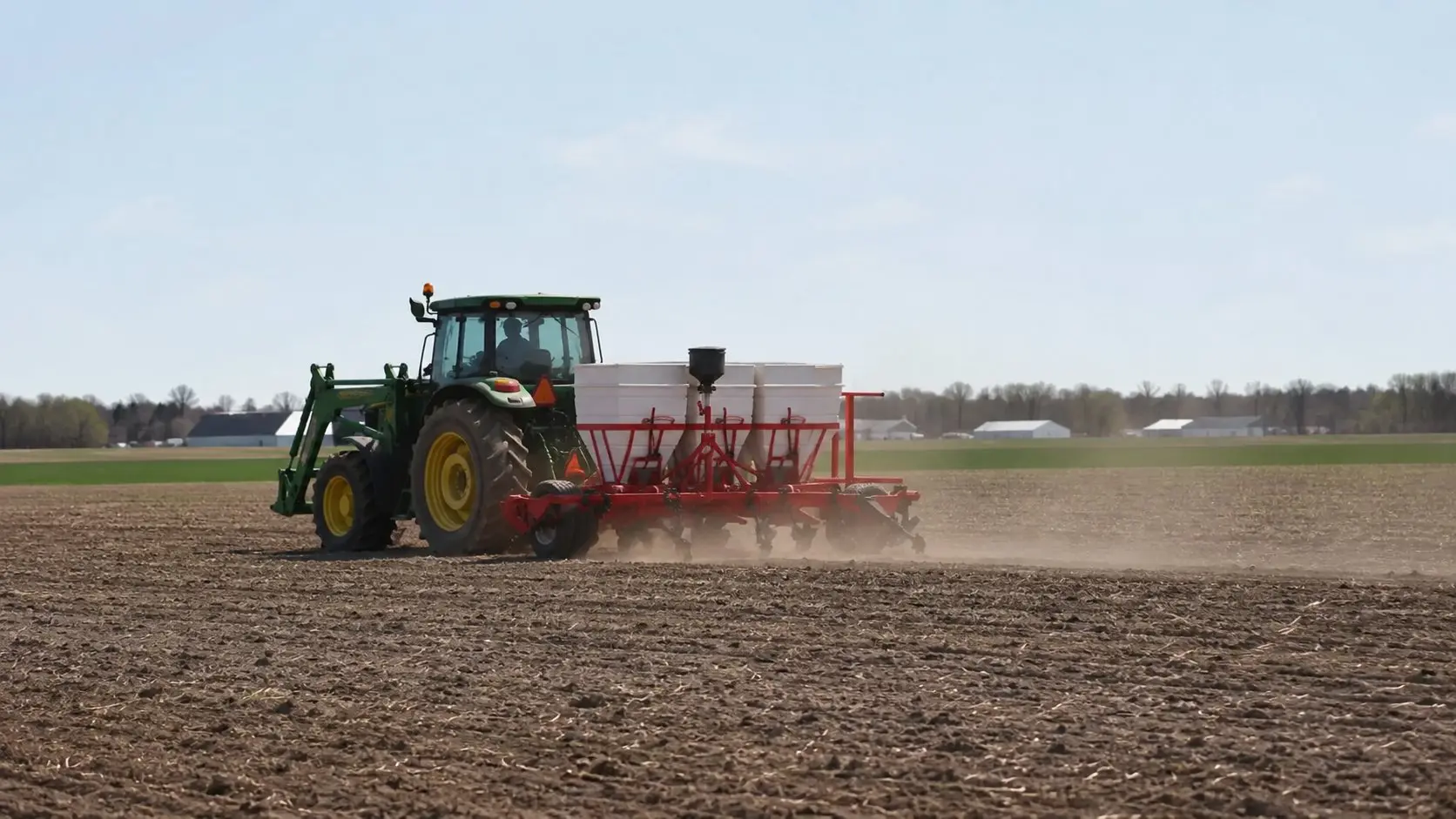
The potato planter is scale-independent in its specification: the same mechanism that places seed at calibrated depth and spacing on a 2 ha market garden operates identically on a 30 ha commercial field. The critical variable is not machine size but calibration accuracy — the miss-plant rate and double-plant rate are verified by a 20-metre test pass before each field, with target thresholds of less than 2% miss-plants and less than 1% double-plants. These rates determine stand uniformity at emergence, which in turn determines the distribution of tuber cluster positions relative to the ridge centreline — the reference that the harvest digger’s share follows at the end of the season. A planter that is calibrated at the start of the planting campaign and then left unadjusted through variable seed lot sizes, changing moisture conditions, and worn cup or belt components will drift progressively above these thresholds and produce the lateral cluster displacement that causes harvest losses at the digger.
| Farm Scale |
Tractor HP |
Harvest Digger |
Decision Driver |
| Up to 5 ha |
40–60 एचपी |
Mounted |
Compact range covers all machines; stone clearing high priority on small holdings with limited equipment redundancy |
| 5–15 हेक्टेयर |
60–80 एचपी |
Mounted |
Window workable with mounted digger on most soil types; clay soil with wet autumn conditions may justify trailed upgrade |
| 15–30 ha |
80–120 एचपी |
Trailed recommended |
Mounted gives zero weather margin in 14-day window; trailed provides 4+ contingency days; same 100 HP tractor covers THOR clearing |
| Above 30 ha |
120–160 HP |
Trailed essential |
No mounted configuration can meet throughput requirement; consider two trailed diggers for operations above 60 ha |
Single-Tractor Seasonal Schedule — 80–120 HP, 5–20 ha Potato Operation
THOR + CT-2100 — Sub-surface stone clearing (autumn, one-time)
Rotary Cultivator — Initial autumn cultivation, residue incorporation
BlackBird — Post-frost surface stone pass before spring work
Rotary Cultivator (spring pass) → Furrower + Fertiliser Applicator (combined)
Potato Planter — Seed placement at calibrated depth and spacing
BlackBird — Pre-harvest surface pass (4–6 weeks before harvest start)
Potato Digger (mounted or trailed by scale) — Harvest within 14–21 day skin-set window
अक्सर पूछे जाने वाले प्रश्नों
क्यू
Do all six machines need to be purchased together, or can they be added incrementally as the operation grows?
Incremental adoption is the typical path for most small and medium farms. The most common starting point is the harvest digger and stone clearing equipment — the two stages where stone-related machine damage and crop quality loss are most immediately costly. The furrower, fertiliser applicator, and planter follow as farms standardise input management and seek precision gains in yield and stand uniformity. The rotary cultivator is often already owned for other farm operations and is the most likely existing item in a farm’s machinery inventory. Korea Watanabe specifies and supplies any combination of the six machines alongside the stone clearing system, which integrates with whatever combination of potato machines is in use at any adoption stage.
क्यू
Why is stone clearing categorised as a system prerequisite rather than as one of the six potato machines?
Stone management equipment acts on the stone content of the root zone, creating the operating environment for the other machines — it does not perform a crop production step itself. The cultivator, furrower, planter, applicator, and digger each act directly on the soil or crop to advance its development. Without stone clearing on stony fields, none of the six production machines performs at specification: the cultivator’s tines chip, the furrower’s discs ride over stones rather than cutting cleanly, the planter struggles to achieve consistent depth, and the digger’s shares, chains, and star wheels are damaged at the rates described in detail in the stone damage guide. Stone clearing is the foundational investment that makes the performance of the other six machines predictable and consistent across many seasons.
क्यू
How does planter spacing accuracy at Stage 4 affect digger harvest loss at Stage 5?
Planter spacing accuracy affects harvest loss through the tuber cluster position argument. When in-row spacing is irregular — a mix of 250 mm and 350 mm from a high miss-plant or double-plant rate — the tuber clusters of adjacent plants extend into each other’s growing zone, creating lateral displacement of the cluster centre away from the ridge centreline. The digger’s share follows the ridge centreline at the set depth: if clusters are laterally displaced 30–60 mm from centre, the share passes beside rather than beneath some clusters, leaving tubers in the undug soil. AHDB potato agronomy trial data associates each 1% increase in miss-plant rate with approximately 0.3–0.5% increase in harvest loss on single-row digger operations. Planter calibration — verifying spacing against a measured 20-metre test row before each field — is the investment that prevents this accumulation across the full season.
क्यू
Is the Korea Watanabe potato machinery system suitable for highland and tropical growing conditions?
The range is designed for temperate commercial production but is adapted for highland tropical conditions in key respects. For Southeast Asian highland operations — Philippines Benguet, Vietnam Lâm Đồng, India Himachal Pradesh — the system is available in configurations matched to 40–60 HP compact tractors standard in those markets: narrower rotary cultivator and furrower widths, single-row planter, and mounted digger as the standard harvest machine for the 1–5 ha field sizes typical in highland Asia. The stone clearing argument is proportionally more important in highland volcanic and granite terrain than in lowland temperate production, because stone-to-yield ratios on steep highland fields mean equipment damage is more frequent per hectare than on flat fields with equivalent stone density. Korea Watanabe specifies the stone clearing equipment and potato machinery for each regional context as an integrated package.
क्यू
What is the correct procedure for transferring ridge geometry data from furrowing to harvest?
At the furrowing stage: measure and record the ridge crown height at three representative points per field (headland, mid-field, opposite headland) using a folding ruler from the inter-ridge furrow floor to the crown. Record alongside the target planting depth from the crown surface. The harvest share depth setting = (crown height at planting) + (planting depth from crown) + 3 cm clearance allowance. On fields where the crown height has been affected by hilling-up, irrigation slumping, or heavy rain settling, re-measure before harvest calibration rather than relying on the planting-stage figure. This data transfer — under 20 minutes per field to record and communicate — prevents the most common operator-induced harvest loss on systematically managed potato farms: the digger set at the wrong depth because the harvest operator did not know the actual planting depth.
कोरिया वातानाबे आलू मशीनरी
The Full System — Specified Together for Your Farm Scale, Soil and Season
Farm area + tractor HP + soil type + stone assessment → Korea Watanabe specifies the complete आलू बनाने की मशीनरी system from stone clearing through to harvest digger, calibrated to work as a coordinated sequence rather than as individual purchases.
कोरिया वतनबे रॉक क्रशर ट्रैक्टर कंपनी लिमिटेड · अंसन-सी, ग्योंगगी-डो
संपादक: सीएक्सएम