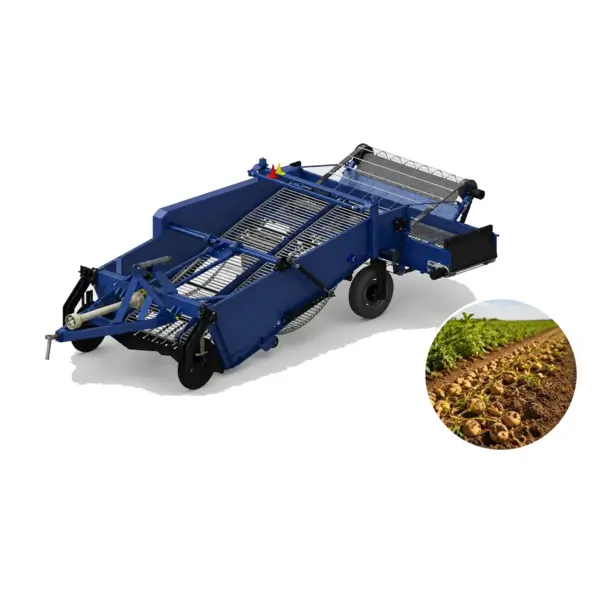
The trailed potato digger is the machine choice that marks a transition in scale — from single-row mounted operations limited by throughput and tractor weight constraints to the kind of steady, high-capacity harvesting that keeps large potato rotations commercially viable when the harvest window is short, the weather is unpredictable, and the soil is heavy. It is mechanically related to the mounted single-row digger — the same share, elevator, and separation principles — but it differs in three ways that matter at farm scale: it harvests considerably faster, it allows the tractor to drive on cleared ground rather than over the planting rows, and it continues harvesting in soil moisture conditions that stop a lighter mounted machine.
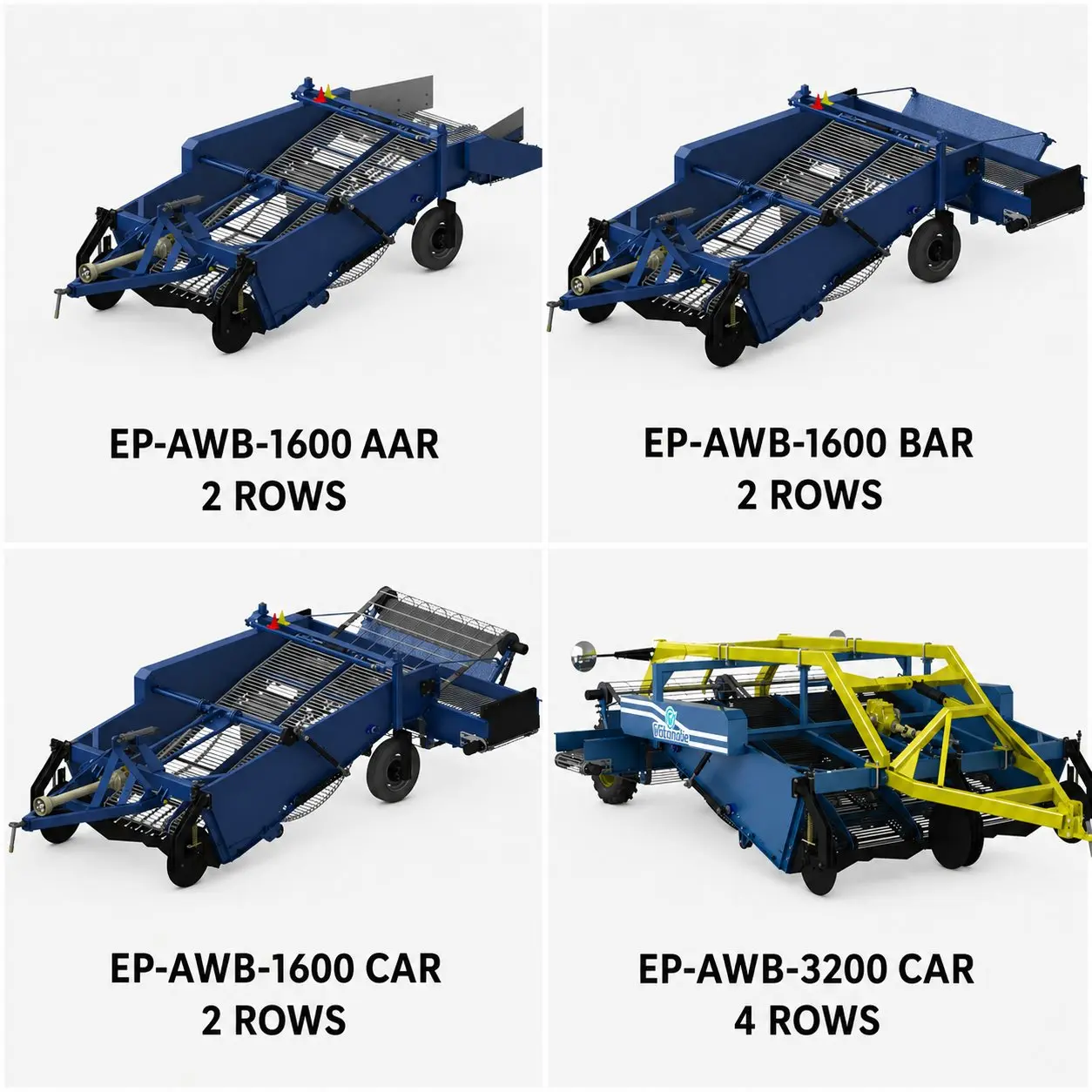
This guide covers the three core advantages of the trailed configuration in detail, the tractor requirements that make them achievable, the stone management requirement that applies equally to the heavier machine, and the decision framework for choosing between one trailed digger and multiple mounted diggers on medium-to-large potato operations. Korea Watanabe’s machine à pommes de terre range includes trailed configurations designed for 80–160 HP tractors across single- and two-row applications.
The Harvest Window — Why Throughput Determines Commercial Viability
Potato harvest is not a task that can be indefinitely deferred once haulm destruction has been carried out. After desiccation or mechanical haulm destruction, skin-set begins immediately — the tuber skin hardens progressively over 14–21 days, reaching the mature skin condition that resists bruising, disease entry, and moisture loss. This skin-set window defines the commercially optimal harvest period: harvest too early (less than 10 days post-desiccation) and the immature skin bruises on contact with harvesting equipment; harvest too late (beyond 25 days post-desiccation) and the over-mature skin begins to show secondary disease lesions (late blight infection through open skin, Rhizoctonia superficial scurf, secondary soft rot at wound sites from August rainfall) that cause downgrade at pack house intake.
Seed potato production operates on an even narrower window — typically 10–14 days — to minimise the period of exposure to airborne Phytophthora spore loads and aphid-transmitted virus after the haulm barrier is removed. The practical consequence: a fixed number of days after haulm destruction during which the harvest must complete, regardless of weather, field access, or machine availability.
Harvest Window Throughput Calculation — 30 ha Potato Operation
Harvest Window
14-day optimal window after haulm destruction. Typical weather-permitted harvest days within this window in UK August-September: 5–8 days (accounting for rainfall, morning dew, and high-humidity skin-scuff risk periods).
Required Daily Rate
30 ha ÷ 6 viable harvest days = 5.0 ha per day minimum. At 8 working hours per day: 0.63 ha/hour minimum net harvest rate after headland turns.
Single-Row Mounted Digger
Typical throughput: 0.5–0.8 ha/hour. At 0.65 ha/hour × 8 hours = 5.2 ha/day. For 30 ha: 5.8 harvest days required — at the absolute limit of the window with no weather margin.
Trailed Digger
Typical throughput: 1.5–2.5 ha/hour. At 2.0 ha/hour × 8 hours = 16 ha/day. For 30 ha: 1.9 harvest days — 4 full weather-margin days remaining in the window.
For any potato rotation above 15 ha: the mounted single-row digger provides no weather margin within the harvest window. The trailed digger completes the harvest in under 2 days, preserving 4+ days of contingency against rain stoppage, field access delays, or machine maintenance pauses. The throughput difference is not a quality preference — it is the difference between a completed harvest and a partial one.
Offset Operation — The Structural Advantage That Protects Adjacent Rows
The most significant structural difference between a trailed potato digger and a mounted single-row digger is not size or weight — it is the geometry of the connection between tractor and machine. A three-point mounted digger is centred on the tractor’s rear linkage: the tractor must straddle the planted row, driving directly over the potato ridge on each harvesting pass. A trailed digger connects via a drawbar and offset tongue that positions the digging unit to one side of the tractor’s wheel path. The tractor drives on the already-harvested strip, the inter-row track, or — in some configurations — on the unplanted headland pass, while the machine works the planted row to the side.
This offset geometry creates a consequence that is commercially significant on any soil type with clay content above 25%, and critical on heavy clay above 45%: the tractor’s drive wheels never pass over the adjacent undigested potato row during the harvest. On wet clay soils — which are common in the UK’s Lincolnshire, Yorkshire, and Scottish harvest periods — a 7,000 kg tractor’s rear wheels apply ground pressure of approximately 140–180 kPa to the soil surface. A potato tuber at 18 cm depth beneath a tractor wheel under this pressure is exposed to a lateral and vertical load that causes the distinctive lenticular (lens-shaped) deformation — a flattening of one side of the tuber from the compaction load — that produces what the industry calls “rollers” or “flatties.” These deformed tubers fail the sphericity specification for Grade 1 ware at the pack house grader and are downgraded regardless of skin condition or size.
Mounted Digger — Tractor Over Row
- ▸Tractor straddles planted row on every pass
- ▸Drive wheel load: 140–180 kPa on clay soils
- ▸Tuber deformation risk at 15–22 cm depth in wet clay
- ▸Lenticular “roller” defect — fails Grade 1 sphericity
Trailed Digger — Tractor on Clear Ground
- ▸Tractor drives on harvested strip or inter-row
- ▸No tractor wheel load over adjacent undigested rows
- ▸Zero compaction-induced tuber deformation
- ▸Full Grade 1 sphericity maintained in wet harvest conditions
The offset geometry is also the reason that the trailed digger can continue harvesting in soil moisture conditions — typically above field capacity, with soil sticking to boots and implements — where the mounted digger must stop. On a mounted digger operating in wet clay, the soil mass loaded onto the elevator chain can exceed the chain’s rated working tension when the sticky clay fails to fall through the rod gaps at the designed rate; the chain stalls and must be cleared manually. The trailed digger’s longer elevator (typically 1.2–1.8 m against 0.8–1.1 m for mounted) provides longer soil residence time on the chain, allowing heavy wet clods an additional 1–2 seconds of agitation to break down before the riddle — extending operable soil moisture conditions by a practical margin of 2–4 percentage points of volumetric moisture content.
Separation System — Longer Elevator, Heavier Chain and Wet-Soil Capacity
The trailed digger’s separation system is the same three-stage architecture as the mounted single-row — share, elevator, riddle — but each stage is engineered to a higher specification to handle the greater soil and tuber volume flowing through the machine per hour. The differences are not cosmetic: they determine which soil conditions the machine can work in, how often the chain requires maintenance, and how clean the windrow output is at the end of each pass.
1
Elevator Length and Soil Residence Time
The primary elevator of a trailed potato digger runs 1.2–1.8 m in length, compared to 0.8–1.1 m on a typical mounted single-row. This additional length — 40–60% more chain surface — directly translates to additional soil residence time. At a chain speed of 1.2 m/s (standard operating speed), the trailed digger provides approximately 1.0–1.5 seconds of additional separation time over the mounted digger. For dry sandy soils this difference is marginal; for wet clay with large clods, that additional time is often the difference between a clean separation and a chain blockage requiring manual clearing. The trailed elevator is also constructed from heavier rod diameter (typically 12–16 mm against 10–12 mm for mounted) and heavier drive sprockets, allowing higher chain tension without deformation under peak load in sticky soils.
Elevator Specification
Length: 1.2–1.8 m (vs 0.8–1.1 m mounted)
Rod diameter: 12–16 mm
Rod spacing: 28–38 mm (adjustable on some models)
Chain speed: 1.0–1.4 m/s
Wet Soil Advantage
Operates in soil up to 2–4% higher volumetric moisture than the mounted digger before chain blockage risk exceeds acceptable frequency — extending usable harvest days in wet autumn conditions.
2
Secondary Agitation Web — Pre-Riddle Clod Breakdown
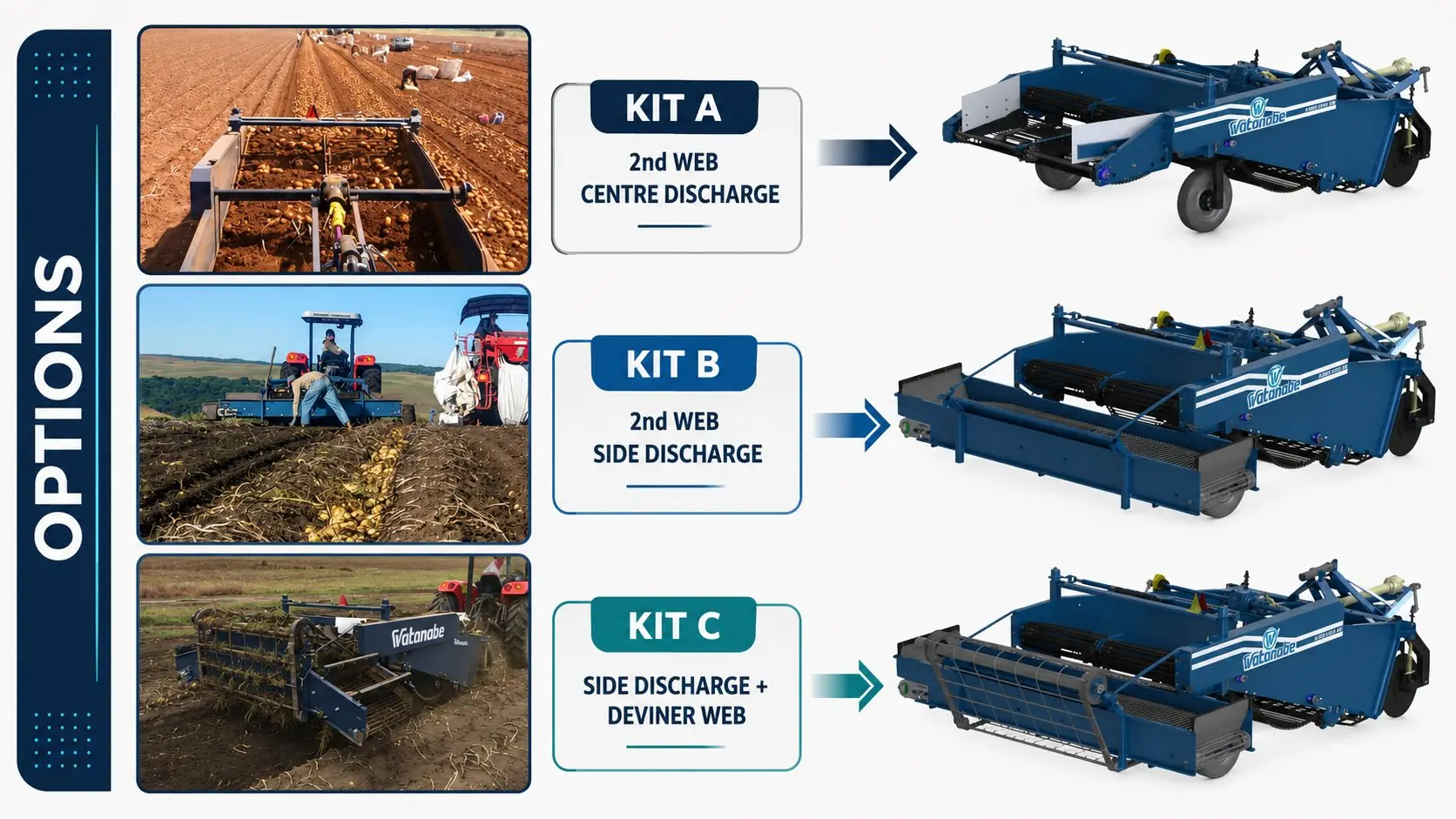
Higher-specification trailed diggers include a secondary agitation web positioned between the primary elevator and the side riddle. This secondary web — typically a shorter, more aggressive open-mesh section operating at a different speed ratio to the primary elevator — breaks down large clay clods that have survived the primary elevator without falling through. The inter-web drop (typically 80–120 mm) between primary and secondary elevator provides an impact event that fragments clods that are too wet to crumble on the vibrating chain but brittle enough to break on a controlled fall. This two-stage separation approach is what allows trailed diggers to produce clean windrows in soil conditions where a single-stage mounted digger produces a mixed output requiring a second windrow-cleaner pass.
Secondary Web Adjustment
Secondary web speed ratio to primary: 0.85–1.15× (adjusted by chain sprocket selection). Lower ratio for heavy clay (slower movement gives more agitation dwell time); higher ratio for light soil (faster transit to reduce potato contact time).
3
Side Riddle — Stone Rejection and Discharge Quality
The trailed digger’s side riddle has a larger surface area and typically more adjustable oscillation amplitude than the equivalent section on a mounted digger. Wider riddle mesh options (up to 50 mm on some models) allow larger stone sizes to be excluded from the windrow on stony ground — but this requires that the stones are already fragmented to below windrow-contamination threshold by THOR pre-clearing, because a riddle mesh wide enough to exclude large stones will also pass small tubers and cause field losses. The riddle adjustment range (angle, oscillation speed, and mesh size) is the most frequently used in-field adjustment on the trailed digger: experienced operators adjust riddle angle by 2–3° between dry morning and wet afternoon conditions as soil moisture changes through the harvest day.
Windrow Quality Check
Inspect windrow at the start of each field and after soil moisture changes: target fewer than 2 stones >30 mm per metre of windrow, less than 5% clod by volume, and no tuber losses visible in the disturbed soil between ridges after the machine has passed.
Tractor Requirements — Power, Hydraulics and Running Gear
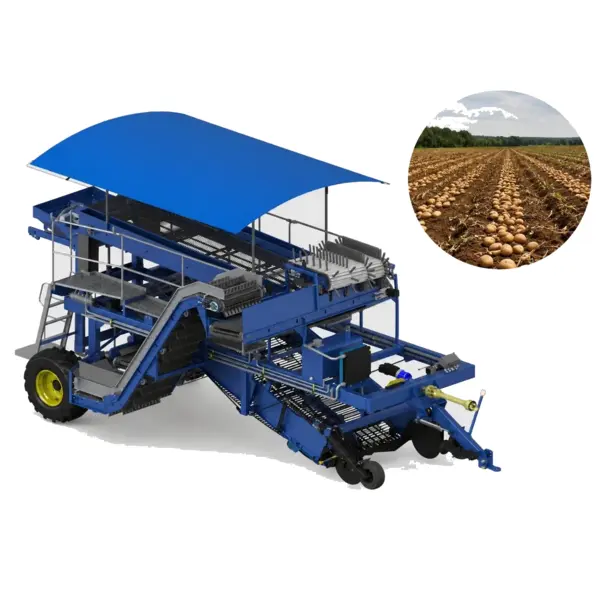
The trailed potato digger’s tractor requirements differ from the mounted digger’s in three important ways: the power demand is higher (and must be sustained, not just available at peak), the hydraulic demand is continuous (the running gear uses active hydraulic height control to maintain consistent digging depth independently of the tractor’s three-point position), and the tractor’s stability requirements change because the machine’s weight acts through a tow hitch rather than a rear linkage, altering the front-axle load distribution.
| Spécification |
Minimum |
Recommandé |
Why It Matters |
| Engine HP |
80 HP |
100–140 HP |
PTO must sustain 540 RPM through heavy clay without drop |
| PTO output |
540 tr/min |
540 RPM ground-speed PTO |
Ground-speed PTO maintains chain-to-forward-speed ratio as ground speed varies |
| Hydraulic flow |
45 L/min |
60–80 L/min @ 180 bar |
Running gear height control and optional hydraulic chain tension require continuous flow |
| Drive configuration |
FWA (4×2) |
4WD |
Machine’s 800–1,200 kg drawbar pull shifts tractor weight forward — 4WD critical in wet clay |
| Drawbar pin diameter |
32 mm |
38–50 mm |
Larger pin absorbs drawbar shock from stone impact without hitch wear |
| Forward speed range |
1.5 km/h |
2.0–3.5 km/h |
Higher operating speed enables the throughput advantage over mounted digger |
The running gear is the structural element that most distinguishes the trailed digger from the mounted configuration at the operational level. The trailed digger rides on its own independently-sprung or hydraulically-controlled wheels that maintain the digging share at a constant depth relative to the soil surface, regardless of what the tractor’s rear axle is doing. On uneven headlands where the tractor pitches forward into a hollow, a mounted digger’s depth varies with the three-point linkage position; the trailed digger’s running gear compensates continuously, maintaining consistent share depth within ±2 cm across terrain variations that would cause ±5–8 cm depth variation on a mounted machine. This consistent depth is particularly valuable on seed potato harvest where uniform depth of digging is critical for even tuber recovery and minimal damage to the deeper-set tubers.
Stone Management — Why a Heavier Machine Still Needs Pre-Season Clearing
A common assumption when upgrading from a mounted to a trailed potato digger is that the heavier machine, more robust chain, and larger shear bolt protection system provide meaningful protection against stone-induced damage. This is partially true: the trailed digger’s heavier driveline tolerates a higher instantaneous torque spike before the shear bolt activates, and the larger machine’s chain rods are harder to fracture on a single stone-wedging event. But the five damage modes documented for potato diggers (share chipping, chain fracture, star wheel cracking, gearbox shock, and tuber bruising) apply to the trailed digger at the same field stone concentrations as the mounted — the machine is larger, but the stones are the same size.
The commercial argument for stone clearing before the trailed digger season is, if anything, stronger than for the mounted digger: the trailed digger has a higher throughput value per operating hour, meaning each hour of stone-induced downtime loses more harvested area within the fixed harvest window. On a 30 ha operation with a 14-day window and a trailed digger harvesting at 2.0 ha/hour, a single 3-hour gearbox incident leaves 6 ha of potatoes un-harvested in what was a workable weather day — potatoes that may not get another chance within the window.
①
Concasseur de roches THOR — Pre-Planting Deep Clearing
Set THOR at the trailed digger’s planned operating depth plus 3–5 cm (typically 22–30 cm for a trailed digger reaching 18–25 cm). THOR 2.4 for limestone and sandstone; THOR 3.0 for granite, dolerite, or quartzite. The trailed digger’s heavier share puts greater lateral force on the soil ahead of the cutting edge when a stone is encountered — making deep sub-share stones more likely to be pulled into the share zone than they would be with a lighter mounted digger share. THOR clearing depth should therefore be set 3 cm deeper than for the mounted digger equivalent on the same field.
②
Ramasse-roches CT-2100 — Élimination définitive des calculs
After THOR, the CT-2100 permanently removes the fragmented stone. On large-scale potato operations, the collected stone volume from CT-2100 passes following THOR provides a useful secondary benefit: the collected stone can be used to fill farm track ruts and gateways that are degraded by the heavy tractor and trailer traffic of the harvest period — converting a waste material into a farm maintenance resource at no additional cost.
③
Râteau à roches BlackBird — Pre-Harvest Annual Surface Pass
At 9.5 m working width, the BlackBird clears a surface pass across 10 ha in under 3 hours at 10–12 km/h — less than a half-day’s work before the main harvest operation. On large potato farms (30+ ha), the BlackBird can be operated on a field-by-field basis the week before harvesting begins on each field, maintaining the stone-clear condition established by the pre-planting THOR + CT-2100 treatment throughout the season.
Foire aux questions
Q
What exactly causes the lenticular “roller” tuber deformation from tractor compaction, and how does the trailed digger’s offset path prevent it?
Lenticular deformation occurs when a developing or mature potato tuber, at 15–22 cm depth in plastic clay soil, is subjected to a vertical compaction load from an overhead wheel pass. The load mobilises a soil pressure bulb that extends to approximately 1.2–1.5× the wheel width in radius below the contact patch. A tractor rear wheel at 180 kPa ground pressure generates a pressure bulb reaching 20–27 cm depth — placing the potato tuber directly within the zone of maximum deviatory stress. The deformable starch-filled flesh is compressed from above while supported laterally by the surrounding soil matrix, creating the characteristic flattening on the upper surface of the tuber (the side towards the compaction load). The resulting shape fails the sphericity ratio test (major axis ÷ minor axis >1.25) used in Grade 1 ware potato specifications. The trailed digger prevents this by placing the tractor wheels on already-harvested ground — where there are no tubers in the soil — rather than over the undigested planted ridge. Once the first pass has been harvested, every subsequent tractor wheel track is in either the harvested area or the inter-row, making the offset geometry self-reinforcing as the harvest progresses across the field.
Q
Can the trailed digger operate in wet clay where the soil moisture is above field capacity?
The trailed digger extends operable soil moisture range compared to the mounted single-row, but does not make wet-soil operation consequence-free. At soil moisture above field capacity: the longer elevator (providing 40–60% more chain residence time) and the secondary agitation web (providing an inter-web impact event that breaks wet clods) allow the trailed digger to maintain acceptable separation quality at moisture levels that would cause a single-stage mounted digger’s chain to block. Practically: the trailed digger can typically operate at volumetric soil moisture 2–4 percentage points above the mounted digger’s practical wet limit before chain clearance frequency becomes operationally unacceptable. However, harvesting at very high soil moisture — even with the trailed digger’s superior wet-soil handling — increases tuber skin damage (skin-slip and bruising from wet clod impacts on the elevator) and should be avoided if a 24–48 hour drying period can be obtained. The trailed digger’s wet-soil advantage is most valuable at the boundary conditions of harvest weather — the borderline damp days where a decision must be made whether to harvest or wait — not in genuinely wet soil conditions where a full stop is warranted regardless of machine specification.
Q
Does the ground-speed PTO option on the trailed digger make a practical difference, and which tractors have it?
Ground-speed (or ground-driven) PTO is a genuine operational advantage on the trailed potato digger for a specific reason: it maintains the ratio of elevator chain speed to tractor forward speed as forward speed varies. A standard engine-speed 540 RPM PTO runs at constant speed regardless of ground speed — meaning the chain runs at the same rate whether the tractor is doing 1.5 km/h uphill or 3.0 km/h on the level. This creates under-separation (too fast chain relative to forward speed) downhill and over-loading (too slow chain) uphill. A ground-speed PTO scales the chain speed proportionally to forward speed, maintaining consistent soil-on-chain ratio throughout the pass. The practical result is more uniform windrow quality across undulating fields. Ground-speed PTO is available on most mid-range European tractors (100+ HP, post-2005) from Case IH, New Holland, John Deere, and Fendt. If your tractor has a standard engine-speed PTO only, the equivalent adjustment is to change forward speed rather than tractor gear as ground conditions change — maintaining a consistent gear and varying engine throttle to hold ground speed is a reasonable approximation of ground-speed PTO behaviour at the expense of fuel efficiency.
Q
When should a potato farmer choose two single-row mounted diggers instead of one trailed digger?
Two mounted diggers make operational sense over one trailed digger in three specific situations: (1) When the farm has two tractors in the 60–80 HP range that are not at their full productive utilisation during harvest and can both be allocated to digger duty — converting idle tractor time into harvest throughput at a lower incremental equipment investment than a single trailed digger. (2) When field geometry is highly varied — many small fields of 0.5–2 ha with frequent road transport between sites — where the trailed digger’s larger turning radius and road transport configuration (which requires a trailer permit in some jurisdictions above a certain transport width) creates logistical friction that two smaller mounted machines avoid. (3) On mixed-variety operations where two different crops with different planting depths and row spacings are harvested simultaneously: two mounted diggers can be set and adjusted independently for each variety, while a single trailed digger must be reconfigured between crop types. The trailed digger is clearly superior when the operation is: above 15 ha, harvested in a single variety, on fields above 3 ha each, and in clay soil conditions where the offset tractor path and wet-soil performance are commercially important. Below that scale, two mounted diggers is a defensible alternative that benefits from flexibility and lower tractor HP requirements.
Q
What is the correct headland procedure for the trailed digger to avoid crop losses at field ends?
The trailed digger’s larger turning radius — typically 6–10 m depending on tongue length and tractor wheelbase — requires more headland space than a mounted digger, which can complete a headland turn in approximately 4–6 m with a 60–80 HP tractor. The standard headland procedure for the trailed digger: (1) Raise the digging share by activating the running gear hydraulic ram to lift the share clear of the ground at approximately 3–4 m before the headland end — this avoids the share undercutting the headland turn area and losing tubers in the turning zone. (2) Disengage PTO before the turn begins to prevent chain damage from operation without forward movement (chain running without soil feed can cause chain slap against the elevator frame). (3) Complete a 3-point turn on the headland, aligning the machine’s tongue with the next row. (4) Re-engage PTO, lower the share gradually over the first 2–3 m of the next row — not at the field end — to allow the chain to reach operating speed before full soil load is applied. The headland crop loss zone from incorrect procedure (share too late to lift, or too early to lower) is typically 2–4 m of each row end — representing 0.5–1.0% of total field yield on a 100 m field length. Correct headland procedure consistently recovers this loss.
Machines à pommes de terre Watanabe de Corée
Trailed Potato Digger — Specified for Your Scale, Soil and Harvest Window
Your operation scale + tractor HP + soil type + stone assessment → Korea Watanabe specifies the correct trailed arracheuse de pommes de terre configuration alongside the THOR, CT-2100, and BlackBird pre-season stone management programme that protects machine and harvest quality through the full season.
Corée Watanabe Rock Crusher Tractor Co., Ltd. · Ansan-si, Gyeonggi-do
Éditeur : Cxm