واتانابي المحراث الدوار PSW-3200 range includes two major configurations. The Standard model performs the tillage function alone — creating the fine-tilth seedbed that furrowing and planting depend on. The Model B adds a 2,000 Kg integrated granular fertilizer bunker to the rotavator body, simultaneously distributing base fertilizer into the tillage depth as the rotor processes the soil. This combination converts two separate field operations — Steps 2 and 4 in the Watanabe 7-step potato system — into a single pass.
The decision between the Standard PSW-3200 and the Model B is a logistics calculation specific to each Korean farm’s spring preparation calendar. This guide provides that calculation framework, explains the mechanical details of how the B model’s integrated fertilizer system works, and identifies the Korean potato production scenarios where the Model B’s pass-reduction advantage outweighs the separate EP-ADB fertilizer applicator approach — and where it does not.
PSW-3200 Standard vs Model B — Complete Comparison
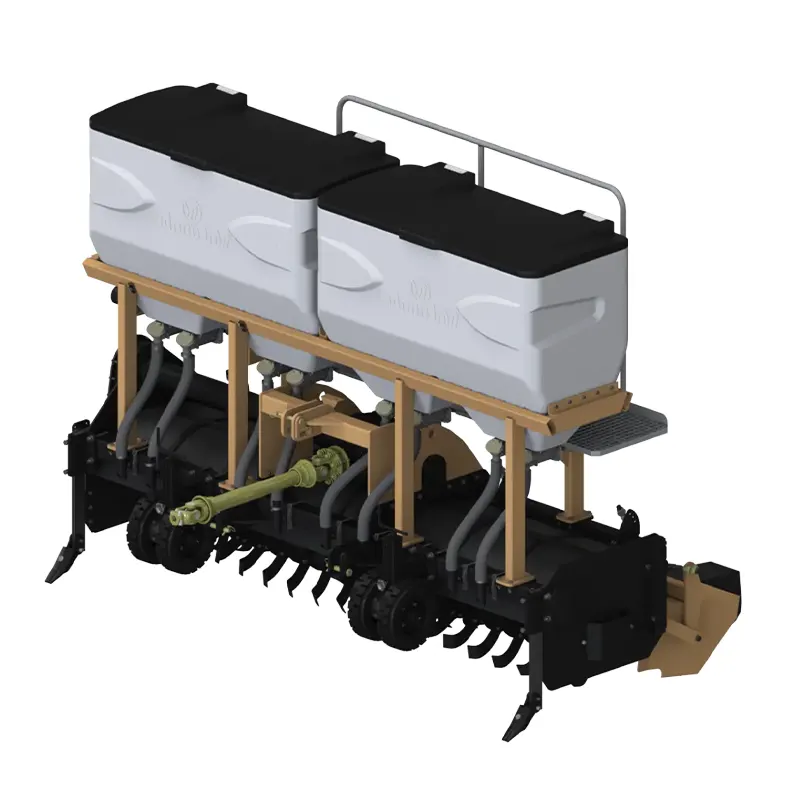
معيار PSW-3200
140 HP · 3.0–3.6 m · Cat.2 · 540/1000 RPM
- →Tillage only — Steps 2
- →Separate EP-ADB pass for Step 4
- →Lighter machine weight
- →Fertilizer placed at furrowing (better row concentration)
- →Lower initial purchase cost
PSW-3200 Model B
140 HP · 3.0–3.6 m · 2,000 Kg fertilizer bunker
- ✓Steps 2 + 4 combined in one pass
- ✓No separate EP-ADB field pass needed
- ✓2,000 Kg bunker — fewer refill stops
- ✓Saves 1 tractor pass (fuel + time) per season
- ✓Fertilizer incorporated at full tillage depth uniformly
How the Model B Works — Fertilizer Integration Mechanism

The PSW-3200 Model B integrates fertilizer distribution through a gravity-feed metering system mounted above the rotavator’s rotor housing. As the rotor blades till the soil and the tractor advances, the metering system releases granular fertilizer through distribution tubes that direct the granules into the actively tilling rotor zone — where the rotating blades immediately incorporate the fertilizer into the loosened soil mass.
Agronomic Comparison — Model B vs Separate EP-ADB

The fundamental agronomic difference between Model B (fertilizer at tillage) and the Standard + EP-ADB approach (fertilizer at furrowing) is fertilizer placement depth and distribution pattern:
| عامل | PSW-3200 Model B | Standard + EP-ADB |
|---|---|---|
| Fertilizer placement | Throughout tillage depth (25–30 cm), full bed width | Row zone only — maximum root availability |
| Potassium availability | Uniform bed — roots reach K throughout the bed | Row-concentrated — highest early-season K availability |
| Field passes | 1 pass (Steps 2+4 combined) | 2 passes (Step 2 rotavator + Step 4 EP-ADB) |
| سعة المخبأ | 2,000 Kg — covers 3–3.5 ha per fill | Smaller per-row bunkers — more refill stops |
| Runoff risk (sloped fields) | Fertilizer incorporated immediately — low runoff risk | Incorporated at furrowing — similar low runoff risk |
| Equipment cost | Higher (bunker system included) | Lower PSW-3200 + separate EP-ADB cost |
| الأفضل لـ | Time-compressed spring; single tractor operations | Two-tractor operations; low-K soils; precision row placement |
When the Model B Saves Time — The Pass Reduction Advantage
The Model B’s primary advantage is operational: one fewer field pass in the spring preparation sequence. In Korean highland potato production where the preparation window is compressed to 2–3 weeks, each eliminated field pass reduces both calendar pressure and total operating cost (fuel, tractor hours, operator time). The pass reduction is most valuable in these scenarios:
✅
Single-tractor operations. When the farm operates only one tractor, the Standard PSW-3200 and the EP-ADB must use the same tractor on separate days (rotavator tillage, then change to the furrower with applicator). The Model B performs both in a single day’s work — the tractor is freed earlier for furrowing and planting.
✅
Large farm areas (15+ ha) where passing time compounds. Each field pass on a 15 ha farm takes approximately 2 working days for the PSW-3200 at normal tillage speed. Eliminating one pass saves 2 days — which at the peak of the spring preparation window can make the difference between completing preparation before the planting date or falling behind the frost calendar.
✅
Soils where uniform fertilizer distribution across the bed is adequate. On Korean highland soils with moderate natural potassium content (above 150 mg/kg exchangeable K from soil test), full-bed fertilizer incorporation via the Model B is agronomically adequate — the potassium is distributed throughout the tillage zone accessible to roots during the critical bulking phase. On soils with very low K (below 100 mg/kg), row-concentrated EP-ADB placement at the furrowing step provides a precision advantage over the Model B’s uniform bed distribution.
✗
Not advantageous when soil K is very low. The EP-ADB approach (separate pass, row-placed K at furrowing) is agronomically superior when soil test K is very low — the row-concentrated potassium provides higher early-season K availability than the Model B’s uniform bed distribution at the same total application rate. On documented low-K Gangwon-do highland soils, the separate EP-ADB approach may produce better tuber K nutrition than the Model B, and the pass reduction advantage is outweighed by the placement quality difference.
PSW-3200 Model B Operation — Speed, Calibration, and Bunker Management
PTO Speed Setting — 1000 RPM for Potato
The PSW-3200 supports both 540 RPM and 1000 RPM PTO input. For Korean highland potato seedbed preparation, 1000 RPM is the preferred setting regardless of whether the Standard or Model B is being used. Higher rotor tip speed at 1000 RPM produces finer soil particle size that supports uniform ridge formation at the furrowing step, consistent planting depth at the planting step, and better soil-fertilizer mixing in the Model B configuration. The 540 RPM setting is reserved for situations where the soil is already fine-textured and aggressive fragmentation would produce excessive dust or over-worked seedbed — uncommon in Korean highland granite-derived soils that benefit from thorough fragmentation.
Bunker Calibration — Critical Before Each Season
Step-by-step calibration procedure for PSW-3200 B:
Bunker Refill Logistics
The 2,000 Kg bunker capacity is the Model B’s operational advantage over small per-row bunkers on the EP-ADB — but it requires planning the refill logistics before the field operation begins. At a typical Korean highland potato base fertilizer rate of 500–800 Kg/ha (compound NPK), the 2,000 Kg bunker covers approximately 2.5–4 ha before requiring a refill. For a 15 ha operation, the operator will refill the bunker approximately 4–6 times during the rotavator pass. Each refill from a field-edge bulk bag (500 Kg jumbo bag) takes 15–20 minutes with a front loader or telehandler. Pre-position refill bulk bags at the field headland before beginning the tillage day to minimize refill stop time.
PSW-3200 B in the 7-Step System — What It Changes
7-Step System — PSW-3200 Standard
المجموع: 5 pre-planting passes
7-Step System — PSW-3200 Model B
المجموع: 4 pre-planting passes — 1 fewer pass saved
Practical Operating Notes — Getting Consistent Results with the PSW-3200 B
Working Speed and Tillage Depth
The PSW-3200 B at 1000 RPM and the recommended 2–4 km/h forward speed produces a uniform fine tilth appropriate for Korean highland potato and vegetable seedbed requirements. Operating too fast (above 4 km/h) produces coarser particle size and leaves larger clods that compromise ridge formation quality at the furrowing step. On initial spring tillage of soil that has been fallow through winter, a slower first pass (2–3 km/h) produces better fragmentation of compacted clod structure before the second pass at the full production speed.
Tillage depth should be confirmed at the season start by measuring the actual depth of disturbance with a probe in the tilled zone after the first pass. Target depth: 22–28 cm for Korean highland potato. Shallower tillage (below 18 cm) risks leaving the base fertilizer distributed by the Model B’s bunker system above the root zone where it is most needed; deeper tillage (above 30 cm) risks bringing subsoil material to the surface, particularly on shallow Taebaek mountain soils where bedrock or fragmented rock begins at 35–40 cm.
Blade Wear Inspection
The PSW-3200’s rotavator blades — high-chromium alloy steel with hardened cutting edges — wear progressively during Korean highland granite soil operation. Inspect blade wear at the end of each operating day during heavy-use periods. Indicators of blade replacement need: tip shortening to below 60% of original blade length; visible chipping or cracking of the cutting edge; asymmetric wear (one side wearing faster, indicating possible tractor hitch misalignment). Replacement blades are available from Korea Watanabe with next-day domestic dispatch. Carry one full set of replacement blades on site for any operation spanning multiple days — mid-operation blade change is common on Gangwon-do highland granite soils and takes 30–60 minutes with the correct tools.
Model B Maintenance — Fertilizer System
The PSW-3200 B’s fertilizer distribution system requires specific maintenance beyond the standard rotavator service:
- →End-of-season bunker flush: After the last use of the season, empty the bunker completely and run a small volume of dry rice hulls or clean dry sand through the metering system to clear any residual fertilizer granules that could absorb moisture and compact during off-season storage.
- →Metering aperture inspection: Compound NPK fertilizer contains hygroscopic components that can form hard deposits in the metering aperture channels over winter storage. Inspect all metering apertures at the start of each season; use a small wire brush to clear any deposits before recalibrating for the new season’s fertilizer product.
- →Distribution tube inspection: Check the flexible distribution tubes that carry fertilizer from the metering unit to the discharge points above the rotor zone. Look for cracks, kinks, or blockages that would cause uneven distribution. Replace any damaged tubes before the season’s first field use.
الأسئلة الشائعة
Can I still use the EP-ADB at Step 4 if I have the PSW-3200 B model?
Yes — owning the PSW-3200 B does not prevent using the EP-ADB at Step 4 as well. Some Korean operators use the PSW-3200 B for the phosphate and potassium component of the base fertilizer (incorporated at full tillage depth by the B model), then apply a separate nitrogen top-dress at Step 4 via the EP-ADB — achieving the agronomic benefit of deep P and K incorporation while retaining row-placed nitrogen at the furrowing stage. This combined approach requires soil test-based fertilizer program design to avoid double-counting nutrients. Confirm the split fertilizer approach with your agricultural extension officer or agronomist for your specific soil test results.
Does the PSW-3200 B work with both 540 RPM and 1000 RPM PTO?
Yes — the PSW-3200 B supports both PTO speeds, with the same 1000 RPM recommendation for Korean highland potato seedbed preparation as the Standard model. The fertilizer metering system’s drive mechanism is independent of the PTO speed — it is driven by the ground wheel (linked to forward speed) rather than by the PTO, ensuring that fertilizer application rate is proportional to forward distance covered regardless of which PTO speed is selected. Recalibrate the metering system if forward speed changes significantly between calibration and field use, as application rate is distance-based (kg/ha) not time-based.
Can the PSW-3200 B bunker be left empty when only tillage is needed (no fertilizer application)?
Yes — the PSW-3200 B can be operated as a standard rotavator with the bunker empty and the metering apertures closed. In this configuration, it performs identically to the Standard PSW-3200. The empty bunker adds some machine weight without the fertilizer payload — typically 50–80 Kg for the bunker structure itself. This weight addition is negligible at the 140 HP tractor rating. Operating with the bunker empty is appropriate when the field has already received fertilizer broadcast application before tillage, or when the specific field section does not require fertilizer at this point in the rotation.
Does the PSW-3200 B subsidy eligibility differ from the Standard model?
The PSW-3200 Model B qualifies under the same 로터리 (rotavator) category of the Korean agricultural machinery purchase support program as the Standard model — the addition of the fertilizer bunker does not change the fundamental machine classification. The subsidy amount may differ if the program sets a maximum eligible machine price (기준 가격) and the Model B’s higher purchase price exceeds the Standard’s eligible price ceiling. Confirm the current year’s eligible machine price ceiling for the rotavator category with your regional agricultural technology center (농업기술센터) before purchase — if the B model’s price exceeds the ceiling, the subsidy covers up to the ceiling amount with the buyer paying the difference.
PSW-3200 Standard or Model B? Tell Us Your Spring Calendar Constraints.
Tractor count + farm area (ha) + soil test K level + planting window length → PSW-3200 Standard or Model B recommendation with bunker size and calibration guidance. Both PSW-3200 models in Korea local stock, Ansan-si, Gyeonggi-do.
المحرر: Cxm