
The single-row mounted digger is the entry point for mechanised potato harvest. At some point — typically when the potato enterprise reaches 5–8 hectares or when the harvest window starts to feel uncomfortably tight — the question arises: what next? The two options most farmers consider are a two-row mounted digger and a step up to a trailed machine. The choice is not always obvious, and the two-row mounted is frequently underestimated as a transitional step because it sits in the middle of the market without the simplicity of the single-row or the scale of the trailed machine.
The two-row mounted digger’s argument is straightforward: it approximately doubles the harvest capacity of a single-row unit while retaining all the handling advantages of three-point linkage mounting — the full headland lift, the compact turning radius, the rapid attachment, and the transport convenience of a machine that rises completely off the ground. It requires a tractor upgrade from the single-row’s 40HP threshold to a 65HP minimum, and it demands a Cat 2 three-point hitch with adequate lift capacity. Within those tractor requirements, it fits farms from 5 to 20 hectares that have neither the justification for a trailed machine’s investment nor the productivity constraint that forces that investment. This guide works through the machine’s architecture, tractor requirements, capacity realities, and setup procedure with the technical detail needed to make a confident decision and run the machine correctly.
Why Two-Row Mounted — The Upgrade That Doesn’t Require a New Tractor Strategy
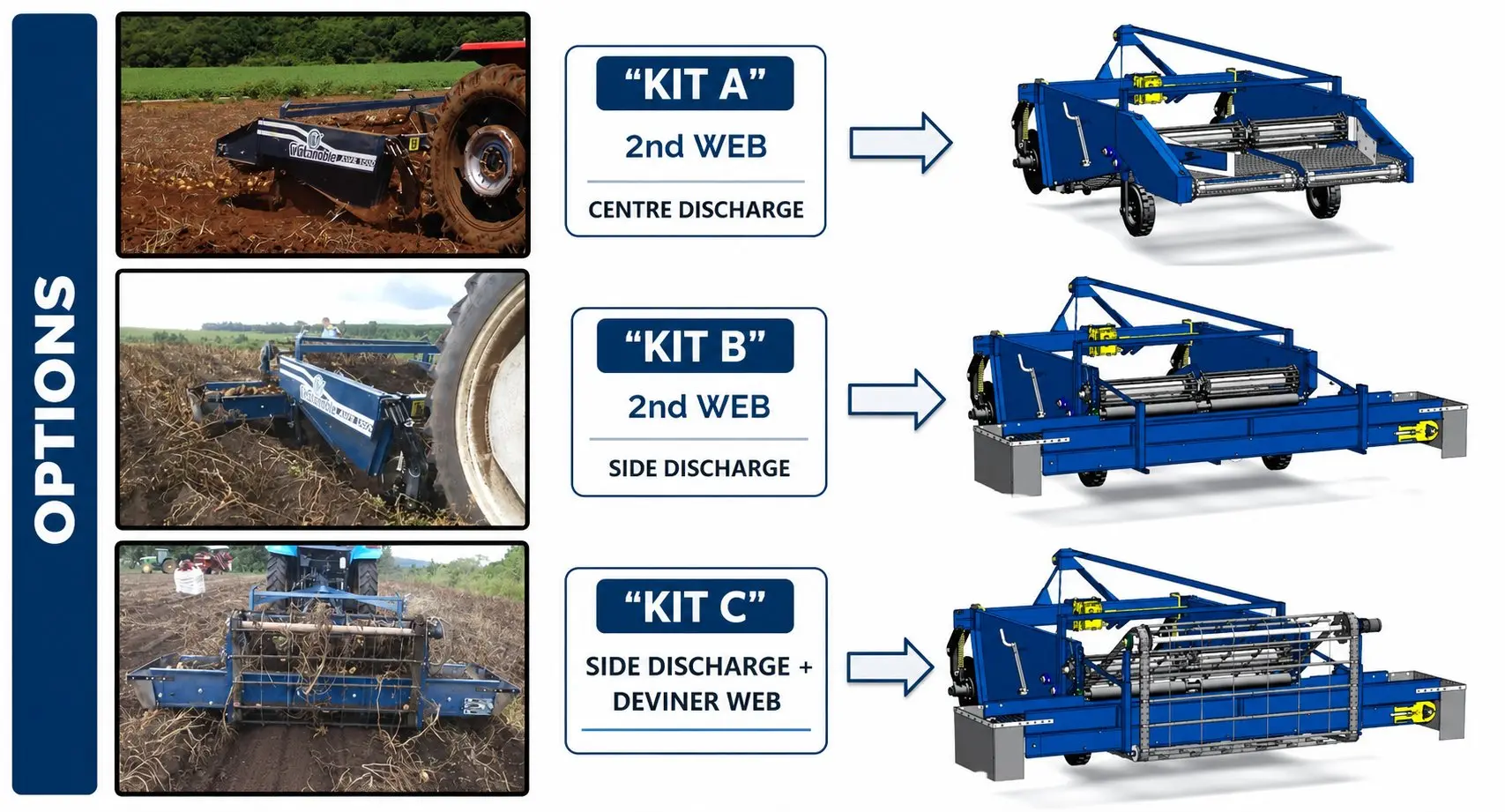
The dominant reason farms choose the two-row mounted over the trailed alternative at equivalent working width is the headland. A two-row mounted digger works at 150–180 cm — which is also the entry-level width for a trailed two-row unit. Yet the trailed version of the same working width brings with it a trailing frame, its own running gear, wider headland turn arcs of 8–12 m, hydraulic connection requirements, and a transport management consideration that the mounted machine does not. For farms with multiple smaller fields, awkward shapes, or headlands under 10 m wide, the two-row mounted digger delivers the same harvest width as a trailed unit with none of these complications.
The mounted machine also responds to a specific tractor situation. Many farms in the 5–15 hectare potato range have upgraded from a 50HP tractor to a 75–85HP unit for general farm work — grain drilling, slurry spreading, or heavy cultivation. That 75–85HP tractor cannot run a large trailed digger efficiently (which would need 100HP+), but it is perfectly matched to a two-row mounted unit. The machine and tractor grow together without either being forced.
The capital cost comparison is also relevant. A two-row mounted digger represents a substantially lower investment than an equivalent-width trailed machine, because the trailed unit’s running gear, independent frame, and additional hydraulic systems add significantly to its cost. For a farm that will reach its full size at 15–18 hectares and has a 75HP tractor, the two-row mounted unit often represents the correct long-term answer — not a transitional machine, but the endpoint of the farm’s digger requirement.
Technical Architecture — How the Two-Row System Works Across Dual Rows
A two-row mounted digger is not simply two single-row diggers bolted together on a common frame, though that is a reasonable intuitive model for understanding it. The machine uses a single PTO input feeding a central gearbox that powers both the elevator chain and the separator system. The two digging shares are mounted in parallel on the same rigid mainframe, typically adjustable in their lateral spacing to accommodate different row widths (usually set for 75 cm, 80 cm, or 85 cm row spacing). Each share lifts the soil from its respective row independently, but both deposits merge immediately behind the shares onto a single wide elevator chain that spans the full working width of both rows combined.
| Bileşen | Single-Row Reference | Two-Row Specification | Operating Note |
|---|---|---|---|
| Kazı hisseleri | 1 share, 75–90 cm | 2 shares, 150–180 cm combined | Each share independently depth-adjustable via depth wheel |
| Elevator chain width | 75–90 cm | 150–180 cm (full working width) | Single chain spans both rows; must be tensioned uniformly across full width |
| Separator system | 2–3 star wheels or riddle frame | 4–6 star wheels or extended riddle frame | Wider separator for final soil removal from combined two-row volume |
| PTO drive | Single input, direct gearbox | Single input, wider gearbox distributing to full chain width | 540 or 1000 RPM; 1000 RPM preferred for uniform chain speed across width |
| Makine ağırlığı | 150–280 kg | 320–500 kg | Cat 2 hitch with minimum 1,500 kg lift capacity required |
| Row spacing adjustment | Fixed at 75 or 85 cm | Adjustable via share carrier bolts (75/80/85 cm) | Must match planted row spacing — verify at field entry before working |
| Tuber deposit pattern | Single-row swath, ~80 cm wide | Two-row combined swath, ~120–160 cm wide | Wider swath — collection crew must cover broader pick-up zone |
The wider elevator chain is the critical component distinguishing a two-row mounted digger from its single-row equivalent. A chain spanning 150–180 cm must maintain uniform tension and consistent rod spacing across its full width — uneven tension causes the chain to run unevenly, with one side carrying more soil than the other, reducing separation efficiency and accelerating wear on the higher-loaded rods and carrier links. Chain tensioning on a two-row machine is not simply tightening until the sag disappears; it requires the operator to measure sag at multiple points across the chain width and adjust the tension bars until the sag is uniform from left to right at the manufacturer’s specified value (typically 10–20 mm mid-span deflection under no load). This uniform tensioning check should be performed at the start of each harvest season and after the first five hours of operation with a new or replaced chain.
Tractor Requirements — HP, Linkage, and Ballast for Dual-Width Operation
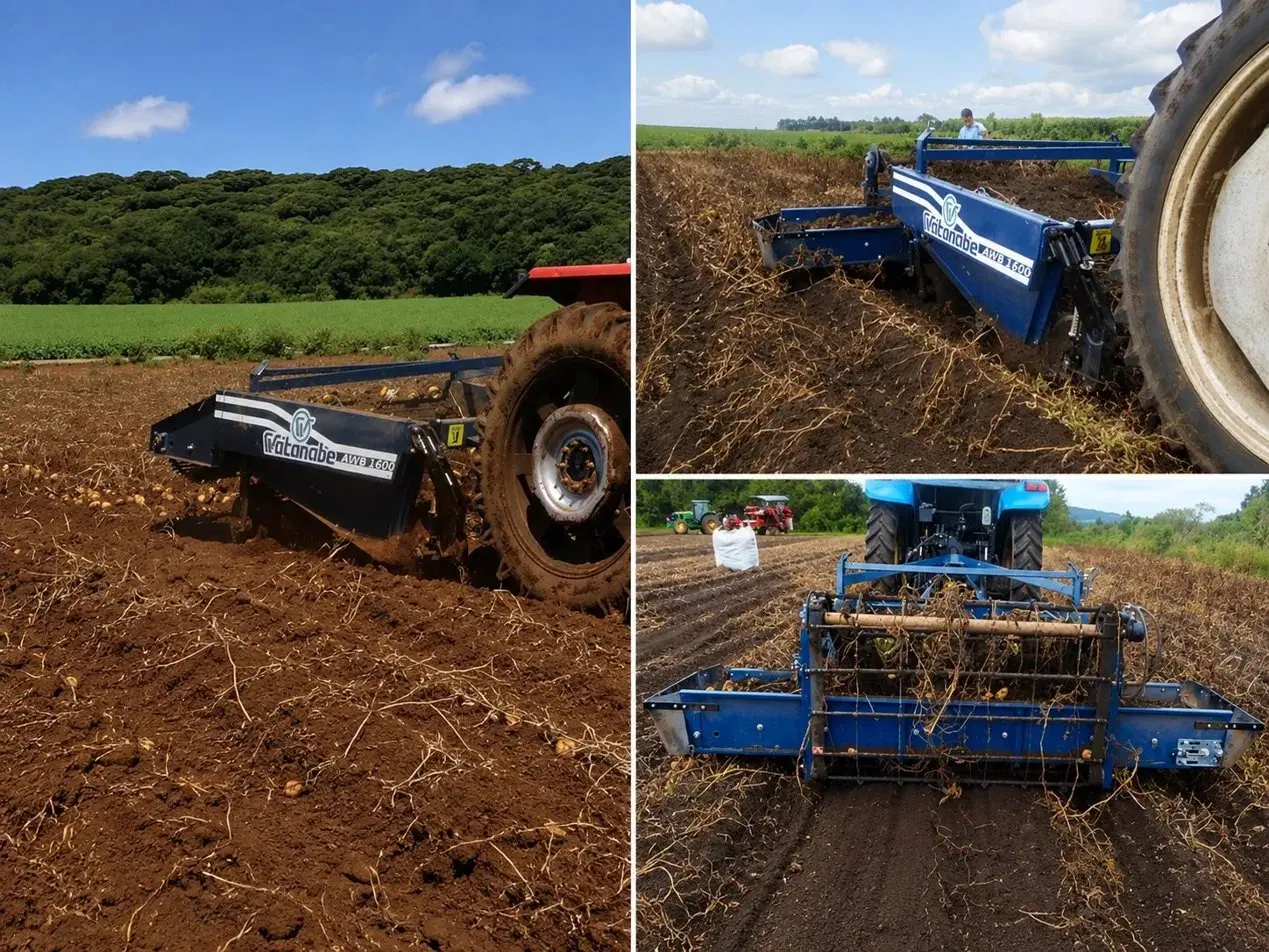
The two-row mounted digger’s tractor requirements are non-negotiable in two respects: engine horsepower and three-point hitch category. The power requirement is driven by the doubled elevator chain width and the corresponding doubling of soil mass that must be lifted and agitated per unit time. The hitch category is driven by the machine’s weight — at 320–500 kg, the two-row unit is near or above the practical lift limit of any Cat 1 hitch, and it must be matched to a properly rated Cat 2 system on a tractor whose hydraulic system can maintain the set position under the varying soil loads of real harvest conditions.
| Gereklilik | Sandy / Loam Soil | Clay / Stony Soil | Neden Önemli? |
|---|---|---|---|
| Motor Beygir Gücü | 65 HP min | 80–90 HP | Double chain width doubles PTO demand at equivalent forward speed and depth |
| Üç noktalı bağlantı | Cat 2 — lower link pin 28 mm | Cat 1 (22 mm pin) cannot safely support 320–500 kg at working extension | |
| Linkage lift capacity | Minimum 1,500 kg at maximum extension | At full extension, effective lift is ~60–70% of rated cylinder capacity — verify actual figure with tractor manufacturer | |
| PTO hızı | 1,000 RPM strongly preferred | Uniform chain speed at full 150–180 cm width is difficult to maintain at 540 RPM on heavier soils | |
| Front ballast required | 80–100 kg | 100–140 kg | A 400 kg rear-mounted digger shifts weight distribution to 28:72 front:rear — front ballast restores steering weight |
| Rear tyre ballast | İsteğe bağlı | Tavsiye edilen | Fluid-ballasted rear tyres improve drive traction on clay and wet soils at peak PTO load |
Field Capacity — What Two Rows Actually Delivers Per Working Day
The theoretical capacity advantage of two rows over one is exactly 2:1 — but real field capacity is always lower than theory, and the gap between theory and practice is larger for wider machines because headland turns and repositioning take the same absolute time regardless of working width. For a farm with long rows (150 m+), the two-row mounted digger delivers 1.7–1.9× the daily hectares of a single-row unit on the same tractor. For short rows (under 80 m), the advantage narrows to 1.3–1.5× because headland time represents a higher proportion of the total field time.
| Parametre | Tek Sıralı Monte Edilmiş | Two-Row Mounted | Two-Row Advantage |
|---|---|---|---|
| Working width (at 75 cm rows) | 75 cm | 150 cm | 2.0× |
| Typical forward speed (loam) | 3.5–5 km/h | 3–4.5 km/h | Slightly slower (heavier chain load) |
| Effective ha / 8-hour day (long rows, loam) | 1.8–2.8 ha | 3.0–4.8 ha | 1.7–1.9× |
| Effective ha / 8-hour day (short rows <80m) | 1.2–1.8 ha | 1.6–2.5 ha | 1.3–1.5× |
| Days to harvest 10 ha (long rows) | 4–6 days | 2.5–3.5 days | ~40% reduction |
| Minimum traktör beygir gücü | 40 HP | 65 HP | +25 HP minimum step |
The practical implication of this capacity table: a farm harvesting 10 hectares of potato in ideal conditions completes harvest in 4–6 working days with a single-row digger and in 2.5–3.5 days with a two-row unit. In a season with reliable harvest weather, this difference may not be critical. In a season where two weeks of September weather provides only five harvest-quality days, the difference between completing the harvest in those five days or needing eight is the difference between full crop recovery and a significant quality loss from soil-damaged tubers. The two-row machine’s advantage is therefore most valuable precisely when the harvest window is most constrained — which is typically the seasons with the worst conditions, the ones that matter most financially.
For the full range of single-row and two-row potato digger specifications, confirm working width, row spacing adjustment range, and hitch compatibility with Korea Watanabe before ordering.
Setting Up and Operating a Two-Row Mounted Digger
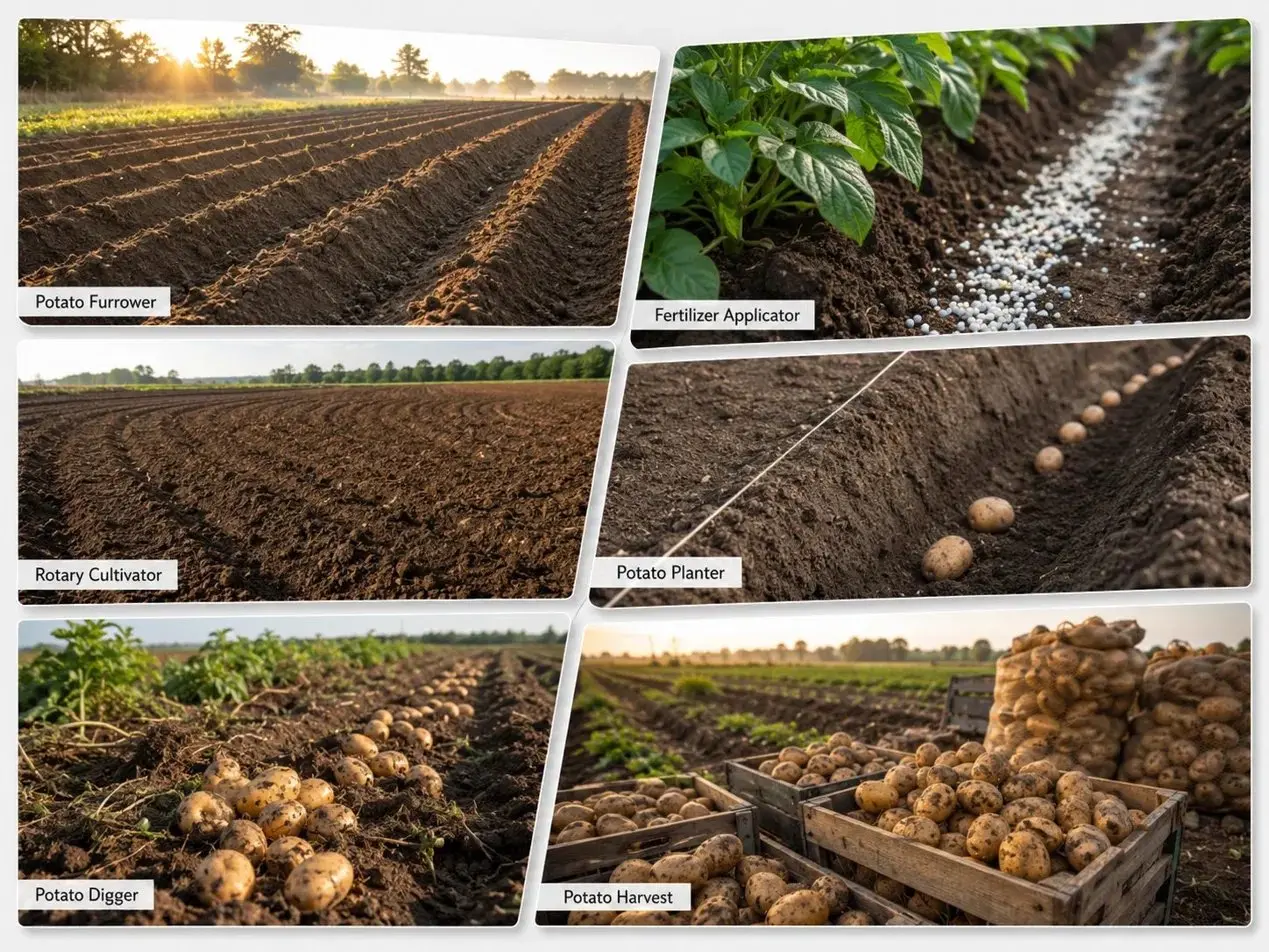
The pre-season setup of a two-row mounted digger requires more precision than a single-row unit because two errors that would be tolerable on a narrow single-row machine — slightly misaligned row spacing and slightly uneven depth between the two shares — both multiply in their effect when covering two rows simultaneously. The setup sequence below should be completed on a flat, hard surface before the machine enters the field.
Sıkça Sorulan Sorular
▶My rows are planted at 85 cm. Can a standard two-row mounted digger be set for this spacing?
Most two-row mounted diggers offer share spacing adjustment across the common European and North American row widths: 75 cm, 80 cm, and 85 cm are all standard adjustment positions on well-designed two-row frames. The adjustment is made by repositioning the share carrier brackets along slotted mounting rails — a process that typically requires only spanners and takes 15–30 minutes. Some models also accommodate 90 cm row spacing for specific markets. Before purchasing, confirm the adjustment range with the manufacturer and verify that your planted row spacing falls within it. Also confirm the total working width at your chosen spacing and that this is within the reach of your tractor’s Cat 2 hitch lateral stability range — very wide share spacings on a narrow mainframe can create lateral torque on the linkage.
▶The two-row swath is much wider than the single-row — how does my picking crew cope with the wider deposit?
The wider tuber deposit behind a two-row mounted digger — typically 120–160 cm across — is the most immediate operational challenge for a picking crew transitioning from single-row operation. The crew must spread laterally to cover the full swath width, which means walkers cannot stay in a single file behind the machine as they would with a single-row. The practical adaptations are: (1) add one extra picker per two-row pass compared to the single-row equivalent — the crew covers twice the ground per machine pass, so the increased width requires proportionally more people; (2) use a wider picking container (a flat tray or wide-mouth bag) rather than a narrow sack; (3) consider a mechanical spinner or bunker elevator running alongside the deposit, which handles the wider swath more efficiently than hand-picking and reduces the crew size requirement despite the wider machine. The two-row machine’s labour advantage appears most clearly when paired with a mechanical collection system rather than hand-picking.
▶Is it better to harvest two rows simultaneously or to make separate single-row passes on the same tractor?
On all practical farms, harvesting two rows simultaneously with a two-row digger is more productive than making two single-row passes with the same tractor for the simple reason of headland time. Every pass requires a headland turn that takes approximately the same time regardless of the working width. A two-row machine completes the headland turn once per two rows instead of once per row — on a 200 m field with 50 cm headland, this difference is relatively small, but on a 100 m field or on a farm where the tractor must be repositioned between blocks, the headland time savings of the two-row machine compound rapidly. The only scenario where two single-row passes might be preferred over a two-row machine is when the picker crew can only service one row at a time and the excess deposit from a two-row pass goes uncollected — but this is a crew management issue rather than a machine selection issue, and is better resolved by adding collection capacity than by using a narrower digger.
▶At what farm size should I stop considering two-row mounted and move to a trailed machine?
The farm size threshold for graduating from two-row mounted to trailed is typically 18–25 hectares of maincrop potato, though it depends heavily on field shape and the harvest window typical in your region. Below 18 hectares, the two-row mounted machine can complete harvest within a manageable window (typically 5–8 good working days) on most farms. Above 25 hectares, the harvest window becomes critical: at 4 ha per day maximum for a two-row mounted machine, a 25-hectare crop takes at minimum 7 working days, which in a difficult autumn may not be achievable within the quality-retention window. A trailed four-row machine at 8–10 ha per day completes 25 hectares in 3 days. Between 18 and 25 hectares, the answer depends on the reliability of your local harvest weather: farms in regions with stable September-October conditions can push the two-row mounted further; farms in regions with frequent early autumn rainfall should consider the trailed machine earlier.
▶Can I run a two-row mounted digger on a 60HP tractor if I reduce working depth or forward speed?
On sandy loam or light soil in good digging conditions, a 60HP tractor can manage a two-row mounted digger at reduced forward speed (2.5–3 km/h rather than the 4 km/h the machine is designed for) and at the shallow end of the depth range (18–20 cm rather than 25–28 cm). This is not a comfortable operating margin — the PTO is loaded near its maximum, leaving little reserve for stone encounters or soil density variation. In practice, two problems emerge consistently on 60HP: first, any slight increase in soil resistance from compaction, stone impact, or ridge depth variation causes the tractor to slow or wheel-slip; second, the reduced forward speed cuts the field capacity advantage of two-row operation to the point where the two-row’s productivity gain over a single-row on a smaller tractor is minimal. The 60HP threshold is appropriate for a single-row mounted digger on any soil — for two rows, 65HP is the true entry point and 80HP is what the machine will perform as designed on any practical soil type.
Ready to Step Up to Two Rows?
Share your tractor HP, hitch category, planted row spacing, and potato hectares. Korea Watanabe will confirm the correct two-row mounted digger specification — chain width, share spacing, and ballast requirement — for your patates işleme sistemi.
Kore Watanabe Rock Crusher Tractor Co., Ltd. — Ansan-si, Gyeonggi-do
Editör: Cxm