The sweet potato (Ipomoea batatas) and the common potato (Solanum tuberosum) share their market category — both are starchy root vegetables grown in ridges — but they are not related plants, and their biology at harvest time creates completely different machinery challenges. The common potato produces tubers on stolons that develop in a compact cluster above the seed tuber, staying largely within the ridge. Sweet potato produces storage roots that grow from the vine’s root system, radiating horizontally from the plant’s crown in any direction to a distance of 30–60 cm. The above-ground vine at harvest time is a 1–2 metre long, tangled prostrate growth covering the entire soil surface above the roots. Neither the tuber cluster location pattern nor the vine-covered canopy has any parallel in Irish potato harvest.
These biological differences create three specific machinery challenges for sweet potato harvest: vine management before the digger can enter, wider share coverage to reach the full root spread, and gentler elevator handling to protect the fragile skin of the sweet potato storage root. This guide works through each challenge and explains when a standard potato digger can be adapted for sweet potato harvest and when a purpose-designed sweet potato harvester is needed.
Sweet Potato vs Irish Potato — Biological Harvest Differences
| Characteristic | Irish Potato (Solanum tuberosum) | Sweet Potato (Ipomoea batatas) |
|---|---|---|
| Edible part type | Tuber (modified stem) | Storage root (modified root) |
| Root/tuber location | Compact cluster on stolons above mother tuber; largely within the ridge | Distributed roots radiating from the crown 30–60 cm horizontally; not confined to ridge |
| Above-ground crop at harvest | Senescent or killed haulm, 30–60 cm upright; manageable | Prostrate vine, 1–2 m long, tangled, covering full soil surface — must be removed before digging |
| Skin / peel character | Set skin (suberised periderm) — moderate to high damage resistance | Thin, easily-damaged skin — requires gentler handling than Irish potato at all stages |
| Typical growing soil | Any — clay, loam, sandy loam depending on region | Almost exclusively sandy or light loam — sweet potato does not form well in clay |
The storage root classification is agronomically significant: sweet potato roots grow from the plant’s root system and extend outward in any direction that soil conditions allow. In a commercial sweet potato production system on 90–120 cm rows (sweet potato typically uses wider rows than Irish potato), the storage roots of a healthy plant can be found anywhere within a 60 cm radius of the plant crown — a circular zone much wider than the ridge itself. A digger share set to the ridge width will miss storage roots that have developed outside the ridge, in the furrow or even partway up the adjacent ridge side. This is the root cause (literally) of the primary miss-root problem with standard potato digger shares on sweet potato.
Why Standard Potato Diggers Fail on Sweet Potato — Three Specific Problems
Vine Management Before Digging — The Non-Negotiable First Step
Vine management before the digger enters the field is the operational step that has no equivalent in Irish potato harvest and that most significantly distinguishes sweet potato mechanisation from Irish potato mechanisation. Commercial sweet potato operations use one of three methods:
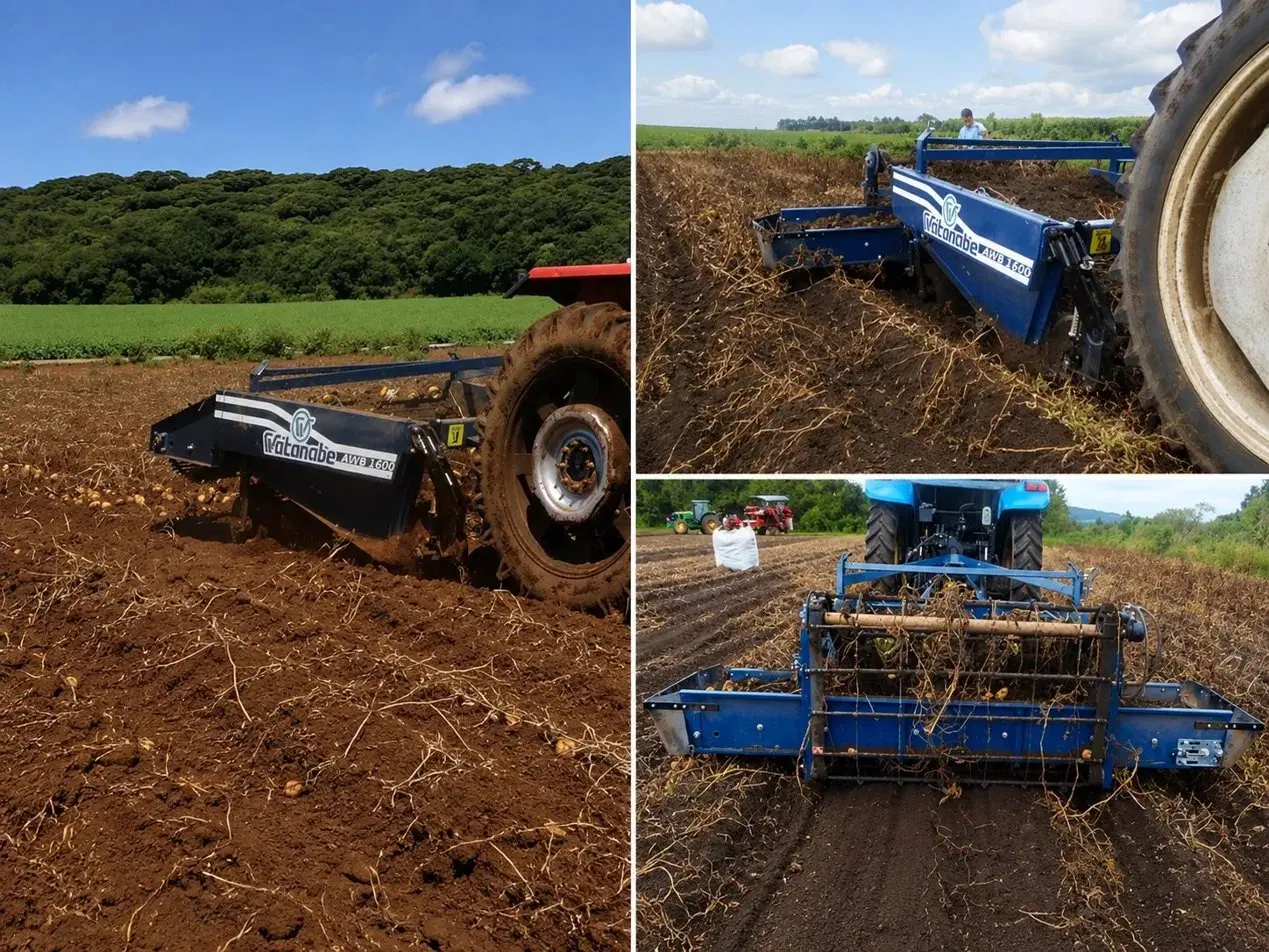
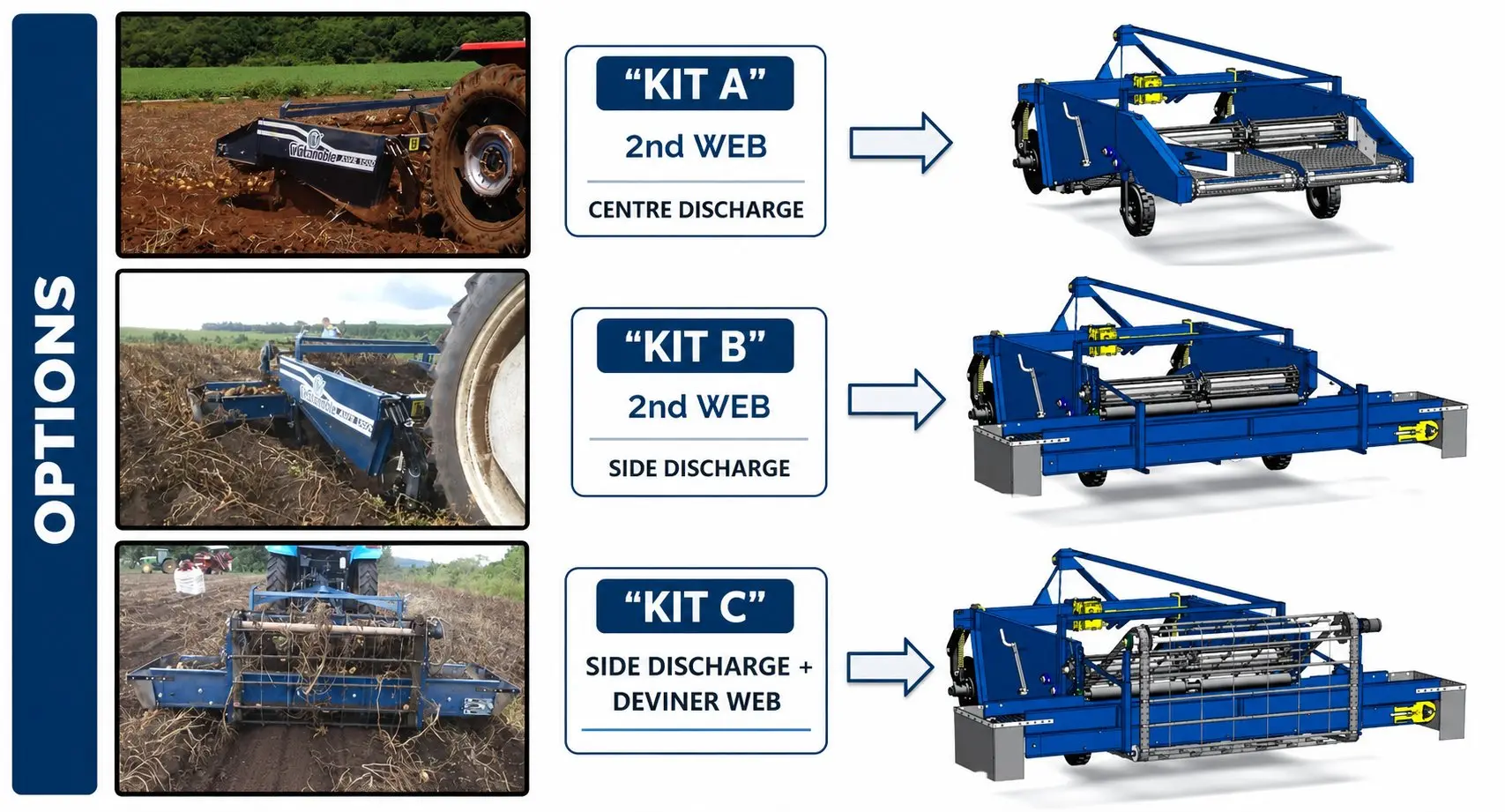
Sorularınız için potato machinery adaptable for sweet potato harvest, Korea Watanabe can advise on share width adjustment options, reduced agitation bar configuration, and vine management attachment compatibility for each digger model.
Sandy Soil — The Natural Environment for Sweet Potato Machinery
Sweet potato is an obligate sandy/light soil crop in commercial production. Heavy clay soils produce misshapen, stunted storage roots with rough skin and low marketable yield — clay’s physical resistance prevents the large, uniform root development that is needed for commercial markets. All major sweet potato production zones worldwide are on sandy to light loam soils: North Carolina’s Coastal Plain sandy soils (the largest US sweet potato producing state), Georgia’s Piedmont sandy loam, the volcanic sandy soils of Japan’s Kagoshima and Ibaraki prefectures, China’s Shandong and Henan sandy river plains, and the savannah sandy soils of Nigeria, Ghana, and the West African sweet potato belt.
This universal sandy-soil context means that the sweet potato digger specification inherits the sandy soil machinery settings as its starting point — riddle frame separator (or no separator at all in some simple one-row designs), minimum agitation bars, low chain speed — and then adds the three sweet potato-specific adaptations: vine management system, wider share, and softer/rubber-coated elevator elements. The result is a machine that is gentler than a potato digger for comparable soil conditions but more complex in its pre-harvest requirements because of the vine management step.
Sıkça Sorulan Sorular
▶What row spacing do commercial sweet potato operations use, and does this affect the digger specification?
Commercial sweet potato operations use wider row spacings than Irish potato — most commonly 90 cm to 120 cm, with 90 cm the most common in European and North American commercial production. Some smallholder systems use 75 cm or even narrower, but these wider rows are preferred because they give the extensive vine growth more room to spread and reduce vine competition between adjacent rows. The wider row spacing directly affects the digger specification: at 90 cm row spacing, the digger’s depth wheel track and share assembly must be configured for 90 cm, not the 75 cm standard of Irish potato machinery. Additionally, the wider share needed to cover the sweet potato root spread zone (110–120% of row spacing) means a share of approximately 100–110 cm on a 90 cm row — significantly wider than any standard Irish potato digger share. Most dedicated sweet potato diggers sold in North America, Japan, and China are configured specifically for 90 cm or 100 cm row spacing; European suppliers of convertible machinery often offer row spacing adjustment kits.
▶Can I use my existing Irish potato digger to harvest sweet potato if I first remove the vines manually?
With vine removal completed by manual cutting or flailing before the digger enters, a standard Irish potato digger can harvest sweet potato in some circumstances — but with two significant limitations. First, the share width: if your potato digger’s share matches your Irish potato ridge width (75 cm or 80 cm) and your sweet potato is grown at 90 cm row spacing with roots extending 30–60 cm laterally, the share will miss a proportion of the storage roots in the outer radius. This miss rate may be acceptable for a farm trial or small volume — but for commercial production, a miss rate of 15–25% in storage root weight is a serious economic loss. The adaptation of fitting a wider share (if the manufacturer supports this) addresses the miss rate. Second, elevator handling: standard potato elevator rods at normal agitation settings will cause more skinning damage on sweet potato than dedicated soft-handling equipment. Reducing agitation bars to the minimum and running at lower chain speed mitigates this but does not eliminate it. The conclusion: adapted potato digger (wider share, reduced agitation) with vines fully removed = adequate for small-scale or trial sweet potato harvest; dedicated sweet potato harvester = the correct commercial specification for any operation above 2–3 hectares.
▶Is sweet potato grown commercially in Europe, and what machinery is used there?
Field sweet potato production in Europe is limited by climate — sweet potato requires a long, warm growing season (at least 100–120 frost-free days with warm nights above 15°C) that is only reliably available in southern Europe (southern Spain, Portugal, parts of Italy and Greece) and with polytunnel or glass cover in northern Europe. Spain is Europe’s largest sweet potato producer, particularly in the provinces of Andalusia (Sevilla, Huelva) and Valencia — grown on sandy river plain soils under drip irrigation. Portuguese production concentrates in the Minho and Algarve regions. These southern European operations use dedicated sweet potato harvesters imported from the US (primarily from North Carolina manufacturer-networks) or Japan, configured for 90–100 cm row spacing and vine lifter attachments. UK sweet potato production is almost entirely under tunnels or glass and is harvested by hand because the scale does not justify mechanisation — the growing conditions limit field-scale production.
▶How deep does the sweet potato digger share need to go relative to Irish potato?
Sweet potato storage root depth is similar to Irish potato tuber depth — the majority of storage roots develop in the top 20–30 cm of soil, with a concentration in the 10–25 cm zone. The digger share depth for sweet potato is therefore comparable to Irish potato (typically 20–25 cm from the soil surface at the ridge crown to the share tip), and the depth wheel setting protocol is the same: confirm the deepest storage roots by pre-harvest hand-digging, set the share 3–5 cm deeper than the deepest root, and verify by walking 20 metres of the first row after digging to check for missed roots. One sweet potato-specific depth consideration: on lighter, sandy soils (the standard for sweet potato) at high soil moisture, the storage roots can sometimes develop slightly deeper than on firmer soils — 25–30 cm from the ridge crown — because the roots follow the water gradient downward in hot, dry conditions. Confirm the actual depth distribution on the specific field before the first harvest day by digging a 1 m × 1 m sampling square to full depth and mapping where all storage roots are found.
▶Are there different sweet potato digger requirements for the major production regions — US, Japan, West Africa?
Yes — the machinery requirements differ significantly between the major sweet potato producing regions based on farm scale, labour availability, and market quality requirements. In North Carolina and Georgia (US commercial production): large-scale farms of 30–100 hectares use mechanised vine lifters followed by dedicated 2-row sweet potato harvesters with bunker systems; quality standards for fresh market and processing require minimal skin damage; machines are imported or built by specialist sweet potato machinery suppliers (primarily based in North Carolina). In Japan (Kagoshima, Ibaraki): high-value fresh market with very strict skin quality requirements; two-wheel tractor-mounted single-row sweet potato diggers are common on smaller Japanese farms (0.5–3 ha average); Japanese manufacturers (Yanmar, Kubota, Iseki) produce sweet potato-specific attachments for their two-wheel tractor range. In West Africa (Nigeria, Ghana): almost entirely smallholder production (0.1–1 ha); hand harvest dominates; vine removal by machete; single-row manual push diggers are being introduced through CGIAR/CIP development programmes but mechanisation remains early-stage. The Korean and Chinese market: China is the world’s largest sweet potato producer; machinery ranges from simple hand-operated diggers to large 4-row commercial harvesters; Korean sweet potato farming (primarily Jeollanam-do and Gyeongnam-do) uses Japanese-style single-row tractor diggers on the island and coastal sandy soils.
Sweet Potato Machinery Query?
Share your row spacing, farm area, and whether vines will be mechanically or manually removed. Korea Watanabe will advise on the wider share and reduced agitation configuration available for patates kazıcı adaptation to sweet potato conditions.
Kore Watanabe Rock Crusher Tractor Co., Ltd. — Ansan-si, Gyeonggi-do
Editör: Cxm