A standard maincrop potato crop receives between 8 and 16 heavy vehicle passes per hectare in a single season. Spring cultivation, ridge formation, planting, 4–8 spray applications during the growing season, and the harvest operation — which alone may involve 3–5 separate tractor and trailer passes — collectively impose a wheel traffic load that no other common arable crop matches. Each pass on moist soil exerts downward pressure that forces soil particles closer together, reducing pore space and pore continuity. When this compaction occurs at depth — below the cultivated layer, in what soil scientists call the B horizon — the resulting dense layer (commonly called a plow pan, compaction pan, or subsoil pan) restricts root penetration to the zone of loose topsoil above it, limits water drainage through the profile, and reduces the oxygen supply available to potato roots in the lower root zone. The potato plant, which needs the top 40–50 cm of soil to develop a full root system for optimal tuber set and bulking, is effectively confined to the top 20–25 cm when a compaction pan exists at 25–30 cm depth.
How Potato Field Compaction Develops — Traffic, Weight, and Soil Moisture
Compaction is not a single event but an accumulation process whose rate depends on three interacting variables: axle load (the weight the vehicle places on each axle), tyre-to-soil contact pressure (governed by tyre size and inflation pressure), and soil moisture at the time of traffic. All three must be managed to control compaction accumulation over a potato growing season.
The critical variable is soil moisture: dry soil resists compaction because the friction between soil particles creates an arch structure that distributes load laterally. Moist soil — particularly moist clay-loam or silt-loam — has reduced inter-particle friction, allowing vehicle weight to press particles together rather than bridging around the tyre footprint. The highest-compaction-risk events in the potato calendar are therefore the harvest passes: by late summer and autumn, the soil has typically received significant rainfall, is at or above field capacity in many years, and is simultaneously being traversed by the heaviest loads of the season — fully loaded tractor trailers of 12–16 tonnes gross, bunker harvesters at 8–12 tonnes when full. This combination of heavy load on moist soil is the primary mechanism for subsoil compaction in potato fields.
The “plow pan” — a specific compaction layer at the base of the cultivated horizon — has an additional cause: repeated tillage to the same depth, year after year. When the rotary cultivator blades work to 22 cm every spring, the bottom of the cultivation zone at 22–25 cm is smeared by the passing blades and compacted by the machine’s weight pressing through the unworked soil below. Over several seasons, this creates a low-porosity layer at a consistent depth that neither cultivation nor root penetration can easily break through.
Detecting Compaction — Penetrometer Protocol and Critical Threshold Values
A soil penetrometer is the most practical field tool for compaction detection — far more accurate than visible field symptoms (poor plant establishment, waterlogging, stunted growth) which typically appear only after compaction has been present for a full growing season. Penetrometers range from the simple hand-pushed pocket penetrometer (adequate for surface compaction assessment) to the data-logging electronic cone penetrometer (required for precise depth profiling). For potato compaction monitoring, a hand-pushed cone penetrometer capable of reading to at least 45 cm depth and calibrated in MPa (megapascals) or kPa is sufficient.
| Resistance (MPa) | Compaction Level | Root Penetration Impact and Required Action |
|---|---|---|
| < 1.5 MPa | None / Acceptable | Roots penetrate freely. No action required. Continue normal cultivation practice. |
| 1.5–2.0 MPa | Moderado | Root growth slowing; water movement beginning to slow. Monitor: if pattern is consistent, plan remediation in drier conditions. Tyre pressure reduction recommended for all future passes. |
| 2.0–2.5 MPa | Significant | Root growth significantly reduced; yield impact likely in current or following season. Subsoil loosening scheduled for appropriate dry conditions. Tyre pressure reduction essential. |
| > 2.5 MPa | Severe — Act Now | Root penetration essentially halted; yield loss of 5–15 t/ha expected in affected areas. Subsoil loosening required before next potato crop. Rotary cultivator alone will not resolve. |
| > 3.0 MPa | Critical | Essentially impenetrable to most agricultural plant roots including potato. Aggressive subsoil loosening in dry conditions required; consider growing a break crop that can exploit frost heave and drying cycles before returning to potato. |
Penetrometer testing protocol: Take readings at three depths — 15 cm, 25 cm, and 35 cm — at 20 random locations across the field, avoiding wheel tracks (which represent worst case but not field average). Read resistance as the probe passes through each depth, not just at maximum insertion. A peak reading at 25–30 cm that is 0.8 MPa above the reading at 15 cm indicates a plow pan at that depth. Compare wheel track readings to inter-row readings to quantify the traffic contribution. Test after harvest and again in spring before cultivation — spring testing after winter frost cycles typically shows lower readings than autumn post-harvest, as freeze-thaw has partially restored pore structure in the surface layers.
The Yield and Quality Cost — Research Evidence from Potato Production
The agronomic cost of soil compaction in potato is well-documented in UK, Dutch, and German research. AHDB Potatoes (UK) and Wageningen University (Netherlands) have conducted multiple controlled compaction studies in commercial potato fields. The consistent findings across these studies provide a practical cost framework for evaluating remediation investment.
Rotary Cultivator as First Corrective Pass — What It Can and Cannot Do
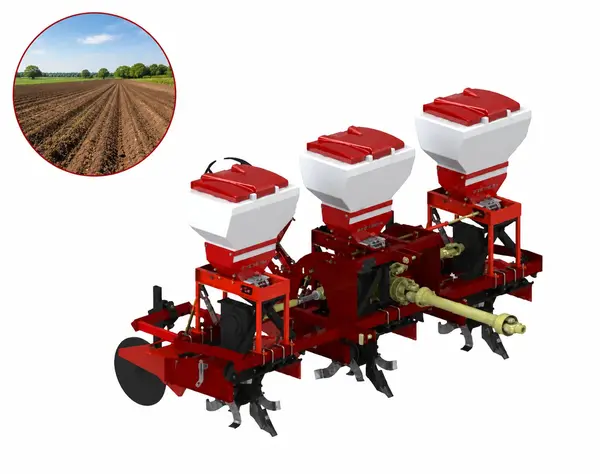
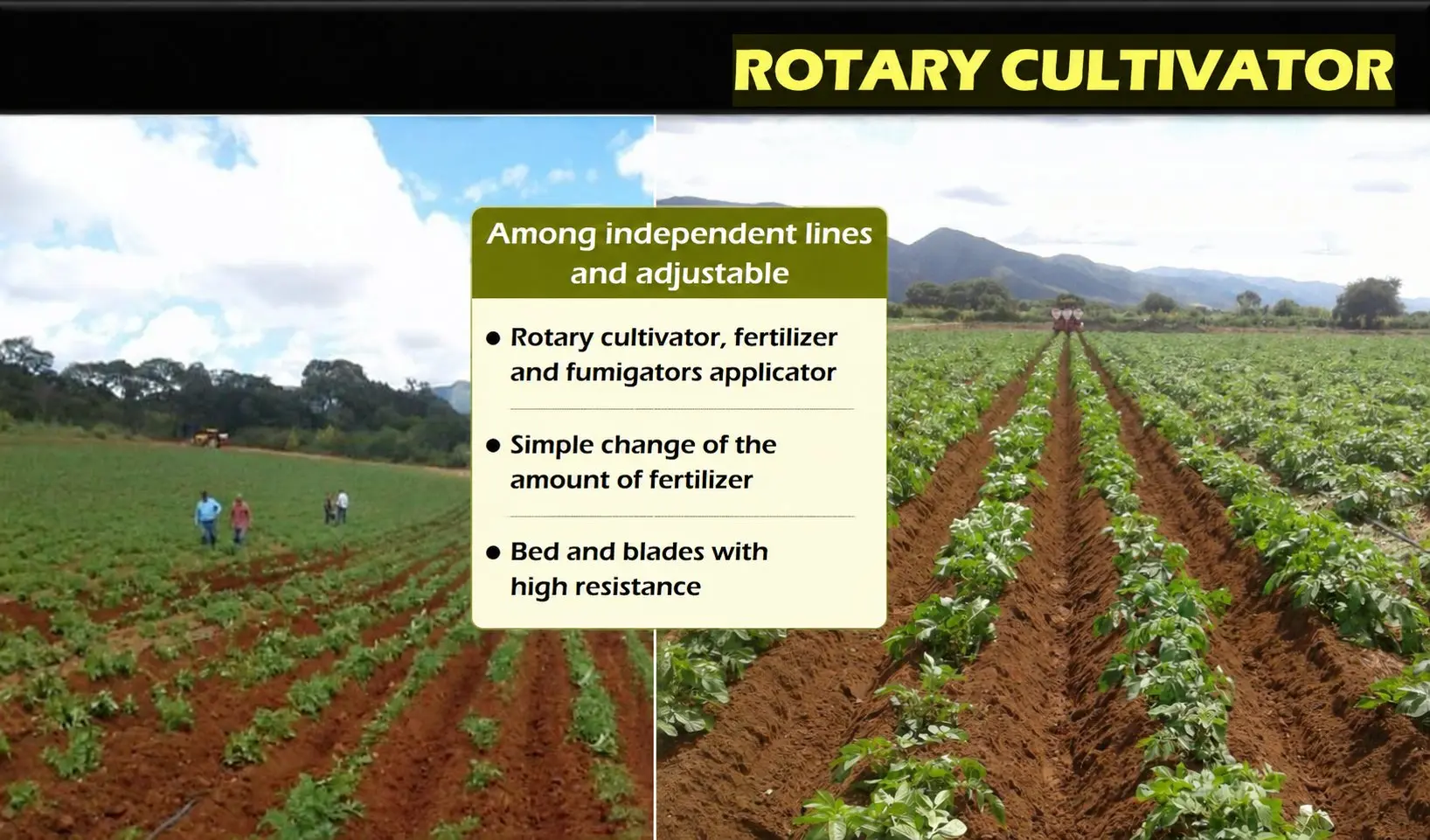
The rotary cultivator is the primary soil preparation implement for potato seedbed preparation and has an important — but limited — role in compaction remediation. Its blades work within the top 20–28 cm of the soil profile, breaking up compacted topsoil aggregates, incorporating organic matter, and creating the fine, uniform tilth that potato planting requires. For compaction within this depth range (surface and shallow pan), a correctly set rotary cultivator can restore adequate pore structure and root access.
What the rotary cultivator cannot do is address compaction below its working depth. A compaction pan at 30–40 cm — below any rotary cultivator’s practical operating depth — is completely unaffected by rotary cultivation. The blades do not reach the pan; the machine’s weight may actually add to surface compaction during the cultivation pass if conditions are too wet; and the seedbed created above the pan looks perfectly prepared while concealing a root-restricting layer that will limit the season’s yield. This is the most dangerous type of compaction for potato production — invisible to any surface inspection, detectable only by penetrometer, but consistently visible in the yield data.
For compaction at 25–40 cm depth, the correct remediation sequence is: (1) subsoil loosening with a chisel plough or rigid-tine subsoiler set to work 5–8 cm below the pan depth, in dry conditions (when soil shatters along natural fracture planes rather than smearing); (2) secondary rotary cultivation to restore tilth and incorporate any disrupted material; (3) planting. The rotary cultivator always follows the subsoiler in this sequence — it is the finishing pass, not the remediation pass. Attempting to combine both functions with a deep-set rotary cultivator typically smears the compaction zone rather than shattering it, particularly in moist conditions.
For enquiries on rotary cultivator specifications for potato seedbed preparation and compaction management, Korea Watanabe can confirm working depth range, rotor blade configuration, and power requirements for each cultivator model.
Controlled Traffic Farming — Preventing Compaction Rather Than Curing It
Controlled Traffic Farming (CTF) is the systematic approach to compaction prevention that restricts all machinery movement to permanent fixed lanes that cover a defined, minimum proportion of the total field area. In a standard CTF system, all tractors, trailers, harvesters, and spray equipment operate on the same fixed track width and the same fixed lane positions in every season. The traffic lanes — typically comprising 20–25% of the total field area — receive all the wheel load compaction; the remaining 75–80% of the field surface is never trafficked and maintains its natural porosity and pore structure year after year.
CTF in potato production requires that all machinery used on the farm shares a compatible track width — the distance between the centre lines of the left and right wheels. For potato production, a common CTF standard is 3.0 m track width (tractor axle extended to 3.0 m, with all trailers and harvesters configured to the same width), which aligns traffic lanes with a 4-row or 6-row potato bed system. The track width must also match between the spring cultivation tractor, the planting tractor, the spray tractor, and the harvest tractor and trailer — a mixed-track system where different machines operate on different widths creates more compacted lanes, not fewer. Full CTF therefore requires either purchasing machinery of compatible track width or converting existing machinery with track-width adjustment kits.
Research evidence for CTF in potato: New Zealand studies (Lincoln University, Canterbury) showed a 12–18% yield improvement in CTF plots compared to random traffic controls after three years; UK studies at Harper Adams University showed a 7–12% yield improvement and a 20–35% improvement in soil pore continuity to 40 cm depth after two CTF seasons. The investment in CTF — primarily wheel-width adjustment and headland management changes — pays back within 2–4 seasons in yield improvement alone, before accounting for fuel savings from reduced soil resistance during cultivation and the reduced compaction remediation requirement.
Perguntas frequentes
▶Does a rotary cultivator working to 25 cm break a plow pan at 22 cm, or does it just skim the surface of the pan?
A rotary cultivator set to exactly the pan depth will partially disturb the top surface of the pan but will not adequately shatter it. For effective pan disruption, the working depth must be set 5–8 cm below the pan depth — if the pan is at 22 cm, the cultivator or subsoiling implement must work to 27–30 cm to properly reach below the pan and shatter it from beneath. When the cultivator blade cuts through the pan level, the smearing action of the blades on the bottom of their travel can actually worsen the pan condition — particularly in moist soil where the clay fraction smears rather than fractures. For a pan at 22 cm, a subsoiler or chisel plough set to 28–30 cm is the correct primary tool; the rotary cultivator then follows at its standard 20–22 cm depth to restore seedbed tilth in the loosened upper profile. If the pan is at 28 cm or below (below a standard rotary cultivator’s reach), the rotary cultivator has no role in remediation — subsoiling alone is required before the cultivator pass is applied.
▶Can cover crops between potato rotations help break compaction, and if so which types are most effective?
Deep-rooted cover crops (sometimes called “bio-drills”) can contribute to compaction remediation through their root action, but their effectiveness at depth is slower and more limited than mechanical subsoiling. The most effective cover crops for subsoil compaction remediation are those with deep, persistent tap roots that physically penetrate the compacted layer as they grow: tillage radish (Raphanus sativus, var. longipinnatus — also called daikon radish) develops a fleshy tap root 30–60 cm deep that, when it decomposes over winter, leaves a bio-pore channel through the compacted zone that subsequent crop roots can exploit; deep-rooted ryegrass or chicory mixes provide surface structure improvement and root channel development to 40–60 cm; and phacelia and buckwheat contribute surface porosity restoration. The limitation for potato rotations is that cover crops are most effective when left in the ground through winter to allow the freeze-thaw cycle to complete the frost-heave cracking initiated by the root channels — this requires planning the rotation to allow a full winter cover crop between potato crops, which is not always agronomically or commercially viable. Cover crops are best understood as a supporting measure alongside mechanical subsoiling, not as an alternative to it.
▶What tyre pressure should harvest machinery run at to minimise compaction, and does CTIS (central tyre inflation system) help?
The Wageningen University research recommendation for potato harvest machinery is a maximum tyre inflation pressure of 0.8 bar (80 kPa) during field passes — a significant reduction from the typical 1.5–2.0 bar road pressure on most agricultural trailers and harvesters. At 0.8 bar, the tyre footprint area expands substantially, distributing the same axle load over a larger soil contact area and reducing the ground contact pressure from the 150–200 kPa typical at high inflation to 60–80 kPa. This lower contact pressure confines significant compaction to the top 15–20 cm (the cultivated layer) rather than penetrating to 35–40 cm. CTIS (Central Tyre Inflation System) — a technology that allows the driver to adjust tyre pressure from the cab — is highly effective for potato harvest operations because it allows the operator to reduce pressure to the field-appropriate level as the machine enters the field and then reinflate for road transport to the storage site. Without CTIS, operators face the practical difficulty of deflating and inflating tyres manually at each field-road transition — which is time-consuming and therefore rarely done. CTIS eliminates this barrier and is considered a worthwhile investment for any potato farm managing more than 15–20 hectares where compaction from harvest traffic is a recurring problem.
▶How quickly does a compacted subsoil pan re-establish after remediation, and how often must it be addressed?
Without changes to the traffic management system, a remediated compaction pan in a 4-year potato rotation (potato every 4th year) typically re-establishes to pre-treatment compaction levels within 2–3 potato crops (8–12 years) if the same wheel traffic is applied. In a shorter rotation (potato every 2–3 years), re-establishment can be within 4–6 years. The implication is that a one-time subsoiling event does not provide permanent relief — it provides 4–8 years of improved root access, after which the pan reform process is advanced if traffic management has not changed. The durable solution is CTF combined with tyre pressure management, which prevents pan re-establishment rather than periodically curing it. Farms that implement CTF typically see their subsoil penetrometer readings gradually improve over 3–5 seasons without any annual subsoiling requirement — the absence of traffic in 75–80% of the field allows natural soil structure processes (biological activity, freeze-thaw, root penetration of existing pores) to maintain porosity. Annual subsoiling on farms without CTF is a maintenance cost; CTF converts that maintenance cost into a one-time system adjustment with a multi-decade compaction management benefit.
▶Does soil compaction affect potato machinery performance beyond yield — specifically, does a compacted field cause digger problems?
Yes — compacted subsoil affects digger performance in two specific ways. First, a compaction pan at 25–30 cm depth directly at or just below the digger’s share operating depth creates uneven draft resistance as the share alternately contacts and passes above the pan. This resistance variation causes the tractor’s draft control system to hunt — alternately raising and lowering the share to maintain constant draft — which produces uneven share depth and inconsistent tuber lifting. The result is an increased miss rate in areas where the pan is shallowest (share lifts above tuber depth) and excess soil disturbance where the pan is deepest (share penetrates to full depth). Second, a compacted pan creates a natural bowl that traps water above it — and waterlogged soil immediately above the pan is at its worst consistency for digger operation (maximum clay adhesion, maximum soil carry-over on the elevator). The field drainage problems associated with a compaction pan therefore translate directly into difficult harvesting conditions in wet seasons. Addressing the compaction pan before harvest is therefore not only an agronomic yield management action but a machinery performance and harvest quality action — the two outcomes are inseparable on heavy-land potato farms where compaction is a recurring issue.
Soil Compaction on Your Potato Farm?
Share your penetrometer readings, soil type, and current cultivation depth. Korea Watanabe will confirm the correct rotary cultivator specification for your seedbed preparation and provide guidance on cultivator depth settings for compaction remediation.
Coréia Watanabe Rock Crusher Tractor Co., Ltd.
Editor: Cxm