Across Korean highland counties — particularly in Gangwon-do, northern Gyeonggi-do, and North Chungcheong-do — significant areas of marginal forest land lie adjacent to established highland farms. This land consists of scrub forest, abandoned orchards, and secondary woodland that has grown on former agricultural fields over the past 30–50 years. Converting it back to productive highland agricultural use is one of the most substantial farm development investments a Korean highland operator can make — and when done correctly, one of the most rewarding.
The challenge that distinguishes forest land conversion from standard field stone clearing is the combination of obstacles: stumps and root systems that a standard stone crusher cannot process, embedded granite stones that a standard forestry mulcher does not fragment to agricultural standard, and a dense sub-surface root mat that neither machine alone addresses. The THOR FLM is the machine designed specifically for this dual-obstacle environment — and understanding its CVT tractor requirement, its workflow position, and the regulatory process that turns cleared forest into registered agricultural land is what this guide covers.
Why Forest Land Needs a Different Machine — Stumps Require Shear Force, Stones Require Impact
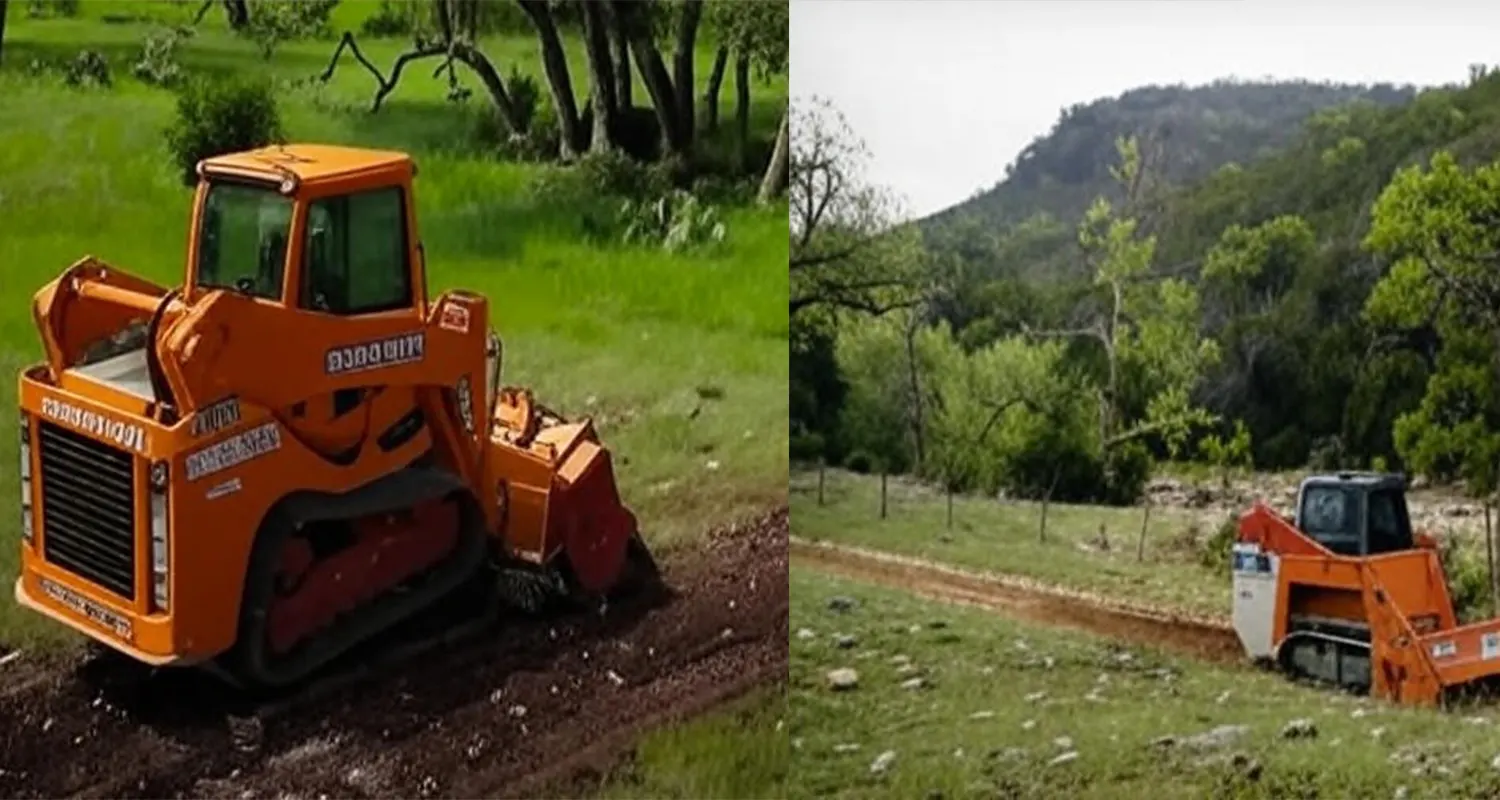
The fundamental difference between standard field stone clearing and forest land conversion lies in the nature of the obstacles present. Standard highland fields contain embedded granite stones — hard, rigid objects that fragment efficiently under the THOR 2.4’s high-velocity impact mechanism. Forest land adds two additional obstacle types that the THOR 2.4’s rotor cannot efficiently process:
Stumps and root balls
Tree stumps, even from small-diameter scrub species, are anchored by a radial root system that resists the THOR 2.4’s downward impact fragmentation approach. The rotor’s teeth are designed to fragment granite, not to shear through fibrous wood. Attempting to clear significant stump density with the THOR 2.4 produces rapid tooth wear, rotor overloading, and incomplete stump removal. The root ball that remains after a failed THOR 2.4 attempt on stumps continues to block deep soil preparation for 3–5 years as it slowly decays.
What processes it correctly: The THOR FLM’s forestry-rated tooth pattern and rotor geometry is designed to shear through wood fibres and root structures at the correct depth, reducing them to chips and fine fragments that decompose within 1–2 seasons after incorporation.
Sub-surface root mat
Forest soil below the stump layer contains a dense mat of lateral roots at 10–30 cm depth — often denser and more continuous than the stone layer in the same soil. A standard PSW-3200 tillage pass on forest land encounters this root mat and cannot create a uniform seed bed without first fragmenting and severing the root structure. Deep tillage through an intact root mat produces ridged, uneven soil that seeds cannot be planted into at consistent depth.
What processes it correctly: The THOR FLM simultaneously fragments the root mat and the stone layer in a single pass, reducing both to manageable particle sizes that the PSW-3200 can subsequently incorporate into a uniform fine-tilth seed bed.
| 애플리케이션 | 토르 필름 | 토르 2.4 |
|---|---|---|
| Primary use | Forestry / silviculture conversion | Agricultural field stone clearing |
| Stump clearing | ✅ Designed for this | ❌ 권장하지 않음 |
| Root mat clearance | ✅ Designed for this | ❌ Rotor not rated for fibrous load |
| Rock / stone clearing (≤30 cm) | ✅ Simultaneous with stumps | ✅ Primary function |
| 트랙터 요구 사항 | CVT 의무적 | 180 HP min., standard gearbox OK |
| PTO 속도 | 1,000 RPM | 1,000 RPM |
| Position in workflow | Step 2 (after timber removal) — first machine on new forest land | Step 3–4 (annual maintenance on cleared fields) |
The CVT Requirement — Why Standard Mechanical Gearbox Tractors Cannot Run the THOR FLM
The most important tractor qualification for the THOR FLM is not horsepower — it is the transmission type. The THOR FLM requires a tractor equipped with a Continuously Variable Transmission (CVT), also called an Infinitely Variable Transmission (IVT) by some Korean manufacturers. This requirement is not a recommendation: a standard mechanical gearbox tractor cannot safely operate the THOR FLM on forest land conversion duty.
Why CVT Is Mandatory — The Stump Impact Load Problem
When the THOR FLM’s rotor encounters a dense hardwood root or stump, the instantaneous resistance can spike to 5–10× the normal operating load within milliseconds. On a mechanical gearbox tractor, this spike transmits directly through the driveline — the PTO shaft, gearbox, and transmission all experience the full shock load simultaneously. On repeated stump impacts over a working day, this accelerated shock loading causes premature gearbox failure, PTO clutch damage, and in severe cases, transmission case cracking.
A CVT transmission uses a hydraulic or hydrostatic drive that inherently cushions impact loads — the hydraulic fluid compresses and absorbs the shock spike rather than transmitting it rigidly through the driveline. The CVT also allows the forward speed to adjust continuously in response to load changes: as rotor load increases on a dense stump, the CVT automatically reduces forward travel speed to maintain constant PTO torque rather than forcing the engine to absorb an overload spike.
CVT tractors are available from LS Mtron, TYM, and Kukje in the 150–230 HP range. When a forest land conversion project is planned, the tractor purchase decision must specify CVT transmission explicitly — not all models in the 180+ HP range include CVT as standard, and some manufacturers offer it only on specific model variants. Korea Watanabe confirms CVT compatibility for specific tractor models during the pre-purchase consultation.
The 5-Phase Conversion Workflow — From Standing Forest to First Crop
Converting Korean forest land to productive highland agriculture requires completing five phases in strict sequence. Each phase is a prerequisite for the next — skipping or partially completing any phase produces rework costs in later phases that typically exceed the cost of doing the skipped phase correctly at the time.
Phase 1 — Permit and Survey (3–6 months before clearance)
Apply for the agricultural land conversion permit through the county office. Provide a land survey, intended crop plan, and drainage scheme. For land with registered forest status, the Korea Forest Service (KFS) de-registration application runs in parallel. This phase runs entirely on administrative timeline — clearance work cannot legally begin until the permit is issued. Start Phase 1 six months before the planned clearing season.
Phase 2 — Timber Removal (1–3 weeks depending on stand density)
Commercial timber is sold or processed before any machine clearing begins. Trees with trunk diameter above 20–25 cm should be felled and removed by logging contractors — the THOR FLM is not designed for standing trunk removal and will not process logs efficiently. After logging, the remaining slash, branches, and small-diameter material can be left on the ground for the THOR FLM to fragment in Phase 3. Organising Phase 2 carefully minimises the fragmentation load in Phase 3 and maximises timber revenue that partially offsets the clearing cost.
Phase 3 — THOR FLM Stump, Root Mat, and Stone Clearing (1–3 weeks per hectare)
The THOR FLM on a CVT tractor makes 2–3 passes over the cleared forest area: the first pass at 20–25 cm depth fragments slash, surface stumps, and the upper root mat and stone layer; the second pass at 30–35 cm targets the deeper root and stone zone. Operating speed on forest land is significantly slower than on agricultural fields — 0.5–1.0 km/h on dense stump ground is typical. After THOR FLM passes, the surface is fragmented wood chip material mixed with crushed stone — visually very different from THOR 2.4 agricultural clearing output.
Phase 4 — THOR 2.4 Agricultural Standard Clearing + CT-2100 Collection (4–8 weeks)
After THOR FLM Phase 3 has removed the forest obstacles, the THOR 2.4 암석 분쇄기 makes the final pass to achieve the agricultural zero-tolerance stone standard. The THOR FLM fragments to forest-clearing standard; the THOR 2.4 brings the result to the sub-5 cm / 30 cm depth standard required for potato production, or the sub-1 cm / 40 cm standard required for ginseng. CT-2100 collection after the THOR 2.4 pass removes the stone material permanently. Phase 4 can typically be completed in October of the year after Phase 3, using the winter frost cycle to heave any residual sub-surface material before the spring soil preparation.
Phase 5 — Soil Preparation, Amendment, and First Crop (Year 2)
Soil test (pH, OM, available nutrients) in November. Lime application + PSW-3200 incorporation in October–November. Wait for the spring frost cycle to complete. PSW-3200 fine-tilth preparation in April. First crop seeding in late April–early May. Year 1 (clearing year) is a zero-revenue year on the new land; Year 2 is the first production year. Year 2 typically delivers 60–75% of the yield achievable on a 3-year established cleared field — the soil OM and microbial community have not yet reached their full productivity, but the stone-free physical environment from Phase 4 allows full-depth machine cultivation and produces Grade 1 proportion well above any un-cleared alternative.
The Land Registration Process — Converting Forest Classification to Agricultural Land
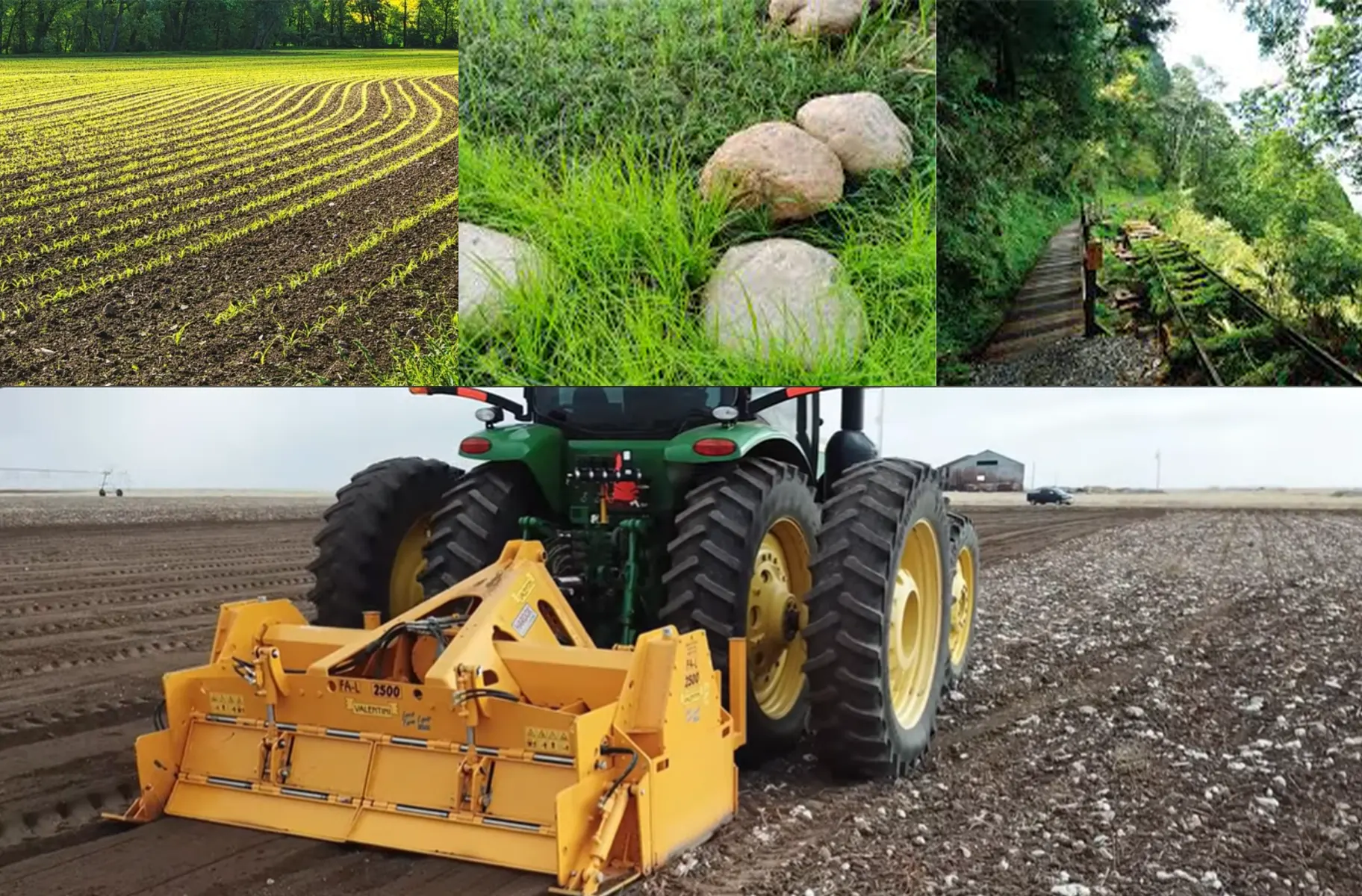
Korean land registration classifies each parcel by its current use — forest land (imya), agricultural land (jeon, for dry crops), and rice paddy (dap). Converting forest classification to agricultural classification requires a formal administrative process that must be completed before the cleared land can be registered as eligible for Korean agricultural machinery subsidies and before it can receive GAP field registration. The key steps:
The complete registration process from KFS application to MAFRA field registration typically takes 12–18 months. Korea Watanabe advises customers starting the process to submit the KFS de-registration application in January of the year before the planned first clearing season — ensuring the permit is in place for October–November clearing, December–March winter settlement, and April first-crop year preparation.
The Investment Case — New Land Value vs Clearance Cost
1 ha Forest Land Conversion — Representative Cost and Return Structure
Permit fees 200,000–500,000 KRW. Timber revenue from commercial timber: 500,000–2,000,000 KRW (offsets). Net: 0–1,500,000 KRW cost.
Contractor rate: 2,000,000–4,000,000 KRW/ha. THOR FLM is typically accessed through a Korea Watanabe affiliated contractor on a per-hectare basis rather than purchased for a single conversion project.
Own machine (if already purchased): fuel + wear parts ~500,000–1,000,000 KRW/ha. Contractor rate: 1,000,000–2,000,000 KRW/ha.
Lime, compost, PSW-3200 passes: 1,500,000–2,500,000 KRW/ha.
~5,000,000–10,000,000 KRW/ha (net of timber revenue offset)
~15,000,000–22,000,000 KRW/ha gross (cleared field, cooperative channel, Year 2 OM level)
6–18 months of full production (Years 2–3) after Year 1 clearing year
Registered agricultural land in Gangwon-do highland zones typically commands 3–5× the land price of equivalent forest parcel — independently of the crop revenue return on clearance investment.
자주 묻는 질문
How do I convert forest land to agriculture in Korea — what is the first step?
The first step is confirming the land’s current cadastral classification. Check the online Korea Land Information System (Gukto Jeongbo Peullaeom) to confirm whether the parcel is classified as imya (forest), jeon (dry cropland), or another category. If it is classified as imya, the KFS de-registration application is the mandatory first administrative step — no physical clearing can legally begin until this application is submitted and approved. Start the KFS application at least 6 months before the planned clearing season. While the KFS application is processing, Korea Watanabe can advise on the clearing specification, THOR FLM contractor availability, and the THOR 2.4 + CT-2100 Phase 4 configuration appropriate for the specific forest land type (density, stump size, stone density assessment).
Can the THOR 2.4 alone clear forest land without the THOR FLM — if the trees were already removed?
If commercial timber has been removed by a logging contractor and the remaining material consists only of slash (branches under 10 cm diameter), surface stumps under approximately 15 cm stump height, and the standard Korean highland stone population, then the THOR 2.4 can make useful progress on Phase 3/4 combined clearing. However, even with timber removed, the root mat at 10–30 cm depth that remains from the original forest stand will still significantly impede the THOR 2.4’s rotor. The THOR 2.4 was not rated for repeated encounters with fibrous root mats — sustained operation through dense root material accelerates tooth wear, increases rotor imbalance risk, and can produce gearbox shock loads above the machine’s design limit. For forest conversion projects where the full THOR FLM Phase 3 is not available, Korea Watanabe recommends: (1) commissioning a THOR FLM contractor pass for Phase 3 even if the THOR 2.4 will handle Phase 4; (2) allowing 6–12 months for root mat decomposition after slash burning before beginning THOR 2.4 Phase 4 work. Never attempt to use the THOR 2.4 as a substitute for THOR FLM on active stump clearing — the warranty explicitly excludes damage from forestry operations on the agricultural stone crusher models.
Is the marginal land clearing cost in Korea worth it compared to expanding by renting existing agricultural land?
The comparison between forest land conversion and rented agricultural land expansion involves several factors unique to each farm situation. Forest land conversion produces a permanent asset — the cleared, registered agricultural land has a capital value that rented land does not. The 5–10 million KRW/ha conversion cost, spread over a 10-year holding period, is 500,000–1,000,000 KRW/ha/year of amortised cost — significantly less than the typical annual rental cost for premium Korean highland agricultural land in established farming areas (typically 1,500,000–3,000,000 KRW/ha/year in Gangwon-do highland zones). For farmers with access to adjacent forest parcels at reasonable acquisition cost, conversion is typically more economical than renting equivalent established land over a 5–10 year horizon, and builds permanent asset value. The calculation changes if the forest land acquisition cost is high — the conversion investment plus purchase price must still produce a positive return versus the rental alternative.
What is the timeline from applying for the land conversion permit to the first crop on converted Korean forest land?
The representative timeline for a 1–5 ha Korean forest land conversion project beginning with the KFS de-registration application is as follows: Month 1: submit KFS application and begin MAFRA agricultural land conversion permit application simultaneously. Months 2–6: permit processing. Month 7: permits issued, timber removal contracted. Month 8: logging complete, Phase 3 THOR FLM clearing begins. Month 9: THOR FLM Phase 3 complete. Month 10 (October): Phase 4 THOR 2.4 + CT-2100 clearing + lime application. Months 11–March: winter settlement, frost heave cycle. April (Year 2): Phase 5 — PSW-3200 fine tilth + soil amendment. May (Year 2): first crop seeding. August–September (Year 2): first harvest. Total elapsed time from first permit application to first harvest: approximately 20–22 months. This timeline is the reason Korea Watanabe advises starting the process in January of Year 1 for a Year 2 first crop — the administrative process alone consumes 6 months before any physical clearing begins.
Is the THOR FLM available for hire from Korea Watanabe for conversion projects?
Korea Watanabe maintains a network of affiliated THOR FLM operators who provide the Phase 3 forest conversion service on a per-hectare contractor basis. The THOR FLM is a specialised machine that most individual farms do not need to own — a single forest conversion project of 2–10 ha is typically completed in 2–4 weeks of THOR FLM operation, after which the machine is no longer needed for the farm’s regular operation. Korea Watanabe coordinates 석재 분쇄기 and contractor availability, scheduling, and pricing for THOR FLM Phase 3 work as part of the complete forest conversion package consultation. The CT-2100 암석 수집기 is included in the Phase 4 planning. Contact Korea Watanabe with the land area, current forest stand description, and planned clearing timeline — Korea Watanabe will confirm THOR FLM contractor availability in the target window and provide a Phase 3 cost estimate for the specific project. The same consultation covers the THOR 3.0 석재 분쇄기 Phase 4 configuration for larger projects where coverage rate is the primary consideration.
Forest Land Conversion Planning — Start With the Permit
Land parcel description + current classification + target crop → Korea Watanabe provides the 5-phase workflow schedule, THOR FLM contractor availability, Phase 4 THOR 2.4 configuration, permit application guidance and Year 2 first-crop projection.
편집자: Cxm