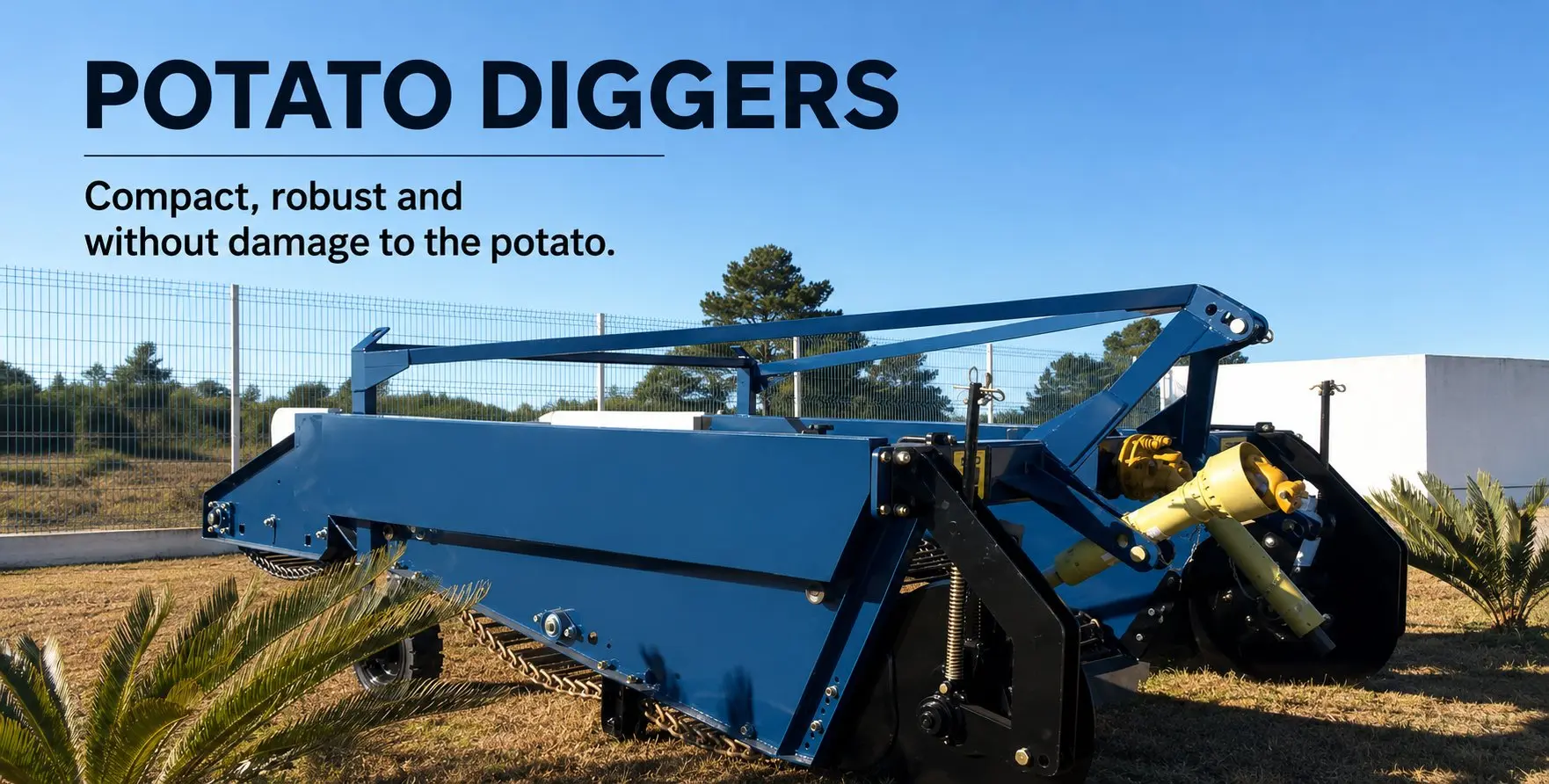
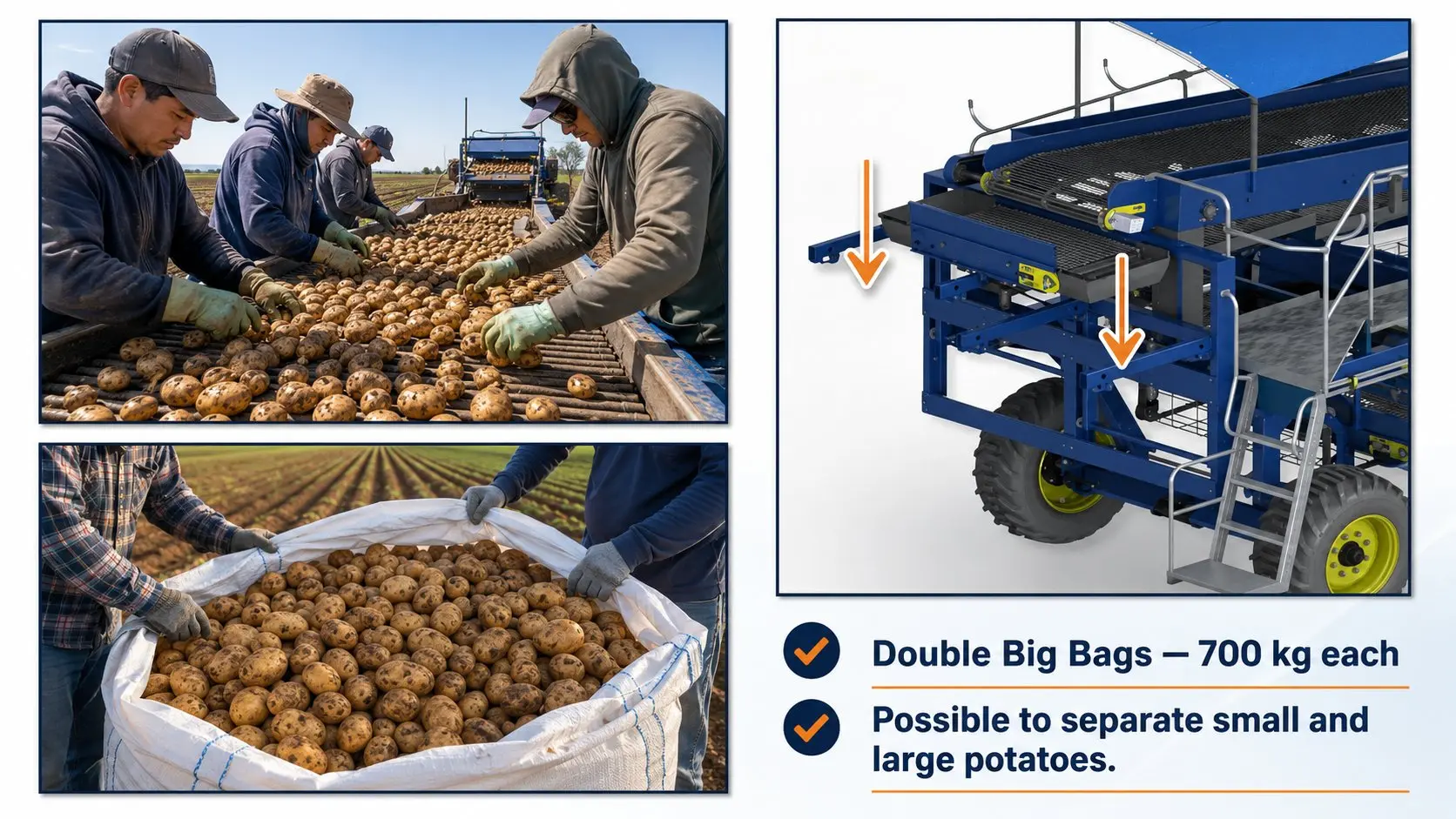
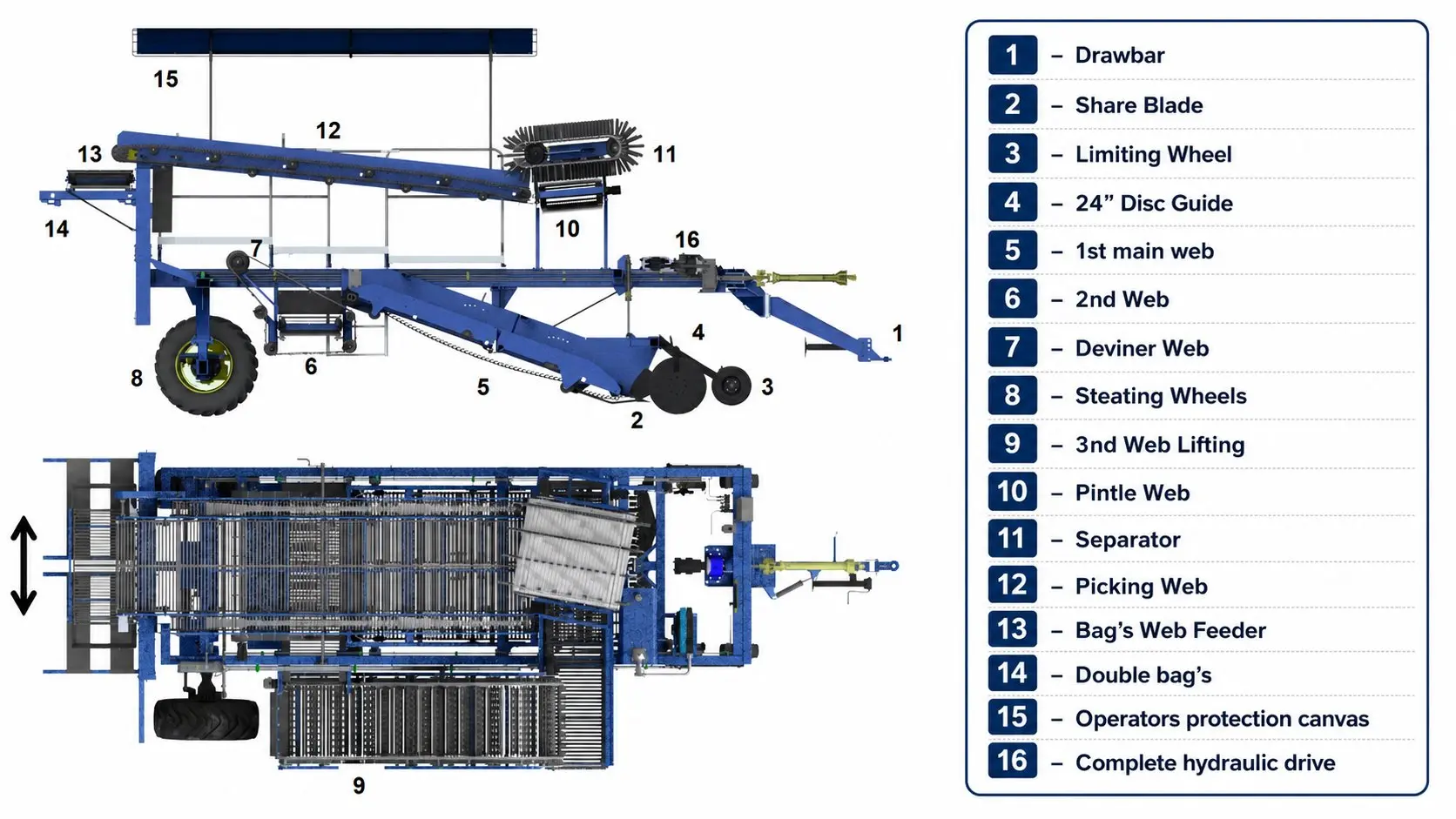
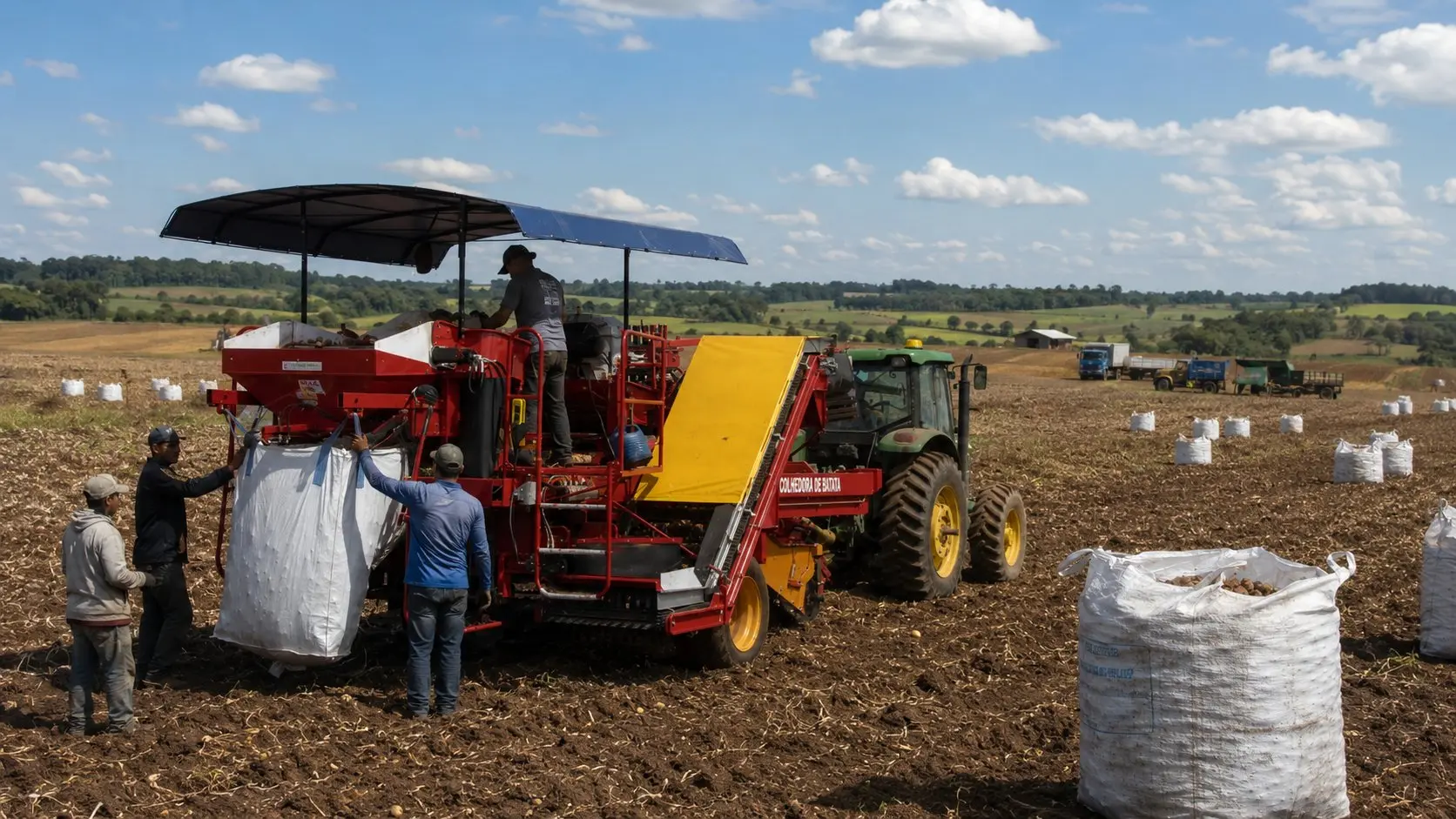
A potato digger lifts soil and tubers onto a vibrating elevator chain that shakes soil away and delivers clean potatoes for collection. The system is precise, fast, and highly effective — on stone-free ground. On stony fields, that same mechanism becomes a collision course: stone meets hardened steel at operating speed, and each impact advances one or more of five distinct mechanical failure modes. Understanding these modes — and the field conditions that trigger each — is the foundation of any sound decision between absorbing repair costs and investing in preventative stone clearing.
This guide covers the five ways stone destroys potato harvesting equipment, the stone concentration thresholds that shift risk from manageable to near-certain, an operational performance comparison between stony and cleared fields, and how Korea Watanabe’s frantoio per rocce, raccoglitore di rocce, E macchinari per la patata work as an integrated system.
The Five Ways Stone Destroys a Potato Digger
1
Digging Share Chipping and Dulling
First contact point
Progressive wear
The digging share made from boron steel (Brinell 400–450 HB) is the first component to meet stone. Limestone and granite chips progressively dull and nick the cutting edge. A blunted share requires significantly greater traction force, increases soil disturbance depth, and drives tubers deeper into the ground — elevating bruise risk before the elevator even touches them.
Key Operational Impact
On cleared ground: 60–100 ha per share set
On stony ground: 8–15 ha per share set
Wear multiplier: 4–6× faster
2
Elevator Chain Rod Breakage
Sudden stoppage
High downtime cost
The elevator chain — a continuous steel rod web spaced 28–35 mm apart — moves the soil-potato ribbon upward across the separation section. A stone wedging between two rods at the drive sprocket (maximum tension point) fractures or permanently stretches the rod, requiring a full field halt for chain replacement. The failure is abrupt and provides no advance warning.
Key Operational Impact
Field downtime per incident: 45–90 minutes
Chain incidents / season (stony): 3–6 events
Chain incidents / season (cleared): 0–1 events
3
Star Wheel and Separator Cracking
Quality degradation
Separation failure
Star wheels operate at high rotational speed to separate remaining soil and stones from the tuber stream. A stone larger than the designed inter-wheel gap either cracks the rubber coating, fractures a wheel arm, or jams the mechanism. A cracked star wheel delivers unreliable stone-potato separation — stones reaching the collection trailer contaminate the crop at the grader and cause further bruising.
Key Operational Impact
Grade 1 throughput reduction: up to 12%
Wheel lifespan on stony ground: 1–2 seasons
Wheel lifespan after clearing: 4–6 seasons
4
Gearbox Shock Load and PTO Damage
Single-event failure
Most expensive mode
When a large stone (>80 mm) is engaged at operating speed, the instantaneous load spike through the driveline can exceed the shear strength of gearbox keys, PTO universal joints, or driveshaft components. Unlike progressive wear, gearbox shock loading is a single-event failure. Shear bolt and slip clutch protection systems respond too slowly for sudden large-stone impacts — they are designed for sustained overload, not instantaneous shock.
Severity — Highest in Series
Harvest halt duration: 3–24 hours per incident
Risk per season on stony ground: Moderate to High
Risk per season after clearing: Very Low
5
Tuber Bruising — The Invisible Quality Loss
Commercial quality impact
Appears 24–96 hrs post-harvest
No field-visible symptoms
When potatoes and stones share the same conveyor, low-speed impacts (0.3–0.8 m/s) rupture cell membranes in tuber flesh. Polyphenol oxidase (PPO) enzymes contact their tyrosine substrate and catalyse melanin formation — creating blackspot bruising visible only 24–96 hours after harvest. Pack house intake protocols catch bruising in a standardised 48-hour assessment after warming, which is why field-origin bruising is only discovered at intake — days after the stone caused it.
Why It’s Commercially Critical
- ▸Invisible at harvest — discovered at pack house
- ▸Primary cause of Grade 1 bruise-related rejection
- ▸Stone clearing is the only field-level prevention
Quality Comparison
Bruised sample (stony): 15–25%
Bruised sample (cleared): 3–6%
The Stone Threshold — Where Risk Becomes Near-Certainty
Stone damage to potato machinery is threshold-dependent, not linear. Below a certain concentration a well-maintained digger absorbs wear at predictable intervals; above the threshold, each harvest carries statistically near-certain failure events. The AHDB Potato Programme and European Cultivated Potato Institute (ECPI) define the following risk bands:
Stone Count
stones >25 mm / m² |
Risk Level |
Share Wear Rate |
Warranty Status |
| <3 / m² |
BASSO |
1.0× baseline |
Full warranty applies |
| 3–5 / m² |
MODERARE |
1.5–2.0× |
Warranty applies; shorter service intervals recommended |
| 5–10 / m² |
ELEVATED |
2.5–4.0× |
Partial — stone damage exclusion may be applied to claims |
| >10 / m² |
HIGH — CRITICAL |
4.5–8.0× |
Voided — Grimme, AVR, Standen all specify exclusion |
PROTOCOL
Field Stone Assessment — Step by Step
① Sample
Lay 10 strips, each 10 m × 1 m, across the field after autumn ploughing. Count all stones >25 mm visible on the soil surface within each strip.
② Frost Timing
Always reassess after the final spring frost — pre-frost counts underestimate harvest-time stone concentration by 20–45% in northern climates.
③ Decision
≥5/m² any strip → THOR + CT-2100 before planting.
3–5/m² → BlackBird pre-harvest minimum.
<3/m² → Annual BlackBird maintenance.
Operational Performance — Stony Field vs Cleared Field
The following tables compare a potato digger operating on un-cleared stony ground against the same machine after THOR + CT-2100 stone clearing. All metrics are based on field research data from the AHDB Potato Programme, ECPI, and Australian and Canadian potato industry agronomy bodies.
⚙ Component Replacement Frequency
| Componente |
Stony Field |
After Clearing |
| Digging shares |
8–15 ha |
60–100 ha |
| Elevator chain |
1–2 seasons |
5–8 seasons |
| Star wheels |
1–2 seasons |
4–6 seasons |
| Gearbox incident |
Moderate–High |
Very Low |
⏱ Harvest Efficiency Metrics
| metrico |
Stony Field |
After Clearing |
| Unplanned stoppages / 100 ha |
4–8 events |
0–1 events |
| Avg. stoppage duration |
45–180 min |
<20 min |
| Fuel increase (blunt shares) |
+12–18% |
Linea di base |
| Grade 1 throughput at pack house |
−10–20% |
Maintained |
🥔 Crop Quality at Pack House
| Quality Measure |
Stony Field |
After Clearing |
| Bruised tubers in sample |
15–25% |
3–6% |
| Stone contamination in load |
Present |
Trascurabile |
| Intake rejection risk |
Moderate–High |
Very Low |
🔧 Digger Service Life Before Major Rebuild
Stony Field
800–1,200
hectares
After Clearing
1,800–2,500
hectares
Continuous stone shock shortens chassis weld fatigue life and main frame integrity by an estimated 30–45%. Stone-cleared fields effectively double the digger’s productive lifespan before a major rebuild is required — a significant capital equipment benefit that compounds over a fleet of machines on a large potato operation.
Regional Stone Profiles — UK, Canada, Australia and Southeast Asia
🇬🇧 United Kingdom — Lincolnshire, Yorkshire, Angus, Tayside
Limestone + Chalk + Granite
UK fields present the widest stone-type variety in a single growing region. Lincolnshire wolds carry chalk and limestone (Mohs 3–4) causing progressive share wear. Yorkshire sandstone (Mohs 5–6) creates elevated chain fracture risk. Scottish Tayside granite grus and quartzite (Mohs 6–7) produce the highest gearbox incident frequency in UK commercial potato production. Frost heave (50–70 days/year) continuously resurfaces new stone — making a post-frost spring reassessment non-negotiable on all northern English and Scottish fields.
Clearing Specification
Limestone/chalk zones: THOR 2.4 @ 18–25 cm
Scottish granite/quartzite: THOR 3.0 @ 20–28 cm
Annuale: Merlo pre-harvest every season
THOR repeat cycle: every 6–10 years
Primary Damage Mode
Gearbox shock events on Scottish granite — most expensive single-season risk across all regions
🇨🇦 Canada — Prince Edward Island, Alberta, Manitoba
Glacial Till + Granite Erratics
Prince Edward Island — Canada’s dominant potato province — sits on red sandstone (Mohs 4–5) with Laurentide ice sheet granite erratics (>200 mm, Mohs 6–7) at unpredictable depths. The sandstone is manageable for shares; granite erratics cause catastrophic gearbox events without advance warning. With 120+ frost days per year on PEI, stone counts measured before planting are consistently lower than at harvest — making both a pre-planting and a pre-harvest BlackBird pass operationally necessary.
Clearing Specification
PEI sandstone + erratics: THOR 3.0 @ 20–28 cm
Alberta quartzite till: THOR 3.0 @ 20–28 cm
BlackBird: pre-planting AND pre-harvest
THOR repeat cycle: every 3–5 years (high frost)
Primary Damage Mode
Unpredictable granite erratic encounters — gearbox shock with no surface-level detection possible
🇦🇺 Australia — Tasmania, South Australia, Victoria
Dolerite + Quartzite — Hardest Profile
Tasmania produces over 30% of Australia’s potatoes. The Northern Midlands potato belt overlaps directly with Jurassic Tasman dolerite intrusions (Mohs 6–7) — the same rock that forms the iconic Organ Pipes cliff faces. Dolerite fragments at 10–20 cm create the most aggressive share-chipping environment in the southern hemisphere. Tasmanian operators report share replacement every 5–10 ha on uncleared dolerite country — the most extreme documented wear interval in this guide.
Clearing Specification
Tasmania dolerite: THOR 3.0 @ 20–28 cm (mandatory)
South Australia quartzite: THOR 3.0 @ 20–26 cm
CT-2100: full permanent collection
THOR repeat cycle: every 10–15 years (no frost)
Primary Damage Mode
Digging share chipping — dolerite hardness creates the fastest share-wear rate documented in this guide (5–10 ha per set)
🌏 Southeast and South Asia — Benguet, Lâm Đồng, Himachal Pradesh
Volcanic + Granite Hillside
Highland potato production across Southeast Asia runs on volcanic and granite hillside terrain at 800–2,400 m elevation, where erosion continuously resurfaces stone from the shallow bedrock. The Philippines’ Benguet Province grows potatoes on andesite soils (Mohs 5–7) at 8–18 cm depth; Vietnam’s Lâm Đồng on basalt highland soils. Small tractors (28–50 HP) matched to single-row diggers have lower structural tolerance for stone shock — meaning the gearbox damage threshold is reached at lower stone concentrations than in European equipment, making preventative clearing proportionally more urgent per hectare.
Clearing Specification
Volcanic andesite/basalt: THOR 2.4 @ 15–22 cm
Granite-gneiss highland: THOR 3.0 @ 18–26 cm
CT-2100: permanent removal priority
Annuale: Merlo before each harvest season
Strategic Note
ROI of clearing is proportionally fastest in this region — machinery replacement cost relative to farm revenue makes prevention the highest-leverage investment available
The Integrated System — Stone Clearing to Safe Harvest
①
THOR Rock Crusher — Primary Deep Clearing, Autumn or Early Spring
THOR fractures sub-surface stone to below 30 mm — the passage-safe size for all five damage-mode components. Operated before planting, not before harvest. THOR 2.4 for limestone/chalk/sandstone; THOR 3.0 for granite/dolerite/quartzite. Depth = planting depth + 3–5 cm. A single THOR pass on 10 ha takes approximately 4–6 working hours and does not need annual repetition on permanent potato rotations.
②
Raccoglitore di rocce CT-2100 — Permanent Removal After THOR
The CT-2100 permanently removes fragmented stone — reducing the field’s actual stone load rather than simply reducing fragment size. No annual repetition required after the initial THOR + CT-2100 treatment. Handles stones to 80 kg with a 3,400 kg bunker capacity. Collected stone can be repurposed as farm track fill or drainage aggregate.
③
Rastrello da roccia Blackbird — Annual Pre-Harvest Surface Maintenance
Even after deep clearing, frost heave, cultivation, and irrigation erosion resurface small stones each season. A BlackBird pass 4–6 weeks before harvest removes these and resets the field’s cleared condition. The 9.5 m working width clears 10 ha in under 3 hours at 10–12 km/h. It also improves drainage uniformity across beds — independently reducing hollow heart and internal rust spot risk.
④
Korea Watanabe Scavapatate — Operating as Designed on a Cleared Field
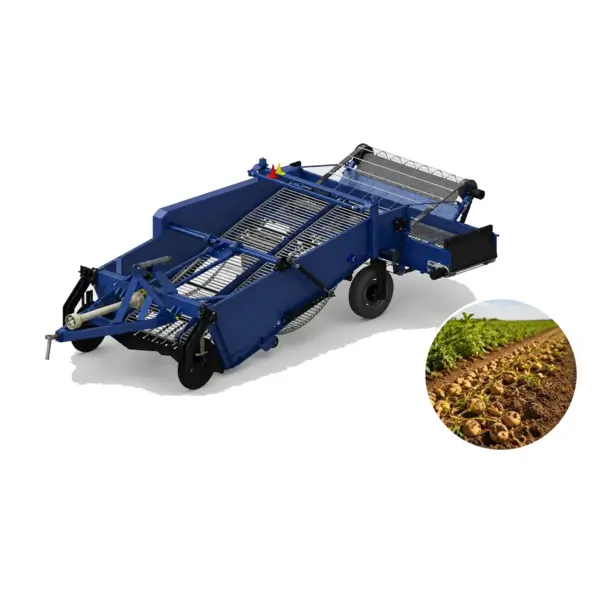
On a THOR + CT-2100 cleared field, the Korea Watanabe potato digger — available in single-row mounted and trailed configurations — operates within its designed performance envelope: shares last their full rated intervals, chains run season-to-season without fracture, star wheels complete multiple seasons without cracking, and gearbox incidents become rare enough that the shear bolt and slip clutch protection functions as its designers intended.
Domande frequenti
Q
Do manufacturers actually void warranties for stony field operation, and how is this enforced?
Warranty exclusions for stone-related damage are enforced through claim assessment rather than automatic denial. When a claim is submitted, the engineer examines the failure mode: chain rods broken mid-rod (rather than at a weld or sprocket) are characteristically stone-wedge failures; share wear at 10 ha instead of 60–80 ha is diagnostic of stone-field operation. Major manufacturers including Grimme, AVR, and Standen include clauses classifying wear accelerated by field stone content as operator-responsibility maintenance rather than product defect. Recommendation: document a stone assessment before first use on new equipment, clear to below threshold, and retain records of the clearing operation for any future warranty claim.
Q
How many years does the cleared condition last after THOR + CT-2100?
At the THOR operating depth the treated zone is essentially permanently cleared — stones at that depth have been fragmented and collected. Stones from below the operating zone continue migrating upward through frost heave at 1–3 cm per year. Practical re-clearing cycles: UK (50–70 frost days) → THOR repeat every 6–10 years; Canadian PEI (120+ frost days) → every 3–5 years; Australian Tasmania (minimal frost) → every 10–15 years. Annual BlackBird passes bridge major THOR cycles on all stone-risk fields.
Q
Why is blackspot bruising only detected at the pack house, not at harvest?
Blackspot bruising from mechanical impact is invisible at the moment of collision. The melanin synthesis reaction (polyphenol oxidase + tyrosine → melanin) requires time to accumulate to visible concentration. At storage temperatures below 12°C, discolouration takes 48–96 hours; at ambient temperatures above 18°C, it may appear in 24 hours. Pack house intake protocols assess bruising in a standardised 48-hour warm-room test — which is why field-origin bruising is discovered at intake, days after the stone-potato collision that caused it. Stone clearing is the only intervention that prevents the initial impact event from occurring.
Q
Does the trailed potato digger handle stony conditions better than the mounted version?
Both share identical stone damage mechanisms for shares, elevator chains, star wheels, and tuber bruising. The trailed configuration carries a heavier chassis and more robust driveline, giving marginally higher structural tolerance for gearbox shock events. However, shares and chains are sized to row width and working depth — not to machine mass — so they are equally stone-susceptible in both versions. Stone clearing addresses both machines equally and is more cost-effective than machine-specification upgrading alone for fields above 5 stones/m².
Q
What minimum tractor HP is needed for the full THOR + CT-2100 + potato digger system?
Each operation has different requirements: THOR 2.4 — minimum 80 HP, recommended 100–120 HP; THOR 3.0 — minimum 140 HP, recommended 160–180 HP; CT-2100 — minimum 80 HP with 60 L/min hydraulic flow at 180 bar; Potato digger (single-row mounted) — minimum 40 HP, recommended 60–80 HP; Trailed digger — minimum 60 HP, recommended 80–100 HP. For a single-tractor small farm (5–15 ha) in the 80–120 HP range: all operations are compatible because THOR + CT-2100 (pre-planting) and the potato digger (harvest) occur at different seasons with no operational overlap. Contact Korea Watanabe for a specific tractor-to-machine compatibility assessment.
Sistema completo di macchinari per la lavorazione delle patate
From Stone Clearing to Safe Harvest — Korea Watanabe Delivers the Full System
Your stone type + field size + tractor HP + target concentration → Korea Watanabe specifies the correct THOR, CT-2100, BlackBird, and scavapatate combination with a full operational performance projection.