The Andean highlands of Peru and Bolivia are the origin centre of the cultivated potato — the Vavilov Centre from which Solanum tuberosum and its wild relatives spread to become the world’s fourth most important food crop. The agricultural communities of the Altiplano and the inter-Andean valleys have been growing potato for 7,000–10,000 years, and they still hold more genetic diversity in their cultivated potato collections than the rest of the world’s potato gene bank combined. Peru alone catalogues over 3,000 documented native potato varieties, ranging from the starchy yellow “papa amarilla” (Solanum goniocalyx) prized in Lima restaurants to the freeze-dried “papa chuño” and “tunta” that were stored in Inca storehouses for years. Bolivia’s Altiplano communities maintain a further extensive collection of varieties adapted to the extreme cold, frost, and altitude conditions of the 3,800–4,200 m production zone.
For a potato machinery guide, the Andean market presents genuinely unique technical challenges that have no parallel in any other production region in this series. The altitude effect on engine power is the most critical: at 3,500 m above sea level, a naturally aspirated diesel engine loses approximately 35–40% of its sea-level rated power. A 50HP engine at the port of Callao (sea level) delivers approximately 30–32HP effective in Puno (3,850 m). This derating is the fundamental factor that determines whether any given piece of machinery is usable at Andean altitude — and it is almost universally underestimated by machinery suppliers whose experience is entirely below 1,000 m altitude. This guide provides the technical framework for specifying machinery that will work at Andean altitude alongside the agronomic and institutional context that defines this market’s unique character.
Altitude Engine Derating — The Critical Technical Variable at 3,500m
Diesel engine power is produced by the combustion of fuel in the presence of oxygen. At high altitude, the air is less dense — fewer oxygen molecules per cubic metre of air — which means less oxygen is available per engine cycle for combustion. The engine’s power output is directly proportional to the mass of oxygen it can consume, so reducing air density reduces power output proportionally. For a naturally aspirated (non-turbocharged) diesel engine, the general rule is a power loss of approximately 3% per 300 m above 300 m, or roughly 10% per 1,000 m above sea level. At 3,500 m — the approximate altitude of Puno, the Bolivian Altiplano near Oruro, and the major Andean potato production zones — the power loss is approximately 30–37% from sea-level rated power.
The 3,500m Power Derating Calculation — What You Actually Have
| Sea-Level Rated HP | Effective HP at 3,500m (naturally aspirated) | Effective HP at 3,500m (turbocharged) | Implement Suitability |
|---|---|---|---|
| 30 HP | ~19–20 HP | ~24–26 HP | Furrower, fertilizer applicator only — NOT digger |
| 45 HP | ~28–30 HP | ~36–38 HP | Single-row digger only with turbocharged engine on sandy soil |
| 60 HP | ~38–40 HP eff. | ~48–51 HP eff. | Single-row mounted digger — minimum workable configuration at 3,500m (turbocharged strongly preferred) |
| 80 HP | ~50–53 HP eff. | ~65–68 HP eff. | Single-row digger comfortable; two-row mounted possible on sandy soil with turbocharged engine |
Note: Turbocharger partially compensates for altitude air density loss by compressing intake air; at 3,500m a turbocharged engine typically retains ~80–85% of sea-level rated power vs ~62–65% for a naturally aspirated engine.
The practical consequence of altitude derating for Andean potato machinery buyers is an HP specification rule of thumb: add 50–60% to the implement’s sea-level minimum HP specification when selecting a tractor for Andean altitude. A single-row mounted digger specified at 40HP minimum at sea level requires a 60–65HP sea-level-rated tractor to deliver 40HP effective at 3,500m (naturally aspirated), or a 50HP turbocharged tractor. Any machinery supplier quoting specifications to a Peruvian or Bolivian buyer who does not explicitly address altitude derating is providing incomplete and potentially commercially damaging information — the buyer who purchases on sea-level specs alone will own a machine that will not perform as specified in the field.
Production Zones and Farm Scale — Smallholder Altiplano vs Commercial Inter-Andean Valleys
| Zone | Altitude (m) | Skala Pertanian | Machinery Context |
|---|---|---|---|
| Puno Altiplano (Peru) | 3,800–4,200 m | 0.1–0.5 ha smallholder; community plots | Walk-behind tractor (motocultor) or animal traction primary; CIP programme machinery for community use; extreme altitude limits any 4-wheel tractor use |
| Bolivia Altiplano (Oruro, La Paz, Potosí) | 3,600–4,000 m | 0.1–1 ha; subsistence to market supply | Walk-behind motocultor dominant; some cooperative 4-wheel tractor hire; PROINPA appropriate technology focus |
| Inter-Andean Valleys — Junín, Huánuco (Peru) | 2,800–3,500 m | 0.5–5 ha smallholder to small commercial | 60HP turbocharged tractor + single-row digger viable; planter and furrower for commercial varieties; most growth in mechanisation |
| Sacred Valley / Cusco Valley (Peru) | 2,900–3,400 m | 0.3–3 ha; heritage and commercial native varieties | Mix of traditional and mechanised; native variety shapes challenge standard digger share; cooperative machinery access model common |
| Sierra valleys — La Libertad, Cajamarca (Peru) | 2,000–3,000 m | 1–10 ha; growing commercial sector | Best altitude range for conventional 4-wheel tractor; 50–70HP tractors work adequately; commercial Canchan and Capiro variety production for Lima market and McDonald’s supply chain |
Native Variety Shapes, Minka Harvest Tradition, and Elevator Design
Andean native potato varieties (papas nativas) present a specific challenge for standard potato digger design. Commercial potato varieties grown in Europe, North America, and Australia are predominantly selected for round, oval, or long-oval tuber shapes — forms that pass readily through standard elevator rod spacings (typically 28–35 mm rod-to-rod gap) without jamming or sustaining abrasion damage. Andean native varieties include shapes that have no commercial equivalent in any other major potato market: elongated “papa huayro” (long, finger-shaped tubers up to 12 cm long, 3 cm wide), spiral “papa curly” and “papa tumbay” (tightly coiled tubers), compressed disc shapes like “papa negra” (flat-round, 4–6 cm diameter but only 2 cm thick), and irregularly knobbed varieties from the Solanum juzepczukii and S. curtilobum species used for chuño production.
For digger operation on native variety potato, the elevator rod spacing and chain agitation level are more critical than for commercial varieties. The primary risks are: elongated tubers (papa huayro type) jamming between elevator rods if the rod spacing is narrower than 30 mm; fragile knobbed tubers (some Solanum juzepczukii) losing protrusions from chain contact; and flat-disc shaped tubers slipping between rods. A digger intended for Andean native variety harvest should be specified with 30–35 mm rod spacing (rather than the 28–30 mm common for commercial varieties), smooth-surface rods (not agitation-bar rods), and minimum chain speed adequate for soil separation. This specification reduces bruise and skin damage on the highly varied shapes of native varieties without requiring a bespoke machine design.
Itu minka (or minga) — the traditional Andean community cooperative labour practice where community members collectively work each other’s fields in rotation — remains the dominant harvest method for native potato in the Altiplano and inter-Andean valleys. Mechanisation of harvest in these communities must be understood as a complement to, not a replacement of, minka labour. When machinery is introduced to a minka community, the most successful models have been cooperative ownership of a single-row digger operated by a trained community member, with the minka labour providing the collection function behind the machine. This cooperative model reduces the capital burden to a level manageable by community finance (or with INIA/CIP programme support) and maintains the social structure of minka while reducing the physical demand of the most labour-intensive digging step.
CIP, INIA and Institutional Programmes — The Development Context for Machinery Entry
Any machinery supplier considering the Peruvian or Bolivian highland potato market must understand that this market is shaped as much by international development institutions and national research programmes as by commercial demand. The International Potato Center (CIP — Centro Internacional de la Papa), headquartered in Lima, is the world’s foremost potato research institution and the body whose technology transfer programmes in Peru, Bolivia, and across the Andes have the most direct influence on which machinery technologies are introduced to smallholder communities. CIP’s appropriate technology programmes have historically promoted 2-wheel tractors (motocultores) and small walk-behind implements for Andean smallholders — an approach appropriate for the extreme altitude, small plot size, and limited capital of Altiplano communities, but one that leaves a gap at the inter-Andean valley commercial scale where 4-wheel tractor machinery is viable.
Peru’s INIA (Instituto Nacional de Innovación Agraria) operates research stations in Puno, Huancayo (Junín), and Santa Ana (Huancayo) that conduct variety trials, mechanisation demonstrations, and extension services for the Andean highlands. INIA has conducted machinery demonstration programmes for single-row diggers in the Junín and Huánuco inter-Andean valley zones, where the altitude (2,800–3,300 m) and farm scale (1–5 ha) make 4-wheel tractor mechanisation viable. An overseas machinery supplier seeking to enter the Peruvian highland market through INIA collaboration would need to: provide a turbocharged tractor-mounted digger for demonstration trials at INIA’s research station; supply altitude-specific performance data showing effective HP at operating altitude; and provide Spanish-language technical documentation suitable for extension use. Bolivia’s PROINPA (Fundación para la Promoción e Investigación de Productos Andinos) operates an equivalent role for the Bolivian Altiplano and inter-valley zones.
For commercial variety production in Peru’s lower-altitude sierra valleys (La Libertad, Cajamarca, and the commercial potato zones at 2,000–3,000 m), the institutional development context is less dominant and direct commercial machinery procurement is more straightforward. The Peru-Korea Free Trade Agreement (Peru-Korea FTA, in force since 1 August 2011) provides tariff preferences for Korean-manufactured goods entering Peru — including agricultural machinery — which may reduce import duty below the general MFN rate. Confirm the applicable tariff classification and current preferential rate with a licensed Peruvian customs agent (Agente de Aduana) before shipment.
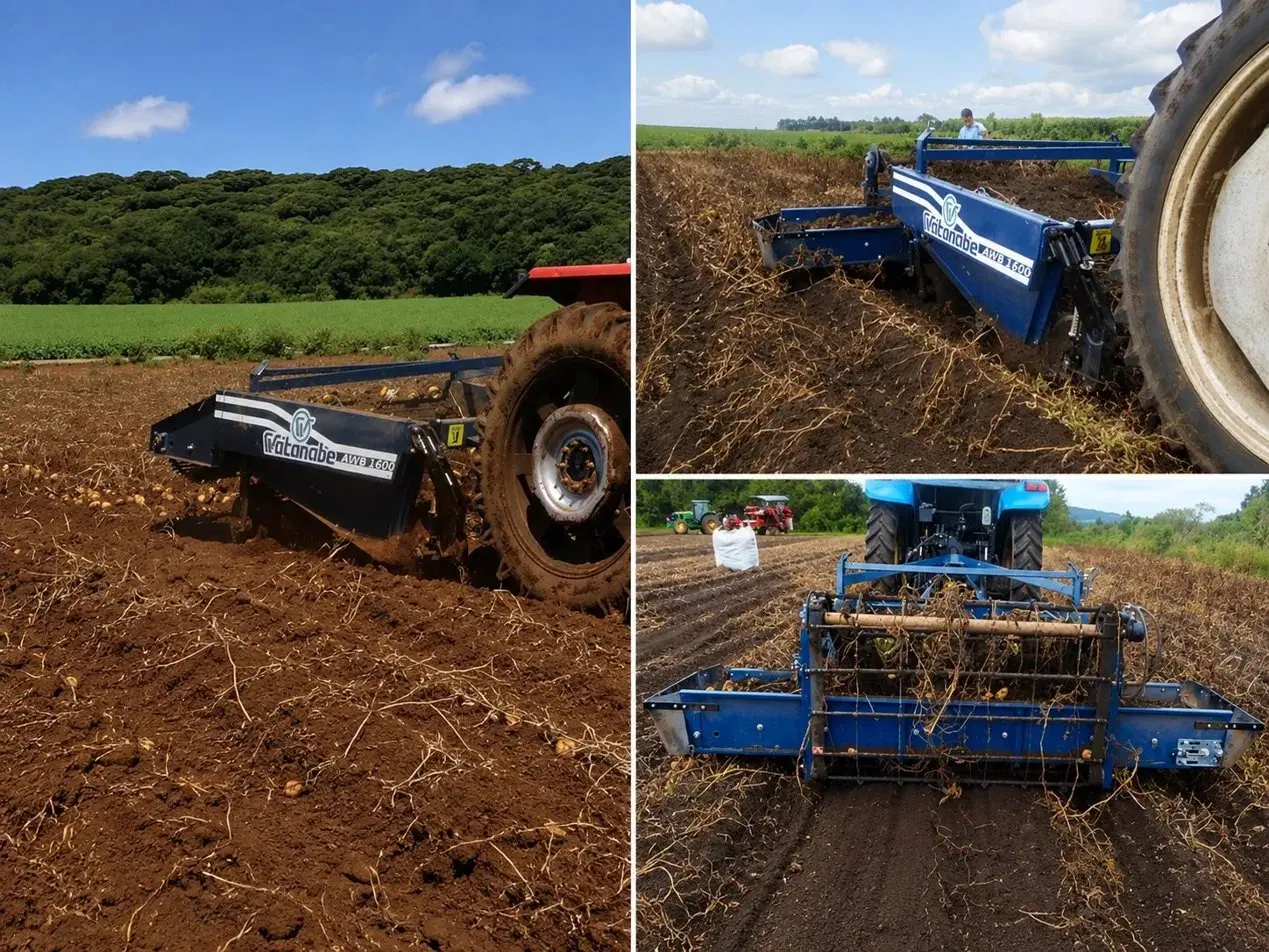
Untuk potato machinery specifications adapted for high-altitude Andean conditions, Korea Watanabe can provide turbocharged tractor compatibility data and altitude performance guidance for each implement category.
Pertanyaan yang Sering Diajukan
▶Does a turbocharged tractor fully compensate for altitude power loss, or is there still a significant deficit at 3,500m?
A turbocharger partially but not fully compensates for altitude air density loss. At sea level, a turbocharger’s function is to increase intake air density above atmospheric — effectively supercharging the engine for higher power output than the displacement alone would produce. At altitude, where atmospheric pressure is reduced, the turbocharger uses the exhaust energy to compress the thinner air back to a denser charge — partially restoring the sea-level air mass per cylinder cycle. In practice at 3,500 m, a modern variable geometry turbocharger (VGT) retains approximately 80–85% of sea-level rated power, compared to a naturally aspirated engine at 62–65%. The turbocharged engine therefore loses approximately 15–20% at 3,500 m versus 35–40% for naturally aspirated — a significant practical advantage, but not complete compensation. Additionally, higher altitude increases cooling demands (thinner air = less cooling capacity for the radiator), which places an upper limit on sustained heavy PTO loads. The rule of thumb: turbocharged engines are strongly preferred for Andean altitude operation, but still require an HP margin above the implement’s sea-level minimum specification — the 50–60% HP margin rule applies to turbocharged engines as a 20–25% margin, versus 50–60% for naturally aspirated.
▶What is the Peruvian government’s position on agricultural mechanisation for highland smallholders?
Peru’s Ministry of Agrarian Development and Irrigation (MIDAGRI — Ministerio de Desarrollo Agrario y Riego) includes agricultural mechanisation as a policy priority under its Sierra Productiva and Haku Wiñay rural development programmes, both of which provide technical assistance and limited capital support for rural highland communities. MIDAGRI’s highland extension focus has historically emphasised water management, variety improvement, and basic soil tillage mechanisation — the rotary cultivator (motocultivador) and walk-behind systems have been the primary machinery promoted at the smallholder level. The growing commercial potato sector in Junín, Huánuco, and La Libertad has created demand for mid-scale mechanisation (single-row digger, furrower, planter) that MIDAGRI’s extension services are beginning to address, but the institutional framework for commercial-tier machinery introduction is still developing. The most effective entry for a commercial machinery supplier is through INIA’s demonstration programmes and through direct engagement with the growing cooperative and contract farming sector in the inter-Andean commercial zones, rather than through the smallholder development programme infrastructure.
▶How does soil type vary across Andean potato zones and does it affect digger choice?
Andean potato soils are remarkably varied and do not fit the simple sandy or clay-loam categories that dominate European potato geography. The Altiplano soils are predominantly Andisols (volcanic ash soils) and Mollisols (dark humus-rich soils), both characterised by high organic matter and relatively light bulk density — which makes them easier to dig than their high-clay-fraction European equivalents but also more susceptible to compaction from heavy machinery in wet conditions. The inter-Andean valley soils are more varied: some valleys have deep alluvial loams (like Junín’s Mantaro Valley — excellent for potato); others have rocky calcareous soils from eroded limestone hills that create stony surface conditions; and hillside plots (ladera) in all zones can have shallow soils over hard rock. Stone is therefore variable rather than uniformly low as in the Masovian plains — a stone survey before digger specification is important in any hillside zone. The riddle frame separator is appropriate for the light Andisol soils of the Altiplano and deep alluvial valleys; star wheel may be needed for heavier clay-loam valley floors where the soil cohesion is higher after rain.
▶Is there any established market for potato machinery in coastal Peru at lower altitude?
Yes — Peru’s coastal valleys (La Libertad, Ica, Lima, Arequipa) produce potato under irrigation at low altitude (0–200 m) on sandy and sandy-loam desert soils. The coastal potato market is smaller in area than the highland market but more commercially organised, with larger farm sizes (5–50 ha), better infrastructure, and closer proximity to Lima’s processing and fresh market chains. Coastal Peruvian potato farming uses conventional commercial varieties (Canchan, Capiro, Única) on regular rectangular irrigated fields, and mechanisation levels are higher than in the highlands. Standard international digger specifications apply at coastal altitude — no altitude derating is required, and the sandy coastal soils (aeolian desert sand) are extremely easy digging conditions with very low draft resistance. The coastal market segment is therefore the most immediately accessible for a conventional machinery supplier entering Peru, requiring no altitude-specific specification adjustments. The relevant machinery dealers are concentrated in Trujillo (La Libertad coastal agricultural hub) and the agricultural zones south of Lima.
▶What are the key Andean potato research contacts for a machinery supplier entering the Peru or Bolivia market?
The International Potato Center (CIP, Lima — www.cipotato.org) is the most important global institutional contact for any supplier entering the Andean potato sector. CIP’s mechanisation and post-harvest technology team has direct relationships with smallholder farming communities, government extension services, and international development funders across Peru, Bolivia, and the broader Andean region. In Peru, INIA’s highland stations in Huancayo (INIA-Santa Ana), Cusco (INIA-Illpa), and Puno (INIA-Illpa research centre) are the primary national research and extension points for highland potato technology. The La Molina Agrarian University (UNALM, Lima) runs an agricultural engineering faculty with mechanical engineering research programmes relevant to appropriate technology development. In Bolivia, PROINPA (Fundación para la Promoción e Investigación de Productos Andinos, Cochabamba) is the lead research body for Bolivian Altiplano potato and has conducted mechanisation trial programmes in the El Alto and Altiplano production zones. For commercial sector contacts, the Peruvian potato chain body is AGAP (Asociación de Gremios Productores Agrarios del Perú) and the La Libertad regional chamber of commerce covers the coastal commercial sector.
Andean Highland Machinery Enquiry?
Share your production altitude, tractor type (turbocharged or naturally aspirated), sea-level HP rating, and potato type (commercial variety or native). Korea Watanabe will confirm spesifikasi mesin kentang with altitude-effective performance data and Spanish-language documentation.
Editor: Cxm