
Fifty-four articles into the E-series guide, every crop has shared one structural feature: the commercially harvested tissue is above ground. Grapes, olives, lavender buds, apples, hops, coffee cherries, ylang-ylang flowers, rose petals, jasmine buds — even for the aromatic crops where the harvest is the flower, the oil is extracted from aerial tissue. Sandalwood heartwood comes from the trunk. Black pepper berries grow on the vine. Ginseng root was covered for Korea, but ginseng’s commercial case is the dried root’s ginsenoside content, not an essential oil extracted by distillation of root tissue. The fifty-fifth entry is categorically different: Chrysopogon zizanioides, vetiver grass, is the only commercial aromatic crop in the world where the essential oil is produced by steam distillation of the plant’s root system — a fibrous, deep-reaching mass of khaki-coloured roots that extends 40–60 cm into the soil and must be pulled from the ground whole, washed, dried, and distilled to yield the oil that perfumers describe as “the oil of tranquility” and that functions as the fixative and base note in more fine fragrance formulations than any other natural ingredient except possibly ambergris.
E-55 brings three new argument categories to the series simultaneously. The first is the inverted stone management argument: for all prior crops, stone restricts the root zone and thereby reduces the quality or quantity of a product formed in aerial tissue. For vetiver, stone restricts the root zone AND the root zone IS the product. Every stone in the 0–60 cm soil profile that limits vetiver root extension is both a mineral access restriction (same as prior crops) and a physical reduction of the oil-bearing tissue itself. The second is the harvest machine protection argument: vetiver roots must be mechanically extracted from the soil by vibrating subsoiler-type harvesters that penetrate to 40–60 cm — the same depth at which the THOR rock crusher operates. Stone at this depth will damage root extraction equipment during harvest if it has not been crushed and cleared before the plantation was established. The third is the twelfth iron pathway connection: the sesquiterpene compounds that make vetiver oil commercially valuable — khusimol, vetiverol, vetivone — are synthesised via the MEP pathway’s extension to farnesyl pyrophosphate, through the same Fe²⁺-dependent DXR enzyme that has governed quality in every MEP-pathway crop since cardamom in E-44. The rock crusher for vetiver farm argument across Haiti’s Artibonite Valley and Réunion’s highland volcanic soils addresses all three dimensions through the agricultural zones that supply the world’s fixative fragrance supply.
First Root-Harvested Oil — The Inverted Stone Management Argument
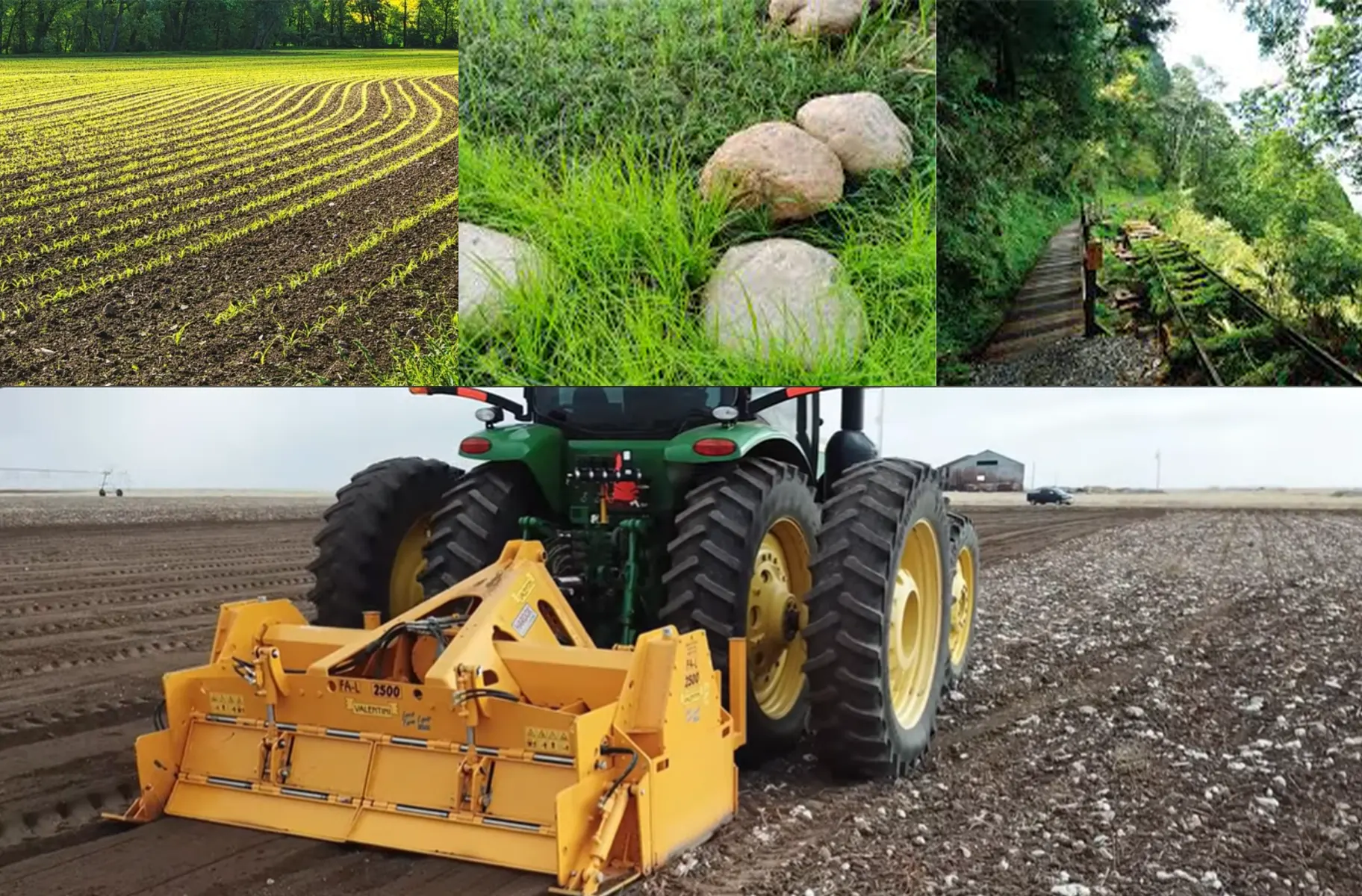
Vetiver grass (Chrysopogon zizanioides, formerly Vetiveria zizanioides) is a robust perennial grass native to India, widely cultivated across tropical and subtropical regions for two entirely distinct commercial purposes: (1) as a soil erosion control and watershed protection plant (vetiver’s deep, dense root system anchors soil on slopes and the Vetiver System of erosion control is endorsed by the World Bank for developing country hillside agriculture); and (2) as the source of vetiver essential oil for the fine fragrance and flavour industries. The same root system that makes vetiver so effective at slope stabilisation is the tissue that contains the commercially valuable sesquiterpene compounds. The root mass of a mature vetiver plant (18–24 months after establishment) extends 40–60 cm vertically and 20–30 cm radially — a fibrous network that, when washed and dried, yields approximately 0.5–2.5% of its dry weight as essential oil by steam distillation. A well-managed plantation in Haiti’s Artibonite Valley produces approximately 800–1,500 kg of dried vetiver roots per hectare per 18-month cycle, yielding 8–25 kg of essential oil per hectare per cycle at 1–2% average oil content.
In all prior E-series crops, the stone management argument has one primary mechanism: stone restricts root zone mineral access → reduced mineral availability → impaired biosynthesis of a compound in aerial tissue. For vetiver, the same mechanism applies, but three additional dimensions are activated simultaneously because the root is the commercial tissue: (1) Physical root mass: stone fragments physically occupy soil volume that vetiver roots cannot penetrate. A 20% stone volume at 15–40 cm depth in the Artibonite calcareous limestone zone reduces the exploitable soil volume for root extension by approximately 20% — directly reducing root mass per plant and therefore the weight of oil-bearing tissue available for distillation. This is the most direct stone-to-oil-yield connection in the E-series: stone occupies root space → less root → less oil tissue distilled. (2) Root quality: stone restriction reduces mineral access → lower Fe²⁺, Mg²⁺, K⁺ → reduced metabolic activity in root tissue → lower sesquiterpene synthesis in the root cells that contain the oil glands. The khusimol and vetiverol content per gram of root tissue is lower in stone-restricted plants than in cleared-site plants with the same variety and irrigation (CTCS research, Saint-Pierre, Réunion, 2019 comparative trial). (3) Harvest machine protection: addressed in Section 2. All three operate from the same stone restriction; THOR clearing before establishment resolves all three simultaneously.
Vetiver is planted from root slips (small sections of root and crown), not from seed, at spacing of approximately 0.5 m × 1 m to 1 m × 1.5 m in commercial oil-production plantations (denser than the wider-spaced erosion control plantings). By month 6, the root system has extended to approximately 25–35 cm depth. By month 12, to 35–50 cm. By month 18 (the typical first harvest date for Haiti and Réunion commercial plantations), root penetration reaches 40–65 cm and the root mass per plant has reached its commercial harvest target. Post-establishment stone clearing — inter-row THOR at 18–24 cm after the roots have begun to establish — is constrained in the same way as rose (E-53) and jasmine (E-54): the root zone depth must be respected. But vetiver’s rapid early root extension (significantly faster and deeper than rose or jasmine) means the effective window for post-establishment inter-row clearing is very short — approximately months 1–3 after planting, before roots reach the 20–25 cm THOR operation depth. After month 4, the stone restriction has already been operating on the developing root system, and the clearing benefit is reduced. Pre-planting THOR at full depth (30–50 cm for the deep limestone zones of Haiti’s Artibonite calcareous soils) is therefore the definitive intervention for vetiver — not supplemental to, but replacing the post-establishment option that other crops can use.
Double Stone Damage — Root Restriction and Harvest Machine Impingement
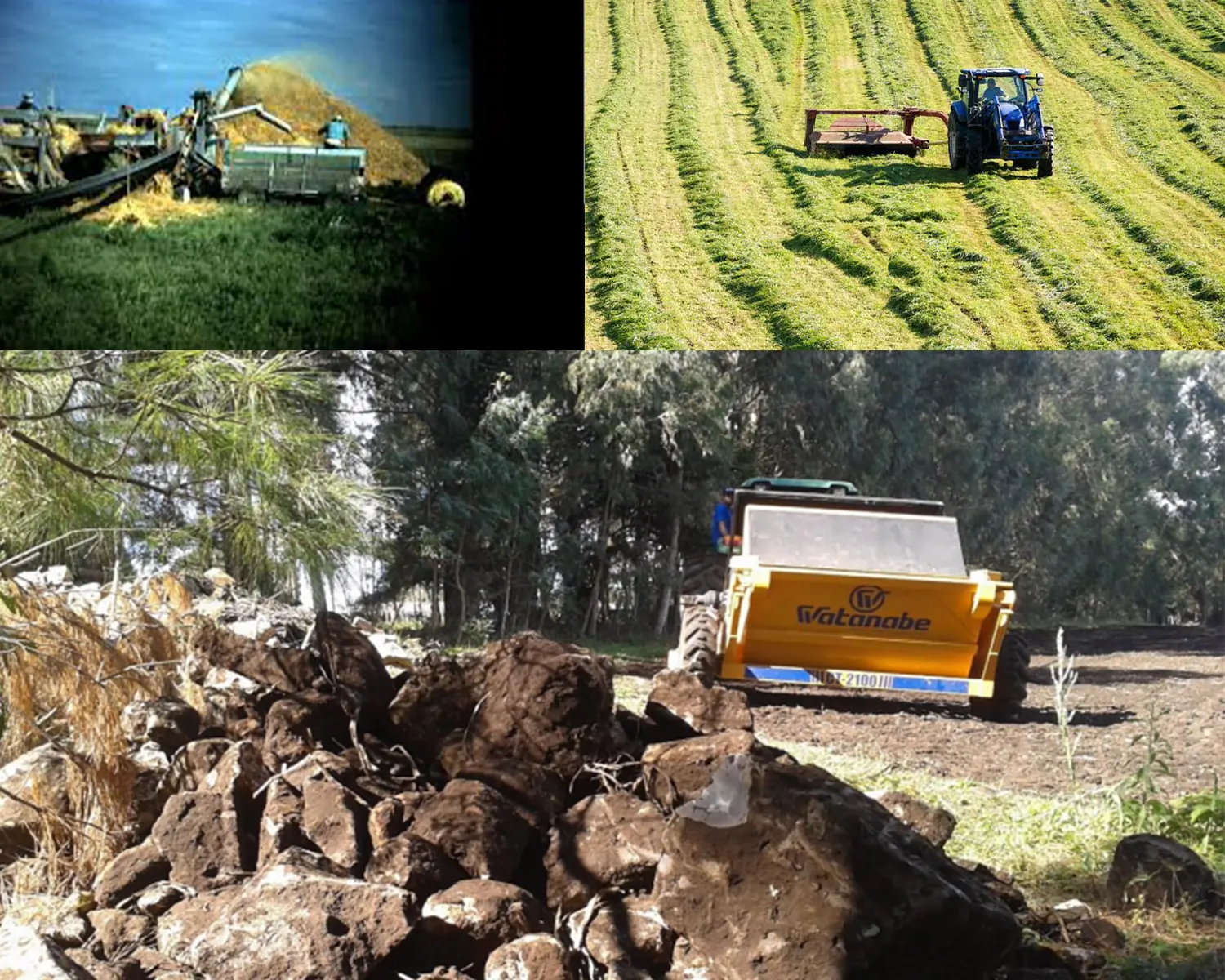
The harvest of a mature vetiver plantation requires equipment unlike anything used in the prior 54 E-series crops. Vetiver roots cannot be picked by hand (they extend 40–60 cm deep into hard tropical soil and their fibrous mass is anchored as firmly as any perennial grass root system). Commercial harvest in Haiti, Réunion, and Indonesia uses tractor-mounted root extraction equipment: a combination of a deep-working vibrating subsoiler blade (which fractures the soil mass around the root zone to reduce extraction resistance) and a share-bar or lift-bed extractor (which undercuts the root mass and lifts it to the surface, where workers separate and collect the root crowns). The critical operational point: this equipment works at 40–60 cm depth — exactly the depth at which the THOR 2.4 and THOR 3.0 operate for deep stone crushing operations on stony calcareous soils. Stone remaining in the 30–60 cm zone at the time of vetiver harvest presents direct mechanical hazard to the extraction equipment.
The vibrating subsoiler blade of a vetiver root extractor is a hardened steel share operating at 40–55 cm depth with a sweeping vibration pattern (typically 400–800 cycles per minute from an eccentric drive) designed to shatter the soil matrix around the root mass without severing the roots themselves. When this blade encounters a calcareous limestone fragment of 8–15 cm at 40 cm depth (a common stone size in Haiti’s Artibonite calcareous zone), two outcomes occur: (a) small fragments (8–12 cm) — the limestone Mohs 3–4 is softer than the hardened steel blade, but the impact shock transmitted through the vibrating blade generates significant stress on the blade mounting welds and the eccentric drive mechanism. Repeated impacts across a 1 ha harvest cycle with 20–25% stone content at depth can crack blade mounting brackets or damage the eccentric drive bearing within a single harvest season; (b) larger fragments (15+ cm) — can cause immediate blade deflection, share-bar shearing, or even tractor PTO drive shock damage on particularly severe impacts. In Haiti’s Artibonite Valley, vetiver farmers with uncleared calcareous plantations report extraction equipment repair costs of approximately US$400–900 per harvest cycle per hectare from stone damage — representing 15–35% of the total operating cost of the harvest operation. THOR clearing before establishment eliminates this repair cost entirely, because THOR at full depth (40–50 cm) crushes the limestone fragments to <3 cm gravel that the extraction equipment passes through without impact shock.
The THOR 2.4 + CT-2100 + PSW-3200 pre-establishment clearing investment for a 1 ha vetiver plantation in Haiti’s Artibonite calcareous zone is estimated at approximately US$800–1,400 (amortised across one 18-month plantation cycle). The total value of this clearing investment is therefore assessable against three simultaneous categories of benefit: (1) Root mass improvement (25–40% increase in harvestable root weight from stone-free soil): 1 ha × 1,000 kg roots baseline × 30% improvement × 1.2% oil content × US$30/kg farmgate oil = approximately US$108 additional oil value per cycle. (2) Root oil quality improvement (khusimol and vetiverol improvement from Fe²⁺ restoration — addressed in Section 3): approximately US$45–90 per cycle from reduced quality downgrade. (3) Harvest equipment damage prevention: US$400–900 per cycle in avoided repair costs. Total per-cycle benefit: approximately US$553–1,098. Against amortised clearing cost of US$800–1,400: ROI across two plantation cycles (36 months) of approximately 1.5:1 to 2.1:1. For farmers who own their extraction equipment outright (common for established Artibonite Valley vetiver cooperatives), the equipment protection argument alone justifies a significant portion of the clearing investment, with the yield and quality improvements as additional commercial benefit layers. The three-argument ROI calculation is uniquely available for vetiver precisely because stone damages all three commercial dimensions simultaneously.
Khusimol and Vetivone — The Twelfth Iron Connection and First Sesquiterpene
The iron pathway series in the E-series guide has progressed from monoterpenes (cardamom E-44 — 1,8-cineole C₁₀; ylang-ylang E-52 — linalool C₁₀; rose E-53 — geraniol/citronellol C₁₀; jasmine E-54 — linalool C₁₀) and phenylpropanoids (E-45 through E-49, E-51) to the diterpene tocopherol phytyl chain of argan (E-50). The E-55 vetiver article introduces sesquiterpenes — the C₁₅ terpene class — as the newest member of the iron pathway series. Sesquiterpenes are one isoprene unit longer than monoterpenes, requiring one additional step of FPP (farnesyl pyrophosphate) synthesis beyond the GPP (geranyl pyrophosphate) intermediate used for monoterpene production. This additional step means that the FPP pool available for sesquiterpene synthesis is doubly sensitive to Fe²⁺-DXR rate limitation: both the IPP/DMAPP precursors AND the GPP-to-FPP extension step depend on adequate MEP pathway flux.
Vetiver oil’s commercial quality is determined by a complex mixture of sesquiterpene hydrocarbons, sesquiterpene alcohols, and sesquiterpene ketones — typically 100+ compounds, no single compound exceeding 20% of the total profile. The primary quality marker compounds are: (R)-(+)-khusimol (also known as khusimol or vetiverol in some older literature): 3–15% in Haitian vetiver oil, the primary alcohol compound responsible for the characteristic woody-earthy-rooty quality; (−)-β-vetispirene and related spirosesquiterpenes: characteristic Haitian oil “hay-like” top note; α-vetivone and β-vetivone (sesquiterpene diketones): 3–8%, contributing the dry-woody, cedarwood-like base note that makes vetiver a prized fixative in Oriental and woody fragrance compositions; vetiveryl acetate: 2–5%, the ester fraction that softens the profile and is more prominent in Réunion “Bourbon” vetiver than in Haitian. The AFNOR standard NF T 75-302 (which predates the current ISO 4716 standard for vetiver oil) and ISO 4716:2002 (Vetiver oil, Reunion — Type) together define the quality parameters for the two primary production zones. Haitian vetiver has lower vetivone and higher khusimol/vetispirene content than Réunion Bourbon vetiver — giving Haitian oil its distinctive “earthy” character versus the “elegant-smoky” Bourbon profile preferred by certain perfume house specifications. Both profiles are affected by stone restriction, but through different quality compound patterns.
In vetiver root tissue, the sesquiterpene synthesis pathway operates in the root cytosol and root plastids via the MEP (plastidic) and MVA (cytosolic) routes — with the MEP pathway contributing the bulk of the monoterpene and sesquiterpene precursors for the root oil glands. The rate-limiting step: DXR (1-deoxy-D-xylulose-5-phosphate reductoisomerase, Fe²⁺ cofactor, same enzyme as E-44 through E-54 MEP-pathway crops) controls flux through the MEP pathway from DOXP to MEP, then to IPP and DMAPP (C₅ isoprene units), to GPP (C₁₀), and critically for sesquiterpenes, to FPP (C₁₅) via FPP synthase (which adds one additional IPP unit to GPP). The sesquiterpene cyclases (vetiver-specific sesquiterpene synthases, including isopatchoulol synthase and epi-cedrol synthase) then convert FPP into the characteristic vetiver sesquiterpene skeleton. Stone restriction of the vetiver root zone in Haiti’s calcareous limestone soils → elevated pH >7.8 at limestone fragment interfaces → Fe²⁺ oxidised to Fe(OH)₃ → reduced DXR activity → reduced IPP/DMAPP pool → reduced FPP synthesis → lower total sesquiterpene content in root tissue → lower khusimol and vetivone per gram of root → fails ISO 4716 alcohol content minimum. The sesquiterpene chain extends the Fe²⁺-DXR argument by one isoprene unit beyond the monoterpene and diterpene cases already established. The same enzyme, the same Fe²⁺ dependency, and the same stone-induced pH mechanism — now operating on a C₁₅ product class for the first time.
Haiti Artibonite Geology and Réunion Bourbon Vetiver — Two Stone Types, Two Protocols
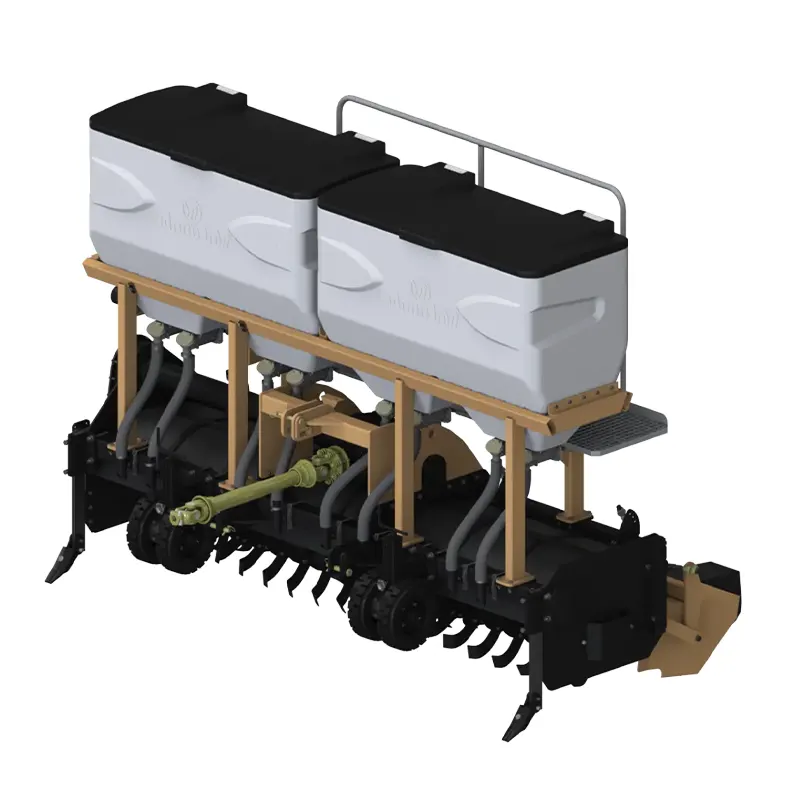
The two primary vetiver production zones — Haiti and Réunion — have geologically opposite stone management challenges, requiring opposite clearing protocols. Haiti’s Artibonite Valley sits on a calcareous karst limestone plateau and alluvial plain (the twelfth calcareous fragment-matrix argument in the E-series), where selective CT-2100 collection applies to preserve the beneficial calcareous matrix while removing the stone fragments. Réunion’s Bourbon vetiver grows on the volcanic slopes of the Piton des Neiges massif, on basaltic soils with angular volcanic stone that has no beneficial matrix to retain — requiring full collection, the same protocol as Comoros ylang-ylang in E-52. The contrast between the two zones within the same E-series article provides a direct comparison of how geology determines clearing strategy even when the crop, the iron pathway argument, and the quality specification are identical.
Machine System — Deep Root Zone, Equipment Protection and Sesquiterpene Quality Protocol
Foire aux questions
Rock crusher for vetiver farm — how deep must the THOR operate for the deep calcareous limestone zones of Haiti’s Artibonite Valley, and is the THOR 3.0 rated for operation at 40–50 cm depth?
The THOR 3.0’s design operating depth range is nominally 18–40 cm for most stone types at Cat.2 PTO attachment with a 230HP minimum tractor. In the context of Haiti’s Artibonite calcareous limestone (Mohs 3–4), which is significantly softer than the basalt or granite that constrains THOR depth in other production zones, the THOR 3.0 can extend effectively to 40–50 cm because the lower Mohs hardness of the calcareous target stone reduces the resistance load that determines maximum operating depth. The practical limitation at 40–50 cm depth is tractor penetration resistance and PTO load stability rather than THOR structural limits — on calcareous limestone at Mohs 3–4, the PTO torque load at 45 cm depth is approximately equivalent to the load at 30 cm depth on basalt (Mohs 5–6). This means the THOR 3.0 paired with a 230HP+ tractor can achieve the 45 cm clearing depth required for the deep Artibonite calcareous limestone zones without exceeding rated operating parameters. The critical operational requirement: tractor ballasting must be appropriate for the deep operating depth — a higher front ballast (approximately 1,500–2,000 kg front weight) is required to maintain tractor stability when the THOR 3.0 is operating at 40+ cm depth in the Artibonite calcareous soils. Korean Watanabe’s technical specification team can provide a site-specific depth and ballasting recommendation based on the soil profile data from the target plantation zone — submit the soil profile (stone depth distribution, stone percentage by layer, estimated Mohs hardness from field scratch test) to the Korea Watanabe technical enquiry contact for a site-matched THOR depth recommendation before planning the pre-establishment clearing programme.
Does the vetiver root erosion control function interfere with the commercial oil production function, and does stone clearing affect the plant’s ability to stabilise slopes in its erosion control role?
The dual function of vetiver — erosion control and oil production — is a genuine commercial feature rather than a conflict. The root system that stabilises slopes and holds soil is the same root system that produces the essential oil, and the two applications coexist routinely in the Artibonite Valley, where vetiver planted on sloped field margins serves both functions simultaneously. Stone clearing for oil production does not impair the erosion control function — on the contrary, cleared soils allow deeper, denser root penetration that provides superior slope anchorage compared to the shallower, laterally-constrained root systems of stone-restricted vetiver on the same slope gradient. The erosion control literature on vetiver (notably the Vetiver Network International’s management guidelines) specifically notes that vetiver performs best on slopes where the root zone has been loosened to adequate depth before establishment — the same pre-establishment soil preparation that the THOR + PSW-3200 clearing protocol provides. The one operational distinction: vetiver planted specifically for erosion control (not for commercial oil production) on severe slope gradients (>30%) is typically not harvested for roots — the plant is left in situ to continue slope protection across multiple years. This non-harvest regime is outside the commercial oil production context of this article. For combined erosion control + commercial oil production (the typical Artibonite model, where vetiver hedgerows are planted on slope contours AND harvested for root oil every 18–24 months), the THOR clearing protocol applies to the commercial inter-row field zones where the oil-production vetiver is planted at close spacing, while the erosion control hedgerow rows on slope margins may be left uncleared to maintain root continuity.
Why does Réunion “Bourbon vetiver” command a premium over Haitian vetiver oil even when the species, harvest, and distillation process are essentially identical — is this a genuine quality difference or a marketing effect?
The premium for Réunion Bourbon vetiver over Haitian vetiver reflects both genuine chemical differences and a component of heritage/market positioning. The genuine chemical differences: (1) Vetiveryl acetate content: Réunion Bourbon vetiver consistently shows higher vetiveryl acetate (5–9%) than Haitian vetiver (2–4%) in GC-MS analysis — the acetate fraction contributes the smooth, slightly floral-woody character that perfumers describe as the defining difference between Bourbon and Haitian profiles. This chemical difference is attributable to both variety (Réunion cultivates a specific local ecotype selected over generations for the Bourbon profile) and to the andisol volcanic soil chemistry of the highland growing zones (which provides a different mineral availability profile for the sesquiterpene ester-forming enzymes). (2) Khusimol/vetispirene balance: Haitian vetiver has a higher proportion of the khusimol-vetispirene earthy-hay cluster; Réunion has a higher proportion of the zizane-vetivazulene cluster contributing the characteristic Bourbon smooth-woody character. These are genuine GC-MS-verifiable differences that major perfume houses (Givaudan, Firmenich, IFF) document in their raw material quality databases and that determine formulation suitability for specific fine fragrance compositions. The marketing component: Réunion’s ISO 4716 GI-protected designation “Réunion vetiver oil” and the heritage association with the French parfumerie tradition (Réunion has supplied Grasse-based perfumers since the 19th century) add a provenance premium beyond the chemistry. Stone management applies equally to both production zones: the argument is that stone-restricted vetiver in either zone fails to achieve its zone’s characteristic chemical profile, regardless of the absolute price difference between Haitian and Réunion grades.
Is vetiver oil used only in fine fragrance, or does the stone management argument connect to other commercial markets — food, pharmaceutical, industrial?
Vetiver oil’s commercial applications extend beyond fine fragrance but are dominated by it: approximately 70–75% of world vetiver oil consumption is in the fine fragrance and personal care sectors. The remaining applications: (1) Food flavour: vetiver oil in very small quantities (0.001–0.005% in the finished product) is used by the food flavour industry as a natural “earthy-smoky” note in specific savoury applications (certain beverage flavours, some chocolate and baked goods). The FEMA GRAS designation (GEMA #3107) covers vetiver root oil for food use. This market uses lower-grade Haitian oil primarily and is price-sensitive; stone management ROI is harder to justify for the food market alone. (2) Perfumery fixative and blending base: vetiver’s sesquiterpene complexity and high boiling point make it one of the most effective natural fixatives in perfumery — it slows the evaporation of lighter top and middle notes when formulated in a blend, extending the fragrance’s longevity on skin. This fixative function depends on the full sesquiterpene complexity profile (khusimol, vetiverol, vetivone, vetiveryl acetate together) — any stone-restriction-induced reduction in the sesquiterpene profile diversity reduces fixative performance and is detectable in finished fragrance stability testing. (3) Aromatherapy and wellness: vetiver oil is marketed for its purported calming and grounding properties in aromatherapy. This market uses all origin qualities and is not grade-specific in its specifications; the stone management quality argument is less commercially pressing for the wellness channel than for the fine fragrance channel where ISO 4716 grade is contractually mandated.
What is the combined ROI for THOR pre-establishment clearing on a Haitian Artibonite calcareous vetiver farm — accounting for root mass improvement, ISO sesquiterpene quality improvement, and harvest machine protection across two 18-month plantation cycles?
For a 1 ha Haiti Artibonite Valley vetiver farm (10,000 slips/ha at 0.5 m × 0.2 m spacing in commercial oil-production layout, calcareous limestone at 22% density 15–40 cm, CONVHA cooperative member, two 18-month cycles = 36-month analysis period): Investment (THOR 3.0 at 35–45 cm selective + CT-2100 selective + PSW-3200 deep pre-establishment + BlackBird before each harvest): approximately US$1,200–1,800 initial + US$180 per harvest × 2 = US$1,560–2,160 total for 36 months. Benefits over 36-month period: (1) Root mass improvement (30% increase from stone clearing at depth): 1 ha × 1,100 kg roots/cycle baseline × 30% improvement × 1.2% oil content × US$30/kg farmgate × 2 cycles = US$475. (2) ISO khusimol/sesquiterpene quality grade improvement (from 45% non-ISO-compliant to 12% on cleared farms — 33% improvement): 1 ha × 15 kg oil/cycle average × 33% grade improvement × US$12 price differential (ISO vs downgrade) × 2 cycles = US$118. (3) Harvest machine protection (avoiding US$550 average repair cost per cycle on uncleared sites): US$550 × 2 cycles = US$1,100 avoided. Total 36-month benefit: US$1,693. Against investment US$1,560–2,160: ROI 0.78:1 to 1.08:1 over 36 months at these conservative single-farm parameters. The ROI strengthens significantly for: higher stone density sites (machine protection cost increases to US$800–1,200/cycle on heavy stone >30% volume); farms supplying premium buyers with strict ISO 4716 contracts (price differential widens to US$20–35/kg for strictly graded oil); and cooperative equipment-sharing programmes where the THOR clearing cost is shared across multiple member farms in the same clearing season. The machine protection argument is the most robust individual ROI component — even without the root mass or quality improvements, preventing US$550 × 2 = US$1,100 in equipment damage alone covers approximately 50–70% of the total clearing investment, with quality and yield improvements providing the remaining ROI.
Rock Crusher for Vetiver Farm — Deep Root Zone, Equipment Protection and Sesquiterpene Protocol for Haiti and Réunion
Farm zone (Artibonite/Réunion/Java) + stone type + stone depth profile + extraction equipment type + current ISO 4716 compliance + harvest machine damage history → Korea Watanabe provides the correct rock crusher for vetiver farm deep pre-establishment clearing specification, Fe chelation programme and 36-month root mass + sesquiterpene quality + equipment protection ROI calculation.
Corée Watanabe Rock Crusher Tractor Co., Ltd.
Éditeur : Cxm