Canada produces approximately 4.5 million tonnes of potatoes annually — a volume that places it among the world’s top ten producers — from four primary growing regions that differ substantially in geology, climate, and farm structure. Prince Edward Island, the country’s most celebrated potato province, contributes over 25% of national production from its distinctive red sandstone soils. Manitoba and Alberta contribute a further 40% from prairie landscapes shaped by glacial deposition. British Columbia rounds out the national picture with smaller-volume but high-quality production in the Lower Fraser Valley. Each region presents a specific stone management challenge, a specific GDD-constrained growing window, and a specific machinery selection argument that differs from the other regional guides in this series.
This guide covers the three commercially distinct arguments for Canada: the unpredictable gearbox damage risk created by PEI’s frost-heaved granite erratics, the Growing Degree Day pressure that makes machinery downtime more costly per day in Canada than in any other guide region, and the winter storage system that amplifies the commercial consequence of harvest bruising beyond what fresh-market regions experience. Korea Watanabe’s machine à pommes de terre et concasseur de roches range addresses each of these challenges through the province-by-province specifications at the end of this guide.
PEI Granite Erratics — The Most Unpredictable Stone Event in This Guide
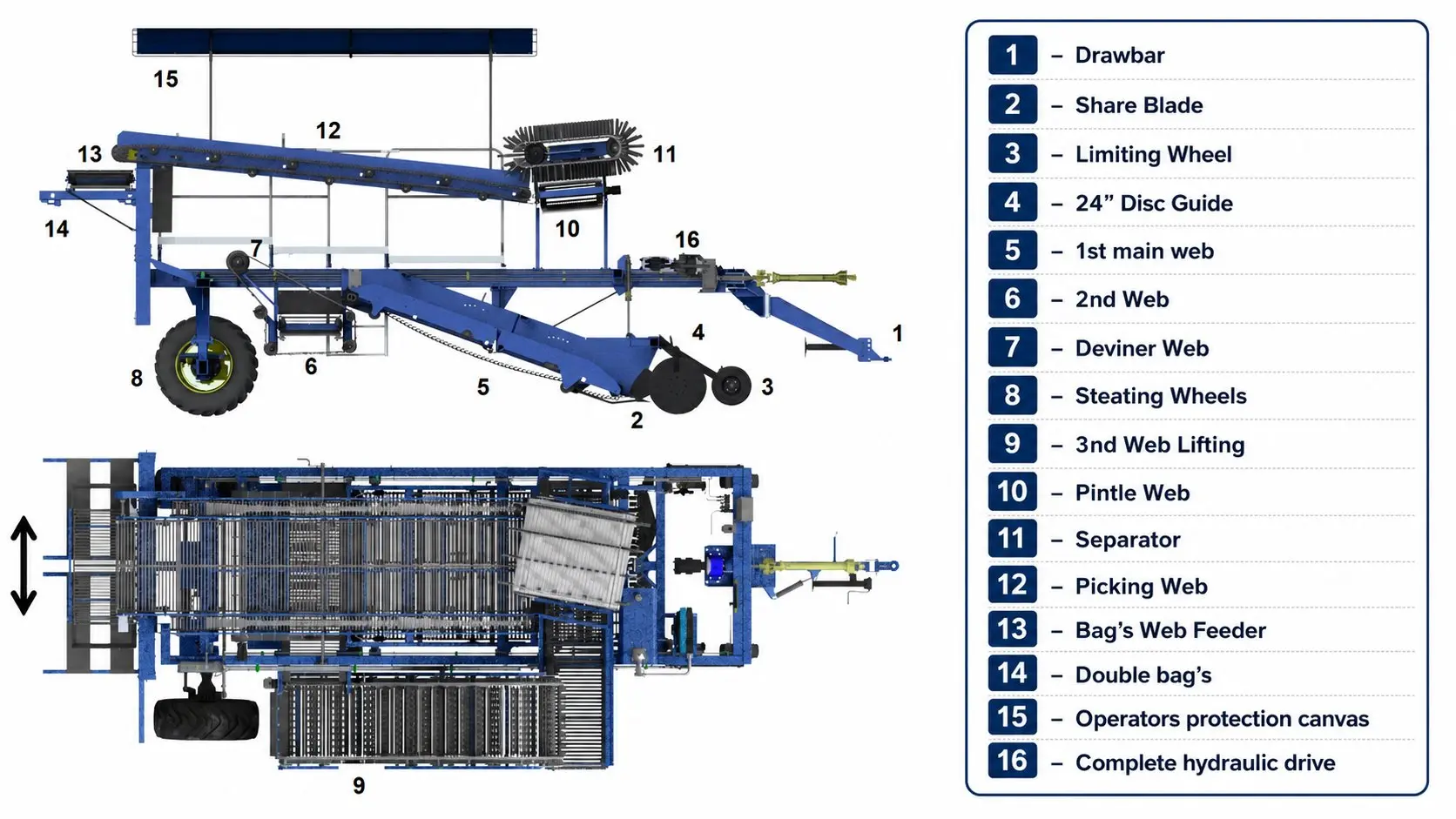
Prince Edward Island sits on a foundation of Permo-Carboniferous red sandstone (Mohs 4–5) — the rock that gives PEI its distinctive red soil colour and that, in terms of stone management, represents a manageable if constant wear source for potato machinery. The sandstone weathers progressively, producing rounded fragments at 8–20 cm that chip digger shares at an elevated but predictable rate. The sandstone stone management argument is straightforward: THOR 2.4 + CT-2100 + annual BlackBird, as documented for other sandstone regions.
The granite erratic argument is categorically different and represents the most commercially dangerous stone scenario in this guide. During the Pleistocene, the Laurentide ice sheet deposited glacial erratics — boulders of granite, quartzite, and gneiss (Mohs 6–7) — across the PEI landscape. These erratics, some exceeding 400 mm diameter, were buried at various depths in the red sandstone till during glacial retreat. Each winter, PEI’s 120+ annual frost days subject the soil to freeze-thaw cycles that push these erratics upward at 1–3 cm per year through the cryogenic pumping process. An erratic buried at 40 cm depth twenty years ago may now be at 20–25 cm — precisely the operating depth of a potato digger share moving at 2.5 km/h.
The critical distinction from continuous sandstone stone management: sandstone fragments follow predictable spatial patterns — they concentrate where the bedrock is closest to the surface, creating a stone map that changes slowly over seasons. Granite erratics follow no predictable spatial pattern. A field cleared last season may have an erratic at 22 cm depth this season that was not there last year. The first indication is the digger’s shear bolt activating — or, if the erratic is large enough for the instantaneous load to exceed the shear bolt’s activation speed, a broken PTO shaft or shear-fractured gearbox key. This unpredictability is why the PEI-specific management protocol requires both a pre-planting and a pre-harvest BlackBird surface assessment, combined with a THOR 3.0 (not 2.4) primary clearing that fragments erratics at the hardness level they present.
PEI Granite Erratic Management Protocol
Primary Clearing
THOR 3.0 @ 20–28 cm. Granite erratics at Mohs 6–7 require THOR 3.0. Repeat every 3–5 years (PEI’s 120+ frost days accelerate erratic migration to surface faster than any other guide region). CT-2100 full collection after each THOR pass.
Pre-Planting Pass
Merle surface pass after final spring frost — typically late April to early May in PEI. Removes erratics that frost heave has delivered to the surface through the winter period. This is the pass that catches the newly surfaced erratics before the cultivator or furrower encounters them.
Pre-Harvest Pass
Second BlackBird pass 4–6 weeks before harvest. Summer soil movement and cultivation disturbance can lift additional stone fragments to the surface even after the pre-planting pass. In PEI’s high-frost environment, a mid-season micro-frost event can move stones 1–2 cm in a single night. This second pass protects the digger.
Field Mapping
Maintain a field map of erratic locations found during each BlackBird pass. Erratics cluster in zones based on glacial deposition patterns — a cluster found this season will likely surface new erratics in the same zone next season. The map guides where to prioritise THOR repeat clearing in subsequent years.
Growing Degree Day Pressure — Why Downtime Costs More in Canada
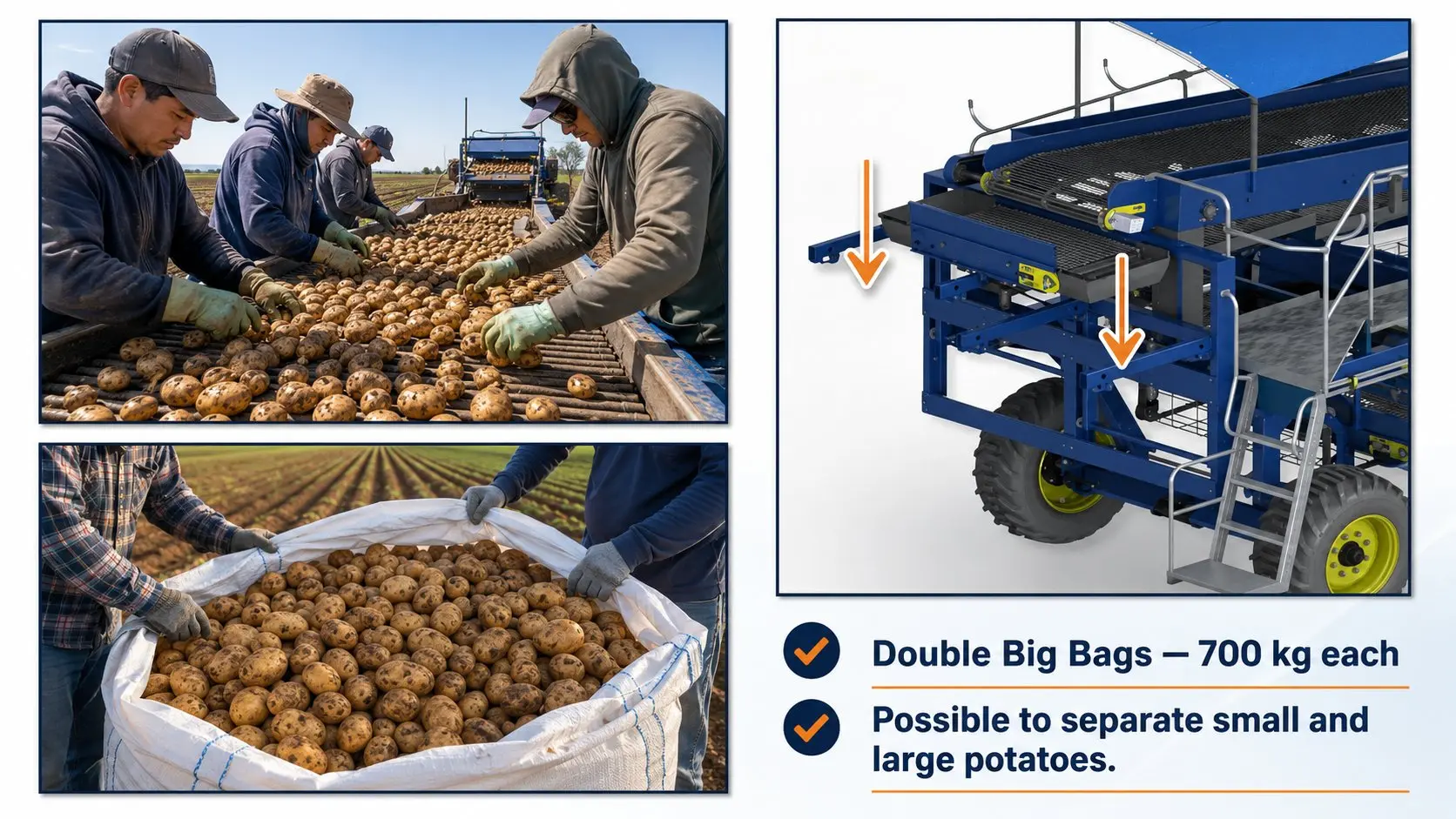
The UK potato guide discusses the 14-day harvest window after haulm destruction as the primary timing constraint. The Australian guide identifies the summer heat threshold above which tuber quality declines. Canada’s constraint operates differently, and with less flexibility: the Growing Degree Day (GDD) budget. GDD is the accumulated heat energy available for crop growth above a base temperature (10°C for potato) from planting to the end of the growing season. In PEI, Manitoba, and Alberta’s northern districts, the annual GDD budget available to potato crops is approximately 1,000–1,200 GDD — a narrow window between the soil warming above 10°C in spring (typically mid-May to early June) and the killing frost threshold in autumn (typically late September to early October in PEI, earlier in northern Manitoba and Alberta).
The commercial implication: the GDD balance that remains between any given day in the harvest period and the first killing frost is the reserve that determines whether the crop can be harvested safely. A potato digger that suffers a gearbox incident and requires a 2-day repair in late August on a PEI farm is not simply experiencing 2 days of harvest delay — it is consuming 2 days of GDD reserve at the rate of 15–20 GDD/day (typical late-August PEI temperature), reducing the frost-safe margin from, say, 3 weeks to less than 2. If an unexpected early frost arrives (which in PEI can occur any time after September 10 in cool years), those 2 days of stone-induced machinery downtime are the difference between a completed harvest and a partial one with the remaining crop exposed to killing frost temperature.
| Région |
GDD Budget |
Frost Risk Date |
Downtime Impact |
| PEI |
1,100–1,300 |
Sept 10–30 (variable) |
1 day downtime in Aug = 15–20 GDD lost; can shift harvest into frost window on cool years |
| Manitoba |
950–1,150 |
Sept 1–20 (variable) |
Tightest GDD budget; any Aug downtime critically compresses margin in northern districts |
| Alberta (south) |
1,100–1,400 |
Sept 15 – Oct 5 |
Slightly wider than PEI; irrigation extends flexibility but chinook variability adds risk |
| UK (comparison) |
1,500–1,800 |
Oct 15 – Nov 15 |
2–4 weeks more buffer before killing frost than any Canadian region |
The GDD argument directly informs the machinery specification decision in Canada. On a Manitoba farm with a September 10 average killing frost date and a 30 ha potato area: a mounted single-row digger at 0.65 ha/hour harvests 5.2 ha/day — requiring a minimum of 5.8 harvest days to complete 30 ha. Against a realistic window of 6–7 harvest days in the August-September period before frost risk, the mounted digger operates with zero weather margin and zero machinery downtime tolerance. A single gearbox incident consuming one day of harvest may leave 5 ha unharvested in the ground when the killing frost arrives. The trailed digger at 2.0 ha/hour completes 30 ha in 1.9 harvest days — leaving 4+ days of frost margin. For Canadian operations above 15 ha, the trailed digger is not a productivity enhancement; it is a frost-risk management tool.
Winter Storage — How Stone Bruising Compounds Over Four to Eight Months
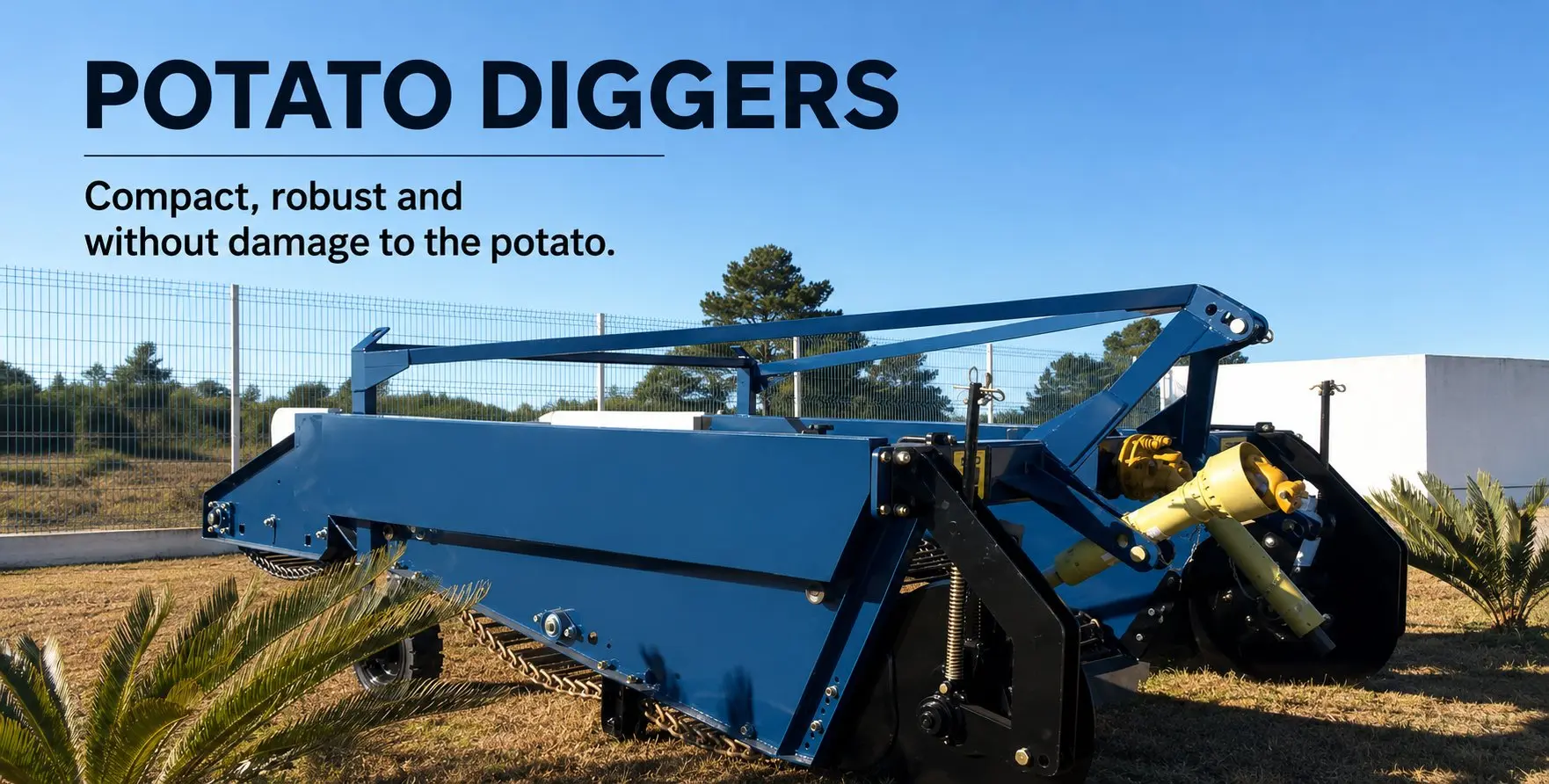
Canada is the only regional market in this guide where virtually the entire potato harvest enters large insulated storage facilities — potato cellars — for holding through the winter before sale. PEI cellars, Manitoba bulk storage, and Alberta controlled-atmosphere stores hold potatoes at 4–7°C for periods ranging from 4 months (early fresh market varieties) to 8 months (processing varieties held for March-April plant delivery). The implications for stone-induced harvest bruising are substantially different from fresh-market or short-storage regions.
In a fresh-market system (a UK market garden delivering to a pack house within 3 days of harvest), blackspot bruising from stone-potato collisions in the harvest digger causes a quality downgrade at intake — visible and commercially significant, but contained to that batch’s intake assessment. In Canada’s bulk winter storage system, the same bruising creates a secondary consequence that compounds over the storage period: the disrupted cell tissue at the bruise site is colonised by Erwinia carotovora (soft rot bacteria) and Fusarium solani (dry rot fungi) that enter through the skin wound or through the sub-skin tissue disruption of the bruise itself. At storage temperature, these pathogens progress slowly — but over 4–8 months, a single bruised tuber in a bulk pile can inoculate adjacent sound tubers through respiratory moisture movement. In severe seasons with high bruise incidence at intake, bulk pile losses from secondary rot can reach 3–8% of stored volume by the spring grading date — a loss that was entirely created at harvest by stone-potato collision in the digger.
Stony Field Harvest → Storage
- ▸15–25% of harvested tubers carry harvest bruising
- ▸Bruise sites colonised by Erwinia et Fusarium
- ▸Secondary spread to adjacent tubers over 4–8 months
- ▸Bulk pile loss 3–8% by spring grading
Cleared Field Harvest → Storage
- ▸3–6% of harvested tubers carry harvest bruising
- ▸Significantly fewer pathogen entry points at intake
- ▸Secondary spread substantially reduced in well-wound-healed pile
- ▸Spring pile loss typically below 1%
Storage System Implications for Stone Clearing Investment
Canada’s winter storage system converts the stone-induced bruising argument from a harvest-day quality problem into a 4–8 month compounding storage loss problem. The ramasse-roches CT-2100 investment that prevents stone-potato collision at harvest therefore prevents not just the immediate Grade 1 downgrade but the secondary pile loss that represents the larger commercial consequence in the Canadian storage-dependent system. Canadian potato buyers and contract growers regularly specify bruise-incidence thresholds at storage intake — farms that consistently deliver low-bruise crops from cleared fields command premium storage allocation and contract renewal priority that stone-affected farms cannot match.
Province-by-Province Selection Guide
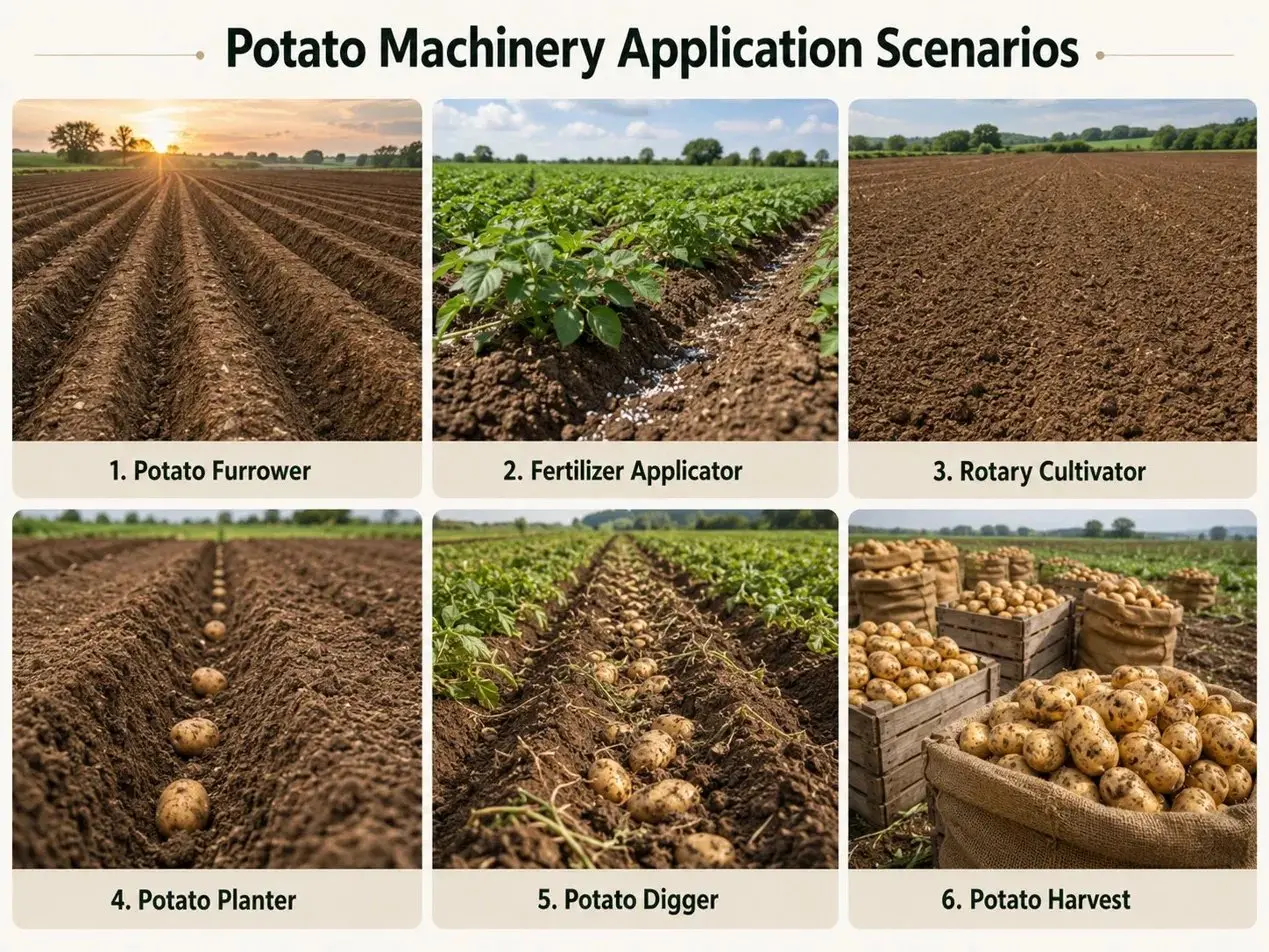
Prince Edward Island — National Heartland, Red Sandstone and Erratics
Erratic risk — HIGHEST
PEI produces over 25% of Canadian potato volume with Russet Burbank as the dominant processing variety alongside Shepody and Ivory Russet. The red sandstone soils are naturally fertile but carry the erratic risk described above. Frost heave with 120+ frost days per year is the highest in this guide. Farms range from 40 ha to 500+ ha, with the larger operations requiring trailed digger specification. The GDD window is 1,100–1,300 GDD with killing frost typically September 10–30.
Recommended System
Stone: THOR 3.0 @ 20–28 cm, repeat every 3–5 years
Annuel: 2× BlackBird (pre-planting + pre-harvest)
Harvest: Trailed digger for farms above 15 ha
Harvest: pelleteuse montée for farms up to 15 ha
Priority: Erratic field mapping mandatory before each season
Manitoba — Portage la Prairie, Carberry, Red River Valley
Glacial till — tightest GDD
Manitoba’s potato country around Portage la Prairie and Carberry produces Russet Burbank and Norland varieties on glaciolacustrine (former lake-bottom) and glacial till soils. Stone type: mixed quartzite, limestone, and granite erratics from Lake Agassiz glacial deposition — similar to PEI but with generally lower surface concentration. The defining challenge in Manitoba is the GDD budget — 950–1,150 GDD with killing frost possible from September 1 in northern districts. This is the tightest GDD window in this guide. Trailed digger specification is essential for any Manitoba operation above 12 ha given this extreme frost margin pressure.
Recommended System
Stone: THOR 3.0 @ 20–28 cm, repeat every 4–6 years
Annuel: 2× BlackBird (pre-planting essential after spring thaw)
Harvest: Trailed digger strongly recommended above 12 ha
GDD buffer: Zero tolerance for machinery downtime in Aug–Sept
Alberta — Lethbridge, Picture Butte, Taber (Irrigated)
Quartzite + limestone till — irrigated
Southern Alberta’s potato belt around Picture Butte, Lethbridge, and Taber is primarily sprinkler-irrigated production on glaciolacustrine soils carrying quartzite and limestone till fragments. The irrigation context creates the stone resurfacing dynamic described in the Australian guide — irrigation wheel traffic promotes stone migration upward. The chinook wind events that characterise Alberta’s weather can rapidly change field conditions from frozen-solid (impassable) to workable in 48 hours, which can compress the harvest window even within an otherwise adequate GDD budget.
Recommended System
Stone: THOR 3.0 @ 20–26 cm (quartzite Mohs 6–7)
Irrigation resurfacing: 3× BlackBird per season (as per irrigated protocol)
Harvest: Trailed digger for Alberta commercial scale (typically 20–100 ha)
Repeat THOR: every 4–6 years; more frequent in heavily irrigated zones
British Columbia — Lower Fraser Valley, Okanagan, Interior
Mixed geology — assess by site
BC’s potato production is geographically diverse and generally smaller-scale than the prairie provinces. The Lower Fraser Valley produces fresh potatoes on deep alluvial soils with low stone risk. The Okanagan and Thompson-Nicola interior districts operate on glacially-deposited soils over granitic basement — moderate to high erratic risk. The longer growing season (1,400–1,600 GDD in the Lower Mainland) gives more harvest window flexibility than any other Canadian province, making the GDD pressure argument less acute. Stone clearing priority varies dramatically by site — a Fraser Valley alluvial farm may need BlackBird management only, while an Okanagan interior farm requires THOR 3.0 for its granite erratic profile.
Recommended System
Fraser Valley alluvial: BlackBird annual may be sufficient
Okanagan/Interior granite: THOR 3.0 à 20–26 cm
Harvest: pelleteuse montée for most BC scale (typically 5–20 ha)
Stone assessment mandatory before THOR investment decision
Foire aux questions
Q
Why do granite erratics in PEI cause more sudden gearbox damage than the continuous sandstone fragments that are also present?
The damage mechanism differs fundamentally between sandstone and granite erratic encounters. Sandstone fragments accumulate gradually in the working zone — they’re present at low concentrations across the field, and the digger share chips progressively as each small fragment contacts the cutting edge. This is a high-frequency, low-peak-force event pattern that causes predictable share wear without sudden load spikes. Granite erratics cause the opposite: a low-frequency, extremely high-peak-force single event. A 250 mm granite erratic at Mohs 6–7 has a contact surface area orders of magnitude larger than a sandstone chip, and its hardness (roughly equivalent to the digger share’s own hardened steel) means the share cannot chip or deform around it — the full momentum of the digger’s operating mass is transferred instantaneously through the rigid contact into the driveline. This is the gearbox shock loading event described in the stone damage guide: the load spike is instantaneous (milliseconds), and the shear bolt or slip clutch protection system, which requires 50–100 ms to engage, cannot activate fast enough. The result is a direct driveline transmission of the impact force to the gearbox internals. Sandstone fragments rarely cause this event because they’re too small and too soft to create a rigid, instantaneous impact against the share face.
Q
Does PEI’s red soil colour indicate anything about its stone content or management requirements?
PEI’s distinctive red soil colour is caused by the high iron oxide (haematite and goethite) content of the Permo-Carboniferous red sandstone bedrock that underlies the province. The sandstone weathers to produce the characteristic red iron-oxide-rich clay fraction that colours the derived soils. The red colour is an indicator of: (1) sandstone-derived parent material — which means the base stone content is red sandstone at Mohs 4–5, confirming THOR 2.4 as appropriate for the sandstone fraction; and (2) free-draining, well-aerated soil chemistry — the red colour indicates that iron is maintained in its oxidised (Fe³⁺) form rather than being reduced to grey-green ferrous (Fe²⁺) forms characteristic of waterlogged soils, which means PEI’s red soils drain freely and do not waterlog potato ridges in normal conditions. The red colour does NOT indicate anything about granite erratic presence — the erratics are geologically unrelated to the sandstone matrix and can be present at any density regardless of soil colour. Red soil colour is therefore a positive indicator for drainage and sandstone management (THOR 2.4 adequate) but provides no information about erratic risk, which must be assessed independently through field surveys.
Q
Can Korea Watanabe’s potato digger operate in PEI autumn conditions where early frost may arrive while harvest is underway?
Korea Watanabe’s potato diggers are designed for operation in soil temperatures down to approximately 2°C before the soil becomes too frozen for the share to cut cleanly. In PEI’s autumn, early light frosts (−1 to −3°C air temperature) typically freeze only the surface 3–5 cm, leaving the potato zone at 15–22 cm depth unfrozen and workable for another 24–48 hours after the surface freeze. The digger can operate through light frost conditions with one operational adjustment: reduce forward speed by 20–30% when the surface soil is frozen, because the frozen surface layer increases the share’s required cutting force and reduces the elevator chain’s soil-separation efficiency (frozen clods don’t break down as readily on the vibrating chain). A killing frost (−4°C or colder sustained over 4+ hours) that penetrates to tuber depth makes harvest inadvisable — tubers that have been frozen at depth are salvageable if handled carefully before thawing, but once they begin thawing the cell membrane disruption from ice crystal formation causes rapid quality deterioration. The operational priority in PEI is therefore to complete harvest before a sustained killing frost, not to harvest through it — which is the core argument for the trailed digger’s higher throughput on operations above 15 ha.
Q
How does PEI’s potato contract system (most production under processor contracts) affect the stone clearing investment decision?
The majority of PEI potato production is grown under multi-year contracts with processors (primarily McCain Foods and Cavendish Farms), which specify: delivery volume, variety, grade standards (bruise tolerance, size distribution, defect thresholds), and delivery timing windows. These contracts typically include quality clauses that specify maximum bruise incidence at intake and maximum stone contamination in delivered loads. Farms that consistently deliver high-bruise product may face: (1) price penalties per tonne for bruise-incidence above threshold; (2) load rejection with return transport cost; or (3) contract non-renewal in the following season. Stone clearing investment, by reducing harvest bruising from 15–25% to 3–6% of sampled tubers, directly reduces the frequency of penalty trigger events. In the PEI contract system where 5–7 year contracts represent the farm’s primary revenue security, the stone clearing investment is not evaluated purely on per-season return — it is evaluated as a contract compliance tool that protects the farm’s processor relationship and multi-year revenue certainty. Contact Korea Watanabe for the processor-contract bruise specification compliance protocol and how the THOR + CT-2100 system is documented for contract quality records.
Q
What is the recommended tractor HP range for Canadian farms that need to operate both THOR 3.0 and a trailed potato digger with a single tractor?
THOR 3.0 requires 140 HP minimum, recommended 160 HP. The trailed potato digger requires 80 HP minimum, recommended 100–120 HP. The two operations do not overlap in timing — THOR operates in autumn after the previous harvest or in spring before planting, while the trailed digger operates in August–September at harvest. A single 140–160 HP tractor can therefore power both machines across the season without operational conflict. For Canadian farms with an 80–100 HP tractor that cannot reach THOR 3.0’s requirement: the options are (1) THOR contracting — contract the THOR clearing to a neighbour or service provider with the correct HP, while the farm’s own 80–100 HP tractor handles all planting, cultivation, and harvest machinery; (2) THOR 2.4 for sandstone-only fields where erratics have been confirmed absent through field mapping — THOR 2.4 requires 80 HP minimum, allowing the farm’s own tractor to operate it for sandstone management even though it cannot handle erratic-grade stone; (3) shared ownership of a THOR 3.0 between neighbouring farms, reducing the capital cost of the high-HP machine across multiple operations. Contact Korea Watanabe for the THOR contracting and shared-ownership programme options available in each Canadian province.
Korea Watanabe — Canada
Canadian Potato Machinery — Specified for Your Province, Stone and GDD Window
Province + stone type + farm area + GDD window + storage system → Korea Watanabe specifies the complete machine à pommes de terre and stone clearing system for your Canadian growing conditions — from PEI erratic management through Manitoba GDD pressure to Alberta irrigated production.
Corée Watanabe Rock Crusher Tractor Co., Ltd. · Ansan-si, Gyeonggi-do
Éditeur : Cxm