Germany and the Netherlands together form the most intensively managed potato production zone in continental Europe and, arguably, in the world. The Netherlands, a country smaller than West Virginia, produces approximately seven million tonnes of potato annually — more per hectare than almost any other national average globally — while simultaneously driving the world’s seed potato breeding and export trade through companies such as Agrico and HZPC. Germany, with four times the area and a more diversified agricultural base, produces a further eleven million tonnes across contrasting soil types from the sandy plains of Lower Saxony to the heavier alluvials of Bavaria. For a potato machinery supplier seeking to serve either market, the combination of sophisticated buyers, established high-machinery-use farm structures, stringent EU regulatory requirements, and specific agronomic conditions creates a demanding but commercially significant opportunity.
This guide addresses the soil types, farm scale, operational standards, regulatory compliance requirements, and equipment selection logic that define potato machinery for the German and Dutch markets. EU machinery buyers are among the most technically informed in the world — understanding the market before approaching it is essential.
Germany and Netherlands — Production Context and Regional Geography
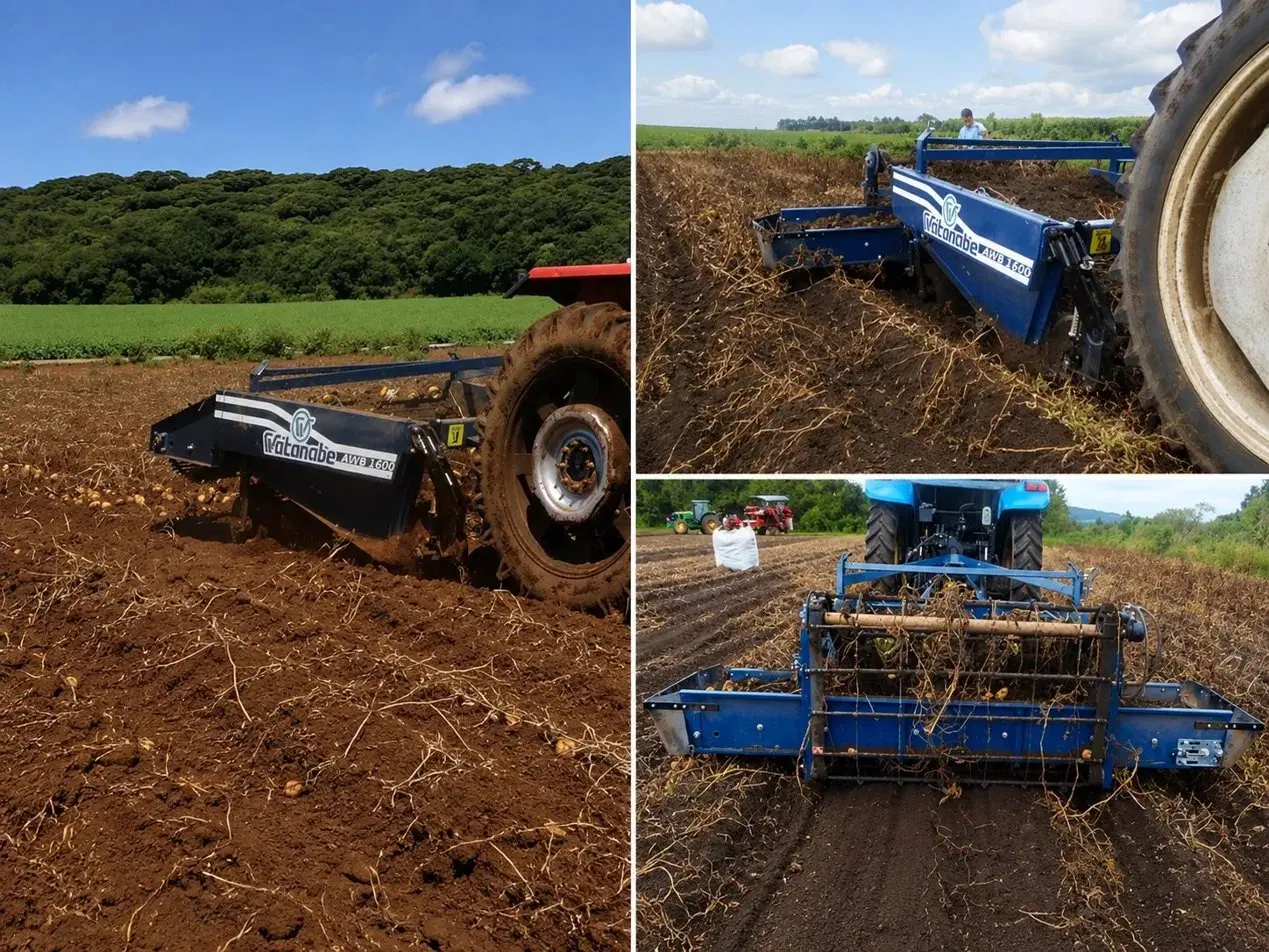
Germany’s potato production is concentrated in three main regions. Lower Saxony (Niedersachsen) is the dominant zone — the sandy loam soils of the Lüneburg Heath and the Hanover basin provide the light, well-drained conditions that German potato production has built its reputation on. North Rhine-Westphalia (Nordrhein-Westfalen) contributes significant volumes from the slightly heavier clay-loam soils of the Münsterland, and Bavaria (Bayern) harvests potato from the fertile alluvial plains flanking the Danube. German farms involved in potato production range from 20-hectare family operations supplying regional food processors to 300+ hectare specialist estates that are among the most technically advanced potato enterprises in Europe.
The Netherlands’ potato geography is more compact but equally diverse in soil terms. Drenthe and Groningen provinces in the northeast produce on light dekzand (aeolian sand) soils that are the closest European equivalent to the Canadian prairie soils — free-draining, low stone density, and highly amenable to precision row cultivation. Zeeland and Noord-Brabant produce on heavier marine clay soils with high fertility but more demanding harvest conditions. The crown jewel of Dutch production, Flevoland — a polder province reclaimed from the IJsselmeer between 1950 and 1968 — has some of the deepest, most productive clay soils in Europe, capable of yielding 60+ tonnes per hectare in favourable seasons.
| Região | País | Dominant Soil | Digger / Separator Preference |
|---|---|---|---|
| Niedersachsen (Lower Saxony) | 🇩🇪 Germany | Sandy loam (Sandlehmboden) | Riddle frame — excellent free-fall separation on light soil |
| Münsterland / NRW | 🇩🇪 Germany | Clay-loam (Lößboden) | Star wheel — more positive separation for cohesive soil |
| Bayern (Bavaria) | 🇩🇪 Germany | Alluvial loam (Auenboden) | Star wheel or riddle frame depending on site moisture |
| Drenthe / Groningen | 🇳🇱 Netherlands | Dekzand (aeolian sand) | Riddle frame — very light soil separates freely at low chain speed |
| Flevoland | 🇳🇱 Netherlands | Deep polder clay (Polderveen) | Star wheel — clay cohesion requires active separation; reduce speed after rain |
| Zeeland / Noord-Brabant | 🇳🇱 Netherlands | Marine clay (Zeeklei) | Star wheel; strict soil moisture timing before digging |
Farm Structure, Field Scale, and the 75 cm Row Spacing Standard
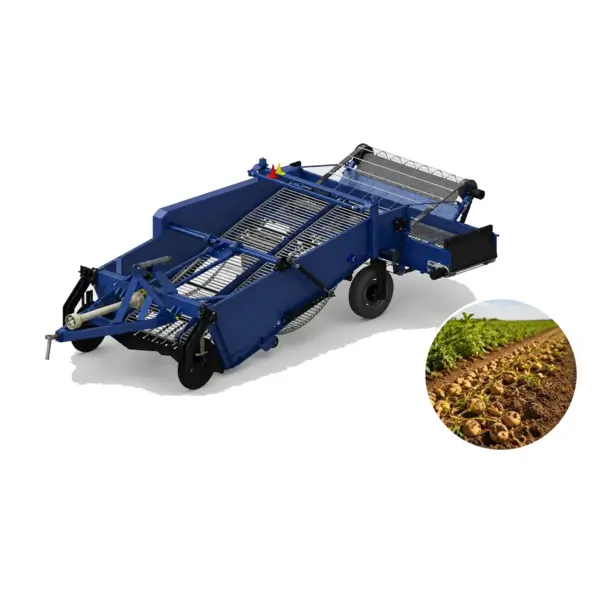
German and Dutch potato farms are large by European standards. The average potato specialist farm in Niedersachsen operates between 40 and 150 hectares of potato in a rotation, typically within a broader arable rotation of cereals, sugar beet, and green manure. In the Netherlands, specialist potato enterprises in Flevoland and Drenthe are often 80–250 hectares of potato with their own harvester, cold store, and direct supply contracts to processing factories or seed potato certification programmes. These are not farms that will consider a single-row mounted digger — they are, almost universally, operating multi-row trailed diggers or fully trailed harvesters with bunker or direct-to-trailer collection systems.
The 75 cm row spacing is the universal standard across both countries and across virtually all of continental western Europe. Unlike the UK (which uses both 75 cm and 85 cm depending on variety and rotation) or North America (which ranges from 81 to 91 cm in different regions), German and Dutch growers have standardised on 75 cm as the baseline that all machinery must be configured to. This means that any digger, furrower, or planter supplied to these markets must have its share spacing, disc spacing, or row unit spacing confirmed at 75 cm before delivery. A machine delivered with shares set at 80 cm or 85 cm and without the parts to adjust to 75 cm will not be accepted in these markets.
The Dutch are also notable for their adoption of precision agriculture in potato production. GPS-guided tractor operations, variable-rate fertilizer application, and crop monitoring drones are standard practice on specialist Dutch potato enterprises. Machinery compatibility with precision guidance systems — specifically, does the implement have appropriate mounting points for lightbar or auto-steer guidance compatibility — is a question that Dutch buyers will raise. This is not a legal requirement, but it is a practical market expectation at the commercial scale.
CE Marking and EU Machinery Directive — Import Compliance for Non-EU Suppliers
The European Union’s Machinery Directive 2006/42/EC is the legal framework governing the safety and market access of all machinery sold within EU member states, including Germany and the Netherlands. For a Korean manufacturer or a buyer importing potato machinery into the EU from outside the bloc, this directive creates specific obligations that must be met before any machine can legally be placed on the EU market. Non-compliance is not a minor administrative issue — EU market surveillance authorities can order the removal of non-compliant machinery from sale, impose financial penalties, and prohibit the import or sale of further units from the same manufacturer.
For a buyer in Germany or the Netherlands wishing to import potato machinery manufactured in Korea, the practical pathway is: (1) confirm with the Korean manufacturer that they have either completed EU CE conformity assessment for their machinery range, or engage an EU Authorised Representative to complete it on their behalf; (2) obtain the Technical File and EU Declaration of Conformity before the machine ships; (3) verify that the German or Dutch language instruction manual is included with the machine at delivery. Machinery that is CE-marked but lacks a German-language Betriebsanleitung cannot legally be handed to a German operator — the language requirement is a market surveillance enforcement point, not merely a courtesy.
Equipment Selection for German and Dutch Potato Conditions
| Operação | Recommended for Niedersachsen / Drenthe (Sandy Loam) | Recommended for Flevoland / Münsterland (Clay) |
|---|---|---|
| Seedbed preparation | Rotary cultivator at 18–22 cm; single pass on well-structured sandy soil | Rotary cultivator at 22–28 cm; may need primary ploughing or subsoil loosening on clay pan |
| Ridge formation and planting | Disc furrower at 75 cm; combined furrower-fertilizer-planter standard at commercial scale | Mouldboard-type furrower preferred on clay to create higher, better-drained ridge; 75 cm spacing throughout |
| Harvest — digger type | Trailed multi-row with riddle frame separator; windrow delivery to bunker loader | Trailed multi-row with star wheel separator; harvest only in adequate soil moisture window |
| Harvest scale (typical) | 4-row trailed digger + bunker loader is baseline; larger operations use 6-row or full trailed harvester | 4-row trailed harvester with bunker preferred — clay soil makes windrow pick-up less efficient |
| Tractor HP requirement (harvest) | 100–140 HP for 4-row trailed; 150–180 HP for 6-row trailed | 120–150 HP for 4-row (clay resistance adds 20–30% power demand) |
| Row spacing — all operations | 75 cm universal standard. Confirm all implement share, disc, and row unit spacings at exactly 75 cm before delivery. Non-standard spacings will be rejected by professional buyers. | |
The German and Dutch markets have two additional expectations that distinguish them from most export markets. First, after-sales service network: German farmers in particular place high value on the availability of parts and service from a local or regional dealer. A machine sold without an established service partnership in Germany faces significant barriers to repeat sales and customer satisfaction — the first breakdown in a harvest season without local parts availability creates a commercial relationship problem that can end market access permanently. Second, documentation standards: CE marking is the minimum legal requirement, but professional German agricultural buyers expect full technical documentation, calibration guides, and a German-language parts catalogue as standard with any professional-grade machine purchase.
For enquiries about potato machinery compatibility with EU and German-Dutch market requirements, contact Korea Watanabe to discuss CE compliance status and available documentation for each implement category.
Perguntas frequentes
▶Does the EU Machinery Directive apply to used or second-hand machinery imported into Germany or the Netherlands?
Yes, with some nuance. A used machine that was already CE-marked and placed on the EU market before its resale is generally not subject to a new conformity assessment — the original CE marking and Declaration of Conformity remain valid if the machine has not been substantially modified. However, a used machine imported from outside the EU that was never CE-marked — for example, a Korean-manufactured machine previously operating only in Korea — must undergo full conformity assessment before it can be legally placed on the EU market, regardless of its age. Substantial modification of any machine (adding new functions, changing safety-critical components, rebuilding major systems) requires a new conformity assessment even on machines that were previously CE-marked. Buyers considering importing second-hand non-EU machinery into Germany or the Netherlands should seek a legal opinion on compliance before the machine ships.
▶Germany uses 75 cm row spacing — but some German growers use 90 cm for specific varieties. What should I specify?
The 75 cm standard applies to the mainstream processing potato sector in Germany and the Netherlands — ware and processing potatoes for crisping, chipping, and the fresh market. Some German growers producing large-sized cooking potatoes or specific organic varieties do use 80–90 cm row spacing, but these are a minority. For a first-market specification, 75 cm is the correct default — this matches the widest production base and the purchasing specifications of German potato cooperatives and processing contracts. If a specific buyer requires a different spacing, confirm before manufacture that the implement’s adjustment range covers their requirement. Most well-designed modern potato furrowers and diggers can be adjusted from 70 to 90 cm within their standard frame; confirm this adjustment range with the manufacturer before any EU-market supply commitment.
▶Are there EU subsidy programmes that help German or Dutch potato farmers purchase new machinery?
EU agricultural subsidies under the Common Agricultural Policy (CAP) are primarily income-based direct payments, not machinery purchase subsidies. However, several EU and national programmes provide support for machinery investment. Germany’s Agricultural Investment Programme (Agrarinvestitionsförderung, AFP) offers grants of typically 15–20% for qualifying agricultural machinery investments, administered at the state (Länder) level with varying eligibility criteria — Lower Saxony and Bavaria both operate AFP programmes. The EU’s EAFRD (European Agricultural Fund for Rural Development) funds some machinery investment through its agri-environment and modernisation measures. In the Netherlands, the SDE++ scheme and various LNV (Ministry of Agriculture) programmes occasionally include machinery investment components, particularly for precision agriculture adoption. The applicable programmes change with each EU CAP programming period — buyers should consult their national advisory service (German: Landwirtschaftskammer; Dutch: Agentschap RVO) for current eligibility and application procedures.
▶The Netherlands is a major seed potato exporter — does seed potato production require different machinery specifications?
Yes — Dutch certified seed potato production operates under NAK (Naktuinbouw/Nederlandse Algemene Keuringsdienst voor Zaaizaad en Pootgoed van Landbouwgewassen) certification, which imposes specific requirements on handling, storage, and harvest that affect machinery selection and operation. For the harvest operation, the critical specifications are: minimum drop height from digger chain to collection point must be as low as possible (seed potato certification deducts for mechanical damage to seed tubers); chain speed must be carefully calibrated to avoid abrasion of skin during separation; and the elevator system must be free of any carry-over from previous varieties (contamination is a certification failure). For a digger or harvester supplied to a Dutch seed potato operation, these operational specifications must be confirmed alongside standard commercial requirements. A machine that meets the CE marking requirements and standard 75 cm specification is the baseline — the NAK-specific operational requirements add a further layer of calibration and cleaning protocol that must be addressed at the operational level.
▶What German potato trade shows or industry events should a machinery supplier know about?
The two most important German agricultural trade events for potato machinery are Agritechnica (Hanover, biennial in November — the world’s largest agricultural machinery trade fair) and EuroTier (also Hanover, biennial in alternate years from Agritechnica). For potato-specific networking, the German potato industry’s annual meeting structures are organised through BVVG (Bundesvereinigung der Erzeugerzusammenschlüsse) and through the regional Landwirtschaftskammern conferences in Lower Saxony and NRW, which are the key contact points for established potato farm buyers. In the Netherlands, Potato Europe (biennial, rotating international venue) is the sector’s dedicated event combining field demonstrations with a trade exhibition — it draws buyers and suppliers from across Europe and is the most efficient single-event networking opportunity for potato machinery in the continental EU market.
Enquiring for Germany or the Netherlands?
Provide your production region, soil type, row spacing requirement, farm scale, and CE compliance questions. Korea Watanabe will confirm the potato machinery specifications relevant to EU market standards and discuss CE marking documentation availability.
Coréia Watanabe Rock Crusher Tractor Co., Ltd.
Editor: Cxm