
The economic cost of missed tubers is straightforward to calculate: every percentage point of the crop left in the ground is a direct revenue loss equal to one percent of the season’s yield value. For a farm producing 35 tonnes per hectare at a market value of £200 per tonne, missing 5% of the crop across 10 hectares costs £3,500 — before accounting for the cost of the next crop’s interference from volunteer potato plants emerging from the missed tubers in the rotation. Volunteer potatoes are a quarantine concern for many seed potato certification systems and a nuisance weed for cereal growers: a single missed tuber can produce 6–10 daughter tubers the following season if left undisturbed.
Despite the commercial significance, missed tubers are consistently underestimated in practice — because they are invisible during the harvest operation. The digger passes, the tubers arrive on the trailer, the day ends. Nobody walks the field behind the machine unless there is a specific reason to check. This guide provides a systematic diagnostic framework for the five root causes of missed tubers, with specific adjustment protocols for each cause and a pre-season checking procedure that establishes the correct settings before the field survey confirms a problem.
The Five Root Causes of Missing Tubers — Diagnostic Framework
| Root Cause | Diagnostic Sign in Field | Primary Fix |
|---|---|---|
| 1. Share too shallow | Tubers found at base of ridge or below ridge centre line when walking behind digger; shallow soil disturbance in the wheel track | Lower depth wheel; switch linkage to draft control (float) |
| 2. Ridge wander (driver tracking) | Tubers found consistently to one side of the machine’s path; clean unlifted ridges visible beside the share track | Slow down; use depth wheel track as row reference; consider GPS row guidance |
| 3. Stolon tubers below share depth | Main crop lifted but isolated deeper tubers (usually smaller) remain; pattern consistent across the variety, not just occasional spots | Increase share depth by 2–3 cm; confirm maximum stolon depth with pre-harvest dig |
| 4. Forward speed too fast | Tubers found in loose disturbed soil ahead of and beneath the lifted ridge; pattern worsens at speed, improves when slowing | Reduce forward speed to 3–4 km/h; re-test at each speed reduction until misses stop |
| 5. Worn share tip | Increasing miss rate across the harvest season despite unchanged settings; share tip visibly rounded or worn on inspection | Replace share tip; inspect every 40–50 ha harvested and replace before critical wear |
In the majority of missing-tuber incidents investigated in UK potato growing practice, cause 1 (share too shallow) is the primary or contributing factor — either because the depth wheel is incorrectly set or, more commonly, because the tractor’s three-point linkage is in position control rather than draft control, preventing the depth wheel from doing its job. Before investigating any other cause, confirm the linkage control setting.
Share Depth — The Most Common Cause and the Correct Adjustment Protocol
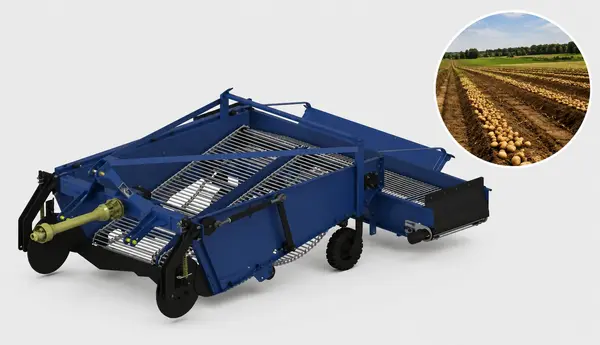
The potato digger’s share depth is controlled by the depth wheel — a flat or ridged wheel that runs on the soil surface alongside the share shank. The wheel’s axle height relative to the share mounting point determines the depth at which the share tip operates. Adjusting the wheel’s mounting position (raising or lowering the wheel axle relative to the shank) changes the depth: lowering the wheel axle pushes the wheel further from the share tip, allowing the share to penetrate deeper; raising the axle brings the wheel closer to the share tip, lifting the share to a shallower working position.
This mechanical relationship only functions correctly when the tractor’s three-point linkage is set to draft control (also called draft sensing, position control in float, or simply “float”). In draft control, the linkage responds to the force the implement places on the tractor’s lower links — when the share encounters hard soil and resistance increases, the linkage allows the machine to ride up slightly; when resistance decreases over softer patches, the machine settles back to depth. Crucially, in draft control the depth wheel is free to follow ground contours and maintain the share at its set depth relative to the soil surface, regardless of undulations in the field. In position control (the setting used for transport and for implements that should maintain a fixed height above the ground), the linkage locks the machine at a fixed geometry relative to the tractor — which means any undulation in the ground surface causes the share depth to change rather than the depth wheel tracking the surface. A rise in the field surface in position control pushes the depth wheel down, effectively reducing share depth and missing deeper tubers. Most tractor operators are accustomed to using position control for many implements — the digger is one of the few implements where draft control is essential for consistent depth.
① Confirm linkage control lever is in draft control / draft sensing position (not position control).
② Confirm depth wheel is bearing the machine’s weight — with the tractor at a standstill on flat ground and the digger lowered to working depth, attempt to lift the rear of the machine by hand. If you can raise it easily, the linkage is supporting the weight rather than the depth wheel — move the draft control setting toward more draft (lower number on most control dials).
③ Confirm depth wheel rotates freely and is not seized or packed with clay from the previous use.
④ Confirm depth wheel height adjustment lock (bolt or locking collar) is tight — a loose adjustment can shift under vibration during the first 100m of travel, changing the depth without the operator’s knowledge.
Ridge Tracking — Keeping the Digger on the Row Across the Field
Ridge tracking is the driver’s primary harvest skill. A digger that enters the row precisely on its centreline — share exactly under the ridge peak — maximises the volume of soil and tubers lifted by the share. A share that is offset to either side by more than 5 cm misses the bottom 10–20% of the ridge on the offset side, leaving the deepest tubers (which form near the ridge base) in the ground. On undulating ground, around field curves, and at every headland re-entry, the driver must actively track the row rather than holding a fixed tractor line.
The common driver error is using the tractor’s bonnet centreline as the tracking reference. On a single-row mounted digger where the share is centred on the tractor’s PTO centreline, this works on straight rows — but the share is offset by the linkage geometry from the bonnet sightline, and on curved rows or at headland approaches, the bonnet line deceives. The correct tracking reference is the depth wheel track — the wheel is mechanically connected to the share and runs alongside the ridge, making it the most accurate visual reference for share position. Where the tractor has GPS row guidance available, even a simple lightbar system set to the planted row centreline removes most of the operator-induced tracking error and reduces missed tubers from wander significantly.
At field headlands — the highest-risk zone for ridge wander — the correct procedure is to slow to crawling speed (1 km/h) as the digger crosses the headland, confirming share position visually at each row entry before accelerating to working speed. The seconds lost at each headland entry are recovered many times over in the missed tubers that would have been left without this confirmation.
Forward Speed — When Faster Travel Creates More Missed Tubers
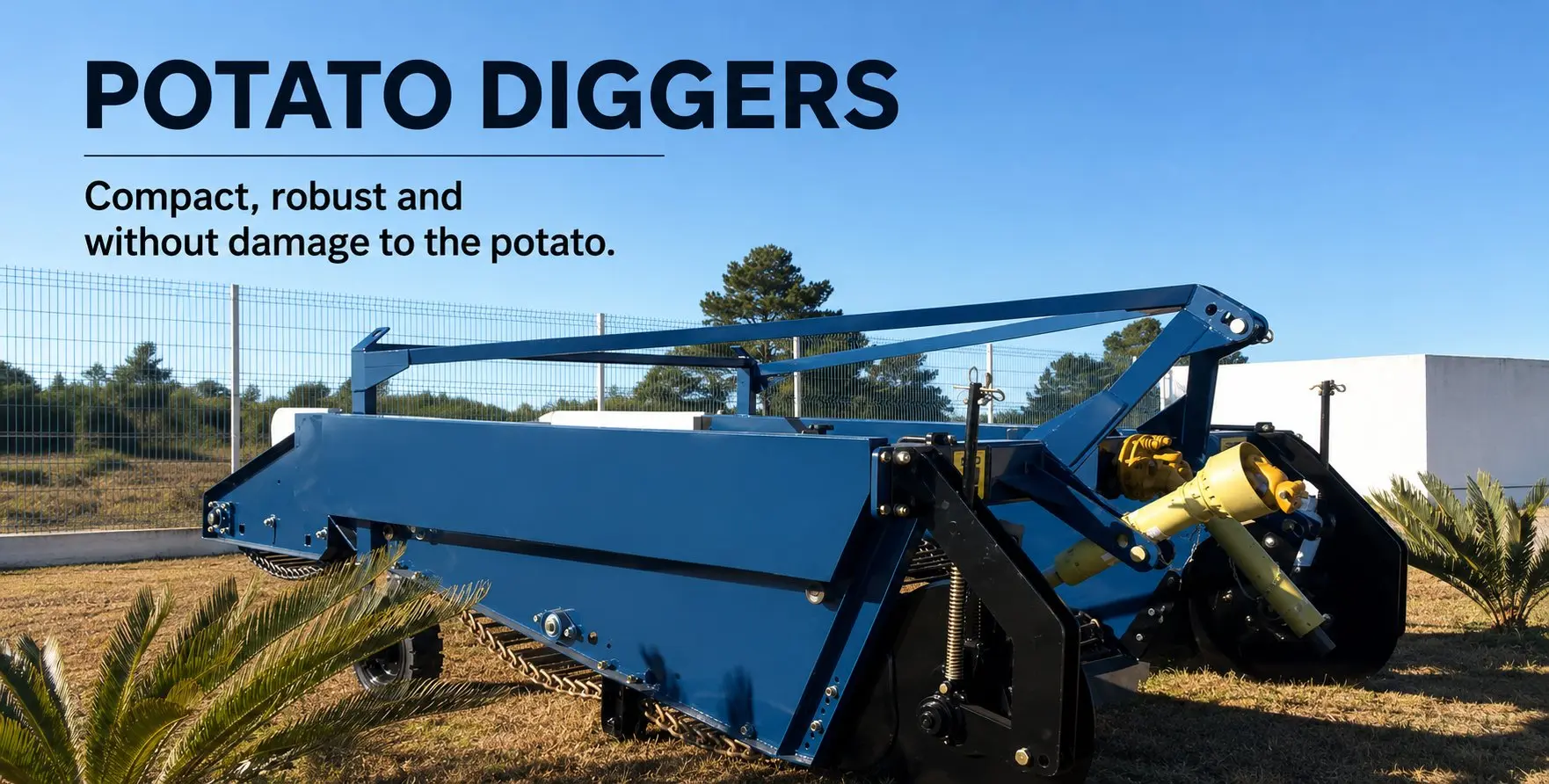
A potato digger’s share is designed as an inclined plane — the share surface angles upward from its leading edge at the tip to its rear junction with the elevator chain, creating a ramp that lifts lifted soil and tubers upward onto the chain as the machine moves forward. This inclined plane geometry works correctly at the forward speeds for which the share’s angle is designed, typically 3–5 km/h. At speeds above this range, the effective relationship between the share’s incline and the relative velocity of the soil changes: the share behaves more like a horizontal pushing blade than an inclined lifting plane. Tubers at the leading face of the ridge encounter the share moving faster than the share’s incline can redirect them upward — they are pushed forward or sideways rather than lifted, and slip under or around the share into the furrow behind.
The practical confirmation: if a field is delivering a pattern of missed tubers across the soil surface behind the digger — not at the base of the ridge but scattered in the open furrow at digger depth — and the pattern worsens as forward speed increases, the forward speed is above the optimal range for the share geometry. Reduce speed by 0.5–1 km/h and re-walk the following 50m of row. If the miss rate decreases, continue at the lower speed. The correct working speed for any digger on any soil is the maximum speed at which zero tubers remain in the soil profile at the correct depth — not the maximum speed the tractor can manage.
Pre-Season Ground Penetration Check — Setting Depth Before the Field
The most efficient missing-tuber prevention is the pre-season check: establishing the correct share depth setting before harvest begins, so that the first field is correctly set from the first pass rather than discovered to be incorrectly set after the first trailer has been loaded.
For technical guidance on share depth settings, depth wheel specification, and linkage compatibility for specific potato digger models, Korea Watanabe’s technical support team can confirm the correct setup procedure for each machine in the range.
Veelgestelde vragen
▶How many missed tubers per square metre is acceptable and how do I measure the miss rate accurately?
Commercial potato production targets zero visible tubers in the soil profile at digging depth after the digger has passed — but in practice, on stony or variable-depth soils, some misses are almost inevitable. A miss rate of less than 0.5 tubers per square metre is generally considered acceptable for maincrop ware potato supply; a rate above 1.0 per square metre is commercially significant and warrants immediate adjustment. To measure miss rate: after the digger has passed, mark out a 10 m × 1 m strip (10 m²) in the field — using pegs and string to define the exact area behind the share track. Hand-dig the full marked area to 5 cm below the share’s working depth. Count every tuber found larger than 20 mm diameter (marketable size). Divide the count by 10 to get tubers per square metre. For a standard crop at 35 t/ha with approximately 120,000 tubers per hectare, 1 tuber per square metre represents approximately 0.8% crop loss — small per hectare but significant across a 50-hectare farm. Check 3–5 locations across the field and average the results for a representative miss rate figure.
▶My digger leaves tubers at the end of each row — the headland area consistently has more misses than the main field. What is causing this?
Headland misses have two common causes, each with a different fix. The first cause is share lifting: as the driver approaches the headland to turn, the natural instinct is to begin raising the linkage before the share has completely cleared the final rows of the crop — the share lifts prematurely, cutting across the final ridge at an angle rather than lifting it fully. The fix is to maintain full working depth until the share has completely cleared the last planted row, then raise rapidly. A physical mark on the field (a stick at the row end) gives the driver a reference for when the share has genuinely cleared the crop. The second cause is speed reduction before the headland: the driver slows from working speed to turning speed while the share is still in the crop, changing the forward speed from the range at which the share geometry works correctly to a slower speed where the share may stall without fully lifting the last section of ridge. Both causes are driver practice issues rather than machine faults — and both are significantly reduced by GPS guidance that maintains consistent approach direction to each headland turn.
▶Can a stony field cause missed tubers from stone disrupting the share path, and if so how is this managed?
Yes — stone encounters can disrupt share path in two ways. First, a large stone directly in the share path can deflect the share upward or sideways for a brief moment as the stone is displaced — this causes the share to miss the tubers immediately behind the stone contact point, as the share is no longer at the correct depth and alignment during and immediately after the encounter. Second, a high-density stone field forces the driver to focus on machine protection (listening for stone impacts, reducing speed to reduce impact force) rather than ridge tracking — driver attention is divided, and tracking accuracy falls. Both problems are managed by the same solution: stone clearance before potato harvest. A field that has been cleared of surface stones and sub-surface stones in the top 25 cm has fewer share deflection events and allows the driver to maintain consistent tracking focus. For fields where pre-season stone clearance is not complete, reducing forward speed during harvest (giving the share more time to recover from stone deflection before the next tuber cluster) and increasing depth by 1–2 cm (providing more margin between the share tip and the deepest tubers) are the operational adjustments.
▶The miss rate increases progressively across the harvest season — same field type, same settings, but worse results in October than September. What is changing?
A progressive worsening of miss rate across the season with unchanged settings almost always indicates share wear. The share tip is the hardest-working component on the digger — it impacts soil and stones continuously at the leading edge of the digging action. As the tip wears from its manufactured geometry (typically a sharp or angled leading edge) to a rounded, flattened profile, the share’s effectiveness as an inclined lifting plane decreases: the rounded tip pushes soil aside and forward rather than slicing through and lifting, and the effective lifting angle at which tubers are redirected upward onto the chain reduces. The result is an increasing miss rate even though all other settings remain constant. The fix is straightforward: inspect the share tip at the end of each 40–50 ha harvested and replace before the wear becomes critical. Carrying a spare share tip in the field kit allows a rapid replacement (typically 15–30 minutes with a socket set) rather than returning to the workshop. Tungsten-carbide tipped shares wear more slowly than standard steel and justify their higher cost on stony or abrasive soils where tip wear is the primary maintenance driver.
▶Does missing tubers at harvest have any crop rotation or disease consequence beyond the direct yield loss?
Yes — volunteer potato plants (emerging from missed tubers in subsequent crops) are one of the most problematic weed and disease concerns in potato-rotation arable farming. A single missed tuber that is not frost-killed over winter can produce 6–15 volunteer plants in the following crop, each capable of harbouring potato viruses (particularly PVY — Potato Virus Y), Phytophthora infestans (late blight), and nematode populations (potato cyst nematode, Globodera rostochiensis and G. pallida) that were suppressed during the potato crop’s own management programme. In seed potato certification systems (Scottish Seed Potato Classification, Dutch NAK standards), volunteers in the field are a serious certification risk — fields with volunteer plants above threshold levels can be rejected for seed potato production. In combinable crop rotation, volunteer potato is listed as a weed that is difficult to control post-emergence with many standard cereal herbicides. The direct revenue cost of missed tubers (lost yield) is therefore the smaller of the two costs — the indirect cost from volunteer management in the following crop and the certification risk are often substantially higher in the full multi-season accounting.
Missing Tubers at Harvest?
Share your digger type, soil type, estimated miss rate, and operating depth setting. Korea Watanabe’s team will confirm the share depth, depth wheel, and linkage settings for your aardappelrooier to minimise harvest loss.
Korea Watanabe Rock Crusher Tractor Co., Ltd. — Ansan-si, Gyeonggi-do
Redacteur: Cxm