India’s potato sector is the largest mechanisation opportunity for agricultural implement suppliers in Asia outside China. At approximately 54 million tonnes per year across 2.3 million hectares, India is the world’s second-largest potato producer — and it produces this volume with a mechanisation level that remains, by the standards of Europe, North America, or Australia, dramatically low. Manual harvest is still the dominant method on the majority of India’s smallholder potato farms. The transition from manual digging with a khurpi or khanpi to mechanised single-row digger operation is underway, driven by rising rural labour costs, government machinery subsidies, and the expanding presence of contract farming arrangements that create economies of scale for machinery deployment. For a potato machinery supplier, understanding the Indian market means understanding its regional production geography, its 30–55HP tractor fleet, its subsidy infrastructure, and the specific performance constraints that smallholder farm sizes impose on machinery selection.
This guide addresses each of those dimensions, building from national production statistics through regional soil and climate variation to the specific machinery configurations and tractor compatibility parameters that define viable equipment for each segment of the Indian potato market.
India’s Potato Sector — Production Volume, Seasonality, and Mechanisation Gap
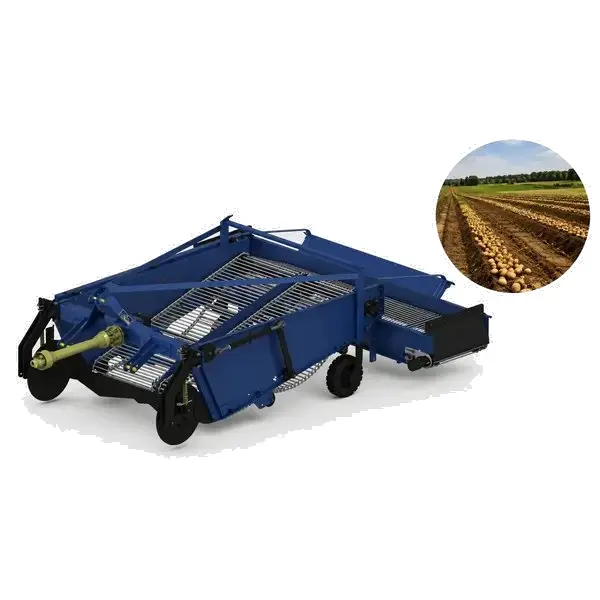
India’s potato production is dominated by the rabi (winter) crop — planted in October-November after the monsoon recedes and harvested February-March before the summer heat arrives. This rabi season accounts for approximately 85–90% of national potato production. A smaller kharif (summer) potato crop is grown in the Himalayan foothill regions of Himachal Pradesh and Uttar Pradesh hills, planted April-May and harvested August-September. The compressed rabi harvest window — four to six weeks across the main producing states before soil temperatures rise above tuber quality thresholds — creates significant harvest timing pressure and is one of the primary drivers of mechanisation demand: manual harvesting is too slow for large blocks of potato when the window narrows.
India’s national average potato yield is approximately 23–24 tonnes per hectare — significantly below the Dutch average of 45–50 t/ha and the German average of 40–45 t/ha. The yield gap is attributable primarily to seed quality, input levels, and variety selection, not to climate — India’s Indo-Gangetic alluvial soils are inherently fertile and the rabi season climate is well-matched to potato physiology. This yield gap represents both an agronomic opportunity and a machinery sizing consideration: at 24 t/ha, a two-hectare Indian smallholder farm produces 48 tonnes — a manageable volume for a one-pass single-row digger with two to three workers following. At hypothetical 45 t/ha yield levels under improved management, the same two hectares would produce 90 tonnes — creating stronger justification for a harvester-type collection system.
Uttar Pradesh, West Bengal, and Gujarat — Three Distinct Market Segments
| State | Share of India Production | Dominant Soil Type | Farm Scale and Machinery Context |
|---|---|---|---|
| Uttar Pradesh (UP) | ~37% | Indo-Gangetic alluvial loam to sandy loam; well-drained; low stone content | Farm size 0.5–5 ha typical; mechanisation adoption accelerating in Agra, Farrukhabad, Kanpur; 35–50HP tractors dominant |
| West Bengal (WB) | ~23% | Alluvial silt-loam, moisture-retentive, high fertility; Hooghly and Bardhaman districts | Smaller average farm size (0.3–1.5 ha); higher cropping intensity; compact tractor preference; manual harvest still widely used |
| Gujarat | ~8% | Sandy loam to loamy sand in Banaskantha and Sabarkantha; free-draining, low clay content | Larger commercial farms more common (2–10 ha); higher mechanisation; contract farming with processing companies; 40–55HP tractors |
| Punjab / Haryana | ~6% | Deep alluvial loam to clay-loam; high irrigation infrastructure | Most mechanised Indian states; 50–75HP tractors; early adopters of digger technology; strong dealer network for spares |
| Bihar / Madhya Pradesh | ~10% | Variable — alluvial plains to clay-loam upland; some black cotton soil (vertisol) | Mechanisation at early stage; strong potential but limited dealer infrastructure; subsidy schemes are primary purchase driver |
Uttar Pradesh is the most commercially significant target for potato machinery introductions because it combines the largest production volume with an accelerating mechanisation transition and the highest proportion of farms of sufficient scale to justify powered machinery. The Agra, Farrukhabad, and Etawah districts of western UP are the most concentrated potato production zones, with some farms reaching 10–20 hectares — large by Indian smallholder standards and well-positioned for two-row mounted digger adoption. These UP farmers are the primary candidate base for a step-up from single-row manual or tractor-assisted harvest to mechanised single or two-row digger operation.
Indian Tractor Fleet — HP Range, PTO, and Hitch Compatibility
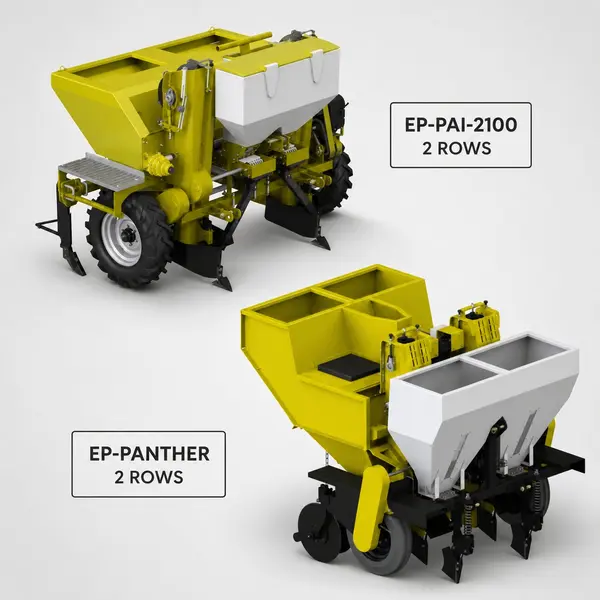
The Indian tractor market is one of the largest in the world by unit sales, but it is dominated by a different power range than European or North American markets. The majority of tractors purchased in India’s main potato-growing states fall in the 30–55HP range, manufactured by domestic brands (Mahindra, TAFE, Sonalika, VST Tillers Tractors) and international manufacturers with Indian production (John Deere India, Kubota India, New Holland Agriculture India, Same Deutz-Fahr India). These tractors share several technical characteristics that are critical to potato machinery compatibility.
| HP Range | 히치 카테고리 | PTO 속도 | Compatible Potato Implements |
|---|---|---|---|
| 20–30 HP | Cat 1 (22 mm) | 540 RPM | Furrower (light disc type), fertilizer applicator, narrow rotary cultivator (0.9m) — NOT single-row digger |
| 30–40 HP | 카테고리 1 / 카테고리 2 | 540 RPM | Single-row planter, furrower, fertilizer applicator, cultivator — single-row digger marginal on sandy soil at 38–40HP only |
| 40–55 HP ⬅ Core zone | Cat 2 standard | 540 RPM; some 1000 RPM | Full planting system + single-row mounted digger on any UP / Gujarat alluvial soil — the complete potato system tractor range |
| 55–75 HP | 카테고리 2 / 카테고리 3 | 540 and 1000 RPM | Two-row mounted digger (on sandy loam); wider rotary cultivator; full commercial planting system — emerging segment in Punjab/Haryana and larger UP farms |
The dominant PTO speed across India’s 30–55HP tractor fleet is 540 RPM. This has a direct implication for potato digger specification: a digger designed primarily for 1000 RPM PTO (as is common in European markets) must either be specified in a 540 RPM variant or fitted with a 540/1000 dual-speed gearbox for the Indian market. Most single-row potato diggers can be designed or adapted for 540 RPM operation — the chain speed and agitation characteristics at 540 RPM are adequate for the sandy loam soils of UP and Gujarat. The adaptation requirement is a specification issue that must be addressed at the order stage, not at delivery.
An important technical note for the Indian market: many Indian tractors in the 30–45HP range with Cat 2 hitch have a rated three-point linkage lift capacity in the 1,000–1,300 kg range, which is at or near the margin for a mounted single-row digger at working depth in wet, heavy soil. Specifying a digger of known weight (and verifying the tractor’s actual lift capacity under load) before confirming the purchase is essential for avoiding the situation where the tractor’s linkage cannot maintain share depth on wet days when digging is hardest.
Equipment Selection — What Works at India’s Dominant Farm Sizes
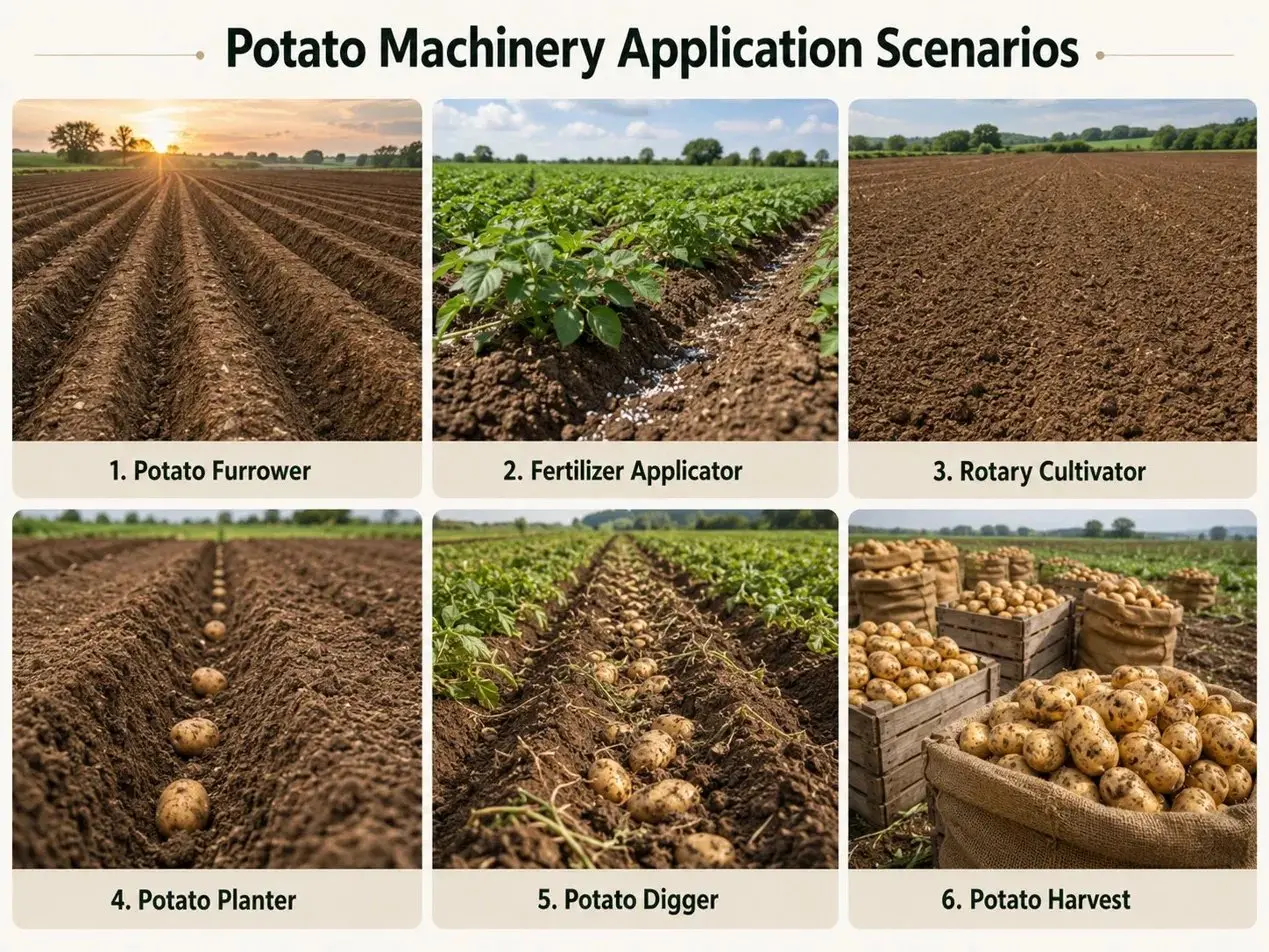
India’s potato farm structure is predominantly smallholder — the overwhelming majority of potato growers cultivate between 0.3 and 3 hectares of potato per season, with the average in UP approximately 1.2 hectares. This scale determines the appropriate machinery tier more directly than any other factor. At 1–2 hectares, the economic case for owning a full potato machinery system (rotary cultivator, furrower, planter, digger) is marginal on any individual farm — which is precisely why the Indian government’s Custom Hiring Centre (CHC) scheme and the broader SMAM machinery subsidy programme are so important to machinery market development: they aggregate demand across multiple farms and create viable machinery ownership at the cooperative or entrepreneur level rather than requiring every smallholder to purchase independently.
India’s Custom Hiring Centre (CHC) scheme allows an entrepreneur, cooperative, or Farmer Producer Organisation (FPO) to purchase a complete machinery set with government subsidy (typically 40%) and then hire the machinery to smallholder farmers on a per-acre, per-hour, or per-task basis. A single CHC with a 45HP tractor, single-row digger, planter, and furrower can serve 50–100 smallholder potato farms in a season, generating hire income that services the machinery purchase cost while providing mechanisation access to farmers who cannot individually afford ownership. This CHC model is the dominant route through which potato machinery reaches India’s smallholder farms — and it means that the effective buyer of a potato digger in India is often not the individual farmer but an entrepreneur or cooperative purchasing for custom hire.
Government Subsidy Schemes — RKVY, SMAM, and Custom Hiring Centres
India’s central and state governments operate several schemes that directly subsidise agricultural machinery purchases, making them the single most important factor in the Indian potato machinery purchasing process. Any supplier or buyer engaging with the Indian market must understand these schemes, because they affect both the effective purchase price and the paperwork and registration requirements at the point of sale.
For machinery suppliers exporting to India, a critical practical step is empanelment with state agricultural departments. Many subsidy schemes require that machinery be purchased from empanelled dealers or manufacturers — a process that involves registering the machinery model with the state government, providing technical specifications, and agreeing to supply and after-sale obligations. Without empanelment, subsidy claims cannot be processed by the buyer, which effectively raises the net price of the machinery by the subsidy amount and makes it commercially uncompetitive against empanelled alternatives. Engaging a registered Indian agricultural machinery dealer or importer who has existing empanelment relationships is the most efficient route to market for an overseas manufacturer entering the Indian potato machinery sector.
For current enquiries on potato machinery specifications compatible with Indian tractor requirements, Korea Watanabe can provide full technical specifications for subsidy registration documentation.
자주 묻는 질문
▶What row spacing is used for potato in India — and does it match international equipment standards?
Indian potato row spacing varies by region and production system, but the most common spacings are 60 cm, 67 cm, and 75 cm, with 75 cm increasingly adopted where mechanisation is being introduced (because it matches the standard row spacing for which global digger and planter manufacturers configure their equipment). Traditional smallholder planting in UP and West Bengal often uses narrower spacings of 45–60 cm, which is incompatible with most commercial single-row diggers designed for 75 cm or 85 cm row spacing. When introducing mechanised potato farming into a new area, agreeing on row spacing before planting — and confirming that the digger’s share width matches the chosen spacing — is the single most important agronomic decision in the mechanisation programme. The Indian Council of Agricultural Research (ICAR) and state KVKs recommend 60–75 cm as the mechanisation-compatible target for potato, with 75 cm the preferred spacing where commercial digger deployment is planned.
▶Is imported potato machinery eligible for SMAM or RKVY subsidy in India?
Eligibility for SMAM and RKVY subsidy for imported machinery depends on whether the machinery is registered with the relevant state agricultural department’s approved list and whether it is purchased through an empanelled dealer or importer. In principle, imported machinery can qualify — there is no blanket exclusion of foreign-manufactured equipment from subsidy schemes — but in practice, the administrative pathway for imported machinery is more complex than for domestically manufactured units. The buyer must ensure: (1) the machinery has a BIS (Bureau of Indian Standards) safety certification or equivalent approval, where required for the specific machinery category; (2) the importer or dealer is empanelled with the state agricultural department; (3) full technical specifications in English and Hindi are available for the subsidy application documentation. Working through an established Indian agricultural machinery distributor with existing subsidy empanelment is strongly recommended for any overseas manufacturer entering the Indian market.
▶What is the typical hire rate for a custom-hire potato digger in UP, and how does this compare to manual harvest cost?
Custom hire rates for potato digger operation in UP vary by district and season but typically fall in the range of INR 1,500–3,000 per bigha (approximately INR 5,600–11,200 per acre or INR 13,800–27,700 per hectare) for the complete digger service including tractor and operator, with the farmer’s family or hired casual labour providing the collection. Manual potato harvest labour in UP costs approximately INR 300–450 per person-day, with a typical smallholder 0.4-hectare plot (1 bigha) requiring 8–12 person-days for a complete manual dig — a total manual harvest cost of INR 2,400–5,400 per bigha. At current labour rates, mechanised digger hire and manual harvest have similar total costs per bigha for the basic dig — the mechanised option’s advantage is speed (completing the harvest in 1–2 hours rather than 8–12 days) and reduced harvest window risk, not necessarily direct cost saving per bigha. As labour costs continue rising in rural UP, the economic calculation will shift progressively in favour of mechanised hire.
▶Does India’s soil type — alluvial Indo-Gangetic plains — require any special configuration for a standard potato digger?
The alluvial soils of the Indo-Gangetic plains in UP and Bihar are among the easiest digging conditions for a potato digger in the world — the soils are light to medium texture, well-structured from repeated cultivation, and virtually stone-free. Standard single-row digger configurations designed for European light soils (riddle frame separator, moderate chain speed, 18–24 cm share depth) are excellent for UP and Bihar conditions. The specific adjustment needed for Indian rabi potato is operating depth: Indian farmers in UP typically plant potato at 10–15 cm depth (shallower than European practice) to allow manual earthing-up during the season, and the harvest depth is accordingly shallower than a European setting. The share depth adjustment should be confirmed with the local farmer before harvest begins, as setting the share 5 cm too deep on shallow-planted Indian potato will cause share-tip damage to tubers and excessive soil lift without harvest benefit. Gujarat’s sandy loam soils are even lighter and offer very low draft resistance — forward speed can typically be increased compared to European sandy loam settings without loss of separation quality.
▶What industry events or contact points should a potato machinery supplier know for the Indian market?
The most important national agricultural machinery event in India is AGRITEX / India International Agri Show (held in various cities) and the annual IMTEX and AgriMach exhibitions, though these are broader industrial events. For potato-specific market contacts, the most productive access points are: ICAR-Central Potato Research Institute (CPRI) in Shimla, Himachal Pradesh — the national apex body for potato research and mechanisation trials, which conducts annual demonstrations of harvesting and planting machinery in partner states; state agricultural universities (G. B. Pant University of Agriculture and Technology, Pantnagar, Uttarakhand for UP market context; Bidhan Chandra Krishi Viswavidyalaya, West Bengal for WB market); and the Potato Association of India (PAI), a trade body that coordinates between potato farmers, processors, and input suppliers including machinery. Direct engagement with agri-input dealers in Agra, Farrukhabad (UP) and Mehsana (Gujarat) covers the two most commercially accessible entry points for new potato machinery introduction.
Enquiring for the Indian Market?
Share your target state, farm size range, tractor HP, and PTO speed. Korea Watanabe will confirm the potato machinery specifications compatible with Indian tractor requirements — including 540 RPM variants, Cat 1/2 hitch data, and technical documentation for subsidy registration.
한국와타나베 암석분쇄기트랙터(주) — 경기도 안산시
편집자: Cxm