Potato production in highland Southeast Asia operates under conditions that no single other regional guide in this series encounters in combination: volcanic and igneous stone geology (Mohs 5–7) on slopes of 8–25°, annual monsoon rainfall of 2,000–4,000 mm that continuously delivers new stone from upslope outcrops to the growing zone, two complete potato crop cycles per year that double the annual machinery wear exposure relative to temperate single-crop operations, and field sizes of 0.5–3 ha accessible only to compact tractors of 28–50 HP. The Philippines’ Benguet Province, Vietnam’s Lâm Đồng Province, Indonesia’s Dieng Plateau in Central Java, and India’s Himachal Pradesh highlands are the principal growing areas — each with distinct geology and monsoon patterns but sharing the same fundamental machinery constraint: everything must be lighter, smaller, and more damage-resistant per unit of throughput than in any other region this guide covers.
This guide covers the monsoon erosion stone resurfacing dynamic unique to SE Asian highland production, the compact-tractor system compatibility that defines the full Korea Watanabe macchinari per la patata range in this market, the double-crop-per-year ROI acceleration argument that makes the frantoio per rocce investment proportionally more valuable here than anywhere else, and a region-by-region specification across the four principal growing areas.
Monsoon Erosion — The Most Dynamic Stone Resurfacing Mechanism in This Guide
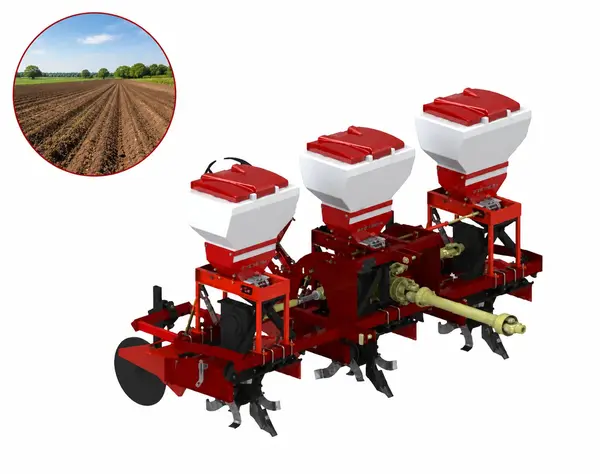
Frost heave — the mechanism responsible for stone resurfacing in Canada, the UK, and other temperate regions — operates by thermally cycling water in soil pores to exert upward pressure on stones. In tropical highlands with minimal frost, this mechanism is absent or negligible. But the stone resurfacing problem in SE Asian highland potato production is more severe than in most temperate regions, because monsoon rainfall creates a continuous erosion-and-deposition cycle that delivers new stone material from upslope volcanic and igneous bedrock exposures to the potato growing zone every season.
The mechanism: intense monsoon rainfall (often exceeding 100 mm/day during peak events) on sloped volcanic terrain generates high-velocity surface runoff that suspends and transports soil particles, small stones, and rock fragments from the steeper upper-slope positions where bedrock is exposed or near-surface. These materials are deposited at the lower slope and terrace positions where velocity decreases — exactly the positions where potato fields are typically established. The deposition rate on a typical Benguet or Lâm Đồng terrace field during a single monsoon season can add 5–15 mm of stony material across the field surface, with individual storm events depositing concentrations of 30–50 mm of material in low points and drainage concentrations within the field. This is a supply-driven stone accumulation: stones are not heaving from below, they are arriving from above and upslope.
Monsoon vs Frost Heave — How the Stone Management Approach Differs
Stone Source
Frost heave: stones come from below the cleared depth, migrating upward. SE Asia monsoon: stones arrive from above and upslope, depositing on the field surface from erosion transport. The cleared sub-surface zone remains cleared; the surface accumulates new material annually.
Clearing Response
Frost heave: THOR must be repeated every 3–15 years as sub-surface material migrates into the operating zone. SE Asia monsoon: THOR 2.4 at initial clearing persists at depth; annual
Merlo passes remove the surface-deposited material — one or two passes per cropping cycle (two per year).
THOR Repeat Cycle
In SE Asian conditions without frost heave: a single THOR clearing establishes a permanent sub-surface cleared zone. Monsoon erosion adds to the surface, not to the sub-surface. THOR repeat is needed only if new stone is identified at operating depth — typically 8–15 years on stable terrace fields.
BlackBird Frequency
Two complete crops per year means two BlackBird pre-harvest passes per year — one before each crop’s harvest. The pre-first-crop pass also serves as the pre-planting surface clear for the second crop cycle. On fields with high monsoon stone deposition: a third pass immediately after the rainy season peak may be warranted before machinery re-enters the field.
Compact Tractor Compatibility — Every Machine on 28–50 HP
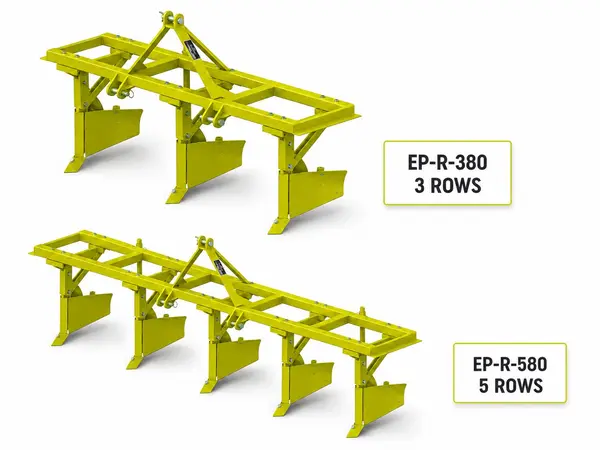
SE Asian highland potato farms operate under access and terrain constraints that make the compact-tractor compatibility of the Korea Watanabe machinery range not simply a convenience — it is the binary condition for whether the machinery can be deployed at all. Fields in Benguet at 1,400–2,400 m elevation are reached by unpaved mountain roads with gradients of 15–35% and turning radii that exclude any trailer combination wider than approximately 2.5 m. Fields in Lâm Đồng and on the Dieng Plateau have similar access constraints with additional restrictions imposed by irrigation channel networks and terrace retaining walls that limit the turning radius within the field to 3–5 m. A machine that requires a 100 HP tractor with a 3 m turning radius cannot operate on these fields regardless of its performance specification.
| Macchina |
HP minimo |
SE Asia Sweet Spot |
Slope Rating |
SE Asia Status |
| Rotary cultivator |
28 HP |
35–50 HP |
Up to 25° |
✅ Full compatibility |
| Potato furrower |
28 HP |
35–50 HP |
Up to 20° |
✅ Full compatibility |
| Fertiliser applicator |
28 HP |
35–45 HP |
Up to 20° |
✅ Full compatibility |
| Piantapatate |
28 HP |
35–50 HP |
Up to 18° |
✅ Full compatibility |
| Mounted digger (single-row) |
28 HP |
40–50 HP |
Up to 15° |
✅ Primary SE Asia harvester |
| THOR 2.4 (andesite/basalt) |
55 HP |
65–80 HP |
Up to 12° |
⚠ Contract or shared tractor |
| Rastrello da roccia BlackBird |
40 HP |
50–70 HP |
Up to 12° |
✅ Essential annual pass |
The slope rating column is particularly important for SE Asian highland operations. The Korea Watanabe single-row mounted digger maintains stable operation up to approximately 15° slope — which covers most Benguet terraced field positions but excludes the steeper field edges and inter-terrace transition zones where hand digging remains the only practical approach. The THOR 2.4 and BlackBird have lower slope limits (12° for stable operation without counterweight ballast) — on steeper sites these machines require down-slope working direction (operating downhill rather than across slope) and reduced forward speed to maintain lateral stability. Site-specific slope assessment before machine deployment is essential; Korea Watanabe provides slope operation guidelines for each machine on request.
Two Crops Per Year — How Double-Cycle Production Changes the Stone Management ROI
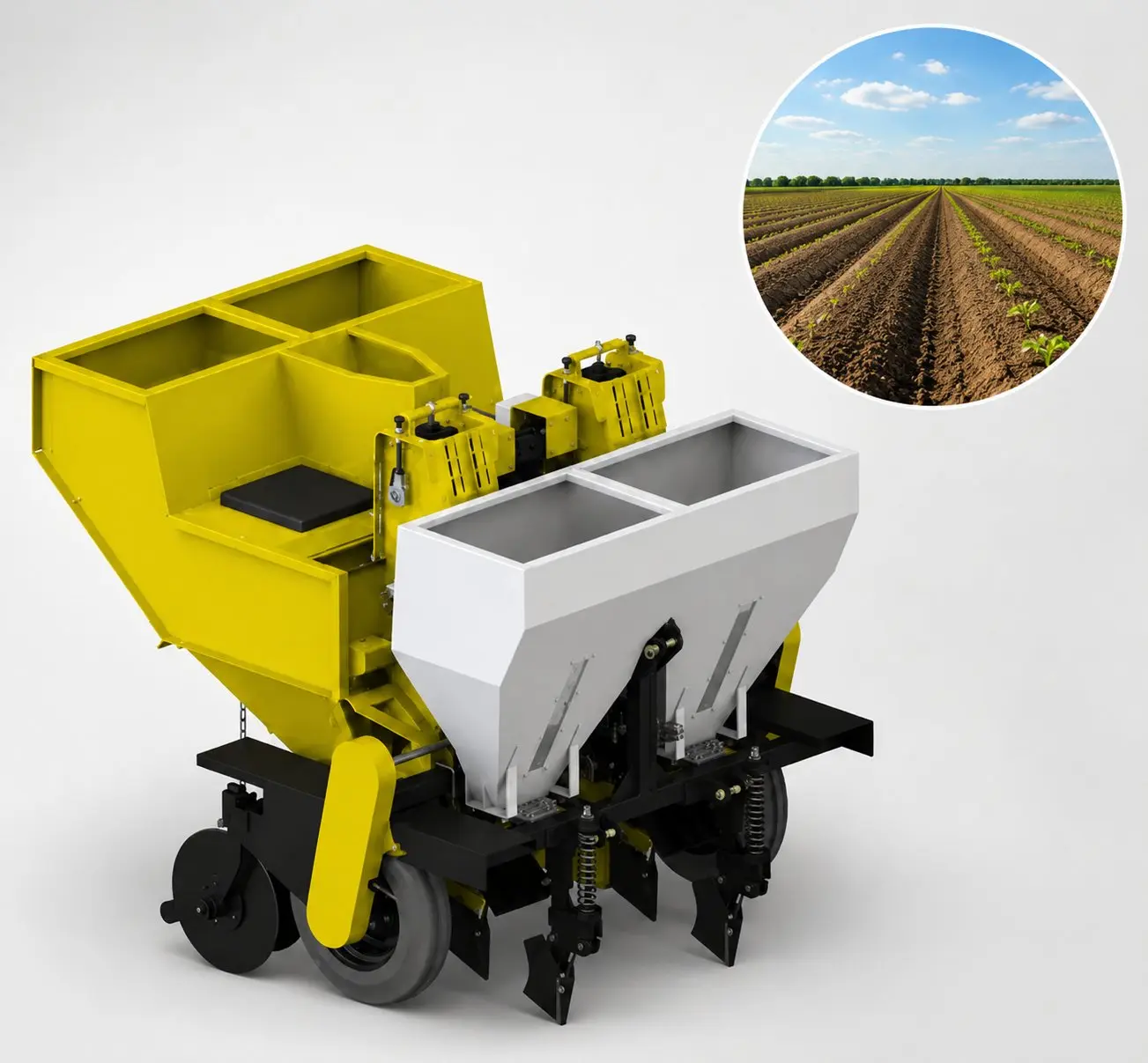
SE Asian highland potato production achieves two complete crop cycles per year on most commercial growing sites — a production intensity made possible by the tropical climate modified by altitude. At 1,400–2,400 m elevation, year-round temperatures of 15–22°C allow potato planting in any month, and the monsoon calendar creates a natural two-season structure: a dry-season crop (typically planted after the monsoon ends in October-November, harvested in January-February) and a rainy-season crop (planted in March-April ahead of the monsoon, harvested in June-July before peak rainfall). This double-cycle structure has a direct and underappreciated effect on the stone management ROI calculation: every analysis of stone clearing investment versus return that applies in temperate single-crop regions must be multiplied by two for SE Asian highland production.
The 2× Multiplication Argument — Why Stone Clearing Has the Fastest ROI in SE Asia
Annual Machinery Passes
Temperate single-crop: 1 rotary cultivation + 1 furrowing + 1 planting + 1 harvest = 4 machinery passes per year.
SE Asia double-crop: 2 × each stage = 8 machinery passes per year. Stone encounters double accordingly.
Annual Wear Rate
A digger share that lasts 60 ha per set on cleared UK ground lasts only 30 ha equivalent annual area on cleared SE Asian ground — because the machine completes 60 ha of work in 6 months rather than 12. Uncleared share life of 8–15 ha per set means 2–4 sets consumed per year, not 1–2.
Stone Clearing ROI Speed
The wear reduction benefit of stone clearing applies to both crop cycles. If clearing saves one share set per crop cycle, it saves two share sets per year in SE Asian double-crop production — twice the annual benefit of the equivalent field in a temperate single-crop region at the same upfront clearing cost.
Revenue Impact
Tuber bruising downgrade on stony ground affects both harvests per year. Stone clearing that improves Grade 1 yield proportion delivers the grade premium improvement twice annually — compressing the clearing payback period proportionally relative to single-crop regions.
Region-by-Region Guide — Benguet, Lâm Đồng, Dieng and Himachal Pradesh
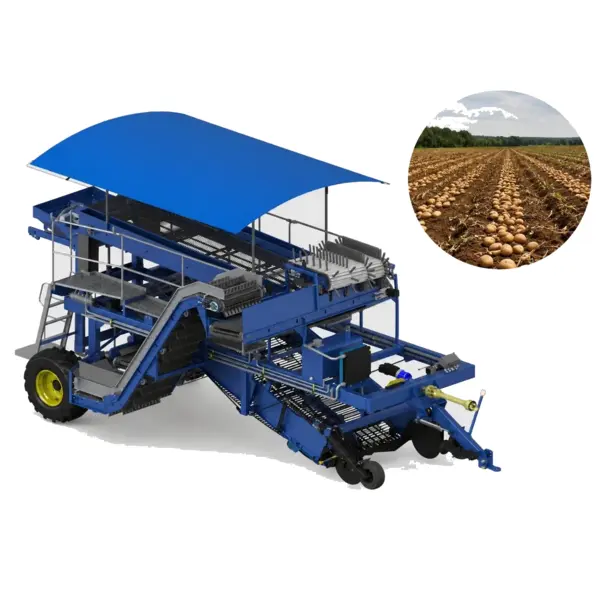
🇵🇭 Philippines — Benguet Province (La Trinidad, Atok, Kibungan)
Andesite Mohs 5–6
Benguet’s Cordillera mountains produce approximately 40% of the Philippines’ potato supply from terraced hillside fields at 1,400–2,300 m. The primary potato-growing municipalities — La Trinidad, Atok, Kibungan — operate on andesitic volcanic soils over basalt and andesite bedrock (Mohs 5–6). Stone is continuously delivered from the steep upper slopes above the terraces by monsoon rainfall erosion (June–October, 2,500–3,500 mm/year). Field sizes: typically 0.3–1.5 ha per terrace. Tractor size: 28–45 HP walkbehind two-wheel tractors are the most common, with four-wheel compact tractors increasingly adopted for the 40–50 HP range on wider valley terraces.
Two crops per year: dry season (November–February) and wet/transitional season (March–June). The dry season crop is the higher-quality production cycle — lower disease pressure, better skin finish, higher Grade 1 yield. Stone damage to the digger share is highest at the wet season harvest (June–July) when the recently ended monsoon has deposited the season’s maximum stone load on field surfaces.
Sistema consigliato
Calcolo:
THOR 2.4 @ 15–22 cm (once-off; no frost heave)
CT-2100: permanent collection post-THOR
Merlo:
2–3× per year (pre-each-harvest + post-monsoon)
Digger: mounted single-row (40–50 HP tractor)
THOR repeat:
10–15 anni (minimal frost heave)
🇻🇳 Vietnam — Lâm Đồng Province (Đà Lạt, Đơn Dương, Lạc Dương)
Basalt Mohs 5–7
Vietnam’s Lâm Đồng Province — centred on Đà Lạt city at 1,500 m — produces premium fresh potatoes for the Vietnamese domestic market and for export to regional ASEAN markets. The geology is predominantly Cenozoic basalt overlying older granite-gneiss basement at 40–80 cm depth. The upper basalt layer (Mohs 5–6) is fragmented by THOR 2.4; where granite-gneiss basement is exposed by erosion at the surface (common on steeper slopes above 15°), THOR 3.0 is recommended for effective fragmentation. Lâm Đồng’s monsoon (May–October, 1,800–2,400 mm/year) creates significant hillside erosion during the June–August peak rainfall period.
Sistema consigliato
Calcolo: THOR 2.4 (basalt zones) / THOR 3.0 (granite-gneiss exposed slopes)
CT-2100: full permanent collection
Merlo: 3× per year (pre-each-crop harvest + post-peak monsoon)
Digger: mounted single-row (40–50 HP compact tractor)
THOR repeat: 12–18 years
🇮🇩 Indonesia — Dieng Plateau (Central Java), Karo (North Sumatra)
Active volcanic — pumice + andesite
Indonesia’s Dieng Plateau at 1,800–2,100 m in Central Java’s Wonosobo and Banjarnegara districts is a unique production environment: active geothermal and volcanic activity means the soil profile contains a mix of relatively young volcanic pumice (low density, Mohs 5–6) and older consolidated andesite fragments from earlier eruptions (Mohs 5–7). The pumice fraction is mechanically soft and easy to fragment; the andesite fragments are harder and require THOR 2.4 at minimum for effective size reduction. The Karo Plateau in North Sumatra (around Berastagi) presents similar young volcanic soil conditions. Both areas receive 2,000–3,500 mm of rainfall annually with extended wet seasons that accelerate surface stone deposition from slope erosion.
Sistema consigliato
Calcolo: THOR 2.4 @ 15–20 cm (volcanic soil depth limited)
CT-2100: full collection; recovered volcanic stone repurposed as aggregate
Merlo: 3× per year in high-rainfall zones
Digger: mounted single-row (35–50 HP compact)
Active volcanic monitoring: consult local geological survey before major clearing investment on active geothermal sites
🇮🇳 India — Himachal Pradesh (Shimla, Kullu, Lahaul), Uttar Pradesh highlands
Granite-gneiss Mohs 6–7
Himachal Pradesh produces India’s finest seed potato — the high-altitude (2,000–3,000 m) growing conditions reduce aphid-transmitted virus pressure and produce clean seed potato stock that is distributed across the Indian subcontinent. The geology is granite-gneiss of the Greater Himalayan Crystalline Series (Mohs 6–7) — the hardest stone environment in SE and South Asia. Shimla and Kullu districts receive 1,500–2,000 mm of monsoon rainfall (July–September) with associated slope erosion into the potato terraces. Importantly, Himachal Pradesh experiences light frost (40–60 frost days/year in the higher elevations), adding a minor frost heave component to the monsoon erosion stone resurfacing.
Sistema consigliato
Calcolo: THOR 3.0 @ 18–26 cm (granite-gneiss Mohs 6–7)
CT-2100: full permanent collection
Merlo: 2× per year (pre-harvest + post-monsoon)
Digger: mounted single-row (40–55 HP compact)
THOR repeat: 8–12 years (minor frost heave at high elevation)
Domande frequenti
Q
What is the maximum slope gradient where the Korea Watanabe mounted potato digger can safely operate, and what modifications are available for steeper terrain?
The Korea Watanabe single-row mounted digger’s standard operational slope limit is approximately 15° (27% gradient) for cross-slope operation — the most common working direction on terraced highland fields. Above 15°, the machine’s lateral stability is insufficient to maintain consistent share depth and safe tractor operation without supplementary support. The safe slope limit for down-slope (with-slope) operation is somewhat higher, approximately 18°, because the machine’s weight distribution aids rather than resists the tractor’s traction. Modifications available for SE Asian highland conditions: (1) Counter-balance ballast weight on the upslope side of the three-point hitch — typically 80–120 kg of bolt-on cast iron ballast — improves lateral stability on 15–18° cross-slope by lowering the combined tractor-plus-digger centre of gravity. (2) Reduced elevator chain width configuration — narrowing the effective chain width reduces the side-extension moment that causes lateral instability on steeper slopes while slightly reducing throughput per pass. (3) Tyre selection — R-1W agricultural traction tyres with extended lug spacing provide significantly better lateral hillside grip than standard R-1 tyres on the wet volcanic soils typical of SE Asian highland fields. Confirm the specific slope configuration with Korea Watanabe before deployment on any site steeper than 12°.
Q
How does the monsoon timing affect when the THOR clearing operation should be scheduled — before the wet season or after?
The THOR clearing operation should be scheduled in the dry season — ideally in the two months before the first crop’s planting date, which in most SE Asian highland regions falls in October-November (post-monsoon). The reasons: (1) Soil moisture at dry-season clearing is at the workable range for THOR operation — soil that is too wet (above field capacity) clogs the rotor assembly and reduces fragmentation effectiveness, and the post-monsoon drying period typically brings soil moisture to the optimum range by October in most highland zones. (2) THOR-cleared soil needs 4–6 weeks of settlement before the first cultivator pass — clearing in October before November planting is the correct timing. (3) Scheduling THOR after the wet season means the monsoon erosion stone load for that year has already been deposited — the initial THOR + CT-2100 pass addresses both the pre-existing sub-surface stone and the most recent monsoon deposition in a single operation. The annual BlackBird maintenance passes (pre-each-harvest) address subsequent monsoon deposition in interim years between THOR repeat cycles.
Q
Does Korea Watanabe machinery require adaptation for local electrical voltage standards across SE Asian countries?
Korea Watanabe potato machinery and rock crushing equipment uses 12V DC electrical systems for any lighting, sensor, or control components — the standard agricultural tractor electrical system voltage used universally across SE Asia (Philippines 220V AC mains, Vietnam 220V, Indonesia 220V, India 230V — all use 12V DC agricultural machine systems). No mains voltage adaptation is required for the machines themselves, as they draw all power from the tractor’s 12V battery/alternator system rather than from mains electricity. Lighting configurations (working lights, reflectors, marker lights) are specified in compliance with road transport regulations in each country; Korea Watanabe provides country-specific lighting kits on request for road-transport certification in the Philippines, Vietnam, Indonesia, and India. The THOR rock crusher has no electrical systems — it is a pure PTO-driven mechanical machine. The BlackBird rock rake is similarly fully mechanical. No electrical adaptation is required for any machine in the Korea Watanabe range for SE Asian operation.
Q
Benguet produces seed potato for national distribution — does this tighter quality standard change the stone management specification?
Seed potato production in Benguet — supplying certified seed to potato growers across Luzon and beyond — operates under PhilSeed (Philippine Seed Industry Authority) certification requirements that specify skin condition, size grading, and absence of mechanical damage (scuffing, cracking, and puncture damage from machinery contact) as primary certification criteria. Each of these quality requirements is adversely affected by stone-related machinery performance failures: stone contamination on the elevator causes skin abrasion and puncture at the stone-potato contact point; high share wear on stony ground increases the share tip’s tendency to deflect and strike tubers laterally rather than cleanly lifting them; irregular share depth from uncleaned stony beds increases the proportion of tubers contacted at their upper rather than lower surface, creating the “lid-off” skin damage pattern (the upper skin peeled by the share contact) that causes PhilSeed certification failure. For Benguet seed potato certification, stone clearing is effectively a certification prerequisite rather than an optional performance investment. A seed potato lot with visible stone-contact skin damage at the PhilSeed inspection point will not achieve class A or B certification regardless of its disease and virus status. Stone clearing before every planting cycle — not just the initial THOR + CT-2100 treatment, but the annual pre-harvest BlackBird pass that resets the field’s surface condition — is the operational standard for Benguet seed potato production.
Q
What is the appropriate starting package for a 1.5 ha Benguet potato farm currently using hand tools and a 35 HP walkbehind two-wheel tractor?
For a 1.5 ha Benguet farm transitioning from hand tools to mechanised potato production with a 35 HP walkbehind tractor, the most practical mechanisation sequence prioritises the operations where labour displacement has the highest proportional impact on farm profitability: (1) First — potato digger. Harvest by hand digging is the most labour-intensive operation on a Benguet potato farm, consuming 60–80 person-days per hectare per crop. A single-row mounted digger on a 35–40 HP compact tractor reduces this to 3–5 person-days per hectare per crop — the highest labour-to-machine substitution ratio of any operation. Even on the 35 HP walkbehind, a single-row digger attachment reduces harvest labour dramatically. (2) Second — THOR 2.4 (contracted) + BlackBird. Protecting the digger from stone damage is the highest-ROI follow-on investment. One THOR clearing pass on 1.5 ha takes under 2 hours contracted; the BlackBird annual pass takes under 1 hour. Both protect the digger investment that precedes them. (3) Third — compact furrower + planter. Mechanising the bed formation and planting stages reduces the two next-largest labour inputs. For a 1.5 ha farm at two crops per year, the full payback period for the complete Korea Watanabe potato machinery system (digger + THOR + BlackBird + furrower + planter) is typically 3–5 years in Benguet market conditions. Contact Korea Watanabe for a specific payback calculation using current Benguet farmgate potato prices and local labour rates.
Korea Watanabe — Southeast Asia
SE Asian Potato Machinery — Compact Tractor Specified for Slope, Stone and Monsoon
Region + stone type + slope + tractor HP + crops per year → Korea Watanabe specifies the complete macchinari per la patata system for SE Asian highland conditions — from Benguet’s andesite through Himachal Pradesh’s granite-gneiss.
Corea Watanabe Rock Crusher Tractor Co., Ltd. · Ansan-si, Gyeonggi-do